|
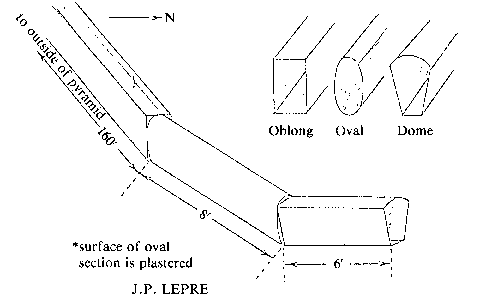
Architectural
Analysis of the Great Pyramid.
The
architectural features of the Great pyramid offer an invaluable insight into the
builders, their methods and the process of construction.
Interior Architecture.
|
External Architecture.
Associated Architectural Features.
Conclusions |
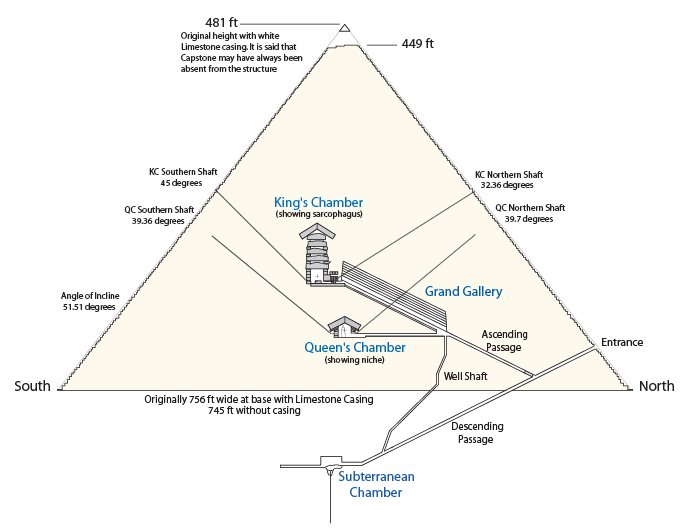
The Great Pyramid in
cross-section.
| The
Interior Features of the Great Pyramid: |
It is
understandable that so much confusion surrounds the Great Pyramid,
considering the availability of such a wealth of confusing and conflicting
facts. It is a common practice in archaeology to propose the function,
method of construction, age and builders through the design features of the
building. In the case of this pyramid however, which has been surrounded by
myth and speculation since the earliest of times, an bridge across the
border of fact and fiction has materialised, hindering the journey of
seekers of truth. This page is presented without the prejudice of previous
reports and literature, in order that the design features of the interior
speak for themselves
The following sections are laid out as if one was
entering the pyramid and travelling through its interior.
|
2.20) The
Original Entrance.
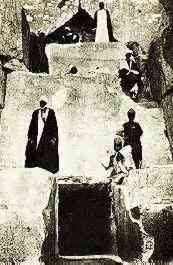 The
true entrance to the great pyramid was bypassed by Al Mamun in 820 AD. The
original entrance into the pyramid was through the
now missing door at the top of the Descending corridor, a
feature common to other early dynastly pyramids. The door
was described by Strabo around 24 BC, who said that it swivelled
open. (Text) The
true entrance to the great pyramid was bypassed by Al Mamun in 820 AD. The
original entrance into the pyramid was through the
now missing door at the top of the Descending corridor, a
feature common to other early dynastly pyramids. The door
was described by Strabo around 24 BC, who said that it swivelled
open. (Text)
It is noticeable
in Strabo's text
that he mentions
a hidden door on the south face of the pyramid, while the
door is actually on the north face.
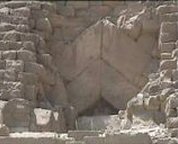
The stones that
surround the entrance are some of the largest used in the
pyramid. What we see today of course is not the entrance as it
was intended to be seen because the casing stones and masonry
surrounding it have been removed. Rather, we are able to see the
remains of what appears have been an exercise in extreme engineering.
How these huge stones and the immense corbel's relate to the final
doorway placed/hidden into an otherwise flat surface is a
mystery.
The
architecture of the entrance raises some interesting points such
as the fact that apart from the unnecessary extra work involved
in building with such huge stones or the apparent pointlessness
of having an opening door for a tomb never to be disturbed,
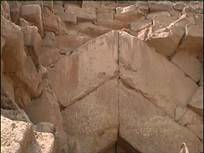
there is also the matter of the symbol carved over the doorway
(photo below).
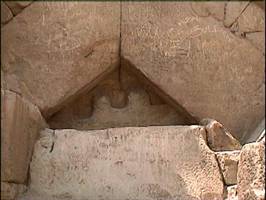
Apart from
being a curious choice of location, there is little if no
agreement on what its meaning might be. The vague similarity to
the Egyptian hieroglyph for the word 'Horizon' has led to the
suggestion that this symbol might be a representation of that
word.
"According to Walter
Marshall Adams, the triangle was meant to symbolize the 'door of the
horizon', the hieroglyphic sign for the horizon�having been carved inside
the triangle, which from a distance, assumes the form of a pupil. Thus,
Adams believes, the hieroglyphic sign must be the pyramids divine name".
(16)
(More
about the Original Doorway) Al Mamun's Forced
Entrance.
Today tourists enter the Great
Pyramid via the 'Robbers' tunnel dug by workmen employed by
Caliph al-Ma'mun around AD 820. The tunnel was cut straight through the masonry of the pyramid for approximately
27 metres (89 ft), then turns sharply left to encounter the
blocking 'plugs' in the Ascending Passage. The workmen
tunnelled up beside them through the softer limestone of the
Pyramid until they reached the Ascending Passage.
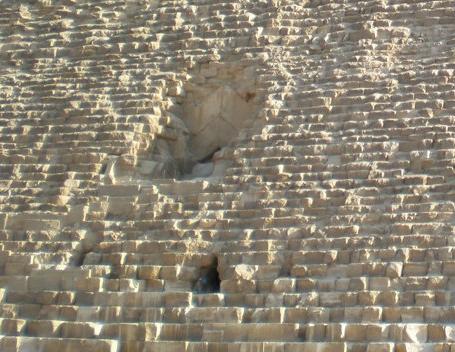
Al Mamun
decided to bore direct centre on the North face of the
pyramid and on the level of the 7th course. The
original entrance is ten courses higher and 24 feet
east of the main axis than Al Mamun dug.
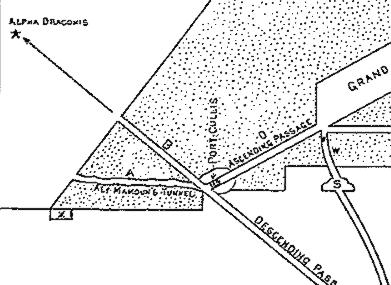
The fact is that Al Mamun
appears to have tunnelled directly towards the junction of
the ascending and descending passages. The hole that he quarried was
unnervingly accurate... ?
|
|
 2.21)
The Granite 'Plugs'. 2.21)
The Granite 'Plugs'.
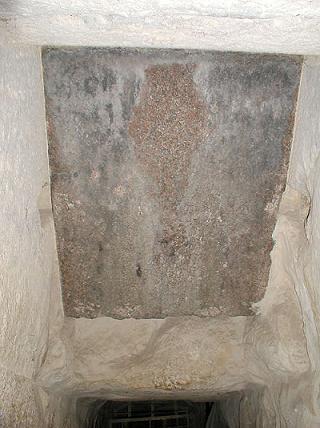
The three granite 'plugs'
which sit in
the bottom of the ascending passage are believed to have been built
'in-situ' by some sources and 'slid' into place by others.
Although other
pyramids also show evidence of having had 'plugging' stones, those at Giza
are the only ones that can still be seen today.
The ascending passage tapers inwards slightly at the bottom
end (as seen in the 'Trial passages' outside) which
would have required extremely accurately cut blocks. The granite blocks fit
almost seamlessly into the passage, barring a 4 inch cavity between the
bottom block and the next one up reported by Petrie
(13).
This has now closed, not unsurprisingly (considering one of the tapered
sides is now exposed).
(Right: The bottom granite plug as seen from underneath)
The following testimonies describe the plugs when they were
first found. They reveal much about the design of the plugs.
Extract from Petrie: - 'The present top one is not the
original end; it is roughly broken, and there is a bit of granite still
cemented to the floor some way farther south of it. From appearances there I
estimated that originally the plug was 24 inches beyond its present end'
(13)
Extract from Petrie :-
'The broken end of the upper block, and
a chip of granite still
remaining cemented to the floor of the passage a little above that, showing
that it was probably 24 inches longer than it is now, judging by marks on
the passage. Thus the total length of plug-blocks would be about 203 inches,
or very probably 206 inches, or 10 cubits, like so many lengths marked out
in that passage.....the plug-blocks cannot have stood in any place except on
the sloping floor of the gallery'.
Extract from the Edgar
Brothers :- (Vol II) - 'The Granite plug is
composed of three blocks of red granite. There is a space of a few inches
between the lowermost and middle blocks (Petrie says 4 inches). The top end
of the uppermost block is much fractured in appearance�Professor Petrie says
he saw a bit of granite still cemented to the floor two feet further up the
passage. We, also, saw what for some time we took to be a piece of granite
at the place indicated; but on more careful examination it proved to be
a lump of
coarse red plaster. We saw several similar pieces of plaster adhering to the
angles of the floor and walls throughout the length of the passage, and we
required to clear some of them away as they hindered careful measuring. We
also saw at least one such piece of plaster in the Grand Gallery. This
coarse red, or, rather, pink plaster was very extensively used by the
ancient workmen in the core masonry of the building, and some of it can be
seen in certain wide joints in the dilapidated portion of the First
Ascending Passage. We believe that the upper end of the Granite Plug is in
its original state, and that its rough unfinished appearance has symbolic
significance. The upper end of the lowermost block also has a fractured
appearance, which is certainly original, for the stone is very inaccessible
and there is no room for anyone to work at it'.
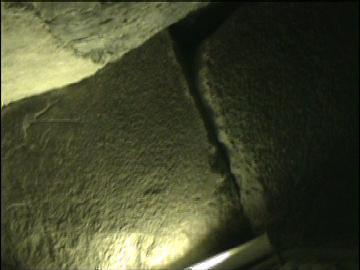 Although
there has never been a
suggestion that the plugs were actually cemented in place themselves, this
and the (now closed) cavity between the top plugs suggest that the plugs
could have been slid into place. Petrie however, says that he found 'a
chip of granite still
cemented to the floor' in the
corridor above them.
The
Edgar brothers say they found what '...Proved to be a lump of coarse red
plaster'. Either way, if the plugs were slid into place from where do
these lumps of plaster originate? This is clear evidence that either the
plugs were not slid into place, or that some construction work
took place after the pyramid had closed, both of which demand an
explanation. Although
there has never been a
suggestion that the plugs were actually cemented in place themselves, this
and the (now closed) cavity between the top plugs suggest that the plugs
could have been slid into place. Petrie however, says that he found 'a
chip of granite still
cemented to the floor' in the
corridor above them.
The
Edgar brothers say they found what '...Proved to be a lump of coarse red
plaster'. Either way, if the plugs were slid into place from where do
these lumps of plaster originate? This is clear evidence that either the
plugs were not slid into place, or that some construction work
took place after the pyramid had closed, both of which demand an
explanation.
It has been suggested that masons
gained entry after the pyramid was closed to cut the Davison channel and
repair the damaged beams of the Kings chamber, perhaps this can explain the
origin of the plaster and rubble piled up above the granite plugs.
Although it is seems quite unlikely that masons would have re-entered a 'tomb'
for repairs after it was closed, there is evidence of repair work in
the breaching of Davison's chamber and the use of plaster for repairs in the
Kings chamber. However, unless this work was done after the plugs were slid into
place we still have no explanation for the lumps
of plaster on the floors and walls of the descending passage.
One has to ask what would motivate anyone to force entry into
a sealed pyramid just to repair it?
The repairs in the King's
chamber are associated with the Davison's chamber which was cut through existing masonry
(already completed),
if the
repair work was done before the pyramid was closed the rubble
would have been taken outside, but how does that information tie in with the
'Pyramids as tomb's' theory.
Because there is no precedent (or logic) for the argument that workers would
break back into an already finished pyramid in order to carry out 'repairs',
we are left either to conclude either that the works were so uniquely
important that they demanded attention, or that the repairs were carried out
before the pyramid was closed off, and the plaster on the walls and floor
remained there because the granite plugs were built in place. The rubble in
this scenario would be assumed to be from the breaching of the
Well-shaft by intruders at a later date.
The position of Al-Mamun's
tunnel makes it reasonably clear that he was specifically seeking entry to the upper parts
and the accuracy suggests that he knew that there was an alternative access to the upper
parts either bypassing the granite plugs or via the well-shaft. barring
complete coincidence, it is likely that Al Mamun had already seen the bottom
end of the granite plugs before he started digging. In addition, the evidence of a
forced-entry prior to Al-Mamun
seems likely, else one would assume Al Mamun would have
entered the upper parts through the well-shaft for which there is no record.
We can be clear that the pyramid had been breached before him.
If the granite plugs have been in place since the pyramid was
built, and as it has been shown that the 'well-shaft' was part of the
original design (with the probable exception of one 'roughly cut' part), it
seems possible that the upper parts were not just hidden to prevent an
'accidental' entry (being left incomplete so that only an 'initiate' would
be able to 'force-entry' at a later date - which they presumably did!), but
also perhaps, to prevent water damage (the 'rough-cut' section of the
well-shaft was cut through blocks). This supports the earliest Arab legends
which say that:
'The purpose of the pyramid was said to be to conceal the
literature and science held within it, well hidden from the eyes of the
initiated, and to protect them from the flood'.
Article: (Sept 2011).
Philip A. Femano, Ph.D.
Analysis of the Granite Plugs.
|
| 2.215) The
Descending Passage.
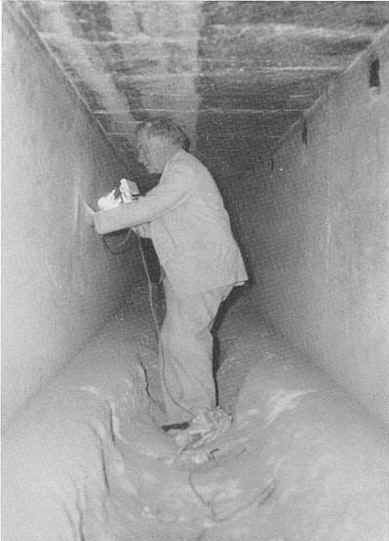 The
testimony by Strabo of a swivel door combined with the
hidden upper parts suggests that the only part of the
internal structure which were intended to be seen was the
descending passage and the subterranean chamber. The
testimony by Strabo of a swivel door combined with the
hidden upper parts suggests that the only part of the
internal structure which were intended to be seen was the
descending passage and the subterranean chamber.
The
descending corridor extends down into the heart of the
pyramid for 91m. The accuracy is such that it deviates less
than 1/2 inch over its entire length. the passage was
designed, along with all the Memphite pyramids to point
directly towards the pole star.
Assuming
that the long narrow downward passage leading from the
entrance was directed towards the pole star of the pyramid
builders, we should be able to use this information to
discover the date of commencement of the pyramid.
Astronomers have shown that in the year 2,170 B.C (long
after Khufu was dead), the passage pointed to Alpha Draconis
at its lower culmination. It should be mentioned, however,
that the date named is not the only possible one. Mr.
Richard A. Proctor the astronomer, after stating that the
Pole-star was in the required position about 3,350 B.C., as
well as in 2,170 B.C., said "...Either of these would
correspond with the position of the descending passage in
the Great Pyramid; but Egyptologists tell us there can
absolutely be no doubt that the later epoch is far too
late..." He adds: 'If then we regard the slant passage as
intended to bear on the Pole-star at its sub-polar passage,
we get the date of the pyramid assigned as about 3,350 years
B.C., with a probable limit of error of not more than 200
years either way, and perhaps of only fifty years.' (This
date also agrees very suitably with the date given by
Diodorus Siculus).
(More
about the dating of the Great Pyramid) |
|
2.22)
The 'Subterranean' chamber.
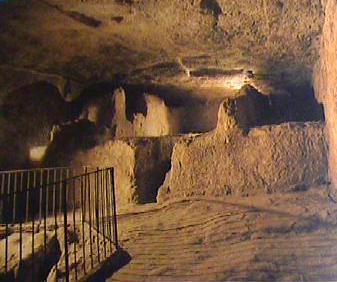 The first noticeable thing about the subterranean passage is that it has
the
appearance of being unfinished. The southern passage was in the process of
being carefully cut, and adds to the idea that work was stopped in the
middle of the chamber. The obvious question is - why as it was left unfinished
when it was such an obviously original feature of the pyramid. The Polar
shaft was a feature of all the other Memphite pyramids. The first noticeable thing about the subterranean passage is that it has
the
appearance of being unfinished. The southern passage was in the process of
being carefully cut, and adds to the idea that work was stopped in the
middle of the chamber. The obvious question is - why as it was left unfinished
when it was such an obviously original feature of the pyramid. The Polar
shaft was a feature of all the other Memphite pyramids.
It has been commonly argued in the past
that the upper chambers were created following a 'change in plan'. Anyone
who has actually been in the subterranean chamber will know that it would be
impossible to get a sarcophagus down there. The existence of this chamber
contradicts the 'Pyramid as Tomb' theory.
The 'pit' in the floor of this chamber
contains a granite stone with holes it it similar to the one by the main entrance, and the one
in the well-shaft. These are believed to be the 'portcullis' stones from the
King's chamber above. The pit was dug deeper by
Cavigula by another 30ft in the 1800�s.
A southern tunnel was cut for 16m leading from the
subterranean chamber. It leads nowhere, and ends abruptly.
|
|
2.225)
The Ascending corridor.
The bottom of the Ascending corridor was determined to have been cut
through pre-existing masonry. This has been suggested to be evidence of a possible change in design (from
the upper level where the stones were prepared).
As the descending corridor extends up to the
18th
course, we can conclude that any fitted masonry
features below that level must be from the original design. The addition of
the gable stones over the entrance bring the original hypothetical level to
around the 30th
course (There is a dramatic change in the size of blocks at the 35th
course - which
brings us to some interesting conclusions). The architectural features below
these levels include the descending passage and entrance, the girdle stones,
the well-shaft and most importantly, the Queens chamber. As it has been
shown that the lowest part of the ascending passage was cut through existing
masonry, it is impossible to say for certain whether the girdle stones or
upper passages were ever included in the first design. However, the fact
that the route to the subterranean chamber is too small for a sarcophagus
makes it likely that (at least some of) the upper parts were always intended
to be a part of the original plan.
Knowing that the lower part of the
ascending passage was cut through existing masonry, i t is at
this
level that we have to look as it was here that we can
assume the builders decided to cut a new shaft through the upper parts of
the pyramid. This does not explain how the 'girdle stones' were so
accurately included into the plan (unless they were put in place at this
time). Unless a satisfactory reason can be determined
for the reason why the lower parts were cut through existing masonry,
it is reasonable to conclude that there may have been some change in
design, although in order to accept this theory, the other
internal features need to be explained within the same context.
The top of the Ascending corridor 'meets' the top of the
Well-shaft. If the upper part of the Well-shaft is proven to be original,
then it is not unreasonable to assume that the lower, neatly cut sections
were also original. Of course, this lends weight to the idea that the upper
parts were in the original design, but still requires an explanation for the
lower section being cut (with at least one girdle-stone in situ)
The presence of the three neatly cut Girdle-stones (below) lends weight to the original idea that the corridor (and all other
upper parts) were in fact planned from the start.
|
|
2.23)
The 'Girdle stones'.
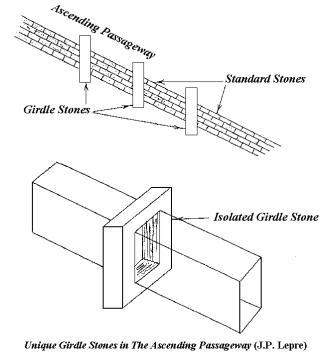 These three stones in the Ascending corridor are baffling. They
are described in detail by the Edgar Brothers: (Vol I). who said the following
of them: These three stones in the Ascending corridor are baffling. They
are described in detail by the Edgar Brothers: (Vol I). who said the following
of them:
Extract from Edgar
Brothers, Vol I - '�The
chief discovery was, that at stated intervals the smaller blocks forming
elsewhere separately portions of the walls, floor, and ceiling of the
passage, were replaced by great transverse plates of stone, with the whole
of the passage's hollow rectangular bore cut clean through them; wherefore,
at these places, the said plates formed walls, floor, and ceiling, in one
piece�Additionally, let into the walls immediately below the three upper
Girdles, there are
peculiar inset stones, which look like
pointers�let into specifically large wall stones'�
And�' It is quite probable that the stones forming the three upper
girdles were built in entire, and the bore of the passage cut through them
in situ. The two roof stones immediately above and below each of the three
upper Girdles, are in themselves partial Girdles'.
Mendelssohn
(5)
argued that the Girdle-stones are evidence of buttress walls from an
internal step-pyramid structure. He said the following;
'Since earlier and later
stone pyramids relied on a basic core of buttress walls it is more than
likely that the same design was used in the great
Giza pyramids. Borshardt has drawn
attention to the existence of 'girdle-stones' in that part of the ascending
passage of the Khufu pyramid which was cut through already existing masonry
at the first alteration of the interior design. These are large vertical
slabs through which the new corridor passes at intervals, and he has taken
them as part of internal buttress walls',
but then he says 'This view has been
disputed by Clarke and Engelbach, who have pointed out that it would be
wholly fortuitous for the passage always to have encountered whole stones.
They also maintain, rightly, that the walls of this passage are made of
fitted stones...'
In order to reconcile this information, he concludes
that;
'...probably both sides are correct. The passage was evidently lined
with new masonry and the girdle-stones, while not being part of the original
buttress walls, were placed to mark their positions. This seems more likely
since the girdle-stones are spaced at intervals of 10 cubits (about 5m.),
which is the distance between buttress walls in the medium pyramid. This
indication of internal buttress walls shows that no novel features seem to
have been introduced in the core structure of the
Giza pyramids'.
(Other
Examples of Holed-Stones')
|
|
 2.24)
The 'Queen's' Chamber. 2.24)
The 'Queen's' Chamber.
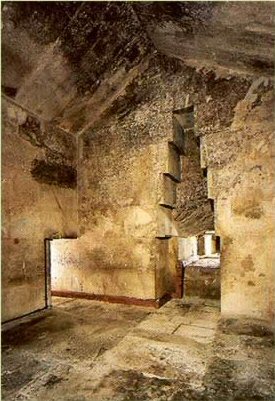
The 'Queens' chamber is
only called so because of its shape which Arab tradition ascribes to female
burials. It sits at the heart of the pyramid.
Petrie was the first to suggest that the chamber was the serdab of
the pyramid (a chamber containing a statue of the dead pharaoh.
Traces of a stairway and a table for offerings are still clearly visible on
the floor in front of the niche. Petri also notes a number of small
fragments of black stone. The serdab of Kagemni at Saqqara seems to
be a 'replica' of this chamber.
(16)
The Queens
chamber is one of the greatest mysteries of the pyramid. It's deliberate
placement in the centre of the pyramid gives it a significance which is
increased by the curious fact that it was disguised by so many numerous
hidden doorways and stone-slabs.
Having
gained entry to the upper parts of the pyramid, the most obvious place to
continue searching would have been the kings chamber as the passage to the
Queens chamber was
concealed by
a huge stone slab over the floor of the 'Grand-gallery'. Even more
significant then is the fact that the 'star-shaft's' which were perfectly
visible in the kings chamber were also 'hidden' or at least remained sealed
over, concealing two more 'star-shaft's' - which are blatantly not that at
all, as they lead only to the 50th level (the course that the 'Kings'
chamber sits on) where they are sealed off by a door made of white 'Tura'
limestone. (see 'star-shafts')
|
|
2.25)
The
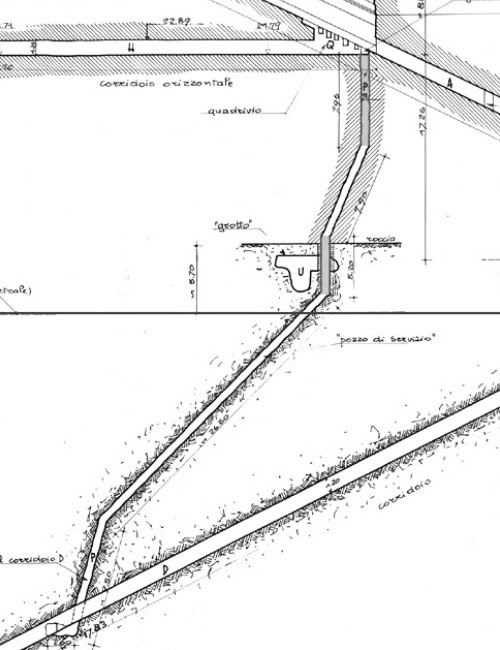
'Well-shaft'.
In the 1830's Captain G. B. Caviglia cleared the descending passage of
debris, exposing the 'pit' for the first time since the Pyramid had first
been opened by Al Mamun. At the same time, Caviglia also discovered and
opened the 'well-shaft'. Its upper opening was concealed at the point where
the horizontal passage to the Queens Chamber branches off. Clearing the
debris from the well-shaft is said to have improved the otherwise stifling
air quality in the Pit and Descending Passage.
Is it possible to determine whether the well was built
before the pyramid was constructed, or after..
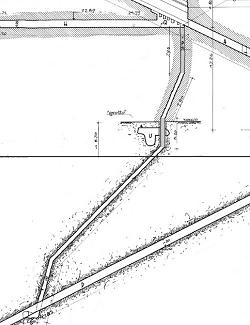 The Well-shaft lies precisely on an E-W plane parallel to the
pyramids passages and chambers. It
can be separated into seven sections, with the upper three sections passing
through 60 ft of limestone masonry and the lower segments being tunnelled
through another 150ft of natural rock. With the exception of section C which
was tunnelled through the masonry in a rough and irregular manner, and
section G, two of whose squarish sides were left rough and not quite
horizontal; all the other sections are straight, precise, carefully
finished, and uniformly angled throughout their lengths. The Edgar brothers
showed conclusively that the upper short horizontal passage, as well as
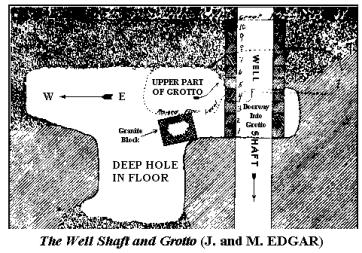
the vertical section were part of the original construction. The two
vertical sections at the top are of equal length). They also found that the lower vertical
section was built with masonry blocks as it passed through the 'Grotto'
in the bedrock. It could only have been so constructed when the rock face
was still exposed, before the grotto was covered with the masonry of the
pyramid. The Well-shaft lies precisely on an E-W plane parallel to the
pyramids passages and chambers. It
can be separated into seven sections, with the upper three sections passing
through 60 ft of limestone masonry and the lower segments being tunnelled
through another 150ft of natural rock. With the exception of section C which
was tunnelled through the masonry in a rough and irregular manner, and
section G, two of whose squarish sides were left rough and not quite
horizontal; all the other sections are straight, precise, carefully
finished, and uniformly angled throughout their lengths. The Edgar brothers
showed conclusively that the upper short horizontal passage, as well as
the vertical section were part of the original construction. The two
vertical sections at the top are of equal length). They also found that the lower vertical
section was built with masonry blocks as it passed through the 'Grotto'
in the bedrock. It could only have been so constructed when the rock face
was still exposed, before the grotto was covered with the masonry of the
pyramid.
The geometry of the shaft, the fact that the top part of the
tunnel was incorporated into the design and the bottom parts cut neatly and
correctly except for the last section, and that the upper section was cut
through solid masonry all support the idea that the well-shaft was built
(but not necessarily completed), as the pyramid was constructed.
The missing blocking stones, chisel marks around the entrance,
and the fact that a part of the well-shaft was roughly cut through existing
masonry has led many to the reasonable conclusion that the well-shaft was
breached at some time in the past in order to access the interior of the pyramid after
construction. The next question then is how was it accessed?
Extract from the Edgar Brothers (Vol II) -
The mouth of the well is formed by a portion of the ramp on
the west side having been broken away: and the appearance of the masonry
surrounding this Well-mouth suggests the thought of the once covering
ramp-stone having been violently burst out from underneath�In addition to
the breaking of the ramp-stone at the head of the well-shaft, a portion of
the lower end of the floor of the Grand Gallery appears to have been
forcibly removed.
This observation leaves the reader with the impression that
the well-shaft was cut through from the bottom up. However, the following quote creates
a different picture.
 'There is incontrovertible evidence that the well Shaft is
an original feature that was dug from the top down�a close examination of
the chisel marks on the topside of the blocks that surround the upper
entranced to the shaft reveals that it was chiselled out from above'.
(10) 'There is incontrovertible evidence that the well Shaft is
an original feature that was dug from the top down�a close examination of
the chisel marks on the topside of the blocks that surround the upper
entranced to the shaft reveals that it was chiselled out from above'.
(10)
We are left with the following confusing possibility: That the shaft
was cut surreptitiously after the pyramid was finished by someone who shared
or had been passed on the knowledge of its whereabouts. The suggestion is not a new one. In fact, the
only thing that stands in its way is the chisel marks at the upper entry
which have been established to have been cut from the top. But what if the
shaft was cut from the bottom, then opened out from the top?
Extract from Great Pyramid Passages: Vol I - 'We
have taken a number of photographs and careful measurements of the lower end
of the Well, where it enters at the west wall of the Descending Passage -
See Plate X. The opening in the wall is rather broken and rough around the
edges, although the sides are, in a general way, vertical and square with
the top. Professor Flinders Petrie believes that the opening was at one time
concealed by a stone' and that 'Al Mamoun's
workmen made their way down the Well shaft from its upper end in the Grand
Gallery, and forced the concealing block of stone from its position at the
lower end'.
(14)
Comments
- It feels significant that the opening of the well-shaft is on the same
level as the 'Queens' passage and chamber. That it was blocked (built over),
for a section towards the top end during construction, but not completely to
the top, is also significant. There must have been a good reason for
concealing it and re-entering it. Yet we can assume that it was not meant to
be found easily yet probably intended for 'reasonably easy access' at a
later date.
Whoever completed the tunnelling had a plan from which to
work by in order to make the final connection and that whoever cut it was
privy to that information. 'It is also possible that the short passage that
connects the two sets of chambers in the Bent pyramid, which is clearly not
part of the original design, was also tunnelled by robbers who knew the
layout'.
(10)
Question:
It was reported that the Well-shaft was partially filled with debris when it
was found so how did the person who filled it get out?. In addition we need
to understand where the debris originated and what was the purpose of
filling it for that matter. In fact, it is worth asking if it was ever
re-sealed at the bottom end.?
Pochan
(16) manages to 'clear away' the issue of rubble at
the bottom of the tunnel. He quotes Coutelle, from the Napoleonic expedition
who recorded the following:
'While descending, I had stopped at a sort of
grotto found above the steep part of the well; that is, in the second
vertical part. This excavation had been made by removing pebbles, bits of
which still remained stuck to the arch; there were more underfoot. I rested
there (and) compared the pebbles I was carrying with these pebbles and
ascertained that
the pebbles at the bottom of the well derived from the excavation of this
grotto'.
The logic of the finding is sufficient to conclude that it is probably
right. It does, however, mean that whoever displaced the pebbles had no
intention of exiting the building via the bottom of the well-shaft.
|
|
2.26)
The Grotto.
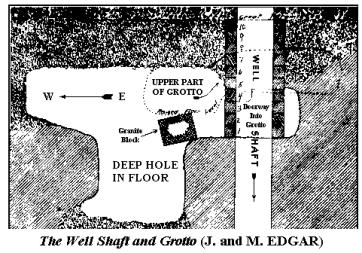
It has been reasonably suggested that the 'Grotto' may have been an original
landscape feature, and that the pyramid might have even been built over it.
However, it is the 'Queens' chamber that occupies the central position of
the pyramid, and not the grotto (although its upper entrance is on the same
level).
The block-work from the upper entrance down to the grotto has
been shown to have been laid as the pyramid rose up which points to the idea
that in some way, the area down to the grotto was an original feature. (The
same is true of the tunnelling below the grotto. It is clean and well
worked). The only rough cut passage is above the grotto, cutting through the
existing masonry until it meets the prepared passage above it.
Lepre
(10),
noted that inside the grotto: 'The ceiling is unusually damp to the point
where there is actually a perceptible coating - like a light frost - over the
pebbles themselves. This unusual composition naturally tempts one to speculate
about the existence of a nearby water source'.
It has been suggested that the grotto was built to allow the
first intruders room to work. This suggestion seems reasonable as in order to cut through the blocks above, there would need to be a
well placed workspace. We can assume that the 'Grotto' had been excavated in
the past (from the 'rubble and sand' found in the tunnel below, which is
similar in composition to that found in the grotto). The only problem
with this theory is the lack of oxygen which again suggests that the top
part of the well-shaft was opened from above and not below.
|
|
2.27)
The Grand Gallery.
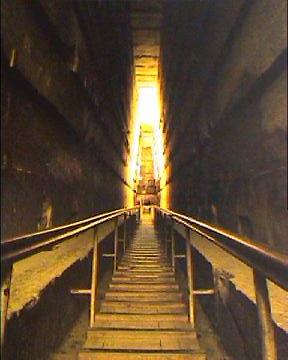 One of the great mysteries about the Great Pyramid remained the apparently
incomprehensible design of the Grand Gallery, a seven levelled,
elaborate corbelled vault forming the upper half of the Ascending Passage
leading to the King's Chamber. One of the most elegantly simple, coherent,
and widely ignored theories about the Great Pyramid was the astronomer
Richard Anthony Proctor's explanation of this aspect of its design. Proctor
was inspired by a passage in the neo-Platonic philosopher Proculus's
commentary on Plato's Timaes, which mentioned that before the Great Pyramid
was completed it was used as an observatory. Based on his reading of the
account he surmised that when the Pyramid was completed to its fiftieth
course, i.e. to the level of the top of the Grand Gallery, which was also
the floor of the Kings Chamber, it would have made an excellent observatory.
He documented his theory in a book published in the late nineteenth century
titled The Great Pyramid, Observatory, Tomb and
Temple. One of the great mysteries about the Great Pyramid remained the apparently
incomprehensible design of the Grand Gallery, a seven levelled,
elaborate corbelled vault forming the upper half of the Ascending Passage
leading to the King's Chamber. One of the most elegantly simple, coherent,
and widely ignored theories about the Great Pyramid was the astronomer
Richard Anthony Proctor's explanation of this aspect of its design. Proctor
was inspired by a passage in the neo-Platonic philosopher Proculus's
commentary on Plato's Timaes, which mentioned that before the Great Pyramid
was completed it was used as an observatory. Based on his reading of the
account he surmised that when the Pyramid was completed to its fiftieth
course, i.e. to the level of the top of the Grand Gallery, which was also
the floor of the Kings Chamber, it would have made an excellent observatory.
He documented his theory in a book published in the late nineteenth century
titled The Great Pyramid, Observatory, Tomb and
Temple.
The function of the ascending passage lies hidden in the
conclusions. The design features suggest that it had a specific purpose. If
it was symbolic, then the features will have symbolic explanations. The
sockets in the sides are all roughly filled except one. Who has filled them,
or were they always filled. The corbelled roof shows remains of a slot along
its length on the 3rd instep. It appears, at first glance to have held a
false roof. The Ascending passage was 'cut through' the pyramids masonry in
the first instance, rather than constructed. So why was the limestone at
this point of a higher quality than that used in the rest of the core
masonry? (They were planned from the beginning, but not finished until
later).
There
is another feature of the Grand Gallery which is worth examining: on each side
a groove�about 7 inches high and 1 inch deep�has been cut into the third
layer of corbelling along its entire length. In addition, at the top of the
grooves there are rough chisel marks running along their entire lengths. At
first impression it seems as though these may have once housed a 'false
ceiling', an idea repeated by several people.
It has been noticed that the Gallery better is 'finished off' at the
Northern, bottom half than the 'rough' Southern top section.
In 1843 Borchardt found an impression, in the walls of the
Great Gallery (BORCHARDT, L., "Einiges zur dritten Bauperiode," Berlin
1930). He established that it was made of mortar, in which a long, round
object had originally been embedded, and later removed. He could not
determine what that object may have been, but he assumed that it had been
attached to the Gallery wall by means of the mortar.
Comment
- It has been suggested that this mark was left be a piece of cord, probably
used for some kind of measuring purposes. One was also found in one of the
'Star-shafts' but it is vertical (see left), and alone makes no sense in
terms of facilitating measurement. The Edgar Brothers reported finding a
number of plaster impressions in the ascending passages, and of having to
clean many off in order to take correct measurements.
The following is an
extract from Pochan
(16) -
'Various hypothesis, each as unlikely as the
next, have been put forward concerning these slots�.But the number of slots
should have attracted the attention of Egyptologists. Wasn't Cheops the
twenty-eighth king of
Egypt after Menes? I
propose that the twenty-eight slots twenty-eight bases for twenty-eight
facing royal statues, and that the Grand Hall is actually the gallery of
King Cheops' ancestors!
The absence of the twenty-eighth slot in the western
banquette, whose place is now taken up by the opening of the 'well', serves
to confirm the views expressed by Petrie; to wit, that the connection of the
Grand gallery wit hthe primitive shaft used by descending stonecutters, a
hole drilled through the masonry, was a task undertaken after the pyramid
had been built.
That the Grand gallery is simply the gallery of the ancestors
is corroborated by two ancient Arab authors. Muhammed Ishaq ibn al-Nadim,
quoted by Ahmed ibn Ali al-Maqrizi, writes: "�A passage pierces this
pavement�; the arch is made of stone and one sees there portraits and
statues standing or resting and a quantity of other things, the meaning of
which we do not understand." And Ibrahim Wassif Shah writes: "�In the
Eastern pyramid, chambers had been built in which the stars and heavens were
depicted, and in which was amassed what Surid's forebears had accomplished
in the way of statues." (Undoubtedly, the manuscript's text has been
misreported; it should read: "�in which were amassed the statues that were
done of Surid's forebears.")'.
Comment
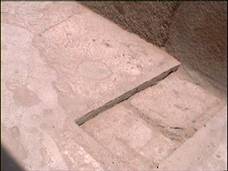
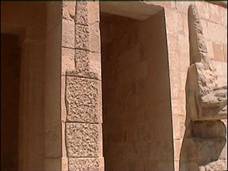
- If Pochan is correct then this is of course,
important. The question is, how many Kings were
there before Choeps? Also, perhaps it is worth counting the slots in the
valley temple (note that they are far less deep.) Note also that we can see
the same kind of damage at Hatshepsut's temple. (see
below)
Context
- The following two pictures show the same style of building corbelled
constructions from inside other Egyptian pyramids:-
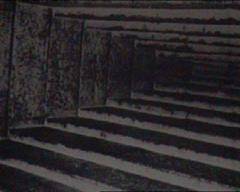 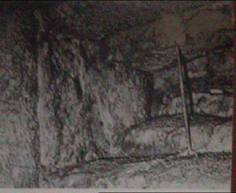
Corbelled Roofs from inside the Red pyramid, and the
'unfinished' Meidum pyramid.
Here is an internal feature similar to that of the 'great' pyramid. There
is a strong suggestion, especially in the 'Red' pyramid, of a contemporary
design (Note - Similar designed stone on entry to chamber, Lack of internal
funerary scripts etc). The same feature can be seen in the 'Bent' pyramid.
Mendelssohn says the following:-
Extract from Mendelssohn - An
inscription found near the Red pyramid mentions the 'two pyramids of Snofru'
and it was at first assumed that the other Snofru pyramid must be that at
Meidum. More recent work at the bent pyramid has, however, shown that this
one, too, definitely belonged to Snofru. We are left with what Sir Alan
Gardener called the 'unpalatable conclusion that Snofru did possess three
pyramids'.
|
|
2.28)
The 'Antechamber' and 'Portcullis' System.
The theory that the antechamber once housed a 'portcullis' system is
generally accepted, although a model of the system that explain all
the features of the antechamber is still forthcoming. The best research in
this area came originally from Lepre, who studied the question in depth.
While his findings are far from conclusive, they are reasonable and remain
the only conclusion of any merit. First, an extract from Petrie:
 'The
rubbish that had accumulated from out of Mamun's Hole was carried out of the
Pyramid by a chain of five or six men in the passage. In all the work I left
the men to use their familiar tools, baskets and hoes, as much as they
liked, merely providing a couple of shovels, of picks, and of crow-bars for
any who liked to use them. I much doubt whether more work could be done for
the same expense and time, by trying to force them into using Western tools
without a good training. Crowbars were general favourites, the chisel ends
wedging up and loosening the compact rubbish very easily; but a shovel and
pickaxe need a much wider hole to work them in than a basket and hoe
require; hence the picks were fitted with short handles, and the shovels
were only used for loose sand. In the passage we soon came down on
the big granite stone which stopped Prof. Smyth
when he was trying to clear the passage,
and also sundry blocks of limestone
appeared. The limestone was easily smashed then and there, and carried out
piecemeal; and as it had no worked surfaces it was of no consequence. But
the granite was not only tough, but interesting, and I would not let the
skilful hammer-man cleave it up slice by slice as he longed to do; it was
therefore blocked up in its place, with a stout board across the passage, to
prevent it being started into a downward rush. It was a slab 20.6 thick,
worked on both faces, and one end, but rough broken around the other three
sides; and as it lay flat on the floor, it left us 27 inches of height to
pass down the passage over it. Where it came from is a complete puzzle; no
granite is known in the Pyramid, except the King's Chamber, the Antechamber,
and the plug blocks in the ascending passage. Of these sites the Antechamber
seems to be the only place whence it could have come; and
Maillet mentions having seen a large block (6 feet by 4) lying in the
Antechamber, which is not to be found there now. This slab is 32 inches wide
to the broken sides, 45 long to a broken end, and 20.6 thick; and,
strangely, on one side edge is part of a drill hole, which ran through the
20.6 thickness, and the side of which is 27.3 from the worked end.
This might be said to be a modern hole, made for smashing it up, wherever it
was in situ; but it is such a hole as none but an ancient Egyptian would
have made, drilled out with a jewelled tubular drill in the regular style of
the 4th dynasty; and to attribute it to any mere smashers and looters of any
period is inadmissible. What if it came out.
of the grooves in the Antechamber, and was placed
like the granite leaf across that chamber? The grooves are an inch wider, it
is true; but then the groove of the leaf is an inch wider than the leaf. If
it was then in this least unlikely place, what could be the use of a 4-inch
hole right through the slab? It shows that something has been destroyed, of
which we have, at present, no idea'. 'The
rubbish that had accumulated from out of Mamun's Hole was carried out of the
Pyramid by a chain of five or six men in the passage. In all the work I left
the men to use their familiar tools, baskets and hoes, as much as they
liked, merely providing a couple of shovels, of picks, and of crow-bars for
any who liked to use them. I much doubt whether more work could be done for
the same expense and time, by trying to force them into using Western tools
without a good training. Crowbars were general favourites, the chisel ends
wedging up and loosening the compact rubbish very easily; but a shovel and
pickaxe need a much wider hole to work them in than a basket and hoe
require; hence the picks were fitted with short handles, and the shovels
were only used for loose sand. In the passage we soon came down on
the big granite stone which stopped Prof. Smyth
when he was trying to clear the passage,
and also sundry blocks of limestone
appeared. The limestone was easily smashed then and there, and carried out
piecemeal; and as it had no worked surfaces it was of no consequence. But
the granite was not only tough, but interesting, and I would not let the
skilful hammer-man cleave it up slice by slice as he longed to do; it was
therefore blocked up in its place, with a stout board across the passage, to
prevent it being started into a downward rush. It was a slab 20.6 thick,
worked on both faces, and one end, but rough broken around the other three
sides; and as it lay flat on the floor, it left us 27 inches of height to
pass down the passage over it. Where it came from is a complete puzzle; no
granite is known in the Pyramid, except the King's Chamber, the Antechamber,
and the plug blocks in the ascending passage. Of these sites the Antechamber
seems to be the only place whence it could have come; and
Maillet mentions having seen a large block (6 feet by 4) lying in the
Antechamber, which is not to be found there now. This slab is 32 inches wide
to the broken sides, 45 long to a broken end, and 20.6 thick; and,
strangely, on one side edge is part of a drill hole, which ran through the
20.6 thickness, and the side of which is 27.3 from the worked end.
This might be said to be a modern hole, made for smashing it up, wherever it
was in situ; but it is such a hole as none but an ancient Egyptian would
have made, drilled out with a jewelled tubular drill in the regular style of
the 4th dynasty; and to attribute it to any mere smashers and looters of any
period is inadmissible. What if it came out.
of the grooves in the Antechamber, and was placed
like the granite leaf across that chamber? The grooves are an inch wider, it
is true; but then the groove of the leaf is an inch wider than the leaf. If
it was then in this least unlikely place, what could be the use of a 4-inch
hole right through the slab? It shows that something has been destroyed, of
which we have, at present, no idea'.
These 'anomalous' granite stones were concluded by Lepre to
be parts of the original portcullis system.
Extract from 'Giza the Truth' - 'It is often suggested
that no fragment of the three missing portcullis' has ever been found, and
from this many alternative researchers�and even some Egyptologists�deduce
that they were never even fitted. In the first instance, the continued
presence of the counterweights�which are above the level of the passage and
therefore would not obstruct the progress of an intruder�suggests to us that
the portcullis' were originally in place but were broken up by the early
robbers. Again we would suggest that, as with the "Bridge Slab", the debris
from this operation would have been cleaned up by restorers. However, in
addition to this evidence, Lepre produces a real coup de grace on the
matter:
he has matched the four blocks of fractured granite
found in and around the edifice
to the dimensions of the portcullis'.
Extract from Petrie - In brief, each
of the main slabs would have been a minimum of 4 feet high by 4 feet
wide�probably more depending on the degree of overlap into the slots�and
most significantly about 21 inches thick (to allow a tolerance of � inch in
the slots). He examined the four blocks�one lies near the pit in the
Subterranean Chamber, another in the niche in the west wall just before the
entrance to this chamber, another in the Grotto in the Well Shaft, and
another outside the original entrance�and established that whilst they were
all less than 4 feet in height and width, they were all 21 inches thick!
(Note that there is a loose block of granite in the King's Chamber, but this
is known to come from the floor thereof and was therefore omitted from the
analysis.) As if this were not sufficient evidence, he found that three of
the four blocks have 3� inch holes drilled in them�in fact the one in the
pit has two, and the one near the entrance three. Furthermore, the holes in
the latter are spaced 6� inches apart. So he established that not only do
the holes have the same diameter as the channels for the ropes in the south
wall of the Antechamber, but they are also spaced the same distance apart.
Although Lepre is unable to provide a foolproof explanation as to how these
four fragments ended up in their present locations�he suggests a variety of
high jinks by early visitors to the monument�nevertheless this strikes us as
pretty convincing evidence that these are indeed fragments of the original
portcullis'.
This is of course, a hugely important finding. Should the
other stones indeed be a part of an original 'portcullis' system, what did
it look like and why was it there? Why is there a piece in the 'Grotto'? Can
we track the movement of these pieces with the historical accounts? There do
not seem to be enough pieces, but the size of them suggests that they may be
remnants.
Extract from the Edgar Brothers: Vol I; (In reference to the
granite block in the descending passage) - 'We also instructed our men to
shift the position of the large limestone block which then lay diagonally
across the passage floor a little distance above the granite block'.
(14) We can assume for now that it is the same stone that now sits in the
'pit'. (see photo below). In Vol I
(14), Plates LVIII and LIX show the block in the recess before the subterranean chamber.
Four granite slabs from inside the Great pyramid - Are these
remnants
of the portcullis system?
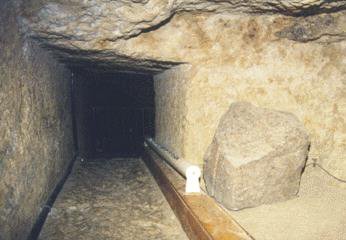
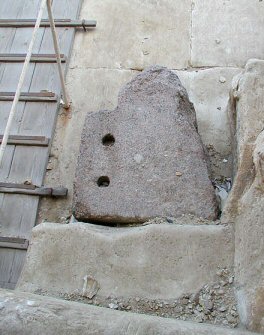
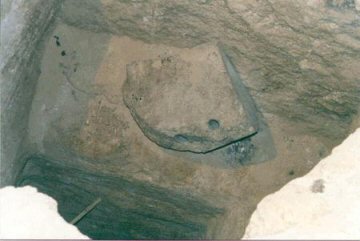
From left to right - Bottom right of the descending passage (found by Petrie
half way down the descending passage), outside the main entrance and
one on a ledge in the subterranean pit.
A
fourth granite block lies in the Grotto.
Question
- How are these stones to be explained in the context of the 'tomb' theory?
The remaining slabs were never intended to fall and it appears possible to
bypass the system regardless. Is this system evidence that the structure may
have had a function before it was sealed?
Extract from Edgar Brothers: Vol I - (In reference to the
Portcullis system) 'Some writers have suggested that the three opposite
pairs of broad vertical grooves originally contained sliding portcullises of
granite, which at one time cut off all entrance to the Kings Chamber�this
suggestion was supported by Col. Howard Vyse�His idea was that, during the
lifetime of the King, the now missing portcullises were suspended above the
floor of the Ante-chamber on a level with the top of the low passages, just
as the Granite leaf is now suspended; but that after the death and
internment of the King, they were one by one lowered gradually by chiseling
away the supporting granite immediately below them on the side walls, until,
sinking down by their own weight, they finally rested on the floor'.
(14)
The Edgar's noticed however, that: '...when, however, we begin
to investigate the subject more closely� we find that there are distinctive
peculiarities about the "granite leaf", which make it certain that it, at
all events, had not been intended by the architect to serve as a
portcullis'. (14) So what was the remaining stone for. It is of interest that the 'Boss' is
well recorded in Egypt. It was believed to have been left on the stones in
order to manoeuvre them more easily, although in this particular case it is
worth noting the following observation: 'The granite leaf appears to be
an inch narrower than its corresponding grooves in the wainscots�Close
examination shows that this difference is made up by narrow one-inch
projections or rebates on the north face of the leaf, which make it fit
tightly into its grooves. With the exception of these rebates (which are
evidence of special design), the whole of the north face of the leaf has
been dressed or planed down one inch, in order that one little part in the
middle might appear in relief'.
(14)
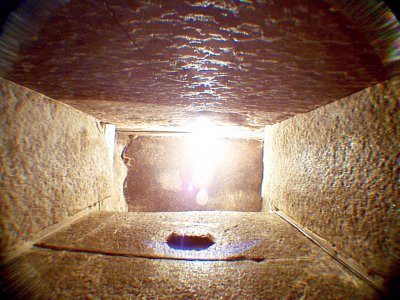
The 'Boss' as seen
from underneath. The fact that it was left in-situ suggests that it had as
symbolic function.
Pochan emphasizes that the whole system must have been closed off at some
time. He says:
'Contrary to the claims made by certain authors�the three
portcullises were actually set in place and lowered. The south wall, in
fact, shows clear, significant traces of damage, which would be totally
inexplicable had the passage to the king's chamber been open. It is obvious
that the damage done to the Antechamber's south wall was effected from the space located above the lowered portcullises. The
first despoilers, having experienced great difficulty in trying to raise the
granite block closing off the entrance to the antechamber, were unable to
force the portcullises and had to settle for making a man-sized hole in the
upper part of the corridors wall, opening onto the chamber of the
sarcophagus'. However, this raises the question: Why was the antechamber
then subsequently cleared of blocks?
In a final note, it is worth quoting Petrie over the granite
portcullis stones of the Khafre's pyramid when he says:
'The skill
required to turn over and lift such a block, in such a confined space, is
far more striking than the moving of much larger masses in the open air,
where any number of men could work on them. By measuring the bulk, it
appears that this portcullis was nearly two tons in weight, and would
require 40 to 60 men to lift it; the space, however, would not allow of
more than a tenth of that number working at it; and this proves that some
very efficient method was used for wielding such masses'.
(14)
|
2.29)
The Kings chamber.
Only called the 'King's Chamber' because Arabs buried their kings in flat-roofed chambers and
Queens in corbelled chambers.
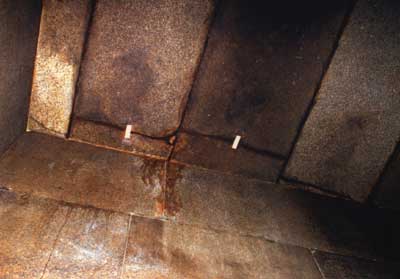 2.291) 'Explosion' or 'Subsidence'.
It has been noted that the Kings chamber has the appearance
of having been
expanded or shifted, suggested to have been caused by an
explosion. An interesting idea considering both al-Mamun and Vyse used
explosives (although we must assume it was done before - as it was plastered
over). So if not an explosion, what caused the huge stones to break?
Need to take into account the fact that the 'star-passages' were
still blocked but correctly aligned still and considered 'candle holder
areas' by Petrie until they were opened by him. The fact that the supporting
beams of the chamber were plastered up 'by hand' definitely points towards
movement within the chamber after its finish. If something had exploded so
violently within the chamber, how did the walls, ceiling and 'coffer' remain
in such good condition?
If movement has occurred however, it needs to be considered
what the cause was, which other part of the pyramid appears affected (except
possibly the lack of casing stones). Le-Mesurier mentions two candidates,
one in 908 AD and the other in 1301AD. (Apparently 30,000 people perished in
Egypt during the 908 earthquake).
Davison
(2), came to the
conclusion that there had been movement within the pyramid.
How these repairs are to be explained is another mystery.
There is no way that the damage was caused by the repairers. Anyone who
would go to the lengths of plastering the walls of the king's chamber in
order to hide the cracks, would also, one would presume, fix all the damage
on the way out. This was not done.
It has been pointed out that 'Davidson's' chamber, was
clearly 'cut through after the blocks had been put in place'.
(10)
2.292)
The 'Sarcophagus' or 'Coffer'.
Pochan
(16)
said of it:
'The sarcophagus, made of Aswan
granite, was equipped with a sliding dovetailed lid; it is similar to many
other sarcophagi, particularly that of Unas and most especially those of the
great mastaba of Meidum and the pyramid of Kephren. Upon closing, three rods
inserted into holes in the lid dropped into three corresponding holes in the
cask, which were not as deep as the length of the rods'.
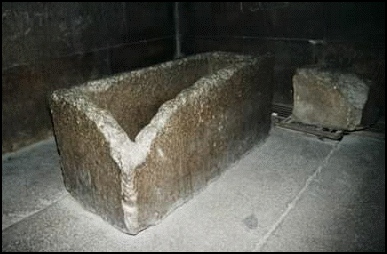
The Kings Coffer (with removed floor stone in
background)
(The Volume of the
interior is equal to half the Volume of the exterior...)
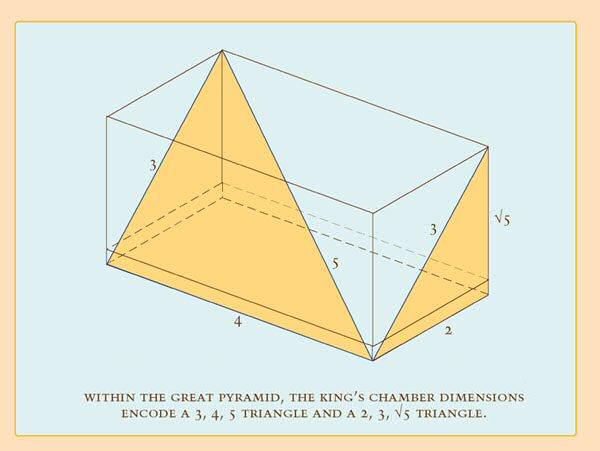
T he coffer's dimensions also demonstrate the application of a 3:4:5
triangle - incidentally demonstrating the geometric method of creating the
angle of slope for Khafre's pyramid.
Note - It
is often claimed (erroneously), that the Coffer would have had to have been
placed in the King's chamber from above as it is too big too fit through the
passage entry.
'Petrie's measurements of
the passage were 41.08 to 41.62 inches wide by 47.13 to 47.44 inches high,
and his dimensions of the box were...41.97 inches outside width, and 38.12
inches outside height'.
(1)
(Answer... think about
it.. think about it... Turn the box
sideways)
2.293)
The 'kings
chamber' as a representation of a 'Djedt', (Osiris's backbone/spine).
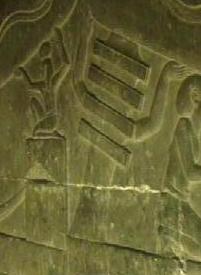
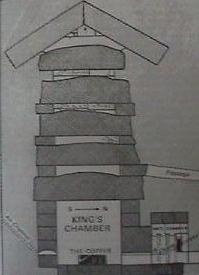 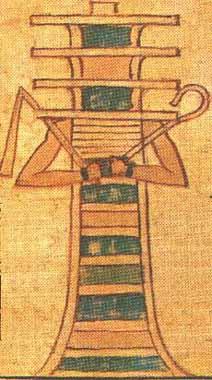
The
Djed is also known as the Djed column, Djed pillar, Tet, Tet Column, or Tet
pillar. It is associated with Osiris and is a metaphor for the phallus.
The Djed pillar hieroglyph means 'stability'.
The source of the imagery is however, shrouded in time. It is clearly
pre-dynastic in origin.
The Djed Pillar is the oldest symbol of Osiris and was of
great religious significance to the ancient Egyptians. It is the symbol of
his backbone and his body in general. The Djed is represented on two ivory
pieces found at Helwan dating to the first dynasty, evidence that the use of
this symbol is at least that old. The djed pillar also came to be equated
with the king's backbone, often painted in the bottom of the coffin, under
where the spine would lay.
|
|
2.30)
The Relieving Chambers.
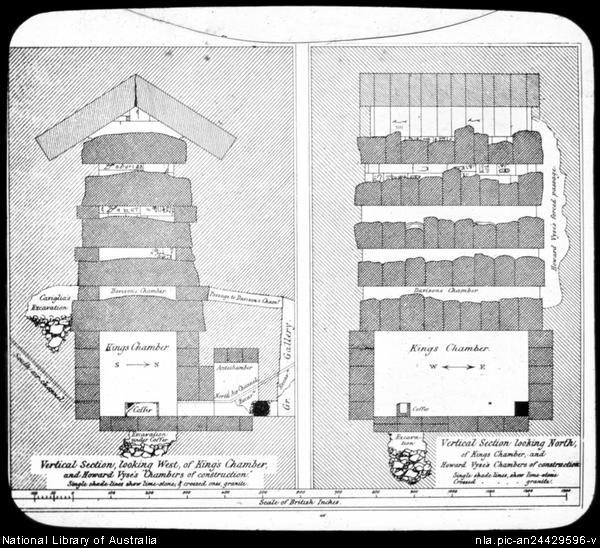
The excavations by Col. Vyse in the 1800's opened the 'relieving
chambers'. Above the roof of the 'Kings chamber is a series of five
relieving chambers formed by granite slabs, which it is argued, were
essential to support the weight of the stones above and to distribute the
weight away from the burial chamber. The top chamber has a gabled roof made
of limestone blocks. In these chambers, are found the only inscriptions in
the whole pyramid. The lowest of the 5 Ceiling Chambers was found to contain
a black dust, possibly the remains of insects entombed in construction
(Exfoliate). The limestone gable of the highest chamber was the only place
(other than the Mid Chamber and some parts of the Grand Gallery) that
contains salt deposits.
In response to the idea that these chambers were for
relieving weight, one has to ask why they were not a feature of the lower
'Queens' chamber, and more to the point, it has been shown that they have no
'relieving' capacity whatsoever.
Petrie said of them:
"All these chambers over the King's Chamber are floored
with horizontal beams of granite, rough dressed on the under
sides which form the ceilings, but wholly unwrought above.
These successive floors are blocked apart along the N. and
S. sides, by blocks of granite in the lower, and of
limestone in the upper chambers, the blocks being two or
three feet high, and forming the N. and S. sides of the
chambers. On the E. and W. are two immense limestone walls
wholly outside of; and independent of; all the granite
floors and supporting blocks. Between these great walls all
the chambers stand, unbonded, and capable of yielding freely
to settlement. This is exactly the construction of the
Pyramid of Pepi at Sakkara, where the end walls E. and W. of
the sepulchral chamber are wholly clear of the sides, and
also clear of the sloping roof-beams, which are laid three
layers thick; thus these end walls extend with smooth
surfaces far beyond the chamber, and even beyond all the
walls and roofing of it, into the general masonry of the
Pyramid."
Pyramids and Temples of
Gizeh, 1883
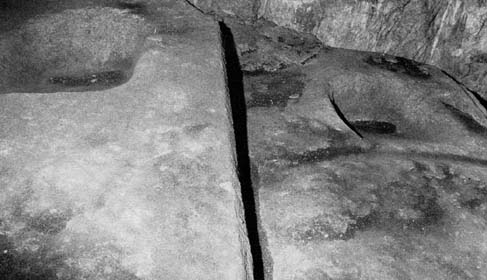
The photo (right) is of depressions or 'bowls' found in the
stones of the top
chamber, called the 'Davidson's' chamber. They are reminiscent of the
Stonehenge lintel-stones but their actual purpose is unknown. All the
granite stones were flattened on their undersides but were left semi-worked
on their upper surfaces.
It appears that it was considered important enough to
smooth the bottom faces, even though they were placed in a position
that would never be seen again.
These are the
amongst the heaviest stones in the pyramid and were quarried and shipped
from Aswan from over 500 miles south. There seems to be no logic behind such
an investiture of energy, and the feature is completely unique in Egyptian
architecture.
From an engineering perspective, Rudolf Gantenbrink
suggested that without these upper chambers the roof beams of the King's
chamber, which deflect about 50% of the load into the horizontal, would have
pushed against the south end of the Grand Gallery. To avoid this, he says
that the builders had to lift the roof above the relevant static structure
of the Grand Gallery. As this seems to be the only reasonable explanation at
present, one must assume that in terms of engineering, they were designed
not to prevent downwards pressure on the 'King's chamber, but rather to
prevent sideways pressure onto the 'Grand Gallery' which sits only metres to
the north of them.
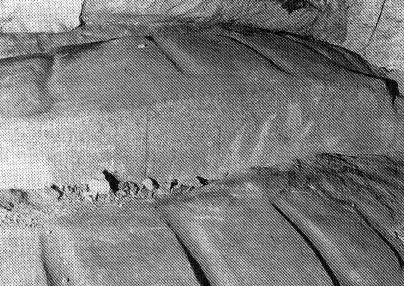
The unfinished tops of the stones in Lady Arbuthnots's
Chamber (left).
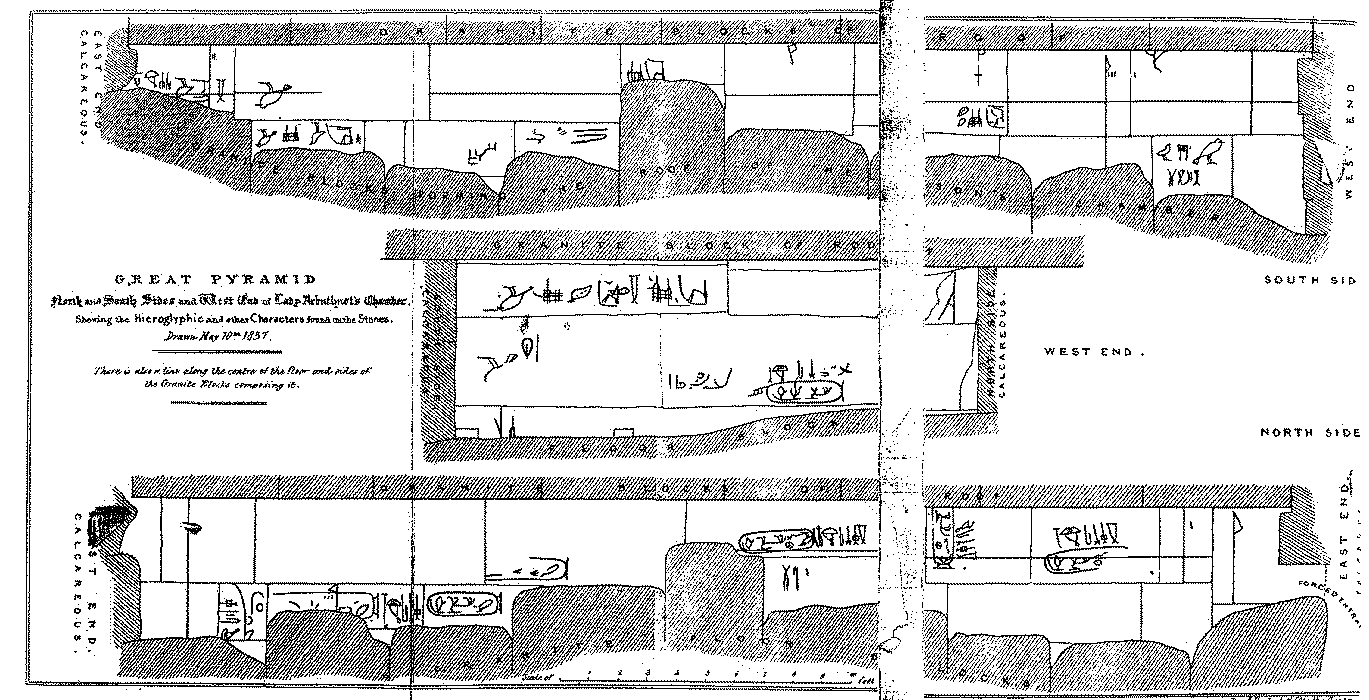
The 'Quarry-marks' or
'Graffitti':
The first level of the relieving chambers
were entered, probably by a repair crew early in the life of the Great
pyramid.
The higher chambers were later shown to have several 'graffitti' marks on
them, presumably from the original builders, as some of the marks can be
seen to continue into currently inaccessible places. These marks represent
the only actual evidence that the pyramid was commissioned by Khufu (or
Khnum-Khufu).
(Original 1837
Drawings of the Graffitti)
It
has been suggested that the quarry marks are not original, but were added by
Vyse in order to gain fame. In response to this, it is noted that some can
be seen to run behind existing masonry. As they are the only direct evidence
of who was responsible for building the pyramid, it is important to know if
they are fake or genuine.
(More about the
Quarry-marks)
|
|
2.31)
The
'Star' shafts.
The so-called 'star-shaft's' were predicted (for air conditioning) before they were
found. It was Col Vyse who first cleared out the air shafts
to the King�s Chamber and it is said that once opened, an immediate rush of cool air entered
the King's Chamber which maintains an even temperature of 68�
to this day regardless of the weather outside. Although this fact is apparent, it is
questionable whether this was their original function.
The extraordinary amount of work that builders undertook in order to
complete the 'star-shafts' makes it clear that they were considered a
fundamental part of the design. They do not appear in any other Egyptian
structure, and therefore have no context in which to place them. There are
two sets of shafts in the great pyramid: One set leading from the 'Queens
chamber' and another from the 'kings chamber'. The set from the Queens
chamber was left sealed at both the top and bottom, while those in the kings
chamber were left open. Gantenbrink's robotic exploration of the shafts
leading from the Queens chamber has aroused much debate in
recent years.
Gantenbrink
also observe that different styles of masonry were used in the construction
of the tunnels.
Diagram Illustrating the different styles of masonry
used in the construction of the 'Star' passages.
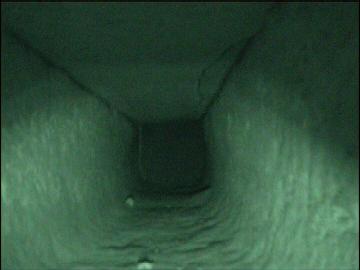
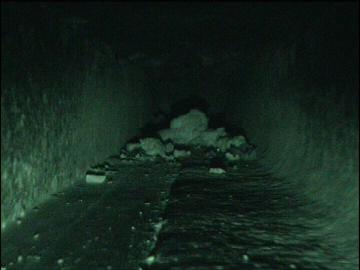
'Queens' Southern star shaft.
'Kings' Northern star shaft (Rubbish photo!)
Gantenbrink writes that the inclinations of the upper shafts could be measured by
drawing a line between the beginning and end of the shaft, and that the
shafts, although bending horizontally, were extremely precise. With a laser
measuring device he didn't find any differences in the width of the shafts
of greater than 0.005 m. Even more fantastic is the fact that the
beginning and the end of a shaft are precisely on one line, even though the
shafts bend in between!.
An observation of the location of the
King's chamber shafts shows that the place at which they entered the chamber
was very specific. They enter at an identical place as the shafts in
the queens chamber, opposite each other and just above the first level of
masonry on the north and south walls. This position was clearly important as
both sets of shafts had to be made so as to manoeuvre around the 'Grand
Gallery', something which would have caused the designers and builders a
great deal of extra consideration.
The
northern 'Queen's' shaft shows settling which might have occurred due to an earthquake
during the building phase; Gantenbrink concluded that the current shaft
inclination might vary from the planned angle by up to 2�. The southern
shaft, on the other hand, has the same accuracy seen in the upper shafts.
'Queens' Southern star shaft.
'Kings' Northern star shaft (Rubbish photo!)
Gantenbrink says - 'I was convinced that the shafts mark
the first construction phase of the pyramid. They constitute basic elements
of great importance. Put simply, a stone structure of such magnitude, built
up in layers over a period of many years, is a sufficiently gargantuan
undertaking to daunt any builder.
But adding diagonal shafts through such a structure so
complicates the task that it becomes a builder's nightmare. The
builders must have ascribed great significance to the shafts; otherwise they
would never have let themselves in for such a massive constructional
headache'.
The existence of the shaft's raises
several interesting questions such as:
Why build two sets of shafts?, Why have a horizontal section at the bottom
of each.?
Why were the top two open while the bottom two were built closed off at both
ends? How are we to explain the design of the top ends of the Queen's
shaft (The 'doors' with handles and an empty space behind)?
T he
current theories for these shafts are:-
1) They are 'Ventilation' shafts: Apart form the fact that the lower shafts were
closed at both ends, it also seems contradictory
that they would leave
open shafts into a Pharaohs chamber, as this would have potentially
exposed the chamber to birds, snakes, rats,
insects, water etc. Something unheard of in terms of Egyptian funerary
chambers. Only one shaft would have been necessary for ventilation. One also
has to ask for whom they were intended to ventilate
2) They are 'star' shafts: This particular theory has gained
weight in recent years although there are some stubborn arguments against
it: Apart from the obvious fact that the queen's chamber shafts were built
closed off at both ends, all the shafts bend, often with extreme angle
fluctuations so that none of them ever pointed directly at anything. While
it is true that certain relevant stars did/do pass in front their entrances
(at different chronological times), their placement on a north - south axis
makes it a simple fact of nature as the sky revolves from east to west.
There is still no conclusive theory to explain all four shafts in this
context. Graham Hancock's theory has been shown to untenable as the stars he
proposes were never in the sky together in the required positions.
3) They were used for religious/symbolic purposes: Although
there are no
other pyramids which show similar features this theory seems possible,
although why this pyramid alone was singled out
for this is uncertain. The suggestion that they were placed there for the passing of the
soul is highly questionable in terms of the queens chamber? Nothing contemporary is recorded
concerning this practice.
Exploration of the
Queens Shafts.
The Queens Chamber shafts were originally sealed with 5"
(12.5cm) of uncut masonry on their inside ends, the blocks they start from
having been hollowed out for several feet behind. The following is Piazzi
Smyth's record of the Dixon brothers' own testimony:
'Dr. Grant and Mr.
Dixon have successfully proved that there was no jointing, and that the thin
plate was a 'left', and a very skilfully and symmetrically left, part of the
grand block composing that portion of the wall on either side'.
(10)
The Queens northern star-shaft has been explored at least
twice. Once in 1872 by Waynman Dixon and D. R. Grant,
and then again in 1993 by Gantenbrink. The following is a list of
objects found in the shaft:-
Objects observed in the 1872 expedition:
1.
A green stone (granite) ball (weighing 1lb 3oz).
2.
A slat or rod of Cedar wood about 13cm long. (Now missing but
recorded by Piazzi Smyth)
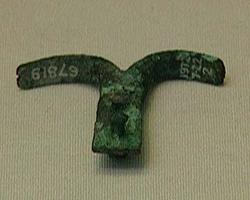
3.
A bronze or copper hook, 5 cm's long,
with a part of a wooden handle still attached.
Waynman Dixon noted in his
diary:
"This thing is bronze green and with strong encrustations
agglutinated. Once riveted on to a wooden handle."
Objects observed in the 1993 expedition:
1 .
A piece of wood with holes (that match the rivets on the bronze item).
2.
A
2m + length of wood resembling a staff with a portion missing.
3.
Various pieces of unidentified material, located in two areas
of the shaft.
4.
A large rectangular object can be seen at the upper end of the shaft
attached to the 2-meter length of wood.
The Gantenbrink experiment also found a metal pole in the
Queens shaft. It has been reasonably suggested that the parts from both
exploration are parts of the same object/s, which were broken. The metal
pole is believed to be a remnant from the 1872 search. Could it be that the
'hook and handle' are remains of an even earlier attempt to explore the
shaft.
    The Gantenbrink experiment was carried out on the 'Queens'
	chamber star-shaft. A remote-controlled miniature vehicle was sent up to
	photograph the upper section of the shaft. It reached a dead-end. The shaft
	was blocked but features of the end-stone suggested that there might be
	something beyond it. After the 1993 experiment, no further research was
	allowed on the shafts by Gantenbrink.
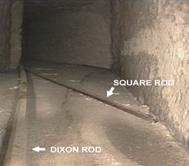
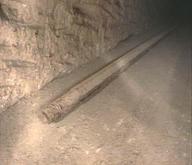
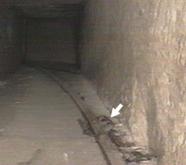
The 'Queens'
northern shaft.
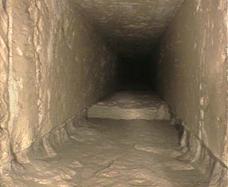
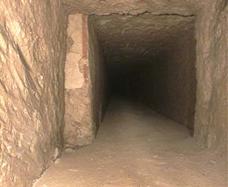
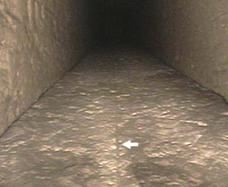
The 'Queens'
southern shaft.
The
'Doors'.
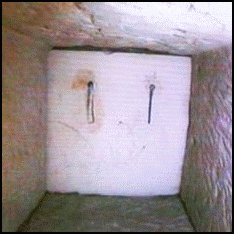
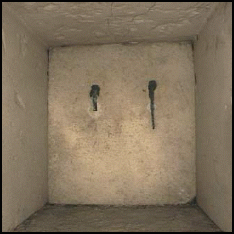
Queens Northern Shaft.
Queens Southern Shaft.
On 18 September 2002, the 'Pyramid Rover' was sent up the
northern shaft, this time off-the-air. Navigation was difficult due to four
sharp bends. Another "stone partition, or door" at the end of the shaft,
again with two copper fittings, was discovered. The Queens southern shaft's
'doors were found to be the
same distance (211 feet) from the Queen's Chamber.
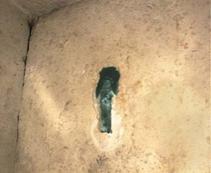 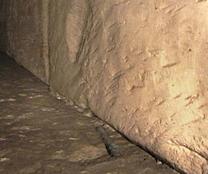
The broken copper 'Handle' with fallen piece on the floor.
Note: the first picture of this shows it as complete.
The 'doors' with the copper 'handles' found at the end of the
queens 'star-shafts', support the idea that the shafts are neither for
ventilation or for astronomical purposes.
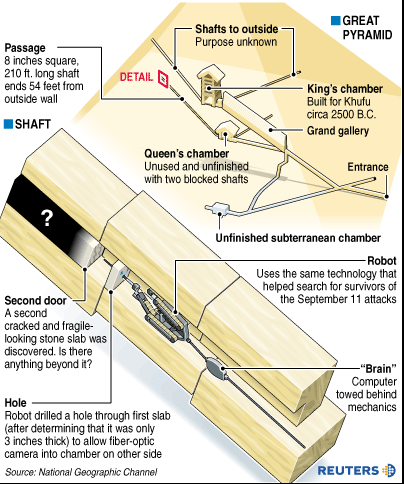
In 2002, another robot, the Pyramid Rover designed by iRobot
of Boston, was sent to the end of the southern shaft to investigate further.
The robot drilled a 3/4-inch hole in the slab and, on 17 September, a
miniature fibre-optic camera was inserted to reveal a rough-hewn blocking
stone lying 7 inches beyond the original southern shaft slab.
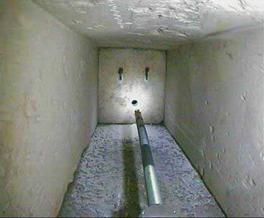
.jpg)
Chris Dunn reports that there is evidence of a vertical shaft
going down in the small chamber behind Gantenbrink's slab. The photo above
seems to support this. Notice the area on the bottom left.
This
report was posted on the Graham Hancock Website.
News
flash from Giza as of December 1, 1999
What
lies beyond the "door" at the upper end of the narrow passage leading up
from the "Queen's Chamber" in the Great Pyramid may have recently been
explored, in secrecy. It
has been reported to us that on October 20, 1996, the Gantenbrink experiment
has now been realized. As previously reported in the Egyptian Gazette
newspaper, Zahi Hawass' choice of Dr. Farouk El Baz to complete this project
to explore the passage, apparently has come to fruition.
This
story was obtained from two separate security guards at Ghiza, and
independently confirmed via a media person working with the Sphinx
expedition of Dr. Joseph Schor, currently in the excavation phase. This is
the report:
At
the end of the ascending passage, 8 inches square, leading from inside the
Great Pyramid's "Queen's Chamber" is a small "door" with two
metal "handles." On October 20, 1996, Dr. El Bas and two assistants
sent a fibre optic camera lens through a flaw in this door. What was
allegedly found was a 2 meter by 1.5 meter chamber inside of which was a
statue. The statue seemed to be in the image of a black male, holding an
Ankh in one hand. On the opposing wall of this chamber was a round shaped
passage leading out.
It has been suggested that because the 'Queens' shafts
terminate before the exterior, (the northern one apparently at masonry level
50, the 'Kings' chamber), that there was a 'change of plan' in the
construction. If however this was the case, why build them sealed off at the
bottom ends and why
did work on the southern shaft continue above the 'Kings' chamber level.
Comment
- While the exact function of the shafts is a mystery, the expenditure of
effort presumes them to be most important features. The shafts are a
point that requires more interpretation. Again the world awaits the Egyptian
authorities response. It seems bizarre therefore that no effort is being
made to pursue this point.??
|
(Return to Top)
|
External Features of the Great pyramid: |
|
2.11).
The Missing Capstone (Benben):
The missing capstone was only
first mentioned by
Diodorus Siculus at around 60 BC. He wrote that in his day when
the Pyramid stood with its casing stones intact, the structure
was:
"complete and
without the least decay, and yet it lacked its apex stone".
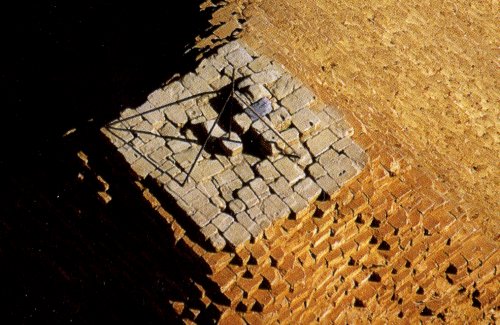
Tompkins and Stechini
quote a reference by a second-century BC Greek writer, Agatharchides of
Cnidus, on the presence of a golden capstone at the apex of the Great Pyramid.
As
all other Egyptian pyramids have a capstone one would assume
there to have once been one, and
although several capstones have been found near Giza, none
are believed to have belonged to the Great pyramid.
|
|
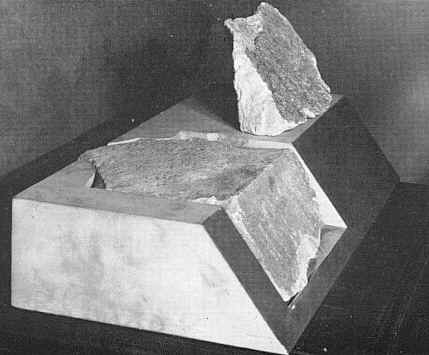 2.12) The Casing stones: 2.12) The Casing stones:
It
is now realised that all the large 'Memphite' pyramids were also originally
faced with white Tura
limestone casing-stones, so this feature of the 'Great' pyramid is not a
unique one. The importance of achieving a smooth face can be deduced from
the amount of extra labour they represent and we must assume that the flat
surface was an essential part of any pyramid. In some cases it can be seen how the casing stones were also
carved at the back to fit existing stones. Davidson (2),
pointed out the following:
'Another remarkable feature of construction (which)
confirms the high degree of accuracy and smoothness of the surface that was
considered necessary. Flaws in the visible surfaces of the casing stones
were cut out and refilled with accurately fitting pieces of limestone,
invisibly cemented in'.
But what purpose or function could this serve?
Davidson reasonably concluded that the intention was:
'...to present a
polished unbroken reflecting surface on all four sides'. He also
concludes 'It is obvious that it was from the brilliant reflexions
from its casing stones that the great pyramid is named, in the inscriptions
of the pyramid period, and in inscriptions of later times, "Khuti - The
lights".
It was Davidson's belief that one of the functions of
the Great pyramid was to act as a 'beacon' which reflected the light of the
midday, solstice and Equinox suns (Although, this does not explain the
presence of 'Tura' casing-stones on other contemporary pyramids).
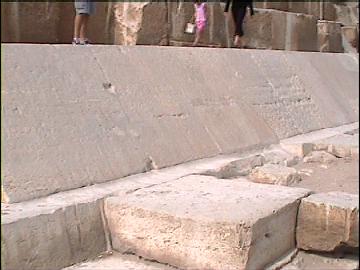
William Fix found conclusive proof that the exterior of the 'Great' pyramid
(or at least a part of it), was once painted red. This remarkable piece of
information creates a clear connection with other 'Solar Temples' or
pyramids that were also painted red. We can see similarities with the
Tibetan religious buildings that are also painted red.
|
|
2.13) The Cornerstones:
Petrie showed that the primary purpose of the corner sockets was to fix the
diagonals of the pyramid (2). However, there is a suggestion that they were
also
associated with rituals and ceremony. For example, the Lisht pyramid of
Senusert I (Dynasty XII), yielded some
interesting articles from
under its Corner stones. Dr. A. Lithgoe described the discovery;
'Under
the platform (of the pyramid) there was found at each of the four corners of
the pyramid a "foundation deposit". These were practically identical in
character, and in each instance had been placed in a square pocket about
80cm in diameter, and 1 metre in depth, excavated in the bed-rock upon which
the platform rested. The bottom of the pocket had been covered, in each
case, with about 5cm. of clean gravel upon which there where some 25 to 30
small pottery model dishes and vases, while scattered among them were a
number of lozenge-shaped blue glass beads. On these objects were laid the
skull and some of the bones of an ox which had been sacrificed as a part of
the ceremonial. The pocket had then been completely filled with gravel, on
which, at about half its depth, was laid a small model brick of sun-dried
Nile mud. Finally the pockets were covered by massive limestone blocks, which
in each case formed the corner blocks of the pyramid'.
(2)
There are
sufficient references in Egyptian hieroglyphs to the ceremony of 'stretching
the cord', a procedure which appears to refer to the initial layout and
orientation of sacred temples and pyramids etc. It is possible that this
ceremony was simply the result of tradition or, as is suspected by many, it
may have been a means of 'endowing' buildings with some form of
'sacred' potential.
|
|
2.14) The 35th
row:
(Diagramatic
Persepective of External Masonry)
This particular course of masonry has led to much debate. It is at the same height as the top part of the gabled
roof of the Queens chamber. It is noticeable because it is the level at
which the masonry becomes larger again, having got progressively smaller
each course it rose below. This effect is repeated several times and it's
significance is as yet unknown.
It has been suggested that
this row may represent the height of an earlier construction.
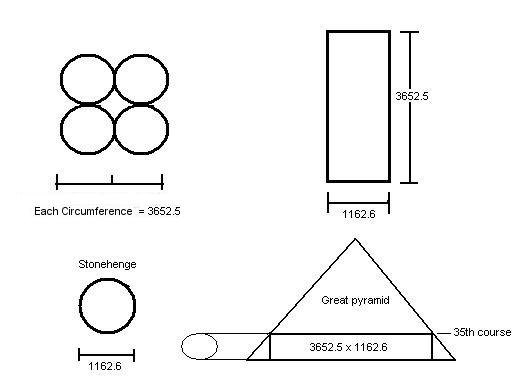
Measurements in Pyramid Inches.
It is noted that it
is exactly the height of a 'quarter araura' a unit of Egyptian measurement (associated
with the solar year). Whether by design or accident, it's height is the exact
same dimension as the diameter of Stonehenge
(3652.5 pyramid inches).
|
|
2.15) The
Entrance:
Strabo mentioned a hidden 'South' door, which presumably remained
until Al-Mamun's time, as he apparently failed to find it. We know
that doors were put into other pyramids. For example:
(Extract from Petrie, 1883)
'The
traces of a stone flap door, or turning block, in the mouth of the South
Pyramid of Dahshur, have been already described (section 109), as well as
the signs of a wooden door behind that. Such a formation of the passage
mouth is unmistakable in its purpose; but after drawing conclusions from
that doorway, it was a most satisfactory proof of the generality of such
doors, to observe the following passage from Strabo on the Great Pyramid.
"The Greater (Pyramid), a little way up one side, has a stone that may be
taken out , (exairesimon,
exemptilem) which being raised up (arqentoV, sublato) there is a sloping
passage to the foundations." This sentence is most singularly descriptive of
opening a flap door; first, the stone is taken out, or lifted outwards from
the face; and then, being thus raised up, the passage is opened. The two
different words exactly express the change in the apparent motion, first
outwards and then upwards; and they show remarkable accuracy and precision
in their use. Besides this description, there is another statement that the
Pyramids of Gizeh had doors, in an Arabic MS., quoted by Vyse; this was
written in 850 A.D., and, therefore, only twenty or thirty years after Mamun
had forced his way into the Great Pyramid, and thus re-discovered the real
entrance'.
An original translation of Strabo's Geographica dating
to 1857, says: "�a stone, which may be taken out; when that is removed"�not
"raised up". The translation of the original Greek is clearly
important.
Conclusion - Strabo talks specifically of a 'hidden' entrance
on the South (North) face with an opening door. The fact that the entrance
and descending passage was not described for so long after this
suggests that it was 'closed' until the entry by Al-Mamun. This clearly
suggests that there was a door which could be either open or closed and 'Hidden'.
Petrie's study of the Bent
(Vega) Pyramid (The only pyramid with remaining doorways around the intact
entrance),
found that on either side of the entrance, there were holes cut opposite
each other, about 9cm in diameter by 14 cm deep. These holes were just
inside the entrance and only 15cm from the top of the passage. Petrie
interpreted these as being hinge sockets to swing a stone door from. Behind
these sockets, the passageway contained more door sockets. These were
smaller vertical sockets for a very lightweight door.
The
following two prints are from Petrie, 1882.

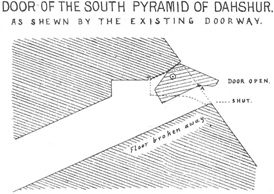
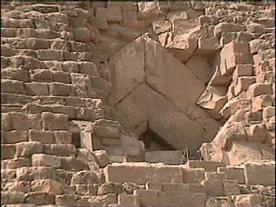 The mechanical proofs of the existence of a
door to the Great Pyramid are of some weight, though only circumstantial,
and not direct evidence like that of the above authors. No one can doubt
that the entrance must have been closed, and closed so as not to attract
attention at the time when the Arabs made their forced passage, about a
hundred feet long, through the solid
masonry. Moreover, it is certain that the entrance was not covered then by
sand or rubbish: (i) because the Arabic hole is some way below it, and the
ground-level at the time of the forcing is seen plainly in the rubbish heap;
(ii) because the rubbish heap, which is even now much below the original
doorway, is composed of broken casing, and the casing was not yet broken up
at the time of forcing the passage. Therefore the doorway must have been so
finely closed that the various accidental chippings and weathering on all
the general surface of the casing completely masked any wear or cracks that
there might be around the entrance; and so invisible was the door then,
that, standing on the heap from which they forced their hole, the Arabs
could not see anything to excite their suspicion on the surface only 35 feet
above them; they, therefore, plunged into the task of tearing out the stone
piecemeal, in hopes of meeting with something in the inside. Yet we know
from Strabo that the Romans had free access to the passage, though he says
that it was kept a secret in his time. No extractable plug or block,
weighing necessarily some tons, would have been replaced by every visitor
until the Arab times, especially without there being any shelf or place to
rest it on while it was removed.* The mechanical proofs of the existence of a
door to the Great Pyramid are of some weight, though only circumstantial,
and not direct evidence like that of the above authors. No one can doubt
that the entrance must have been closed, and closed so as not to attract
attention at the time when the Arabs made their forced passage, about a
hundred feet long, through the solid
masonry. Moreover, it is certain that the entrance was not covered then by
sand or rubbish: (i) because the Arabic hole is some way below it, and the
ground-level at the time of the forcing is seen plainly in the rubbish heap;
(ii) because the rubbish heap, which is even now much below the original
doorway, is composed of broken casing, and the casing was not yet broken up
at the time of forcing the passage. Therefore the doorway must have been so
finely closed that the various accidental chippings and weathering on all
the general surface of the casing completely masked any wear or cracks that
there might be around the entrance; and so invisible was the door then,
that, standing on the heap from which they forced their hole, the Arabs
could not see anything to excite their suspicion on the surface only 35 feet
above them; they, therefore, plunged into the task of tearing out the stone
piecemeal, in hopes of meeting with something in the inside. Yet we know
from Strabo that the Romans had free access to the passage, though he says
that it was kept a secret in his time. No extractable plug or block,
weighing necessarily some tons, would have been replaced by every visitor
until the Arab times, especially without there being any shelf or place to
rest it on while it was removed.*
* Exactly the same
reasoning applies to the Second Pyramid. Diodorus Siculus mentions the
foot-holes up to its entrance, and Herodotus correctly describes the form of
its passages and yet the Arabs forced a large passage in it, in entire
ignorance of the real entrance, which must, therefore, have had a door like
the Great Pyramid.
(This all assumes that the 'Arab's' had no knowledge of the door, whereas it
is also possible that they had complete knowledge of it).
The
restoration of a door would agree to these various historical requirements,
and be in harmony with the arrangement at Dahshur such a block would only
need a pull of 2.5 cwt. on first taking it outwards, and 4 cwt. to lift it
upwards to its final position; it would leave no external opening; it would
also allow just half of the passage to be quite clear; and from the passage
being halved in its height by two courses at the beginning, such an opening
is the most likely. Though the general form is thus indicated, the details
are of course conjectural.
Some photos of the Gabled entrance:-
The whole
entrance is considerably set back from the face and is not easily
visible from below. These features would have all been hidden by the original
casing stones.
Note: It
was suggested by Lepre that the perforated stone in the bottom-left photo is
one of the missing 'Portcullis stones' from the 'Kings' ante-chamber.
According to Walter
Marshall Adams, the triangular area above the doorway was meant to symbolize the 'door of the
horizon', the hieroglyphic sign for the horizon� having been carved inside
the triangle, which from a distance, assumes the form of a pupil. Thus,
Adams believes, the hieroglyphic sign must be the pyramids divine name".
(16)
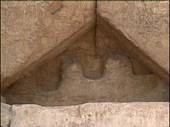
This symbol should be considered of the
highest significance...It serves no structural function and is therefore
representative of something. It is one of the most unique and unexplained
architectural features of the Great Pyramid.
|
|
Associated Architectural Features: |
|
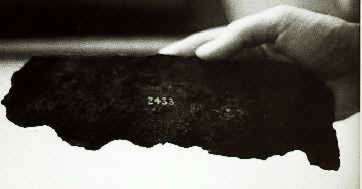 2.35)
The Iron Plate: 2.35)
The Iron Plate:
On Friday, 26 May 1837, after a few days of blasting and clearing, J. R.
Hill (working for Vyse), discovered a flat iron plate about 26 cm (10.2")
long, 8.6 cm (3.4") wide, with a thickness ranging from .4 cm (.2") to
nearly zero, from a joint in the masonry at the point where the southern
airshaft from the King's chamber exits the pyramid. Engineers agree that
this plate was left in the joint during the building of the pyramid and
could not have been inserted afterwards. Colonel Vyse sent the plate to the
British Museum.
Hill affirmed that his find was legitimate:
This is to certify, that
the piece of iron found by me near the mouth of the air-passage, in the
southern side of the Great Pyramid at Gizeh, on Friday, May 26th, was taken
out by me from an inner joint, after having removed by blasting the two
outer tiers of the stones of the present surface of the Pyramid; and that no
joint or opening of any sort was connected with the above-mentioned joint,
by which the iron could have been placed in it after the original building
of the Pyramid. I also shewed the exact point to Mr.
Perring, on Saturday, June 24th.
(Vyse, Pyramids of Gizeh,
I, p. 276)
The plate was examined by the famous Sir Flinders Petrie in
1881. He felt it was genuine and stated that "no reasonable doubt can
therefore exist about its being a really genuine piece".
Extract from Petrie -
That sheet iron was employed we know, from the fragment found by Howard Vyse
in the masonry of the south air channel; and though some doubt has been
thrown on the piece, merely from its rarity, yet the vouchers for it are
very precise; and it has a cast of a nummulite on the rust of it, proving it
to have been buried for ages beside a block of nummulitic limestone, and
therefore to be certainly ancient. No reasonable doubt can therefore exist
about its being really a genuine piece used by the Pyramid masons; and
probably such pieces were required to prevent crowbars biting into the
stones, and to ease the action of the rollers.
H.R. Hall wrote of the
plate in "Note on the Early Use of Iron in Egypt" (Man 3, 1903):
' Now that
Professor Petrie has discovered iron in deposits of VIth Dynasty date at
Abydos, the
contentions of those Egyptologists who have always maintained that iron was
known to the Egyptians from the earliest times must be acknowledged to be
correct. The fact that iron was known to, and used by, the Egyptians over
2,000 years before it came into use in Europe is very remarkable, and it is
hard to square with current theories, but it is a fact. Professor Petrie's
find is a lump of worked (?) iron, perhaps a wedge, which is rusted on to a
bent piece of copper...
This is the third find of iron which can be attributed to the
Old Kingdom. In 1837 a fragment of wrought-iron was discovered in an inner
joint of the stone blocks in one of the 'star'-passages which pass upwards from
the interior of the Great Pyramid to the outer air [Vyse, Pyramids of Gizeh,
I., 276; Beck, Geschichte des Eisens, I., 85]. This is now in the British
Museum, Egyptian Department, No. 2433 (3rd Egyptian Room, Case K, 29). In
1882 Professor Maspero found iron in the pyramid of a Vth Dynasty king at
Ab�s�r. Professor Petrie has now found iron in a VIth Dynasty deposit at
Abydos... The presumption now is that the iron fragments from Ab�s�r and
from the Great Pyramid are of a Vth and IVth Dynasty date respectively. The
G�za fragment will be about 150 years older than the piece from Abydos. (pp.
147-49)
Tests were actually made in the British Museum Laboratory,
and since it seems desirable that the matter should be cleared up, Dr. J.H.
Plenderleith reported the following:
The Pyramid piece was found to consist 'of a thin film of
metallic iron with a more or less thick coating of its oxides.' Samples were
examined and 'no nickel could be detected.' This was in November 1926; in
April 1932 it was examined again, and the results 'completely bear out the
findings of the previous analytical report as regards to the absence of
nickel;' separate tests were applied to the exterior scale and to the
surface of the metallic iron itself, and nowhere could nickel be detected.
As Dr. Plenderleith was advised that 'all known meteoric iron contains some
nickel, about 4-30 per cent,' he considered it 'unnecessary to go any
further in the matter of chemical investigation.' The account of the result
quoted from Man (cf. also Dr. Rickard's Man and Metals 1932, II, 834) seems
therefore to have
mislead Mr Wainwright. The pyramid piece contains
no detectable 'traces' of nickel.
In 1989, an analysis of the iron plate was made by El Sayed
El Gayar and M.P. Jones, published in their article "Metallurgical
investigation of an iron plate found in 1837 in the Great Pyramid at Gizeh,
Egypt" (Journal of Historical Metallurgy Society, Vol. 23 No. 2,
1989, pp. 75-83). El Gayar and Jones, using a hacksaw, carefully cut off a
small corner of the plate for analysis. This fragment was triangular in
shape with an area of 1 cm and a weight of 1.7g. After again determining
that the iron contained "only a trace of nickel", thus confirming a
terrestrial origin (p. 81), the authors found that the plate consists of
numerous laminates of wrought iron and that these laminates have been
inexpertly welded together by hammering. The various layers differ from each
other in their grain sizes, carbon contents, the nature of their
non-metallic inclusions, and in their thicknesses... None of the iron layers
contains siliceous, slaggy inclusions. Furthermore, none of the other phases
within the iron laminates shows any metallic copper globules, nor do
they show more than small traces of the element copper. These
features suggest that the Gizeh iron plate had not been produced as a
by-product of copper smelting operations. The outer layers of the iron have
been badly corroded and now exist as complex banded iron oxides. Small, but
significant, proportions of gold were found in one of the oxidised layers
and it is thought possible that the plate may, originally, have been
gold-plated.
Drs. Jones and Gayer concluded the following: "It is
concluded, on the basis of the present investigation, that the iron plate is
very ancient. Furthermore, the metallurgical evidence supports the
archaeological evidence which suggests that the plate was incorporated
within the pyramid at the time that structure was being built".
A more recent analysis of the plate, however, has cast doubt
on the findings and conclusions of the study by El Gayar and Jones. In their
article "Gizeh Iron Revisited" (Journal of the Historical Metallurgy
Society, Vol. 27 No. 2, 1993, pp. 57-59), Paul Craddock and Janet Lang
of the British Museum reported that they were at first unable to obtain the
section cut by El Gayar and Jones, consequently the initial study was
confined to the larger portion of the plate. A new section was cut adjacent
to the original section, and it was examined under a scanning electron
microscope both at the British Museum and independently at the Ancient
Monuments Laboratory, English Heritage (the work was carried out there by
Dr. G. McDonnell). It was also analyzed by x-ray fluorescence. Surprisingly,
no gold was detected in the metal or in the corrosion. Craddock and Lang
further wrote:
Since the last report the
original section has been returned to the Museum and we have been able to
carry out a thorough investigation. Once again we must report that despite
extensive searches no trace of gold could be detected, and it is our firm
opinion that the original report of gold is incorrect.
The authors agreed with El Gayar and Jones regarding the
structure of the iron plate, but they did not agree on the interpretation.
They conclude the following - 'The structure of the plate is consistent
with iron-making in the post-medieval Islamic era'.
Comment
- The plate has been determined of terrestrial origin. It was declared of
ancient origin because of the numulite imprints in it. This was a specific
observation, as was the determination that it could not have fallen in at a
later date. Other contemporary findings of iron support the idea that this
could at least be genuine.
The royal funerary Pyramid Text �907 reads: The doors of
bA-kA [an unknown region of the sky] which is in the firmament are opened
for me, the doors of iron which are in the starry sky are thrown open for
me, and I go through them ...
And finally, this extract from Miracle in Stone. (It
does seem strange that none of the learned professors above ever noticed
it): 'The
Siniatic Mountains and hills are known to be full of iron of
the most excellent kind. A Mr. Hartland some years ago,
established himself in that region for mining purposes, and there, near
Surabit-el-Khadem ,and not far from Wady Meghara, he found, not traces
merely, but colossal remains, of iron works and furnaces, belonging to the
earliest kings of ancient Egypt, and on a scale so vast as to be testified
to by almost mountainous heaps of genuine iron slag and veritable iron
furnace refuse (see proceedings Soc. Antiq., Vol V, 2d series, June 1873).
Nay. What is more remarkable, here also, is a
tablet containing the cartouches of Shufu (Cheops) and Nem-Shufu, the same
as the quarry-marks discovered by Colonel Howard Vyse on the hidden stones
in the Great Pyramid! These records are engraved in a soffit in the face of
the natural rock, where they directly overlook the scene of the furnaces.
They begin with the name of Soris, the immediate predecessor to Cheops,
under whom the Egyptians seem to have been put through an apprenticeship of
working in iron. One of Egypt's ancient kings also appears on the monuments
with a name which means "A lover of Iron".'
Apart from the obvious implications of an Iron works with the cartouches of
fourth dynasty kings on it, it is interesting that the name 'Soris'
is mentioned, as this seems to confirm Manetho's chronology. It also implies
that Iron was understood and forged before the pyramid was built.
Just how big is this mine and where is the Iron?
As final supporting
evidence for the use of metal at this time we are told by Mendelssohn that
'grooves for metal bars ' were found in the casing stones of the Meidum
pyramid.
Article: NPR.org (May, 2013)
'Ancient Egyptian (3.300
BC) Iron Beads Linked To Meteorite'
'The "Tube-shaped beads excavated from grave pits at the prehistoric
Gerzeh [Giza] cemetery, approximately 3,300 BC, represent the earliest known
use of iron in Egypt,"
(Link
to Full Article)
|
A list of other 'lost and found' objects from the Great pyramid.
|
2.40)
Missing pieces of the puzzle.
-
There are a number of pieces of the 'Great' Pyramid missing!
The most obvious noticeable missing features from the outside
have to be either the lack of casing stones or the fact that the pyramid has
no top. It is generally agreed that the casing stones have been gradually
removed and used as masonry for local building projects in Cairo. The
capstone or 'Ben-Ben', which one would normally assume to be found on top of
any pyramid, is however, conspicuously missing. Although there are various
myths surrounding it, there are no recorded eye-witness accounts, which
suggests that it either never existed or that it was 'lost' at some time in
the distant past. There is no myth or story (That I know of), of it having
been stolen or destroyed. It is not mentioned by Herodotus (which more
suggests that it was there). In fact historians as far back as the time of
Christ described it as both 'perfect and topless'.
Except for Al-Mamuns' hole, the casing stones apparently
remained intact when the Great Pyramid was visited by an Arab historian in
the early thirteenth century. But, over the course of the fourteenth
century, apparently following an earthquake which dislodged some casing
stones (and destroyed Cairo), the rest were systematically stripped off to
rebuild the mosques and palaces of Cairo. A century later, during the
Italian renaissance, Girolamo Cardano, a Milanese physician and
mathematician, and close friend of Leonardo Da Vinci, maintained that an
advanced science must have predated the Greeks. He suspected that knowledge
of a far more exact degree of latitude must have existed hundreds, if not
thousands, of years before the Alexandrian Greeks, and he believed that the
place to look for it would be in Egypt (He also predicted the 'star'-shafts
before they were found, but for ventilation).
Extract from Petrie : -
After the time of Mamun the exterior was used as a quarry; the casing was
apparently stripped off by Sultan Hasan for his mosque in 1356, since he is
said to have brought the stone hence, and William of Baldensel* in 1336
mentions both the large Pyramids as being "de maximis lapidibus et politis."
It was also Hasan, or a near successor of his, who stripped the Second
Pyramid; as I found a coin of his deep down in the S.E. foundation. The top
was not much denuded in the 17th century; Lambert (Trois Relations de
l'�gypte)
in 1630 mentions 12 stones as forming the top of the core,
and says that the platform was 20 spans wide; by his span measures of the
coffer, this would be 230 inches; among these 12 stones was "une qui
surpasse en largueur et longeur Ia croyance des hommes." Greaves in 1638
found 9 stones, and reports two as missing. Thevenot in 1667 reports 12
stones; but as he understood Arabic well he probably accepted a statement of
what had been there thirty years before. Other stones of the top and edges
of the core were thrown down at intervals, until the beginning of the
present century, as is evident from the weathering marks, and the dates of
the graffiti.
Internal Missing Features:
The first thing to notice is that the top of the
top of the upper granite 'plug' is mostly gone. Al Mamun apparently dug around all three
existing plugs before entering the ascending passage, so why is the top plug
missing so much (in comparison with the others).
At the junction of the
ascending passage and the horizontal passage, the entrance to the 'well
shaft' is missing, along with part of another stone next to it.
The
false ceiling/floor at the entrance to the passage leading to the Queens
chamber is gone, as are any 'blocking-stones' to the chamber. ' (if there ever was one), is missing.
The chamber is reported to have once had a coffer in it and the floor is
also missing.
The approach to the antechamber of the 'Kings chamber' has been mutilated as
has the mechanism that once existed there. The entrance to the Kings chamber
has also suffered damage, which looks like a 'forced entry'. Within the
Kings chamber the 'coffer' appears to have 'lost' a corner, (and possibly
the lid). Most people are aware that a 'mummy' of a pharaoh has never been
found in a pyramid (With the singular exception of the Pyramid of
Palenque, in Mexico; the tomb of
which also had two corners of the lid missing).
The Gallery - There is a suggestion that the groove running
along the 'grand gallery gables originally served a function, and that it might have
held
a 'false ceiling' (also missing if true).
The sockets along the wall of the 'Queens' entrance and the grand gallery
wall are curious. Whatever they were for or whatever went in them originally
is also now missing.
Extract from
Petrie : - When, then, was the Pyramid first
violated? Probably by the same hands that so ruthlessly destroyed the
statues and temples of Khafra, and the Pyramids of Abu Roash, Abusir, and
Sakkara. That is to say, probably during the civil wars of the seventh to
the tenth dynasties.
|
|
2.50)
Extra Pieces of the Pyramid:
The list so far is as follows :- A Basket from the Queen's
chamber, The piece of wood and ball from the Queen's star-passage, an iron
plate, debris in the well shaft, beetle 'exfoliate' and the following.
Extract from 'Miracle in
Stone'
- 'After a rain Prof Smyth paced about among the gutters which the wash
cut into these piles of chips and splinters of stone, to see what he could
find. "Towards the top of the heap and just in front of, though at a great
distance from the pyramids entrance portal", he found "frequent splinters
and fragments of
green and white Diorite".
It is the material of which the celebrated stone statue in the Boolak museum
is cut. It is not native to the region'.
(15) As well as this, the Edgar brothers also reported finding 'several
small pieces of green idols'
from the descending passage and subterranean chamber.
Petrie points out that a
quantity of debris from a
black rock
was found near the niche in the Queens chamber.
(16)
|
|
2.55) The Trial Passages:
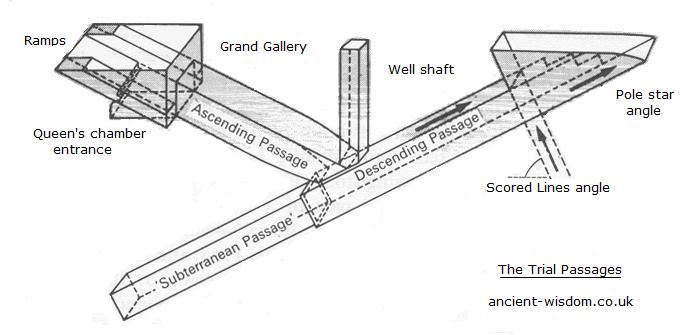
The trial passages are an almost identical
replica of the junction between the ascending and descending corridors.
Petrie said this of them:
30. 'The trial
passages (P1. iii b.) are a wholly different class of works to
the preceding, being a model of the Great Pyramid passages,
shortened in length, but of full size in width and height'...
...'The vertical shaft here is only analogous in size, and not
in position, to the well in the Pyramid gallery; and it is the
only feature which is not an exact copy of the Great Pyramid
passages, as far as we know them. The resemblance in all other
respects is striking, even around the beginning of the Queen's
Chamber passage, and at the contraction to hold the plug-blocks
in the ascending passage of the Pyramid (see section 38). The
upper part of the vertical shaft is filled with hardened stone
chips; but on clearing the ground over it, I p 51 found the
square mouth on the surface. The whole of these passages are
very smoothly and truly cut, the mean differences in the
dimensions being but little more than in the finely finished
Pyramid masonry. The part similar to the gallery is the worst
executed part ; and in no place are the corners worked quite
sharp, generally being left with radius about .15. The N. end is
cut in steps for fitting masonry on to it; and I was told that
it was as recently as 1877 that the built part of it was broken
away by Arabs, and it appeared to have been recently disturbed ;
in Vyse's section, however, the roof is of the present length,
so the removal must have been from the floor. By theodolite
observations the plane of the passage is straight and vertical
within 5' or less.
(The
Pyramids and Temples of Gizeh by W. M. Flinders Petrie)
And Zahi Hawass had this
to say:
'To the east of
the Great Pyramid, Petrie found passages cut into the rock floor
that are very similar to the passages inside the Great Pyramid.
These he called "trial passages", thinking they were a trial run
for making the actual pyramid passage. The trial passages are
just north of the cause-way of Khufu beside the tomb of
Hetepheres.
They lie 87.50 m. from the eastern base of Khufu's pyramid and
43.50 m. north of the east-west axis. The passages are oriented
north to south, the rock was cut carefully and well squared, and
some parts were encased with mortar. The passages have a total
length of 22 m. and a total vertical depth of 10 m. At the north
end there is an opening in the bedrock when is cut in steps.
This becomes a sloping passage 1.05 m. wide and 1.20 m. high,
which continues at an angle of 260�3''. From the north entrance
of this passage, a second passage, of almost identical
cross-sectional dimensions, begins. This second passage ascends
southward at approximately the same angle as that by which the
first passage descends. At 5.8 m. from its beginning, this
second passage reaches the surface of the bedrock and widens
into a corridor which is open to the sky. A square shaft, about
0.72 m. m width, was cut vertically from the surface of the
bedrock to the point where the two passages meet.
About 6 m. west of the trial passages and parallel to them is a
long and narrow trench considered the third trial passage. This
runs parallel to the other passages, and is almost exactly equal
in width to the vertical shaft in the trial passages. Its
southern end is well-cut but its northern end was left rough. It
measures 0.15 m. deep at the north end and 0.43 m, deep at the
south end. This narrow trench is 0.71 m. wide and 7.35 m. long.
Lehner believes that it has some connection with the trial
passages.
The function of these trial passages has been debated by
scholars since their discovery by Perring and Vyse, who believed
that they were part of the substructure of the fourth queen's
pyramid which was left without a superstructure. They offer as
evidence for this view the fact that these passages lie on the
same north-south axis as Khufu's queens' pyramids designated by
Reisner as GI-a, b, and c. They also note that the rock around
the north entrance to the passages was levelled, indicating that
there was a superstructure planned. Petrie, who examined and
mapped these passages, noted the similarity of these passages to
the passages inside the Great Pyramid.
He suggested that the trial passages functioned as a model for
the Great Pyramid's interior structure. Petrie found that "the
trial passages" had the same height and width as the passages in
the pyramids but were shorter in length. The only feature that
differs in the two primary sets of passages is the vertical
shaft, which he did not recognize as appearing in the pyramid.
According to Maragiogho and Rinaldi, the trial passages
reproduce the following features of the Great Pyramid passages:
the descending corridor, the ascending corridor, the northern
end of the grand gallery with the lateral benches, and one
middle horizontal corridor, which is only roughly outlined. A
final point of evidence that these passages were models of the
interior of the Great Pyramid for Maragioglio and Rinaldi is the
fact that the rock was leveled on the sides of the north
opening, which they interpret as an indication of the point
where a passage built in masonry continued hewn in the rock'.
Of particular interest is
the vertical shaft directly above the junction of the Descending and
Ascending corridors.
|
|
Conclusions from Architectural Analysis: |
The casing stones were made as flat as possible, even to the
extreme of 'invisibly' repairing faults.
(2).
All the major 'Memphite'
pyramids had Tura limestone polished casing-stones.
Traces of red (Ochre) were found on the face of casing-stone
fragments from the 'Great' pyramid. (Fix).
The purpose of the corner-stones was to fix the diagonals of
the pyramid.
Other corner sockets in Egypt have revealed ritualistic
deposits.
The 35th row is at the same level as the top of
the gabled roof of the 'Queens' chamber.
Strabo mentions a 'Hidden Door' in the Great pyramid.
There are traces of a 'Door' in the 'Bent' pyramid at Dashur.
One of the missing 'portcullis' stones is possibly sitting to
the left of the original entrance.
The 'Trial passages' contain similar dimensions as those
found in the Great pyramid.
Although most of the dimensions are the same, there are
differences.
The 'Cult' pyramid by the 'Bent' pyramid contains internal
features similar to the 'Grand Gallery'.
The 'Water shaft' fulfils the requirements for Herodotus'
description of 'Khufu's' tomb.
The lower level (With visible columns), is underwater and has
yet to be fully explored.
The upper surface of the top granite 'Plug' in the 'Great'
pyramid is rough.
Other pyramids show evidence of 'Plugging stones'
The Edgar brothers cleared 'several pieces' of 'coarse red
plaster' from above the 'Plugs'.
The start of the ascending passage was cut through existing
masonry.
There is evidence of a 'forced-entry' prior to Al-mamun.
The 'Subterranean' chamber appears unfinished.
The 'Southern passage is neatly cut.
The 'Ascending' passage passes through three 'Girdle' stones.
At least one of the Girdle stones is in the area which was
cut through existing masonry.
The 'Queen's' chamber has similarities to the 'serdab' of
Kagemni at Saqqara.
The 'Queens' chamber occupies the central position of the
pyramid.
Petrie found fragments of black stone in the 'Queens'
chamber.
The floor is missing from the 'Queens' chamber.
The masonry of the upper-parts of the 'Well-shaft' can have
only been fitted as the pyramid rose.
The 'Well-shaft' is on the same level as the 'Queens'
chamber.
One section of the 'Well-shaft' was cut through existing
masonry.
The upper entrance of the 'Well-shaft' shows 'chisel marks'.
The rubble found at the bottom of the 'Well-shaft' probably
came from an excavation of the 'Grotto'.
The excavation of the 'Grotto' was done after the after the
completion of the tunnel.
There is possibly a piece of the 'Portcullis' in the
'Grotto'.
The third corbel of the 'Grand gallery' has a slot running
along its length both sides.
The finishing of the masonry of the 'Grand gallery' becomes
progressively worse the higher one gets.
There are twenty eight slots along the length of the 'Grand
gallery'.
Pochan notes that Khufu was the 28th pharaoh
(16).
Other pyramids have corbelled chambers.
The tunnel to 'Davidson's' chamber was cut through exiting
masonry.
There is probably a piece of the 'Portcullis' in the
'antechamber' to the 'Subterranean' chamber.
There is probably a piece of the 'Portcullis' at the bottom
of the 'Subterranean' passage.
Some of the Granite stones in the 'relieving' chambers above
the 'King's' chamber are cracked.
The Kings' chamber was plaster 'repaired'.
The 'Kings' chamber show signs of subsidence.
The damage appears localized.
The sarcophagus had a lockable 'sliding-dovetailed' lid.
The Sarcophagus is similar in design to Unas, Medium and
Kafre's too.
The 'Kings' chamber appears like a 'Djed'.
The Djed symbol was a symbol of Osiris (backone) and
represented stability.
The 'Relieving' chambers contain the only known inscriptions
in the whole pyramid.
The 'Relieving' chamber granite blocks were polished on one
side only.
Davidson' chamber, which was later opened, has no
inscriptions.
The top chamber is constructed of limestone blocks.
The top chamber contained salt deposits.
The lowest chamber was found to contain insect exfoliate.
The 'Relieving' chambers do not 'relieve' the weight below
them.
The quality of the air inside the pyramid improved when the
Star-shafts were re-opened.
The beginning and the ends of the star-shafts are precisely
online.
The Shafts are neatly worked along their length.
The Kings Northern shaft shows signs of 'settling'.
The Queens shafts were sealed at the bottom with 5 inches of
uncut masonry.
The Queens Chamber-shafts both end at the same distance, with
'Doors'.
Several objects were found in the Queens northern-shaft.
The Queens Southern shaft appears to have a cavity behind the
'Door'.
Each 'Door' has two copper 'handles' on it.
One of the Queens star-shafts reaches the up to the 50th
level (Kings
chamber floor-check).
No other pyramid has 'Star-shafts'.
Their location on the wall (E-W, N-S) appears important.
It appears important that they are opposite each other.
A small sheet of terrestrial 'Iron' as found at the end of
the southern shaft.
A 4th Dynasty iron works was found in the Sinai
Mountains with the name 'Soris' (Manetho) engraved there
There are other known 'Old Kingdom' finds of Iron, some from
before Khufu.
The same engraved record has both 'Khufu's' and 'Khnum-Khufu's
Cartouche on it.
The top (ben-ben), is missing.
There are no historical eye-witness accounts of it, or any
accounts other than speculative.
The casing stones were recorded as being intact in the 13th
century.
The 14th c. earthquake which destroyed Cairo is
also believed to have dislodged the first casing-stones.
The casing-stones are believed to have been used to rebuild
Cairo.
Girolamo Cardano, a friend of Leonardo Da Vinci, predicted the
'star-shafts' before they were found?
The latitude of the Giza pyramids suggests
a deliberate geodetic placement.
The top of the top granite plug appears to be 'missing' or
'unfinished', yet still in its original state.
The blocking-stone to the 'Well-shaft's' upper entry appears
to have been 'cut-out'.
The blocking-stone to the 'Queens chamber' is
missing.
The wall approaching the Antechamber' from the 'Grand
gallery' has been mutilated.
The wall approaching the 'King's' chamber from the
'antechamber' has been mutilated.
The 'Kings-coffer' appears to have 'lost' a corner.
The 'Kings-coffer' has no lid.
The floor appears to be missing from the 'Queens' chamber.
A coffer was recorded as being in the 'Queens' chamber.
All the pyramids appear to have been entered previously, at
some time in the distant past.
Fragments of green and white Diorite were found in debris
associated with the great pyramid
Several pieces of 'green idols' were found by the Edgar
brothers, on clearing the lower passage and chambers.
A 'quantity of black rock' was found near the niche of the
'Queens' chamber.
There is an extra vertical shaft in the
'Trial Passages' outside the pyramid.
|
There are several unique architectural
features at Giza which combine to represent one of the
pinnacles of human achievement. Although the pyramids show
different building styles, the design of the plateau shows
evidence of an overall design (connected to
Heliopolis through the
alignment of the corners).
The next section deals with the question of Who
it was that built Giza. The oldest references of Giza talk
of an immigration of people from the east at the same time
that the Early dynastic pyramid building phase began . |
(Next
Section: Who Built The Great Pyramid)
(Return
to Contents Page)
(Giza
Homepage)
(Egypt
Homepage) |