|
The Great Pyramid: What was it built for?
Egyptologists believe that their pyramids developed independently from an original 'mastaba'
form, which was in turn believed to have originated from the covering over
of rock-cut tombs of nobility, royalty and Pharaohs.
The earliest reports suggest that a socio-religious shift in
thinking occurred in Egypt at the same time as the major constructions of Giza
were completed, an idea which correlates with the change in the pharaohs title (It was
around this time that the pharaohs
began to use the prefix/suffix 'Ra' or 'Re' in their name, identifying
themselves with the one, true god. Ra or Re). The development of such
unparalleled 'super-structures' at this time, along with such a dramatic change
in the social order and worship strongly supports the idea of another, as yet
unidentified influence in the Nile valley culture. In addition, there are
several compelling facts which tend to suggest that the traditional 'pyramids
as tombs' theory can no longer be considered sufficient to explain the
presence of such developments at this time.
Quick
Links:
|
The 'standard' Egyptologist theory:
The picture we have developed concerning the development and purpose of these
pyramids originates solely from the Greek historian Herodotus, who actually said that Khufu was buried on an island surrounded by water.
There have been various
attempts to explain the Great pyramid (and Ghiza). The current explanation from
Egyptologists is that the three pyramids were built individually by the 4th
dynasty Pharaohs Khufu, Khafre and Menkaure (See Appendices for
chronology), which according to the standard chronology,
places the pyramid construction phase
within the extreme
limits of
2,400-2,650
BC. The
theory explains the presence of the Giza complex in terms of a funerary complex
and
is based on
the following premises:
-
Herodotus was told that it was built by Cheops.
-
Each pyramid has a 'coffer
inside' (The great pyramid was said to have had two originally)
-
Other funerary objects around the pyramids have been
associated with Khafre.
-
The 'Polar' passage alignment with 'Alpha Draconis' at
2,400 BC.
However,
while
the 'Tomb' theory is appealing, there are certain aspects of it that leave
'reasonable room for doubt', such as:
-
Some 4th dynasty pharaohs
are credited with more than one pyramid. -
No
original burials have been found in any pyramid in Egypt (Including the
opening of several empty coffers). -
There are no supporting
inscription, stele, or papyrus to commemorate the constructions of Giza.
-
The Giza pyramids have no
internal funerary inscriptions to 'assist the dead'.
-
Several structural features
cannot be explained in 'funerary' terms.
One of the major problems we have today is that there are no
contemporary records or inscriptions to commemorate the constructions at Giza.
In itself, this is a peculiar fact, as other contemporary Egyptian funerary
structures abound with 'sacred' and 'magical' texts and inscriptions inside them
to assist the passing of the dead pharaoh into the underworld.
|
|
Tradition and word
of mouth:
Following
Herodotus statement that it was built for Cheops, the Egyptian high priest Manetho stated in the 3rd century BC, that it was
built by Suphis. (Sophis
incidentally,
is also the ancient
Egyptian name for
Orion;
thus the Sothic year). What Manetho also said was that this Suphis was
buried on an island surrounded by water, which is obviously contradiction to the
'pyramids as tomb's' theory. Perhaps this statement was a reference to the
layout of the pyramids, which have been compared to Orion's belt.
While
many of the original testimonies vary in detail, the name 'Khufu' is constantly
repeated in relation to the great pyramid (HWFW, Khufu, Shufu, Suphis, Cheops, Chephren, Shephren
etc). It must be remembered however, that with the possible exception of Manetho,
most references are based on the original testimony of Herodotus.
It is worth exploring the name 'Khufu' a little further here:
Egyptologists explain
that Khufu's name had become 'a powerful charm', and was put on monuments as a
sign of sanctity and protection. In other words, it was used in later times as
the sign of the cross has been used in Christian countries for nearly two
thousand years. Of course, we do not assume that every representation of a
person bearing the symbol of a cross is Jesus Christ, nor that every building
with a cross was personally ordered to be built by Jesus. Neither do we assume
that every person named Jesus is the original Jesus Christ.
In relation to this, Fix cites evidence to
show that the quarry-marks and cartouches that have been used to attribute
pyramids to kings may have been misinterpreted. Some of the cartouches of
4th-dynasty kings may originally have been sacred symbols identifying different
schools of religious thought, rather than primarily the names of individual
pharaohs. The historically known kings Khufu, Khafre, and Menkaure may well have
appropriated, and possibly restored, the three Giza pyramids as their own
memorial monuments, and may have been responsible for some of the surrounding
auxiliary structures -- small subsidiary pyramids, temples, tombs, and boat pits
-- but there is no conclusive evidence that they started and finished the three major pyramids
themselves.
'The
very able D. Davidson shows a positive engineering proof, eight definite proofs
in fact, that Cheops' body was never interred in the Great Pyramid'
(7).
(Personal note: Having read
the book, I can find no justification for this statement).
There is no question that the name Khufu (Cheops) and its several
variations have been associated with the structure since at least Herodotus
time. The discovery of 'Khufu' (and Khnum Khufu), inscriptions
inside the relieving chambers supports this connection. The fact that this
integral information about the structure was independently preserved orally by
the Egyptian priesthood for thousands of years is a testimony to both the
priesthood and the oral tradition itself.
It seems relevant that the
name accredited to the building of the structure (Knufu-Shufu-Suphis),
is also name that is independently associated with both a God (Khnum-Khufu), a
sacred/good luck charm (Khufu)and the ancient name of the constellation Orion.
|
|
Criticism of the tomb theory.
It is important to 'keep in context' over this issue However, the truth is that
there are a number of anomalous features of the great pyramid that are not
contextual. The Great Pyramid is the only pyramid built with an ascending system
of passages. All the other pyramids only have a descending system with the
'coffer' placed below. Also there are a number of specific design features that
suggest that the pyramid may not have been built to house a body after all. What
evidence is there that it was a tomb? The empty coffer is appealing but there
are no original funerary hieroglyphics, paintings or inscriptions to be found on
or in the Great Pyramid or the coffer. Almost all the other funerary
monuments in Egypt are covered with protective funerary inscriptions. It is unlikely that a
King would have been buried there with no inscriptions and paintings for his
tomb, as these were a form of afterlife protection. The spells and texts of this
period are expected.
Looking at the other contemporary 'Heliopean' pyramids
(and therefore keeping in context),
we find that they all show similar construction features (portcullises, corbels,
corner sockets, casing stones, etc), none have funerary inscriptions and none have
produced
an original body.
Petrie (12),
makes an interesting observation concerning Herodotus' claim that 'Cheops'
was buried 'in a subterranean region, on an island there surrounded by the
waters of the
Nile'. He first calculates that
in order for the Nile waters to 'surround' the coffer, it needs to be another
fifty feet below the existing 'subterranean' chamber. He then produces a
candidate for the chamber. 'Exactly such a locality, too, both sepulchral,
and with the required hydraulic conditions, has since been discovered about
1,000 ft S. East of the pyramid building'. (Plate XIX). The structure is a
large and deep pit on the square and bottom of which rests an
'antique, rude sarcophagus of very gigantic proportions'. The pit is
surrounded by a trench, which is deep enough to descend below the adjacent
waters of the Nile, allowing it to fill with water. It is called 'Campbell's'
tomb.
On a final note, it is noted
that the Ghiza plateau was subject to a spectacular phase of ground-work
before the pyramids were built, with the whole plateau being levelled (to
accuracy of within less than an inch over the whole site - see Petrie), being
covered with a limestone and basalt pavement which runs under all the
pyramids. It is also curious that Khufu, the builder of the great pyramid (and
therefore the first pyramid), chose to build on the edge of the site, leaving
the centre position for Khafre, his son who reigned after him.
The Snoferu Dilemma:
The Dashur pyramids remained a site of worship for well over 1,000 years.
Snoferu's cult was still alive in the new kingdom. The traditional names of
the pyramids are:
The Red pyramid - 'Snofero's northern pyramid'
The 'Bent' pyramid - 'Snoferu's southern pyramid
Meidum - 'Djed Snoferu' Sneru endures''
A
decree from the time of Pepi I (6th Dynasty), which exempts the priests of
'the
two
pyramids of Snoferu' from certain taxes, was written in relation to the 'Red'
and 'Bent' pyramids at Dashur. Cartouches of Snoferu have also been found on both
pyramids (On the corner-stones and upper chambers of the 'Bent' pyramid),
but none yet on the Meidum pyramid.
Snoferu is only credited with a reign of just 23 years (2,575 - 2,551
BC)
(2), suggesting that he managed to move three
times the amount of stone as his son, Cheops (Khufu), but in only half the
time.
Each of the pyramids was built in a
completely different architectural style, with the bent pyramid showing two
separate styles alone (The bottom courses of masonry curve upwards at the
corners, while the top half are built horizontally as at Giza).
It is noticeable that the two Dashur pyramids which
are
attributable to Snoferu align to Heliopolis, as
do other pyramids built in the 4th-5th Dynasties (see below).
This casts a long shadow on the 'pyramids
as tombs' theory.
Apart from circumstantial funerary remains from around Giza, the fact is that
the only 'evidence' that the pyramids themselves were intended for funerary
purposes is from Herodotus original text, which was itself not an observation,
but rather a third person narrative.
If the super-pyramids were constructed primarily to house the tombs of Pharahos,
why place another coffer in the queens chamber of the Great pyramid
and why is the Kings-chamber coffer so small that if we were to place a fully
mummified 'body' in it, we would be dealing with the tomb of a child and not an
adult. Why are coffers found still sealed in their original condition, only to
be found empty on opening them and why build more than one pyramid? These are
the questions which have yet to be satisfactorily answered before the 'pyramids
as tombs' theory can be fully accepted.
|
|
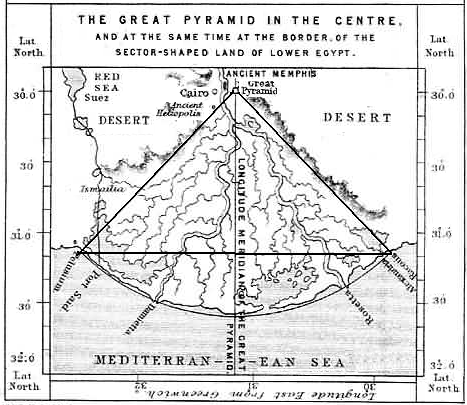 The
Pyramid as a Geodetic Marker. The
Pyramid as a Geodetic Marker.
There has been in the past, research that demonstrated the inclusion of
geometry and astronomy in the dimensions of the pyramid. and Giza The neatly
encapsulated dimensions of the Earth in the pyramid's dimensions, lend weight to
the theory that Giza is a 'Marker' of the 30th parallel, a latitude which
was had a significance to other 'sacred' sites in the past. These include Giza (Heliopolis), then moving
East, Eridu 'King-ship moved there after the flood', Persepolis (No-one lived
there in 600 BC), Harappa and Lhasa (exactly 30 degrees East).
Perhaps it is just
a coincidence, but it is fact that the dimensions of the Grat pyramid represent the
earth's northern hemisphere on a scale of 1:43,200: It's perimeter equals a half
minute of latitude at the equator; the perimeter of the corner sockets equals a
half minute of equatorial longitude, or 1:43,200 of the earth's circumference;
and its height, including the platform, is 1:43,200 of the earth's polar radius.[3]
It is only since the carrying out of satellite surveys from space in the 1970s
that scientists have obtained measurements of the earth as accurate as those
contained in the Pyramid.
Stecchini claimed that a number of other locations throughout the ancient world
were located in exact geodetic relation to the longitude meridian of the Great
Pyramid. Of these the Persian capital Persepolis, whose location otherwise
appears senseless to scholars, is perhaps the most straight forward to explain.
Persepolis was located at 30� 00' north latitude, and three units of exactly 7�
12' east of the meridian of the Great Pyramid. The reason for this 7�
12' unit was that the Persian Empire of King Darius the Great was idealized as
three geodetic squares of 6�
of latitude, stretching from 30� to 36� north. At 33� north, the midpoint of this distance, 6� of latitude is equal to 7� 12' of
longitude, thus making these regions true squares. Among the other ancient sites
exhibiting similar geodetic precision, according to Stecchini, are: Nimrod,
Sardi, Susa, Mycenae, Dodona and Delphi, as well as the Kaaba at Mecca, and Mt.
Gerizim, the original Jewish holy centre, before it was moved to Jerusalem in
980 BC.
The following assertion made by the pre-eminent Egyptologist, Ludwig
Borchardt is typical. He is commenting here on an Egyptian inscription stating
that the distance between Behdet (at the northern tip of the Nile Delta) and
Syene (at the first cataract near Aswan in the south) was 106 atur, "one
must absolutely exclude the possibility that the ancients may have measured in
degrees." Borchardt gives absolutely no grounds for this assertion. It is
instead invoked as an article of faith. It is ironic that it was Cole's survey
of the Great Pyramid, commissioned by Borchardt himself, which provided
Stecchini with his best evidence to refute this long standing prejudice. It
should be pointed out, however, that Stecchini derived his knowledge of Egyptian
geodetic measurement from his reading and interpretation of hundreds, if not
thousands, of hieroglyphic texts. In the case of Borchardt's quote cited above,
if one simply checks the distance, it does in fact measure 106 geodetic atur.
An atur was 15,000 royal cubits, which was also equal to 17,000 of the
older geodetic cubits. The figure 106 atur is significant because it is
1/12 of the length of the meridian from the equator to the pole. (This figure
translates to 15�
latitude).
Piazzi Smyth suggested that the Giza complex was the centre of the world's landmasses.
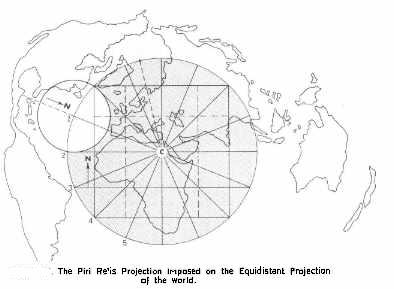
Hapgood's excellent research on the
Piri-reis map demonstrated that the map was centred on the region of Cairo.
This same map (and others), show the outline of the Antarctic continent before it froze over. At present, according to Radio-carbon dating of core
samples taken from the Rosss-sea bed, it is estimated that the last time this
was possible was at around 4,000 BC.
(More
about Egyptian Geodesy) |
Pyramid Alignments:
It is now realised that
the corners of many of the large Egyptian pyramids from the third to fifth dynasties
align towards Heliopolis.
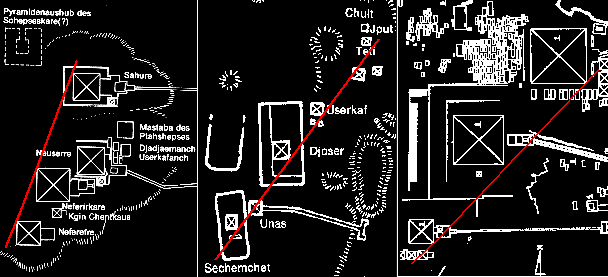 Pyramid sight lines at Abusir,
Saqqara and
Giza
Pyramid sight lines at Abusir,
Saqqara and
Giza
It was Hans Goedicke who made the earliest
suggestions. They were not published first in a scientific journal, but
in a newspaper in 1983. And what does the theory say? Goedicke noticed
that there seemed to be a common constructional element at several
necropolises: one corner of each structure is often on a straight line with
the same corner of other structures in the necropolis. These alignments are
found at Giza (south-east corners of Khufu, Kaphre and Menkaure), Abusir
(north-west-corner of the pyramids of Sahure, Neferirkare and Neferefre),
Saqquara (south-east-corners of Sekhemkhet, Djoser, Userkaf und Teti) - and
even between necropolises as Goedicke suggested that the east face of Userkaf's
Pyramid is aligned with the same face of Khufu's Pyramid several kilometres
to the north.

Goedicke later concluded that these sight lines were aimed at the
solar temple at Iunu (Heliopolis).
Miroslav Verner later confirmed that the south east corners
of the three Giza pyramids and the north west corners of Sahure,
Neferirkare, and the unfinished pyramid at Abusir are aligned with
Heliopolis. He suggests that these alignments intersected at the
temple of the sun god Re, at the tip of the obelisk, which may have
represented a fixed point in the world of the ancient Egyptians in
that period. (Verner, The Pyramids, 2001, p.302)
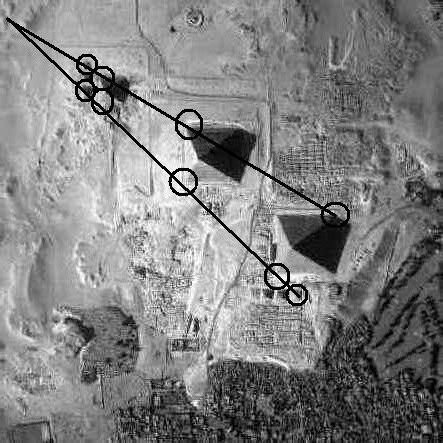
As we can see,
Giza has two sets of corner-alignments, not one.
Should we arrive at the
conclusion that there was an overall design for the Giza complex, and a
specific one too, then we are able to open our eyes to a new set of
possibilities. It is also important to determine whether the great
pyramid itself (and all of its chambers), was built from an original
design. There are various definitive studies that show exactly that.
(More
about the Alignment of Egyptian Pyramids) |
|
Astronomy and the Great Pyramid:
It has long been argued that the Great pyramid embodies certain
fundamental astronomical data in its dimensions. Proctor
(23) said 'we
see in all the Egyptian pyramids the evidence of an astronomical plan'.
As there are certain clear evidences of attention to astronomy in the great
pyramid, any argument that other discoveries of astronomical figures are
'coincidental' have little merit. Proctor firmly believed that the grand gallery
and other passages were designed for determining the declination and ascension
of stars.
Apart
from the polar shaft, and cardinal alignment, which are obvious astronomical
features, it has been long suspected that the great pyramid may have been
originally designed as an astronomical observatory. In Le-Measurier's
interpretation, he suggests that the pyramid was built in different phases, one
of which, up to the level of the 'king's' chamber was for observing the stars,
with the rest of the structure being built in a later construction phase and for another purpose. In
return, it is argued that the proximity of so many other pyramids, with similar
'funerary' features reveals the true context of the pyramids. However, the very
same argument was applied to the British stone circles, where in places
like Scotland, where there are arguably too many 'recumbent' circles in some
areas to explain in terms of just astronomy.
The British astronomer Richard
Proctor, found a reference in the works of the Roman
philosopher Proclus in his commentary on Plato's 'Timaeus'. In 1883
he published 'The Great Pyramid, Observation Tomb, and
Temple',
in which he suggested, more reasonably, that the Great Pyramid was used
as an observatory before its completion. His proposition explains the
'Gallery' in terms of an observation point (thus the evenly spaced holes in the
walls), for viewing the transit of the stars (sun). He claimed that the pyramid
was used in that state then re-used as a funerary complex later. It has been
since discovered that parts of the ascending passage were cut through existing
masonry, which supports his theory.
Early
Arab historians also support the idea that the Great Pyramid was built as an
observatory and that it contained reproductions of the celestial spheres. For
example:
Murtadi, in 1584, said that the magical priest Saiouph made his abode, at the
time of the deluge, in the pyramid; which, he says "was a temple of the
stars, where there was a figure of the sun, and one of the moon, both of which
spoke." He mentions the great grandson of Noah, (Bardesi
?), who, as priest, "applied himself to the worship of the stars."
He adds "It is reported that he made the great laws, built the pyramids, and
set up for idols the figures of the stars".
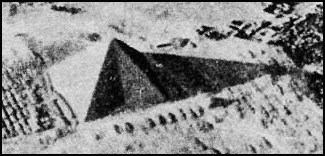
The concavity of
the great pyramid's faces (and the determination of the equinoxes)
The photo above illustrates
the curious optical phenomena that appears on
the pyramid without its casing, at
dawn and sunset at the time of
the equinoxes (around 21 March and 22 Sept), a shadow appears on the south face
of the great pyramid, apparently dividing it in half, with the shaded side
nearest the sun. The phenomenon occurs because the core-masonry is concave on
all four faces by a yard deep. The casing stones that exist show clearly that
the finished surface wasn't concave.
This strange feature was first illustrated in La Description de l'Egypte
in the late 1700's (Volume V, pl. 8). Flinders Petrie noticed a hollowing in the
core masonry in the center of each face and wrote that he "continually observed
that the courses of the core had dips of as much as �� to 1�" (The Pyramids
and Temples of Gizeh, 1883, p. 421). Though it is apparently more easily
observed from the air, the concavity is measurable and is visible from the
ground under favorable lighting conditions.
The purpose for the concavity of the Great Pyramids remains a
mystery and no satisfactory explanation for this feature has been offered. The
indentation is so slight that any practical function is difficult to imagine unless that is its exact function
was to highlight the day of the
equinoxes)
Maragioglio and Rinaldi described a similar concavity on the pyramid of
Menkaure, the third pyramid at Giza. Miroslav Verner wrote that the faces of the
Red Pyramid at Dahshur are also "slightly concave."
An Extraordinary effort was applied in order to achieve this effect. It was
deliberately built into the design.
In
Ancient Egyptian Construction and Architecture, Clarke and Englebach wrote:
Most pyramids have individual
peculiarities which are as yet difficult to explain. For instance, in the
Great Pyramid, as possibly in certain others, a large depression in the
packing-blocks runs down the middle of each face, implying a line of
extra-thick facing there. Though there is no special difficulty in arranging
the blocks of a course in such a manner that they increase in size at the
middle, there is no satisfactory explanation of the feature any more than
there is of the 'girdle-blocks' [in the Great Pyramid's ascending passage]
already discussed.
[p. 128]
A.
Pochan
(16), in the thirties (1935) put forward a paper on the subject to the
Institute d'Egypt. In response, the following was written in 'La Bourse
Egyptienne': 'Yesterday evening, Mr. Pochan, to whom we already owe the
discovery of red paint that once covered the pyramids, revealed quite a curious
phenomenon to the Institute d'Egypte. It seems that the great pyramid
constituted a precision instrument that allowed the date of the equinoxes to be
determined exactly to within twelve hours'. Pochan considered this the
reason that the door was placed to the side slightly as the feature might have
created extra water-ingress had the door been central. However, almost as if to
contradict this idea, the second pyramid has no concavity, and yet the door is
off-centre; similarly, the third pyramid does have concavity, but a central
door.
The 'solstice effect' is a result of concavity and cardinal alignment. The
real question is whether the effect was intentional or not. The concave aspect
of the pyramids face suggests that the 'change of plan' theory never applied to
the external design, which continued without change (excepting the course
heights), to the top. As there is no recognised structural benefit from this
design, and considering the dates that the shadow effect occurs (Solstice), it
seems reasonable to assume that this SOLAR event might have been deliberately
incorporated into the design.
(The
Khufu Calendar)
|
|
The
Great pyramid as a Solar Temple:
It
was a common feature of 'Solar' temples around the world to be painted red.
The use of red paint to denote a religious building is still observed to this
day in Tibet (also on the 30th parallel). Pochan
(16) says - 'at the
tomb of Pen-Meruw at Giza, the name of the Great pyramid is followed by the
determinative reserved for solar temples (This is a pyramid shape, with a small
'pyramidion' on top) and
'Khefre' is one of the Egyptian names for the sun (sunrise, daytime,
sunset)'.
The
following extract is from Pochan
(16), who proved conclusively that the great
pyramid, or a part of it, was at some time, painted with red-ochre paint. He
says: 'As I proceeded to measure the casing stones of the great pyramid, a
peculiar fact attracted my attention. Some detached blocks lined up a few metres
from the pyramid, which apparently had once been a part of the facing, showed a
curious red-brown tint on their flat sloping side.
To
what phenomenon could this tint - which the blocks' other surfaces did not have
- be attributed? To time? Light?
To the sand - as unferruginous as it was - that they had
covered the blocks for so long? It is hardly likely, for the other
surfaces would have shown beginnings of a similar transformation. Moreover, a
knife blade penetrates the coloured surface with difficulty and cuts through the
other surfaces easily.
Chemical tests gave me an immediate result:
the facing blocks were coated with a paint having a ferrous oxide base (red
ochre). Tests carried out on other parts of the sample were negative...',
and he continues 'However, it was
necessary to verify this fact. The second pyramid still retains part of its
casing, which definitely seems to be coloured red fragments taken from the
pyramids casing, when subjected to chemical tests, showed the same reaction as
those taken from the facing blocks of the great pyramid'.
We must also keep in mind that the Sphinx's face is also painted red. Pliny
informs us that it was painted because of a cult However; formal proof that the
pyramid was painted came to me in the course of a separate examination of the
rather deteriorated casing stones found on the pyramids south face. E. Baraize
and I ascertained that some of these blocks showed, on their uppermost
horizontal surfaces, traces of red paint corresponding to the breaks between the
rocks that had been placed directly above them; the coating was clearly thicker
and showed fins'.
Like the Chaldean ziggurats and the pyramid of Zoser at
Saqqara, the pyramids of Tajjin and Vera Cruz have seven recessed terraces. This
must also have been true of the pyramid of Cuicuilco. The strangest thing is
that the pyramid of Tajin was completely painted red, like the pyramid of Cheops
and Kephren; its 365 steps and red colour indubitably prove that it, like
Egypt's great pyramid, was a temple to the sun, its seven terraces, like those
of the Chaldean ziggurats, being dedicated to the seven planets.
(16). The only English pyramid,
Silbury hill also has seven steps.
|
|
The Association with Isis-Osiris.
When
the Sphinx was cleared by Vyse and Cavaglia, they uncovered a Greek inscription
saying that the sphinx was the 'Guardian of the tomb of Osiris'.(10)
The Inventory Stele, found in 1857 by
Auguste Mariette just to the east of the Pyramid, dates to about 1500 B.C., but
according to Maspero and other experts, shows evidence of having been copied
from a far older stele contemporaneous with the Fourth Dynasty. In the Stele,
Khufu himself tells of his discoveries made while clearing away the sands from
the Pyramid and Sphinx. He dedicated the account to Isis, who he called the
"Mistress of the Western Mountain," "Mistress of the Pyramid," and identified
the Pyramid itself as the "House of Isis."
Davidson
(2), first points out some of the pyramid's 'shadow-effects' on certain days,
one of which is Nov 1st.
An important day to ancient Egyptians. He says:
'The rites of Osiris in
ancient Egypt were annually celebrated on the day of
the Festival of the Dead, November 1st. Owing to the fact that the
noon reflections of the great pyramid defined the day of the celebrations,
Osiris in later Egyptian times, was associated with the pyramid. Hence the fact
that Isis, the female counterpart of Osiris, was designated in later times, "The
Queen of the pyramid," and the "Mistress of the commencement of the year". When
the November year was discarded for the Sothic or Sirius year, Isis followed the
alteration of the years beginning, and was identified with the star Sothis or
Sirius. The original November year beginning aspect of the goddess was Hathor,
later absorbed by Isis. 'The Festival of the Dead',
or 'Day of the Dead', is also celebrated in Mexico. Where it is on the 17th
of November, and is regulated by Pleiades. The Mexicans had a tradition that the
world had been partly destroyed, and were afraid that a similar catastrophe
would annihilate them at the end of a cycle.
Strangely, the 17th of November, is an 'alternative,
modern' day for the 1st. According to Plutarch, 'The
alternative dating on the fixed Alexandrian (Julian) calendar of his time, fell
on the 17th day of the Egyptian monh of Atyr (Hahor). In the XIIth
dynasty, the same alternative dating would be the 17th day of Month
I, sowing season, - the 1st month of the fixed 1st
November year' (2). The aborigines of Australia also have their day of the
dead in November, when the Pleiades are most bright. November was called the
'Month of the angel of death' by the Persians and in the XIX dynasty of the
tradition, the 'angel of death' appears as Hathor. (The
house of Horus). The association between Hathor and Pleiades, whose
modern name is the 'seven sisters' was known in ancient Egypt as the 'seven
Hathors'. (2 pp 26).
The XIXth Dynasty narrative of the 'Destruction of Mankind'
states that 'Ra ordered in the midst of the night to pour out the water of the
vessels, and the fields were entirely covered with water and there came the
goddess (Hathor/Venus) at the morning, and she found the fields covered with
water Then Ra ordered that libations be made to her at every festival of the
new-year. The narrative defines this as the 'Festival of Hathor'.
(2)
The Connection with Sirius, the 'dog-star' was recognised by
several Arabian writers, who have seen a mystic correlation between the design
of the pyramid and the revolutions of Sirius, the judge-god of the dead.
Sirius was known as Sothis by the Egyptians, thus the so
called Sothic year, or revolution of 1460 years. Some authors think
Hermes, god of wisdom, was Sirius, or Sothis. Hermes is Thoth, or Anubis,
the deity presiding over the dead, and yet being the originator of learning.
Tradition among Arab writers and revived among certain mystical Christian
writers of the 19th century, indicated Seth as the builder of the Great
Pyramid. Seth, in this case could be Sothis, ('suphis') or Sirius.
No star was so venerated in Egypt as Sirius, associated, as it
was, with the time of the annual overflow of the Nile, which the rising of the
star foreshadowed. The hieroglyphic for Sirius is, oddly enough, the
triangular face of a pyramid. Some 19th Century writers suppose that the
pyramid may have been dedicated to this venerated star or period. It was
also believed that the pyramid was used for observations of Sirius.
The 'star-shafts' might be expected to be included into this
section, but it has yet to be explained how they could be utilized for
astronomy. While it is true that they might have an association with stars, and
an immense amount of labour was spent on building them, their relationship to
the purpose of the pyramid has yet to be determined.
Bauval argued that the Great Pyramid was used
during the 4th dynasty for religious ceremonies connected with the stellar
rebirth cult for kings: the four shafts served a fertility or phallic role, and
assisted the soul of the departed king to ascend to the celestial kingdom of
Osiris-Orion. Bauval finds support for this in the Pyramid Texts, inscribed in
several pyramids of the 5th and 6th
dynasties.
The pyramids were a mirror image, the Earthly representation of
the Belt of Orion, the destination of the dead King! The Egyptians were dualists
-- everything they thought and believed was a duality. Everything had its
counterpart, cause and effect, left and right, East and West, death and rebirth
-- nothing was ever seen in isolation. They had constructed at Giza an exact
replica of the Duat destination of the King. Far from being a tomb, the pyramid
was the starting point of the King's journey back to the stars from whence he
came, back to the First Time. Bauval initially made use of the astronomy program
Skyglobe 3,5 for the PC. Though too inaccurate for
serious work -- it does not take proper motion, rotation, refraction, for
example, into account -- it was sufficient to clarify Bauval's mind as to the
value of his discovery. Skyglobe 3,5 will plot the
Milky Way on its charts if requested, and doing so added further proof to
Bauval's theory. Giza is West of the Nile -- putting
the plane of our galaxy into the equation showed that Orion is "West" of the
Milky Way, in proportion to Giza and the Nile.
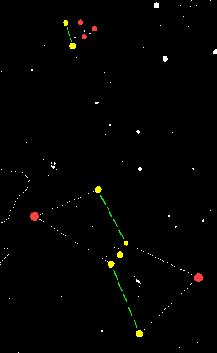
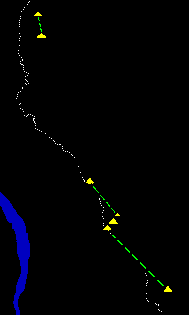
Orion and the placement
of Egyptian pyramids according to Bauval/Gilbert
But the authors found even more similarities which cannot be
explained by coincidence:
-
Star brightness and pyramid size: Giza
consists of two almost equally tall pyramids and a smaller one which is only 53%
of the height of the other two. The belt of Orion consists of two almost
similarly bright stars, and one with only 50% of the brightness of the other
two. The smallest pyramid is the one which deviates from the diagonal, as does
the dimmest star!
-
Other pyramids in Egypt fit the picture of
the sky: the two large pyramids at Dashur are a match for the brightest two
stars in the open cluster "Hyades", two more pyramids near Giza are bright stars
of Orion, and the pyramids of Abusir are exactly where the head of Orion should
be
-
Selection of construction sites: The
centre of the pyramid constellation, Giza, was chosen so that the Nile exactly
represents the Milky Way at the position of Orion's belt. The Milky Way
represents the field of reeds in the legends which had to be crossed to reach
the netherworld, just like the pharaoh had to cross the Nile to go from the land
of the living on the eastern bank to the place of the dead on its western bank
(where all the pyramids and tombs were located).
(Triple
Circles in UK and Orion Worship)
A clear division can be
identified between the orientation of ancient Egyptian temples of upper
Egypt when compared with those of Lower Egypt. Lockyer
(2), made note of the
fact that whereas the early dynastic northern 'Memphite' pyramids,
Giza
pyramids, and Sphinx were orientated cardinally to face equinoxial phases of
the solar cycle, the great temples in the south of Egypt, such as
Karnack,
the Colossi of Memnon and Abydoss, were all orientated to capture the
suns rays on Solstice days of the year.
The Valley temple,
Giza was associated with Isis (As evidenced by
the inscriptions on the 'Sphinx' stella). The
Osireion, which shows remarkable similarities
in construction, was associated with Osiris
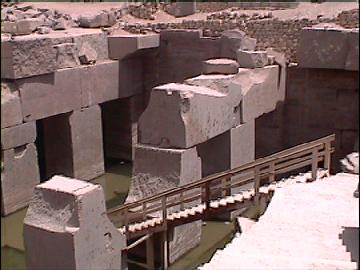
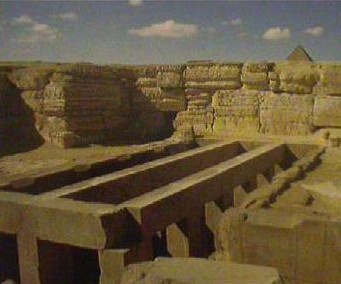
The Osireion (left), and
the Valley-temple (right).
|
|
The pyramid as an 'Initiation' Centre.
According to the theosophical tradition the Great
Pyramid was originally used as a temple of initiation. This idea was researched
by Marsham Adams, who in
1895, wrote the book 'The Book of the Master'
(...of the Hidden House), in which he showed that 'The soul of the
departed is pictured as following the passages and chambers of the great
pyramid. In this version the pyramid itself is seen as an allegory in stone of
the ways and trials of the future life'
(2). To quote Adam's himself, he
said that the Egyptian Book of the Dead refers to an "ideal structure and to
the passages and chambers therein, and that these passages and chambers followed
precisely the order and description of those of the Great Pyramid ". The
sacred procession of the Egyptian dead moves silently along as they pass to the
tribunal of Osiris. They enter into the Hidden Places and penetrate the
secret of the House of Light
(compare the ancient Egyptian name for the Great Pyramid - "Khut," or "Light").
Sir Gaston Maspero endorsed this thesis and added: "The Pyramids and the Book
of the Dead reproduce the same original, the one in words, the other in stone."
Maspero supported the contention that 'The Secret House was the scene where
the neophyte was initiated into the mysteries of
Egypt'.
What is the Egyptian "Book of the Dead"? It was believed by the
ancient Egyptians that the "Book of the Dead" was written by Thoth. He was the
scribe to the gods and was the one responsible for speaking the words of
creation and putting it into effect. Its name is not a correct description of
it. It should be named the "Chapters of the Coming Forth by Day". It is
mainly concerned with the state of the departed soul and its trials and
existences in the afterlife. According to one of the world's experts on the
'Book of the Dead', Sir Wallis Budge, it was not of Egyptian origin but its
ideas were brought to Egypt by a different culture and people.
Ivimy
(21), points out the similarities between the 'Bardo Thodol'
or 'Tibetan Book of the Dead', from the Buddhist philosophy. He says 'It
bears such a remarkable resemblance to the Egyptian Book of the Dead as to
suggest that there was some ultimate connection between the two The similarities
between the two books is particularly noticeable in regard to the doctrines of
the judgment and in the funeral rites they prescribe for the purpose of
assisting the deceased to pass successfully through his ordeal. Both treaties
are, in effect, "nothing more than guide-books for the traveler in the realm
beyond death".
The visual similarities of the Am-duat are clear. The 12-hours of
the 'Duat' may represent the journey taken by the sun on the equinox.
|
|
The Great Pyramid and Religion:
It has been claimed that the pyramid is the Bible 'in stone'. Various authors
have pointed out that the Ark of the covenant is described as 2.5 cubits long
and 1.5 high, which at 25 inches per cubit has the same dimensions as the kings
coffer; Similarly, it has been noted that Solomon's 'molten sea' has the same
capacity as the kings chamber.
Ivimy
(21),
suggests that the Sun-god 'Atum', and 'Adam' were one and the same ruler or king
The
Bible includes some interesting quotes, which have been interpreted as regarding
the pyramid:-
ISIAH
19 :
19, 20 - 'In that day there shall be an alter to the lord in the midst of
Egypt, and a pillar at the
border thereof to the lord, and it shall be for a sign and for a witness unto
the lord of hosts in the land of Egypt'.
The significance of this quote is magnified when it is realised that the word
'Alter' in Hebrew means 'The lion of God'. Ezekiel describes the Alter as
Pyramidal, and calls it the 'mountain of God'. It is also a geographical fact
that the Giza complex is situated at the border of Upper and Lower Egypt, which
places it in 'the midst' and at 'the border thereof'.
(15)
Henry O'Brien
(26) started writing a book in
the 1830's called 'The Pyramids of Egypt for the First Time Unveiled'.
Unfortunately, he died soon after, and we are bereft of his most excellent
insights on the subject. He did, however, include certain observations in his
other literature. On the purpose of the pyramids he said: 'Others have
fancied them (The pyramids) intended for sepulchers; and as the
Egyptians, taught by their ancient Chaldean victors,
connected astronomy with their funereal and
religious ceremonies, they seem not in this to be far astray, if we but extend
the application to their sacred bulls and other animals, and not merely to their
kings, as Herodotus would have us suppose. The immense sarcophagus lying in the
interior of the first or Great pyramid, with the bone found by the Earl of
Munster in the second (Note - Then Major Fitzclarence, March 2nd
1818), must put this question beyond the possibility of doubt'.
The bone he referred to was determined to be
the thigh-bone of an ox. He continues by describing another sarcophagus
found by Belzoni at 'Biban el Moluk' ('The gates of the King' or
' the universal king of the ancients'), which was 9ft 5in long, 3ft 9in
wide and 2ft 1in high, sounding like a bell and transparent as glass, which he
believed was a relic of the Apis cult, supported by the discovery of an embalmed
bull in the innermost chamber. (Remembering also the huge discovery of embalmed
bulls at Saqqara). O'Brien explores the idea that the 'foreign dynasty', and
most specifically Khufu and Khafre were remembered unfavourably by the Egyptians,
presumably for 'prohibition of sacrifices and closing the temple doors'. He then
asks the reasonable question. Exactly what the particular temples alluded to
were? His conclusion was that they were the pyramids.
In support of this theory, O'Brien
introduces a fascinating piece of information. He says: 'This conclusion
receives additional force from the conversation which Wilford, in his
"Dissertation upon Egypt and the Nile" (Asiatic Researches), tells us he had
with several learned Brahmins, when, upon describing to them the form and
bearings of the great Egyptian pyramid, one of them asked if it had not a
communication under ground with the river Cali? Being answered that such
communication was spoken of as having once existed, and that a well was still to
be seen, they unanimously agreed that it was
a temple appropriated to the worship of
Padma-devi, and that the supposed tomb was a trough, which, on certain
festivals, her priests used to fill with the sacred water and lotus-flowers'.
-
The Indus valley culture had a world mountain called 'Mount Meru'. It was also
referred to as a world 'spine', as is the 'Djed' of Osiris.
-
The Great Pyramid is called the 'Golden mountain'
in the sacred Hindu writings (7).
-
The Hindoos call it 'Rucm-Adri', or the 'Golden
mountain'. 'The sacred books of the Hindoos speak of three pyramids in
Egypt, and they describe this as "The Golden Mountain", and the other two as
mountains of silver and less valuable material' .(15)
In reference to 'Padma-devi', as mentioned by Wilford, It appears that she
is a version of 'Brahma'
the creator. We find that she is a part of the trinity formed with Vishnu and
Shiva in Vedic myth. 'Worshippers of Vishnu, Shiva or Devi visualize the
deity as containing all three functions (preserver, destroyer and creator)
within one form or concept Shiva rides the bull; Vishnu flies on the divine
eagle Garuda; goddess Devi
mounts the lion'.(27)
|
|
A Suppository for knowledge:
The idea that the pyramid was in some way a 'Suppository' of knowledge, has
held the imagination of writers and thinkers. Some of the earliest accounts of
the pyramids suggest a link with Hermes and Thoth. This idea is not as without
foundation as it may at first appear to be:
Some
Arabic-Coptic accounts of the Great pyramid say that it was once covered with
inscriptions, some inside and some out. For example:
The
story of King Saurid, as told by Murtadi
(Text), includes references
to 'two great mountains' and the 'mountain of fire'. He says that Saurid had a
dream '300 years before the deluge' in which he saw the 'earth overturned', and
that he ordered the pyramids to be built to 'write their wisdom upon them' and
'secure in them what was of most esteem....with the bodies of their
kings....that the violence of the water might not destroy it'.
Also,
according to the accounts of Masoudi, a papyrus, found in the monastery of Abou
Hormeis, said to have been inscribed with 'Ancient Coptic characters',
apparently said the following 'Upon the walls were written the mysteries of
science, astronomy, geometry, physics, and much useful knowledge, which any
person, who understands our writing can read'
(2).Davidson makes an interesting
suggestion, that the Coptic traditions had begun to confuse the texts and
pictures of the 'Secret house' in the 'Book of the dead', with the Great
pyramids chambers and passages, and that this is the origin of the myth of the
internal passages of the pyramid having been inscribed within. The fact that
there are no such inscriptions supports this idea.
Regarding the 'wisdom' inscribed on them, Herodotus reports that
inscriptions of strange characters were to be found on the pyramid's casing
stones and in AD 1179 the Arab historian Abd el-Latif recorded that these
inscriptions were so numerous that they could have filled "more than ten
thousand written pages". William of Baldensal, a European visitor of the
early fourteenth century, tells how the stones were covered with strange symbols
arranged in careful rows. However, in 1356, following a severe earthquake, the
Arabs took fallen casing stones from the pyramid to rebuild mosques and
fortresses in the Cairo, which had been levelled. As the stones were cut into
smaller pieces and reshaped, all traces of the ancient inscriptions were
apparently removed from them.
There
are no known inscriptions inside, apart from the hidden graffiti. This leaves us
with the casing stones. Should this wisdom have extended beyond the price of
vegetables, as reported by Herodotus Petrie puts the issue to rest in his
report; see extract below:-
Extract from
Petrie :- With regard to the many records of
inscriptions on the outside of the Pyramid, a few words are necessary. From the
time of Herodotus down to the 15th century, inscriptions are continually
mentioned, and their great abundance is described with astonishment by
travellers. This has led to the supposition that the builders had left records
inscribed on the outside, although not a letter is to be found on the inside.
But against the possibility of this view, it must be remembered that no early
inscriptions are found on the casing remaining at the Great Pyramid, nor on any
of the innumerable fragments of those stones, nor on the remaining casing of the
Second Pyramid, nor on that of the Third Pyramid, nor on the casing of the South
Pyramid of Dahshur, nor on the casing of the Pyramid of Medum, nor on occasional
blocks uncovered at the Sakkara Pyramids. In fact, not a single example of
hieroglyphs has ever been seen on any casing, nor on
any fragments of casing. The truth then about these numberless inscriptions
appears to be that they were all travellers' graffiti. Strabo says that the
characters were like old Greek, but were not readable; this points to Phoenician
or Cypriote graffiti.. The accounts of the
inscriptions given by the Arabs also show that they were mere graffiti; Abu
Masher Jafer (before 886 A.D.) mentions Mosannad (i.e., Himyaritic) letters; Ibn
Khordadbeh (10th cent.) also mentions Musnad letters; Masudi (11th cent.)
describes them as being in various different languages; Ibn Haukal (11th cent.)
says they were in Greek. Abu Mothaffer (alias Sibt Al Jauzi, died 1250 A.D.)
gives the fullest account, mentioning seven sorts of writing : (1) Greek, (2)
Arabic, (3) Syriac, (4) Musnadic, (5) Himyaritic (or Hiritic or Hebrew in
different MSS.), (6) Rumi, (7) Persian. William of Baldensel (1336 AD.) mentions
Latin; and Cyriacus (1440 A.D.) mentions Phoenician. Whether these travellers
all understood exactly what they were talking about may be doubted; but at least
none of them describe hieroglyphs, such as they must have been familiar with on
all the tombs and other monuments; and they agree in the great diversity of the
languages inscribed. The earlier travellers also do not describe such a great
number of inscriptions as do the Arabic writers; suggesting that the greater
part recorded in later times were due to Roman and Coptic graffiti.
Now
among the hundreds of pieces of casing stones that I have looked over, very few
traces of inscription were to be seen; this was, however, to be expected,
considering that the pieces nearly all belonged to the upper casing stones, out
of the reach of mere travellers. Three examples of single letters were found,
two Greek and one unknown; and on the W. side, in one of the excavations, a
piece was discovered bearing three graffiti, one large one attracting lesser
scribblers, as in modern times. The earliest inscription was probably of Ptolemy
X., showing portions of the letters Π T O ...........
C ω T .......; the next was a Romano-Greek of a certain M A P K I O C K ......;
and over that an Arab had roughly hammered in .....
m a j ...... This is the only example of continuous inscriptions yet
found, and it belonged to one of the lowest courses; it is now in the Bulak
Museum. Thus, all the fragments and the descriptions point to the existence of a
large body of graffiti, but do not give any evidence of original hieroglyphic
inscriptions.
When
one considers the large number of graffiti which are to be seen on every ancient
building of importance, it seems almost impossible but that the Great Pyramid
�one of the most renowned and visited of all� should not have been similarly
covered with ancient scribbles, like the host of modern names which have been
put upon it since the casing was removed.* The statues Ramessu II., at Abu
Simbel, bear quantities of Greek graffiti, in fact, some of the earliest Greek
inscriptions known, besides Phoenician and Roman; the top of the temple of
Khonsu at Karnak is crowded with the outlines of visitors' feet, with their
names and particulars appended, in hieroglyphic, demotic, and Greek the
inscriptions on the colossi of Amenhotep III. ("the Memnons") at Thebes, and on
the Sphinx at Gizeh are well known; the long scribbles in demotic on the temple
walls at Thebes have lately been examined; the corridors of Abydos bear early
Greek graffiti; the passage of the S. Pyramid of Dahshur has two hieroglyphic
graffiti, besides Greek; and there is scarcely any monument of importance in
Egypt but what shows the scribbling propensities of mankind; be they Egyptians,
Phoenicians, Greeks, Romans, or the worst sinners of modern times, Hellenes and
Americans.
We can assume that the pyramid was, at some time,
covered with text. Which most, if not all, was probably graffiti, the fact that it was not
recognised as Egyptian hieroglyphs by anyone seems significant. Apart from the
inscribed pyramid 'theory', some people believe that the 'information' was left
in the dimensions of the pyramid. As the pyramid has been 'forcibly' entered, we
are also at a loss as to what its original contents might have included.
Stailand Wake (24) suggested that the pyramids were 'intended to mark the
substitution of an astronomy based on the passage of the sun through the twelve
signs of the zodiac for the lunar astronomy which preceded it'. This idea is
the same school of thought as Davidson.
|
|
The word 'pyramid' translated.
The earliest symbols for pyramids were hieroglyphic. The shape was not an exact
triangle, but was used as a sign for a 'solar temple' (se Fix). Hawass points
out that the pyramid shape is 'clearly related to the ben-ben, the symbol for
the sun god'
(13).
The
Egyptian name for the pyramids is 'Khuti' - 'The lights'. Davidson
(2)
believed
that this name originated from the semetic equivelant which was 'Urim' - 'The
lights'. In Phrygian and Greek, the root 'Ur' - 'light', became successively 'Pur'
and 'Pyr' (fire), and 'Pyra' (Plural), for 'Beacon fires'. In Chaldee and
Hebrew, he adds, 'Middin' = 'Measures'. Hence the Chaldee-Hebrew name is -
'Purim-middin' - 'Lights-Measures'
Well
known American Egyptologist Mark Lehner has stated that the ancient Khemitian
term for pyramid was something he calls MR.Pyramid. Lehner bases this on
his translation of MR as "Place of Ascension" following his belief that
pyramids
were tombs for kings and where the dead king's souls
"ascended". But MR, usually written as Mer, is commonly translated
as beloved, as in Meriamen (Beloved of Amen, The Hidden) or Meritaten
(Beloved of Aten, The Wiser). Our indigenous sources tell us Mer meant
"beloved" and had nothing to do with pyramid.
However, the ancient Khemitians apparently used the term PR.NTR, Per-Neter,
for pyramid. Per means "house" and Neter
has been translated by Egyptologists as "God" or "Goddess". However, this could
also be translated as "House of Nature, or House of
Energy" for Per-Neter. The temple was Per-Ba (House of the Soul)
and the tomb was Per-Ka (House of the Physical Projection) according to
the indigenous tradition. With this understanding of Per-Neter as House
of Nature, god or energy, we are given three different interpretations of the
word 'pyramid'.
The Greek word 'Pyramidos' has an
interesting meaning. If we support Dunn's ideas that the energy reactions in the
Great Pyramid took place in the so-called Queen's and King's Chambers, then
certainly it was 'Fire in the
Middle'. Of
course, the work by Davidson (2)
puts this in a slightly better context, as the Greek meaning of the word
'Pyramid' means nothing if it came from a different root language.
J. Seiss,
preferred the Coptic translation for the word. He said: 'In the ancient
Coptic, "pyr" means "division", the same as "peres" in Daniel's interpretation
of the handwriting on the wall; and "met" means "ten" putting them together
-"pry-met"- we have the name given to this structure. And that name, in the
language of the ancient Egyptians, means "The
division of ten".'
(15)
Chapman holds that the pyramid is born of the roots 'pyr', 'em',
and 'us', meaning 'Far resplendent light/fire'
(7).
Verner mentions that 'although
Egyptologists themselves are not entirely certain as to the origin of the word
Pyramid. Some of them derive it from the
special mathematical or geometrical term
per-em-us, which appears in the mathematical Rhind papyri I and II and expresses
the height of the pyramid we should also mention that the ancient Egyptians
themselves used the term 'mer' to designate the pyramid.'
(20).
|
|
The 'Stonehenge-Giza' connection.
It
has been pointed out by Petrie, Davidson, Michell, Gaunt and others that there
appears to be a strong connection between the South of England and Egypt. Place
names, Design, Dating, and plenty more all point to a possibility of research.
-
Stonehenge
was built on the same latitude as the angle of the Great pyramid (Or as near
as possible at 51�
51').
-
At Stonehenge, the
sun sets at 51�51' on mid-summers day.
Much of the following is taken from D.
Davidson's work in 1924
(2); 'The great unit of surface measure in ancient
Egypt was the aroura. This was a square of length of side of an hundred common
Egyptian cubits of 20.63 British inches long. This square was divided into four
quarter squares; the quarter aurora being thus employed as a separate unit of
measurement A circle of this diameter falls precisely internal to the outer ring
of stones forming the circle of Stonehenge (And
so therefore, plenty others - see Thom)
Thus at Stonehenge we find the Egyptian
quarter aroura set out in circular form to define, by its alignments, the points
and circuit of the solar year. A similar association held between the quarter
aroura and the year in ancient Egypt. For as Horapollo states:-
"To represent the current year, they (the Egyptians) depict the fourth art of an
aroura: now the aroura is a measure of land of an hundred cubits. And when they
would when they would express a year they say a quarter" Hence in an Egyptian
inscriptions, there are two hieroglyphics representations of the year - one is
indicated by a square, and the other by a circle'.
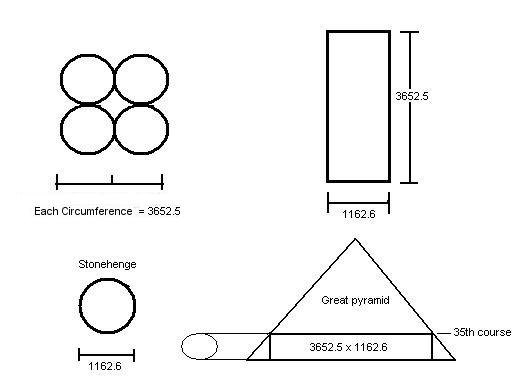
Davidson also comments on the origin of the aroura. He says 'The original
representation was in the form of a circle. The circumference of this circle
measured 3652.42 selected units of length. This represented the circle of the
solar year to a scale of ten selected units of length to a day. The diameter
then measured 1162.6 selected units of length'. Petrie's best estimate of
Stonehenge was 1163 'British' inches.
(More
about Stonehenge)
|
-
The picture we have developed concerning the development and purpose of these
pyramids originates solely from the Greek historian, Herodotus, who also said
that Khufu was buried on an island surrounded by water.
-
No original burials have been found in any Egyptian pyramid.
-
All the large pyramids in the 'Heliopolis' area (18-24) were believed to have been
built over a period of less that 100 years.
Some 4th dynasty pharaohs are credited with
more than one pyramid.
There is no surviving papyrus, stele or inscriptions to commemorate the
designer, construction, or completion of the Giza pyramids.
The Giza pyramids (and others - i.e. the 'Red' - pyramid) have no visible
internal funerary inscriptions.
This is not normal behaviour for Egyptian tomb builders of any period and alters
the context of these 'Heliopolis' pyramids.
Manetho said it was built by 'Suphis', 'Sophis'
is also an ancient name for Orion, from which derived the 'Sothic' year
Khufu's
name had become 'a powerful charm', and was put on monuments as a sign of
sanctity and protection.
The 'Sphinx stele' had the syllable 'Khaf' on it within a cartouche.
There are a number of funerary objects around Giza associated with Khafre.
The 'Polar passage' aligned with the pole-star at about 2,400
BC and another at 3,300 BC.
Mark Lehner's carbon-dating places the pyramid 400-1000 years older than
current, standard theory accepts.
The inventory
stella calls Isis the 'Mistress of the pyramid' and
Osiris, the lord of Rostra (Ghiza).
It also says that Khufu 'found' the temple of Isis,
beside the house of the Sphinx.
It says that Khufu built two pyramids.
The cartouche of 'Djefre' was found on the roofing stones of the boat pit in
front of the Great pyramid.
The 'Heliopean' pyramids of the 3rd - 5th dynasties were aligned towards
Heliopolis.
(Next Section - How were the pyramids constructed)
(Return
to Contents Page)
(Giza
Homepage)
(Egypt
Homepage)
|

