|
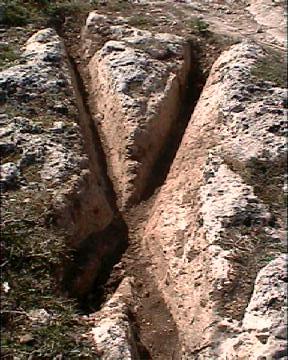
 Cart-ruts:
(Form and Function)
Cart-ruts:
(Form and Function)
|
Cart-ruts: What were they For? |
The earliest reference to cart-ruts was made
by Gian Francesco Abela in 1647 who suggested that they were used to
transport stones from quarries to the sea for exportation to Africa during
the Arab rule in Malta. Since then they have been found in many places
around the world, and their appearance is generally assumed to have been
caused by the continued use of a specific route by a vehicle (wheeled or
otherwise). However, this theory is countered by some stubborn facts. For
example:
1). Examples of single cart-ruts have
been found
(2).
2). Ruts have been found running at angles of up to 45 �
(2).
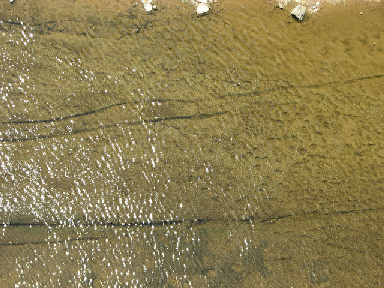
3). Cart-ruts have been found running deep underwater
(2).
In addition to the arguments above, other contentions concerning their
function, their variety of shapes and sizes, and their tendency to meander
and divide has fuelled the debate over the origin and function of
all
cart-ruts. It is clear that there are differences between examples. The
Bolivian ruts (see below), are believed to have functioned as ritual or
ceremonial, an idea which is supported by the engravings alongside them. The
French ruts however (below), are known to have been produced as a result of
quarrying in Roman times, and therefore provide a qualified example of
true cart-ruts, made
by the passing of laden vehicles.
While there is little doubt then, that
some ruts were produced by carts, this is not automatically true of all
ruts. There is also a distinction between the French ruts at Anse de St.
Croix, which were made on sand, and the several examples of cart-ruts
running in stone. The island of Malta in the Mediterranean is the best
known cart-rut location in the world, and it is here that one can see
the full range of features that have lent weight to the confusion over
their origins.
The presence of �stone roads� or "cart
ruts" in such countries as Malta, Greece, Italy, Sicily, Sardinia,
Switzerland, Spain, Cyrenaica, Portugal, Azerbaijan and France has
caused researchers to pay more careful attention to this largely
unexplained phenomenon recently. Following a year long international
study, scientists from these countries came recently to conclusion that
such parallel furrows in the rock bed could not be made, as it was
thought before, by wheels of carts crossing rocky outcrops precisely
along the same lines with absolute accuracy. Besides which, the �roads�
often run in close proximity to ancient quarries. (see Spain-below).
|
When were the Earliest Cart-ruts made? |
The dating of cart-ruts is mainly based on the argument that some pairs
on Malta are cut by Punic tombs. For this reason it is suggested that at
this time the cart-ruts had already served their purpose. Owing to this
fact, which is valid for only a very small percentage of the total
number of cart-ruts found in the Maltese Islands, their dating was
placed by David Trump in the Later Bronze Age. He strengthens his
arguments by saying that in few sites, ruts clearly run up to the
entrances of Bronze Age villages. The
Portuguese cart-ruts
can also be traced at least back to the bronze age through carvings
found alongside the ruts in places.
The cart-ruts found running under-water are proving to be a blessing to
investigators as they both suggest an earlier origin date and at the
same time, offer an excellent means of dating (through their relative
depths underwater). Although at present, this technique is still in its
infancy, we would hope that at some time in the near future this
ambition may be realised. An example of the potential antiquity of the
ruts on Malta is offered by the following extract, supported by findings
on the island of Filfla:
Hancock makes reference to 'Father
Emmanuel Magri, the first official excavator of the Hypogeum at Hal Safleni',
who 'recorded the presence, up until the end of the nineteenth century of
cart-ruts on the tiny uninhabited island of Filfla', a small island
about 5 km south of Mnajdra and Hagar Qim temples. He then adds that in
1912, R. N. bradley commented on cart ruts near Hagar Qim - noting that they
ran "over the precipitous edge of the cliff towards Filfla"
(2)...The conclusion of
this information is that cart-ruts once ran all the way from Hagar Qim to
Filfla across a land bridge, which has collapsed since humans first came to
the island.
Maltese researchers have more recently dated their �roads� to circa
4,000 � 5,000 BC.
(5)
There are several theories that attempt to explain the formation of
cart-ruts.
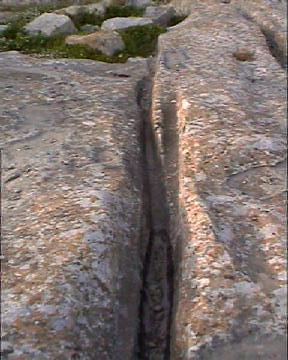 They
were made by the passing of numerous vehicles -
This is the traditional view of the formation of cart-ruts. It is not
likely to remain so for long though, as evidence suggests otherwise in
certain cases. At present, for example, in Malta, the global capital of
cart-ruts, with a reasonably constant gauge across the islands, there is no
evidence whatsoever of any contemporary vehicles, and examples of single
ruts have been found..
They were cut by hand -
This theory is the current outside favourite, although the idea is
incredible when viewed as a pan-European feature, it is plausible that
many ruts may have been started at least by human hand. The variety of
shapes and sizes of internal dimensions of the ruts lends weight to this
theory, although their frequency at certain locations (i.e. Clapham
junction, Malta). stretches the imagination.
They were made by the passing of a single vehicle -
Evidence of this can be seen at Anse de St. Croix, along the seashore.
The fact that single sets of ruts run for long distances suggests that
they were not used for regular transport of goods, as without regular
'passing points', the routes would have had to have been one-way only.
The visual appearance of many 'junctions' of ruts certainly favours this
theory, an
idea which is supported in the article by Dmitry Bekh-Ivanov, a russian
geologist at the following link:
(www.cartruts.ru).
|
Why were the Cart-ruts Made: |
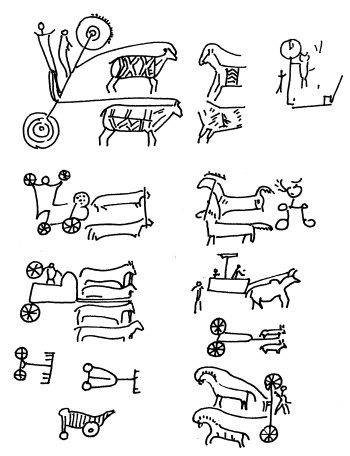 Quarrying
- Having pointed out that there is no evidence of carts in Malta, that by no
means precludes the idea that there might have once been carts on the
island. The drawings (right) are of prehistoric wheeled vehicles in India,
proving (for the pedantic) that the wheel at least existed in prehistory. Quarrying
- Having pointed out that there is no evidence of carts in Malta, that by no
means precludes the idea that there might have once been carts on the
island. The drawings (right) are of prehistoric wheeled vehicles in India,
proving (for the pedantic) that the wheel at least existed in prehistory.
The general consensus is that most cart-ruts were produced as a result
of transporting stone from a quarry to the shore such as the ruts at
Anse de St. Croix, France. The same is suggested from ruts in
Azerbaijan, and from Malta. However, while this may be true of some
ruts, it is clearly not so for all, as many ruts have no association
with quarrying whatsoever.
The examples above however, confirm such an association exists and
research on the Maltese ruts concludes a similar association at some
locations. However, Trump mentions that quarrying at certain sites is
secondary and occurs as a result of the ruts providing a good source
of easily extractable stone
(1). It has also been
noticed that on Malta, some ruts run for many kilometres, more than is
necessary to obtain a good source of stone. It seems that while some
ruts have an association with quarrying, the fact remains that many do not.
The idea that they were used for transporting goods seems
immediately rational, except that the ruts have no 'passing points'
suggesting that they were for one-way only.
Ceremonial paths - It has been suggested that the
ruts may have been 'carved' and that in certain cases, such as the Bolivian
ruts, it is certainly reasonable to assume that they, at least, were created
for ceremonial purposes as they also have carved symbols running beside them
along their entire length. This theory is clearly not true or all ruts
however, and it seems very unlikely that so many ruts were created purely
for ceremonial practices.
Examples of cart-ruts from around the world.
|
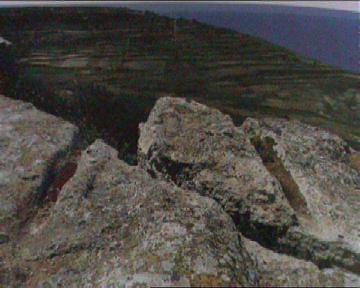
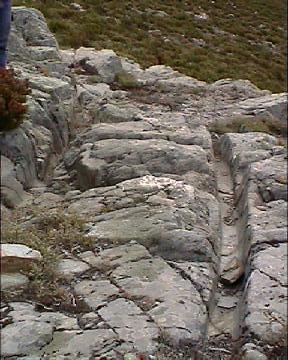
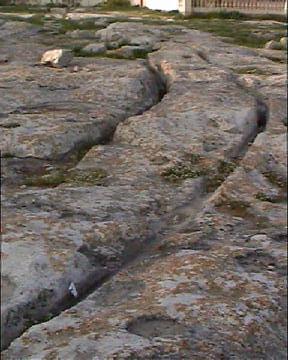
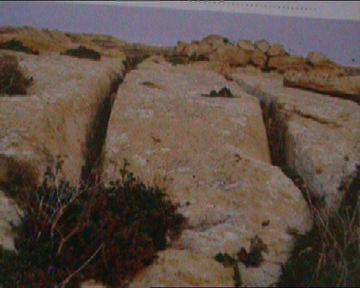
Malta -
The island of Malta is home to the highest concentration of Cart-rut's in
the world. They are dated to at least the latter centuries BC.
(1) On
Malta, the Cart-ruts are traditionally associated with prehistoric
quarrying, although there are several objections to this theory as an
absolute.
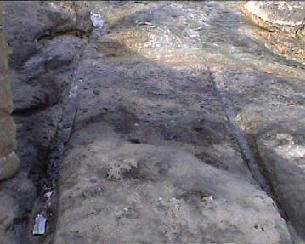
The
Maltese cart-ruts
can be seen to run into the sea in places and have also been found
underwater around the islands, where they have been observed to run as
single lines (rather than in pairs). It is also suggested that some
ruts once ran to the small island of Filfla across a land bridge, which
has collapsed since humans first arrived on the island.
(2)
After adjusting to the presence of the ruts, small inconsistencies begin
to appear, such as their varying depth, shape or course, until the
possibility occurs that each rut may have been made by a single passage
of a vehicle at a time when the substrate was softer .
(More about the
Maltese Cart-ruts)
|
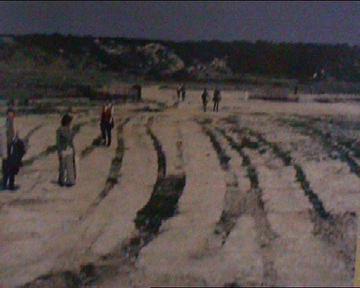
France -
'The date and purpose of the ruts at Anse de St. Croix is known. They were
worn by wagons carrying building stone from the quarries to the waters edge.
From there it was shipped across the bay to build the walls of the Greek city of
Massalia, modern Marseilles in Provence, within a few years of 600
BC'
(1)
(More about Prehistoric France)
|
|
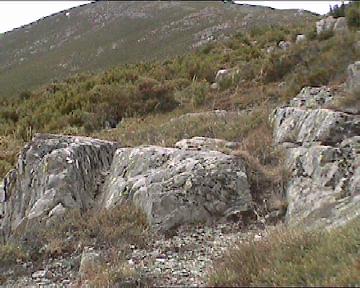
Portugal - 'Strada's Real'
-
The
Portuguese Cart-ruts are also known as 'Strada's Real'
or 'Royal streets', and have been associated with pilgrimage in tradition.
Some of the ruts are said to have been used until recent times, although
bronze-age markings appear alongside them, suggesting a continuous usage of
over 2000 years. (Ref:
Piodao
Museum, Portugal)
(More
about the Portuguese Cart-ruts) |
|
Spain -
Spanish cart ruts recently fell in the spotlight following a recent
Culture 2000 Project entitled:
"The Significance of Cart-Ruts in Ancient Landscapes"
The project involved the
National Museum of Archaeology in collaboration with the Restoration
Unit, Works Division, Ministry for Resources & Infrastructure,
The Faculty of Environmental Sciences, University of Urbino,
Italy and
APROTECO - Association for Economic Development of the Valley of
Lecrin, Granada, Spain.
The investigation involved two sites (only); One
in Malta, called 'Clapham junction' and the other in Spain, located in the
village of Padul near Granada, known as Il Camino des los Molinos.
The project commenced in October 2004 and was estimated
to take one year to complete.
(Ref:
http://www.mri.gov.mt)
|
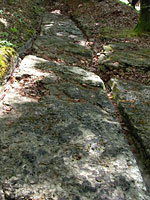
Switzerland -
(Vuiteboeuf, Canton Vaud) - It is said that the
parallel ruts in the region of Canton vaud were cut
into the rock, and usually on steep slopes.
It is believed that since carts did not have brakes, the
tracks were made to prevent them from losing control. The tracks in this
area are traditionally thought to be Roman, although recent research
apparently indicates that some may have been built in the 13th or 14th
centuries.
(Ref:
www.swissworld.com) |
|
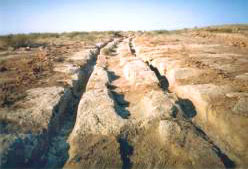 Azerbaijan
- 'Apsheron',
Cart ruts have been found on the Apsheron peninsula. Each of such �roads�
consists of 2-3 (in some cases up to 5) furrows having depth from 5 to
50 cm. These ancient tracks can be met on Apsheron peninsula at several
places � between Turkan and Hovsan villages and next to Surakhani, Gala
and Dubendi settlements. The �stone roads� existing on the Beyuk Zire
(former Nargin) island in the Baku bay were mentioned by the famous
researcher of Baku Sara Ashurbeily. Most of the �roads� were destroyed
with time; extant portions stretch up to 100 meters and most of them
directed to the Caspian Sea.
(4)
The complete similarity of Apsheron�s
findings with Mediterranean�s was confirmed by specialists from Malta
moreover, it is quite probable that �furrows� from Apsheron may
appear of the same age as Mediterranean�s, but Maltese researchers dated
their �roads� by circa 4,000 � 5,000 BC.
(4)
'Upon studying the cart ruts more carefully, we
noticed that they all led from stone quarries directly to the sea. And
they were
clearly hewn out of rock by
hand'.
Since then, we have learned that
similar cart ruts can be found throughout the Mediterranean, along the
seacoasts of Malta, Greece, Italy and southern France. Archaeologists
hypothesize that cart ruts may date back as far as the Neolithic Age
(10,000 � 8,000 BC) or at least from the Bronze Age (5,000 � 4,000 BC).
It's quite likely that they predate the invention of the wheel. Some
scholars suggest that the cart ruts themselves were lubricated, which
would have enabled sledges, laden with heavy limestone blocks, to have
been dragged.
|
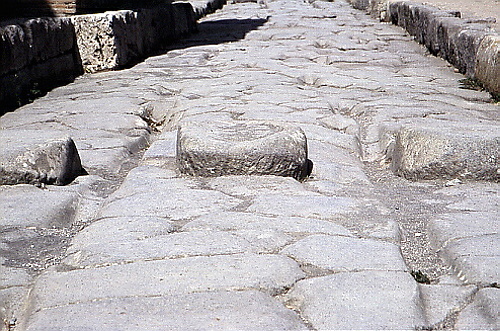
Italy, Pompeii - The cart-ruts in this
road were clearly made by wheeled vehicles passing over a period
of time. The stones in the centre of the road are suggested to
have been placed there to to keep a walkway clear of mud.
(More about
Prehistoric Italy) |
|
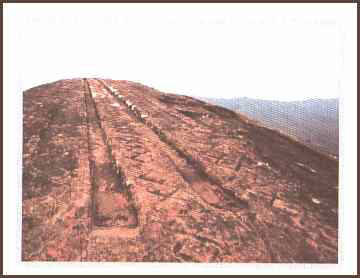
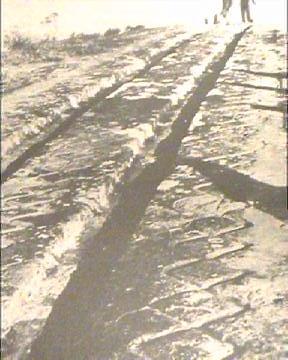
Samaipata, South America. -
The ruts in the photos (left and right)
come from 'El Fuerte', a mountain in the Bolivian jungle. They
are not of the same class as the other, more correctly named
'cart-ruts' on this page as they , but it is possible there may
be a relation in their design. They run from the top of the
mountain, which has had numerous tanks and 'drainage basins',
cut out of the rock. The site is believed to have been used for
'ritual' purposes, but very little is actually known about it.
(3)
(More about
Samaipata, Bolivia) |
|
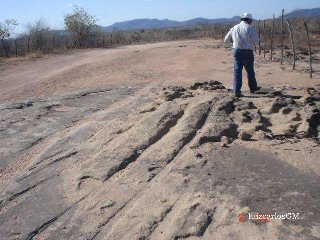 Souza,
Brazil. - Cart ruts have
been reported in 120 million year old rock near Souza, in Paraiba,
Brazil. Souza,
Brazil. - Cart ruts have
been reported in 120 million year old rock near Souza, in Paraiba,
Brazil.
At present there is no further
information on them.
(Photo Credits:
Marcos Roberto) |
Cart-ruts on the
Azores:
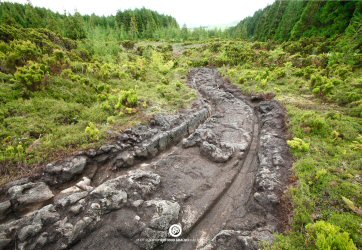
The presence of
cart-ruts on the Azores is one of the most unexpected facts to
present itself in the search for the first settlers on the Azores.
As we have no record of their being made since the
'official' discovery of the Azores, we must assume that these were
made by a people prior to the Portuguese re-opening the debate over
pre-Columbian contact with the Americas.
(More
about the Azores) |
|
Natural Cart-ruts: Greasy Creek, Kentucky. |
It is important to recognise that on occasion,
natural geological features can be mistaken for man-made ones as the
following images from Greasy Creek, in USA demonstrate. Geological
investigation of the area confirms that the 'cart-ruts' in the
following images are a natural formation.
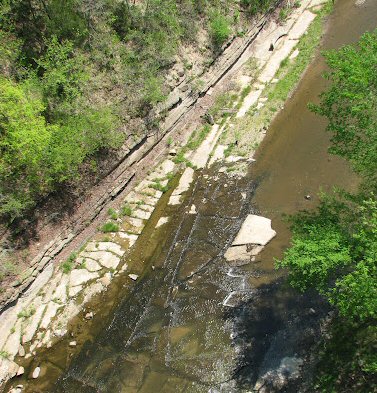
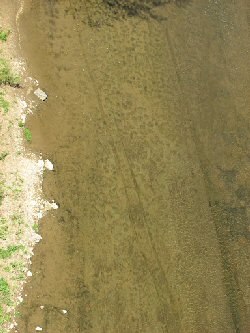
At first glance, the features in the Photo's above could be mistaken
for cart-ruts.
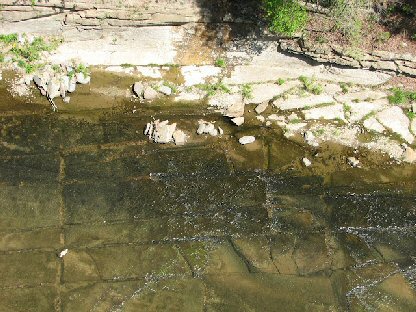
Closer examination shows them to be part
of a larger limestone formation.
(Note that the ruts on the right are not
parallel).
(Photo Credits: George Bertram) More Photos of Greasy Creek:
https://picasaweb.google.com/105463167167048995286 |