|
 Catastrophism:
(Natural Catastrophes..)
Catastrophism:
(Natural Catastrophes..)
The now famous K/T boundary records the almost
complete destruction of the dinosaur dynasty which itself lasted over
130 million years. This single event is believed to have been caused by
an impact from a large meteorite impact in the Gulf of Mexico, and most
life on earth today is indebted to it.
The K/T event was not the first, and it will not
be the last
There is also a body of evidence to support
the idea that we (humanity),
have witnessed the more recent of these events and recorded them into our
mythologies and traditions.
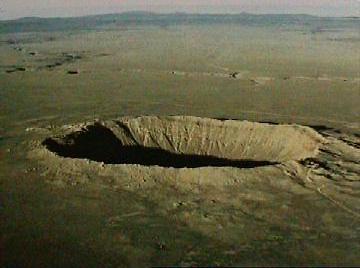
Photo: Barrington Crater, 40 - 25,000 B.P.
1.2 km diameter.
The Largest 5 mass-extinctions of all time.
Cretaceous-Tertiary extinction,
about 65 million years ago,
probably caused or aggravated by impact of several-mile-wide asteroid
that created the Chicxulub crater now hidden on the Yucatan Peninsula
and beneath the Gulf of Mexico. Some argue for other causes, including
gradual climate change or flood-like volcanic eruptions of basalt lava
from India's Deccan Traps. The extinction killed 16 percent of marine
families, 47 percent of marine genera (the classification above species)
and 18 percent of land vertebrate families, including the dinosaurs.
End Triassic extinction, roughly 199 million to 214 million years
ago, most likely caused by massive floods of lava erupting from the
central Atlantic magmatic province -- an event that triggered the
opening of the Atlantic Ocean. The volcanism may have led to deadly
global warming. Rocks from the eruptions now are found in the eastern
United States, eastern Brazil, North Africa and Spain. The death toll:
22 percent of marine families, 52 percent of marine genera. Vertebrate
deaths are unclear.
Permian-Triassic extinction, about 251 million years ago. Many
scientists suspect a comet or asteroid impact, although direct evidence
has not been found. Others believe the cause was flood volcanism from
the Siberian Traps and related loss of oxygen in the seas. Still others
believe the impact triggered the volcanism and also may have done so
during the Cretaceous-Tertiary extinction. The Permian-Triassic
catastrophe was Earths worst mass extinction, killing 95 percent of all
species, 53 percent of marine families, 84 percent of marine genera and
an estimated 70 percent of land species such as plants, insects and
vertebrate animals.
Late Devonian extinction, about 364 million years ago, cause
unknown. It killed 22 percent of marine families and 57 percent of
marine genera. Erwin said little is known about land organisms at the
time.
Ordovician-Silurian extinction, about 439 million
years ago, caused by a drop in sea levels as glaciers formed, then by
rising sea levels as glaciers melted. The toll: 25 percent of marine
families and 60 percent of marine genera.
(7)
How Fast do Extinctions Occur?
Quote from: 'The misread record' (1921):
'There have been mammoths
found with food in their stomach undigested, the very pupil of the eye and
the blood vesicles of the eye preserved. Dr. Hertz's mammoth of 1901 was
found buried in glacier ice with grass in its mouth still un-masticated'.
|
Catastrophe Events:
(Meteorite Impacts, Volcanic Explosion, Flood (Tsunami),
Earthquake, Disease)
Humanity has
clawed its way up the food-chain over the last few million years, and
stands today along with all life on earth as one of the current holders of
the genetic 'torch' of 'life'. Until recently, it was believed that
our path had been one of gradual progression - however, recent research is
starting to show a new picture :
'Proof of our fragility
comes from new research which shows that 60,000 yrs ago humanity became almost extinct. Reduced in
numbers to an isolated group of just a couple of thousand members, a
common 'y' chromosomes has been determined to exist in all males on the
planet originating from that date, and from an area in eastern Africa'.
(Ref: National
Geographic: The search for Adam'. April 2007)
(Ref:
http://news.bbc.co.uk/2/hi/science/nature/2975862.stm)
Article: EurekaAlert.com (May, 2013)
'About 12,800 years ago when the Earth was
warming and emerging from the last ice age, a dramatic and anomalous
event occurred that abruptly reversed climatic conditions back to
near-glacial state. According to James Kennett, UC Santa Barbara
emeritus professor in earth sciences, this climate switch
fundamentally �� and remarkably �� occurred in only one year,
heralding the onset of the Younger Dryas cool episode.
The cause of this cooling has been much debated,
especially because it closely coincided with the abrupt extinction of the
majority of the large animals, as well as the disappearance of the
prehistoric Clovis culture, known for its big game hunting.
"What then did cause the extinction of most of these big
animals, including mammoths, mastodons, giant ground sloths, American camel
and horse, and saber- toothed cats?" asked Kennett, pointing to Charles
Darwin's 1845 assessment of the significance of climate change. "Did these
extinctions result from human overkill, climatic change or some catastrophic
event?" The long debate that has followed has recently been stimulated by a
growing body of evidence in support of a theory that a major cosmic impact
event was involved, a theory proposed by the scientific team that includes
Kennett himself.
Now, in one of the most comprehensive related
investigations ever, the group has documented a wide distribution of
microspherules widely distributed in a layer over 50 million square
kilometres on four continents, including North America, including Arlington
Canyon on Santa Rosa Island in the Channel Islands. This layer �� the
Younger Dryas Boundary (YDB) layer �� also contains peak abundances of other
exotic materials, including nanodiamonds and other unusual forms of carbon
such as fullerenes, as well as melt-glass and iridium. This new evidence in
support of the cosmic impact theory appeared recently in a paper in the
Proceedings of the National Academy of the Sciences'.
(Link
to Full Article)
Over 150 large impact craters have been
found so far world-wide. (1)
Comets are
cyclic. We are now able to predict a behaviour of the following comets:
|
Cycle duration: |
Name of comet: |
|
|
|
|
3.3 years. |
Encke's -
i.e. Tunguska - June 30th - (also beta-taurid meteors). |
|
6 years. |
Pons-winnecke -
|
|
6.5 years. |
Giacobini-zinner -
|
|
6.9
years. |
Holme's -
|
|
16.2
years. |
Schwassman-wach - |
|
76.3
years. |
Halley's - (i.e. 1066 Bayeux, 1986 Giotto probe). |
|
5,700
- 75,000 years |
Kohoutek - (Passed earth by 75 million miles, 1974). |
|
2,800,000 years. |
The 'Great comet' of 1864 - |
Significantly Sized Impact Sites:
210 mill yrs - Lake Manicougan,
Quebec. Canada.
60 km diameter.
65 mill yrs - ' Chicxulub'
- Yucatan Penninsula (10 km diameter.) 75-80% extinction including
most Dinosaur extinction. (K/T Boundary).
In 1980, Luis Alvarez and his geologist son, Walter, proposed that a giant
asteroid or comet struck the Earth approximately 65 million years ago and
caused the mass extinctions of the dinosaurs and over 70% of all life on
Earth. The collision occurred on the Yucat�n platform and is centred near
the port city of Progreso, Mexico. The 200�300-kilometer wide crater lies
buried beneath 1100 meters of limestone laid down in the intervening years
and few clues of its presence remain at the surface.
(2)
In recent years, several other craters of around the same age as
Chicxulub have been discovered, all between latitudes 20�N and 70�N.
Examples include the Silverpit crater in the United Kingdom, and the
Boltysh crater in Ukraine, both much smaller than Chicxulub but likely
to have been caused by objects many tens of metres across striking the
earth. This has led to the hypothesis that the Chicxulub impact may have
been only one of several impacts that happened all at the same time.
(3)
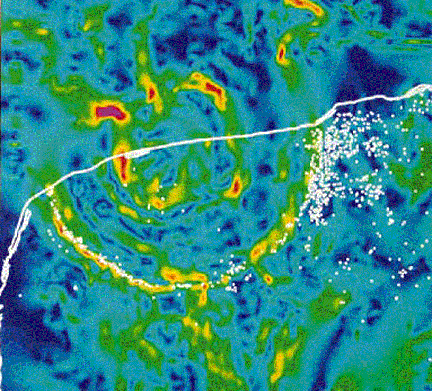
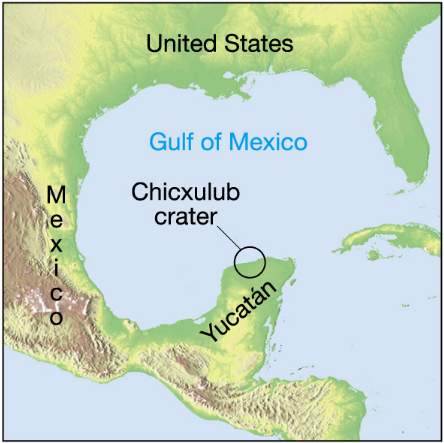
(Left) 'Gravity map' of the Chicxulub Crater, Mexico (after
Hildebrand et al), (Right) Geographic map of Yucatan peninsular
39 mill years. - Popigai crater, Siberia. 100 km diameter.
50,000 years - Barringer crater, Arizona. 1.2 km diameter.
(Photo - right).
When Europeans first discovered the
crater, the plain around it was covered with chunks of meteoritic iron -
over 30 tons of it, scattered over an area 8 to 10 miles in diameter
Scientists now believe that the crater was created approximately 50,000
years ago. The meteorite which made it was composed almost entirely of
nickel-iron, suggesting that it may have originated in the interior of a
small planet. It was 150 feet across, weighed roughly 300,000 tons, and
was travelling at a speed of 28,600 miles per hour (12 kilometres per
second) according to the most recent research. The explosion created by
its impact was equal to 2.5 megatons of TNT, or about 150 times the
force of the atomic bomb that destroyed Hiroshima.
(4)
It is interesting to note that many of the
planets and their moons show impact-craters on one side only, as if they
were all bombarded at a particular moment. Also interesting is that some of
the moons in our solar system exhibit single, large 'umbilical' impact
sites.
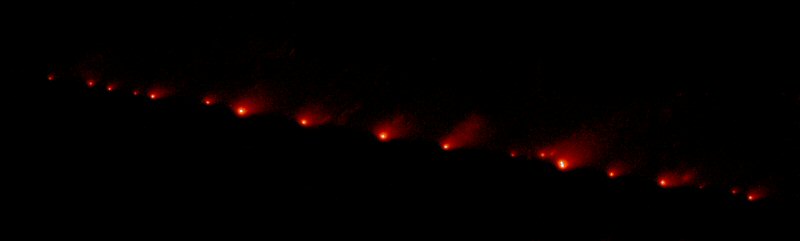
In 1994, the Comet Shoemaker-Levy 9 (D/1993 F2) was seen to
collide with Jupiter, providing the first direct observation of an
extraterrestrial collision of objects in our solar system..
Other links..
Over 40 images of impact craters:
http://www.lpi.usra.edu/publications/slidesets/craters/
Site offering several useful links:
http://www.pibburns.com/catastro/impactim.htm
About 50-60 volcanoes erupt every year. About half are effusive (lava
flows) and half are explosive
(6).
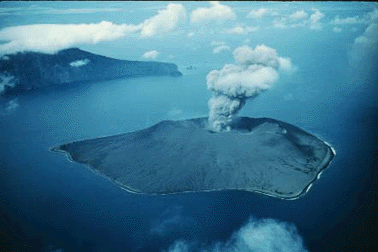 Krakatoa
erupted in 1883, in one of the largest eruptions in recent time. In May,
1883, a series of eruptions commenced which continued until August 27, 1883,
when a cataclysmic explosion blew the island apart. The island exploded with
the force of 100 megatons (the Hiroshima bomb was about 20 kilotons).
(1) Krakatoa
erupted in 1883, in one of the largest eruptions in recent time. In May,
1883, a series of eruptions commenced which continued until August 27, 1883,
when a cataclysmic explosion blew the island apart. The island exploded with
the force of 100 megatons (the Hiroshima bomb was about 20 kilotons).
(1)
1. The explosions were heard on
Rodriguez Island, 4653 km distant across the Indian Ocean, and over
1/13th of the earth's surface.
2. Giant waves reached heights of 40 m
above sea level, devastating everything in their path and hurling ashore
coral blocks weighing as much as 600 tons.
3. At least 36,417 people were killed,
(100,000 including tsunami, disease etc - ref: 6), with 165 coastal villages destroyed.
4. Incoming solar radiation decreased
25 percent and remained 10 percent below normal for about three years.
The Thera (Santorini)
event c.1600 BC.
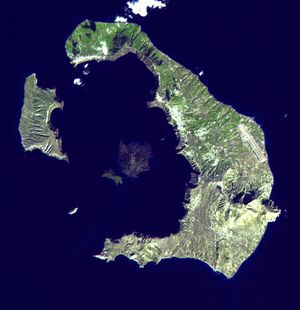 Current estimates based on radiocarbon dating indicate that the eruption
occurred between 1627 BCE and 1600 BCE. Current estimates based on radiocarbon dating indicate that the eruption
occurred between 1627 BCE and 1600 BCE.
"Precise and direct dating of the Minoan eruption of
Santorini (Thera) in Greece, a global Bronze Age time marker, has been made
possible by the unique find of an olive tree, buried alive in life position
by the tephra (pumice and ashes) on Santorini. We applied so-called
radiocarbon wiggle-matching to a carbon-14 sequence of tree-ring segments to
constrain the eruption date to the range 1627-1600 B.C. with 95.4%
probability. Our result is in the range of previous, less precise, and less
direct results of several scientific dating methods, but it is a century
earlier than the date derived from traditional Egyptian chronologies." (5)
For a long time the Thera explosion was believed to have
been directly responsible for the destruction of the great Minoan culture.
However, given that the Minoan decline is usually dated to 1450 B.C., the
gap between cause and effect seemed too large. Scientific maps drawn in the
1960's and 1970's showed its ash as falling mostly over nearby waters and
Aegean islands. By the 1990's, however, affected areas had mushroomed to
include lands of the eastern Mediterranean from Anatolia to Egypt.
Scientists found ash from Thera at the bottom of the Black Sea and Nile
delta.
Peter Kuniholm, an expert at
Cornell on using tree rings to establish dates, found ancient trees in
a burial mound in Anatolia, what now is in the Asian part of Turkey.
For half a decade those trees had grown three times as fast as normal
- apparently because Thera's volcanic pall turned hot, dry summers
into seasons that were unusually cool and wet. More intrigued than
ever, McCoy of the University of Hawaii two years ago stumbled on more
evidence suggesting that Thera's ash fall had been unusually wide and
heavy. During a field trip to Anafi, an island some 20 miles east of
Thera, he found that the authorities had just cut fresh roads that
exposed layers of Thera ash up to 10 feet thick - a surprising amount
that distance from the eruption.
Factoring in such evidence, McCoy
calculated that Thera had a VEI of 7.0 - what geologists call colossal
and exceedingly rare. In the past 10,000 years only one other volcano
has exploded with that kind of gargantuan violence: Tambora, in
Indonesia, in 1816, It produced an ash cloud in the upper atmosphere
that reflected sunlight back into space and produced the year without
a summer. The cold led to ruinous harvests, hunger and even famine in
the United States, Europe and Russia.
In scholarly articles, Jan
Driessen, an archaeologist at the Catholic University of Leuven in
Belgium, and Colin MacDonald, an archaeologist at the British School
in Athens, Greece, have argued that changes to Cretan architecture,
storage, food production, artistic output and the distribution of
riches imply major social dislocations, and perhaps civil war.
By 1450 B.C., Mycenaean invaders from mainland Greece seized control
of Crete, ending the Minoan era. Thera's destructiveness was probably
the catalyst, Driessen and MacDonald wrote, "that culminated in Crete
being absorbed to a greater or lesser extent into the Mycenaean, and
therefore, the Greek world."
Note: The vivid imagery of the
'Plagues' and 'Exodus' of the Jews in the Bible is often claimed to be
related to the Thera explosion.
The volcano plume would have had
to be 30 miles high to have been seen in Egypt, "staff by day, torch
by night." The most recent large volcano, Pinatubo in the Phillipines,
had a plume 26 miles high. The earthquakes and tsunamis could well
have led to the 'parting of the sea.'
(More about
the Minoans)
The 'Toba' Theory: According to the 'Toba
catastrophe theory', around 70,000 to 75,000 years ago a
super-volcanic event at Lake Toba on Sumatra, reduced the world's human
population to 10,000 or even a mere 1,000 breeding pairs, creating a
bottleneck in human evolution. The theory was proposed in 1998 by
Stanley H. Ambrose of the University of Illinois at Urbana-Champaign
(9), and has gained weight in the scientific community.
Although the great flood is a feature of ancient
traditions, none make mention of the preceding 200,000 year ice age.
There are myths of
floods from all around the ancient world, some even included in the
origin myths of ancient cultures. Their importance on the unconscious
mind of humanity cannot be ignored. The Greeks recorded several flood
events into their mythologies as the following examples illustrate.
Zeus sent a flood to destroy the
men of the Bronze Age. Prometheus advised his son Deucalion to build a
chest. All other men perished except for a few who escaped to high
mountains. The mountains in Thessaly were parted, and all the world
beyond the Isthmus and Peloponnese was overwhelmed. Deucalion and his
wife Pyrrha (daughter of Epimetheus and Pandora), after floating in
the chest for nine days and nights, landed on Parnassus. When the
rains ceased, he sacrificed to Zeus, the God of Escape. At the bidding
of Zeus, he threw stones over his head; they became men, and the
stones which Pyrrha threw became women. That is why people are called
laoi, from laas, "a stone." [Apollodorus, 1.7.2]
'The first race of people was
completely destroyed because they were exceedingly wicked. The
fountains of the deep opened, the rain fell in torrents, and the
rivers and seas rose to cover the earth, killing all of them.
Deucalion survived due to his prudence and piety and linked the first
and second race of men. Onto a great ark he loaded his wives and
children and all animals. The animals came to him, and by God's help,
remained friendly for the duration of the flood. The flood waters
escaped down a chasm opened in Hierapolis'. [Frazer,
pp. 153-154]
'An earlier flood was reported to
have occurred in the time of Ogyges, founder and king of Thebes. The
flood covered the whole world and was so devastating that the country
remained without kings until the reign of Cecrops'. [Gaster, p. 87]
'Nannacus, king of Phrygia, lived
before the time of Deucalion and foresaw that he and all people would
perish in a coming flood. He and the Phrygians lamented bitterly,
hence the old proverb about "weeping like (or for) Nannacus." After
the deluge had destroyed all humanity, Zeus commanded Prometheus and
Athena to fashion mud images, and Zeus summoned winds to breathe life
into them. The place where they were made is called Iconium after
these images'. [Frazer, p. 155]
"Many great deluges have taken
place during the nine thousand years" since Athens and Atlantis were
preeminent. Destruction by fire and other catastrophes was also
common. In these floods, water rose from below, destroying city
dwellers but not mountain people. The floods, especially the third
great flood before Deucalion, washed away most of Athens' fertile
soil. [Plato, "Timaeus" 22, "Critias" 111-112]
Recent Examples of Floods:
1212 AD, 1287 AD. Netherlands. Storm
surges over 100,000 deaths total.
1887. Yellow river, China. 9 Million
deaths. (8).
1931. Tze-Kiang River, China. 3.7
million deaths. (6)
(Flood Myth's from the Ancient
World)
Recent Examples of Earthquakes:
1906, California, America - 3,000 dead.
Magnitude 7.8 - 8.0.
1999, Izmit, Turkey. 17,000 dead.
Magnitude 7.4.
2003, Bam, Iran - 40,000 dead. Magnitude
6.6.
2004, Indian Ocean - Tsunami, Earthquake
- 225,000 + dead. Magnitude 9.0.
2005, Pakistan, India, Afghanistan -
73,000 dead. 3 million homeless.
2006, China - SW Sichuan province,
65-99,000 dead. Magnitude 7.9.
|
Polar Shifts and Geomagnetic Reversals:. |
Both of these geological processes are known
to occur, but the exact process or effects have yet to be
recorded.
'Last
geomagnetic reversal of poles - 10,400 BC'.
Ref: Nature Vol 24, 27 Dec
1971, P17.
Ref: New Scientist, 6 Jan 1972,
P7.
' Next
expected reversal of magnetic poles - 2,030 AD'.
Ref : Nature, 12 Feb. 1976.
'The reversal is occurring now'.
Ref:
BBC. Open university 2004.
|
Supporting
Evidence for past 'Geomagnetic-reversals' -
An
old star chart, showing the zodiac and other constellations, was
found on the ceiling of Senmet's grave. He was the architect of
Queen Hatshepsut. The Southern view is reversed and the
constellation of Orion seems to move towards the East in the
opposite direction. All in all, the chart displays a switching of
North and South, East and West. (Could this be an image of the
skies as they were before the poles switched).
The grave contains one more map, its arrangement of celestial
bodies looks as we know it today. However, all constellations have
been shifted. The range of procession cannot sufficiently explain
this strong deviation. It is claimed that the map was passed down
from distant generations, in which at some point in the 26,000
years of the processional cycle the constellations actually
coincided with the locations given in the chart.
Upper and Lower Egypt are named in reverse geographically.
Egyptian texts clearly state that the 'South became the North and
the Earth bends forward', that the stars stopped living in the
West and now appear from the East. They had different names for
the Western and Eastern sun.
The Koran names two Easts and two Wests.
According to the old Chinese chronicle "Schu-King", the
cardinal points were redefined, the motion and rising of sun, moon
and the constellations recalculated and recorded, as well as the
length of the seasons accordingly adopted.
During the lifetime of their ancestors, the sun is said to have
risen where it now sets. The Chinese spoke of a new order and it
is only
since then have the stars been moving from East to West.
Velikovsky observed that the Chinese signs of the zodiac follow
each other in the reversed direction - opposite to the course of
the sun today.
In the second book
of his 'Histories', the Greek historian Herodotus (ca. 490-425 BC)
wrote about conversations with Egyptian priests whom he had
interviewed when he visited the country. He was told about 341
generations of kings and that the sun rose from the opposite
direction four times during their reigns. Twice the sun described
the course we know now and twice did she set where she rises
today.
In 'Electra', the
Greek Euripides (ca. 485-406 BC) mentions stars in backward motion
and a similar trajectory for the sun. In addition to that, he
writes in 'Orestes': "�the sun chariot's winged rush�changing its
westward bound course through the vault of the sky, to where the
dawning day rose flaming red". Another Greek, the philosopher
Plato (ca. 427-347 BC), in his dialogue 'The Statesman' wrote
about the change in the rising and setting of the sun, as well as
other celestial bodies. Apart from that, the universe is said to
have turned in reversed direction.
Central American cultures define four pre-worldly suns, with four
motions. They gave four names to these suns, indicating the
different periods of the skies.
According to the 'Hopi ' indians, we live in the fourth world. The
first was destroyed by fire, the second, with the displacement of
the Earth, and a flood destroyed the third.
The idea that the Poles of the Earth changed position over time
was confirmed first by geologists who were able to detect magnetic
variations in ferrite bearing rocks from different ages. Charles
Hapgood theorized that when the ice on the North pole builds up to
a critical load, it 'slips down' pulling the crust of the earth
with it. This is called the 'crust displacement theory',
suggesting that the crust slides freely over a bed of molten
magma. Einstein agreed with Hapgood's suggestion and it is now
accepted by scientists worldwide.
Supporting evidence
for past 'Polar-shifts' -
Early Jesuit scholars, who were among the first Europeans to visit
China had the opportunity in the imperial library, to study
a vast work consisting of 4320 volumes, said to have been handed
down from ancient times and to contain 'all knowledge'. This great
book included a number of traditions which told of the
consequences that followed when mankind rebelled against the high
gods and the system of the universe fell into disorder': 'The
planets altered their courses. The sky sank lower towards the
north. The Sun, moon and stars changed their motions. The
earth fell to pieces and the waters in its bosom rushed upwards
with violence and overflowed the earth'
Geologists have found that the Antarctic was covered by
tropical vegetation at least until the last ice age 10,000 BC, and
that it has been covered with ice from at least 4,000 BC. This
suggests that it was not in the same position it is now. In
addition, the dramatic freezing (and extinction) of Mammoths across Siberia,
still with undigested food in their stomachs and even mouths, and
most standing as if frozen to the spot, suggests that they were
caught in a fast climatic change. The extinction of the
Mammoths was only a small part of what is now realized was a
mass extinction of species worldwide.
Otto Muck suggested that the region of Siberia was shifted by
approx 3,000 - 3,500 KM south over a period of hours to days only.
This accompanied a shift of the Earths axis of rotation by about
20�. He believed that the shift was a result of a violent asteroid
impact. (Our present tilt is approx 21.5�). Should this theory be
correct, it suggests that before the impact, Earth rotated without
any tilt. This would have the effect of eliminating the seasons
and creating a true 'true-north' pole star for long term
observations.
The Talmud and other old sources mention a disturbance in
the suns movement at the time of the Jews exodus from Egypt.
In
the Bundahish, a Zoroastan scripture it is said that
when angry Mainyu sent the 'vehement destroying frosty', he also 'assaulted
and deranged the sky'.
Old Astronomical charts from India, Sumeria and Babylonian
origin often include inexplicable deviations, as if they had been
taken down at a distant place thousands of miles away, either
the position of Earth changed in its firmament or they made
some incredibly stupid mistakes.
The Writer Solinus wrote about the myths of the people
living along the southern border of Egypt. These ancient accounts
mention a course of the sun, different from today's.
Article:
'2012 - The Elephant
in the Room'.
(Quick
Link)
(2012: The Mayan
End Time.?)
(Return to
Homepage)
(A-Z Index) |

