Throughout history, the remains of
prehistoric monuments have been legitimately and repeatedly re-used and
re-designed and destroyed until what we see today is but a fraction
of the original number of prehistoric megaliths that once existed.
The canons of the
Church councils of Arles (443-452), Tours (567), Nantes (658), and
Toledo (681 and 693), among others, contained passages that condemned
worshipping at the pagan sanctuaries and encouraged the Bishops and all
Christians to neglect, to hide, to desecrate, and even to destroy them,
with the threat of excommunication for those who did not obey.
(2)
John Chapman reported that in 1991 barrows in eastern Hungary were
destroyed, because:
"many plainsfolk so loved the view of an unbroken
flatness that any deviation from horizontality was offensive to their
eyes and they would do their utmost to erase it" (1).
Christianised
Megaliths
A common
strategy employed by the Christian Church was the preservation
and adoption (i.e. 'depaganising' and 'christianising'), of
ancient monuments in order to allow a new interpretation in the
Christian sense. By the edict of Honorius (408), it was even
forbidden to demolish pagan shrines and instead they had to be
rededicated as Christian sanctuaries. In a letter sent in the
year 601 Pope Gregory advised King Aethelberht to "repress the
worship of idols" and "destroy the shrines", but only one month
later Gregory had changed his mind (Marcus 1970), when he wrote
to Abbot Mellitus on his departure for Britain, that'..
"We have been giving
careful thought to the affairs of the English, and have come
to the conclusion that the temples of the idols among that
people should on no account be destroyed. The idols are to
be destroyed, but the temples themselves are to be aspersed
with holy water, altars set up in them and relics deposited
here. For if these temples are well-built, they must be
purified from the worship of demons and dedicated to the
service of the true God. In this way, we hope that the
people, seeing that their temples are not destroyed, may
abandon their error and, flocking more readily to their
accustomed resorts, may come to know and adore the true God.
(2)
Examples of
Christianised Megaliths:
Standing
at almost 8m metres high, the Rudstone monument is Britain's
largest standing stone. The dominating church and surrounding
graveyard were built in such a way that the passer-by could be
forgiven for missing the stone altogether.
The name Rudstone derives from the old
English words meaning 'cross-stone'
(4), offering the possibility that
Anglo-Saxons may have once placed a cross on top in an attempt to
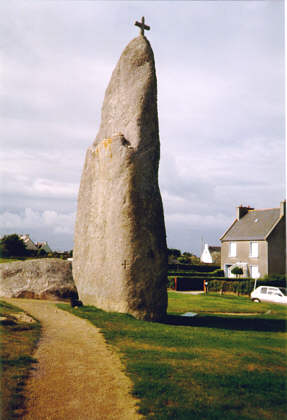
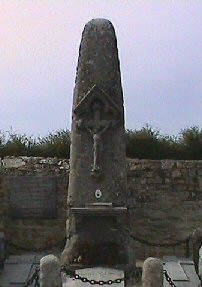
convert it. Similar conversions were performed on several Breton
megaliths, such as the standing stone at Duzec.
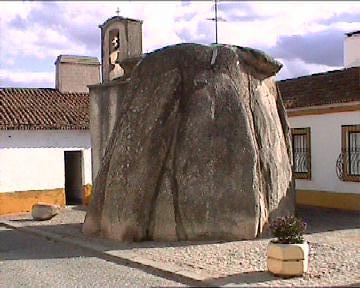
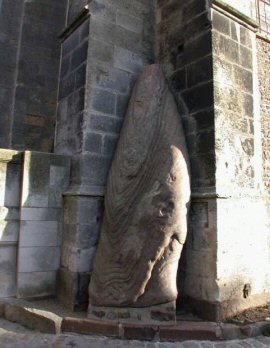
The French have found several ways of Christianising their numerous
menhir's.
Menhir 'Men Marz'
(Left), Lochmariaquer (Centre), Le Mans Cathedral (Right)
Recently
Desecrated Megaliths:
�To destroy the relics
of the past is, even in small things, a kind
of amputation, a self-mutilation not so much
of limbs as of the memory and imagination.�
'Major
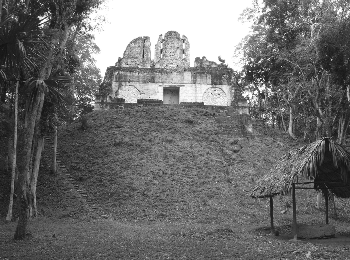
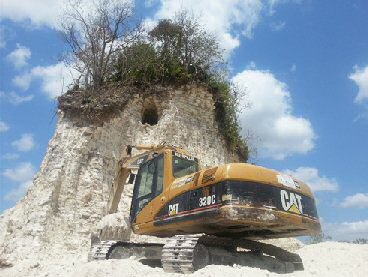
Mayan Monument Bulldozed For Road Aggregate'.
'The main
temple, the ceremonial center for Noh Mul, at
about 20 metres among the tallest buildings in
Northern Belize - and it�s not centuries old,
it�s millennia, thousands of years old and the
thought that it�s rich limestone bricks cut with
stone tools in the BC era. This once towering
ceremonial center in San Jose/San Pablo
has been whittled down to a narrow core by
excavators and bulldozers.
Director of the
Institute of Archeology Dr. Jaime Awe told us
today that what has happened is �intolerable.�
He says they will lay charges against the
company D-Mar�s and the landowner because the
machinery was on site and the land owner should
have not given permission for the mining to have
proceeded. We�ll keep following that part of the
story.
To give a broader sense of context � the site
known as Noh Mul or �Big Hill� is scattered over
a wide area about 12 square miles � and is
estimated to have been home to 40,000 people
between 500 and 250 BC. There are about 81
separate buildings � all on private property.
But the one that has been destroyed is the
namesake, the Big Hill - as it was the
ceremonial center and main structure'.
The Ceremonial centre of Nohmuh - Before and After
Photos.
Article: The
Record.com. (May, 2013).
'First Nations
Group Outraged at Destruction of Ancient Rock Art Sites'.
NANAIMO,
B.C. � Members of a Nanaimo First Nations group are
outraged after crews contracted by BC Hydro damaged a
documented ancient rock art site during work last week.
Douglas
White, chief of the Snuneymuxw First Nation said the
damage is disrespectful of native heritage and he
doesn�t understand how crews could make the mistake,
since existing petroglyph rock art sites are documented
and protected by legislation. �This is a notoriously well-known site,� White said. �I don�t understand this to
be a mistake that can be made ... this is the kind of desecration where I would
expect charges to be laid.�
A
documentation form provided by the Snuneymuxw First
Nation listed previous damage to the same site in 1960
when a power pole was installed in close proximity to
the petroglyph. It is known to archaeologists by the
title Cedar By the Sea Petroglyphs and had been
registered with the province since the early 1970s.
A
spokesperson from BC Hydro confirmed one of its
contractors had started work in the area, unaware it
contained the petroglyphs.
'To the Afghan and Chinese governments, Mes
Aynak is the site of massive copper reserves,
the world's second largest, with an estimated
worth exceeding $100bn (�66bn). To others, it is
a site of enormous historical importance, a
settlement dating back to the Bronze Age which
includes a 100-acre ancient monastery complex, a
mere 10 per cent of which has been excavated.
Its destruction would see Afghan society robbed
of a unique link to its rich heritage'.
'Mohenjo Daro: Could
This Ancient City be Lost Forever.?'
'The
salt content of the ground water is eating away at the
bricks that, before excavation, had survived thousands
of years...Even the Mohenjo Daro Museum has been looted,
with many of its famous seals among the artefacts
stolen..."most of the attempts at conservation by the
authorities have been so bad and so amateur they have
only accelerated the damage"...Some experts have gone so
far as to suggest that the entire site should be buried
again to halt its decline..'
'...One
saving grace may be that some of the city remains
unexcavated...'
'Hammer Vandals Damage 5,500 Year Old 'Stone of
Destiny'
'Damage has been caused in 11 places on all four faces
of the Lia Fail Standing Stone - also known as the
'Stone of Destiny' in ancient Irish texts.
Archaeologists say that although damage was visible on
the stone's surface, a search of the area did not reveal
any f the fragments, which may indicate that they were
taken away'.
'Priddy Circles
damage investigated by English Heritage'
Archaeologists are assessing
the harm to a section of the
Priddy Circles, a series of
four large earthwork
enclosures, on the Mendip
plateau. The spokesman for
English Heritage added: "We
are aware of damage to the
Priddy Circles in Somerset -
a series of four large
Neolithic Henge monuments.
"We are currently
investigating the matter
which includes an assessment
of the harm caused to the
monument through an
archaeological assessment.
"It is also a criminal
offence to carry out works
to a scheduled monument
without scheduled monument
consent from the Secretary
of State."
A spokesman for Somerset County Council said: "Priddy Circles are one of the most important prehistoric monuments in Somerset and they were constructed approximately 5,000 years ago.
"New research has now shown, however, that the monuments at Priddy pre-date the construction and use of Henges and, as such, have few parallels in the UK. Among these parallels is the first phase of Stonehenge."
Article: By Dilshad Azeem. Tuesday, February 24, 2009.
'Authorities look away as Plunder of Mohenjo daro Continues'.
ISLAMABAD: Authorities appear to be dragging their
feet in preventing the pilferage of precious artefacts from the
Mohenjo daro site, according to an official document.
A revised master plan for conservation and promotion of cultural
tourism at the Mohenjo daro site awaits the federal government�s nod
at a time when President Asif Zardari and PPP senior vice-chairman
and Prime Minister Yousuf Raza Gilani are at the helm of affairs.
But the Mohenjo daro site, falling under the federal government�s
jurisdiction, is regrettably facing a double whammy: non-stop
pillage of antiques and severe seepage and damage, reveals the
document made available to The News.
Major features of the revised master plan are archaeological
conservation, acquisition of land, further excavation and
conservation, landscaping and environment development, a tourism
monument plan and an interpretation system.
The Prehistoric destruction of the Tara Valley,
Ireland. (2009)
The Gabhra (Tara-Skreen) Valley is currently
suffering the construction of the M3 motorway,
which passes straight through the heart of one of Irelands most sacred
prehistoric landscapes - destroying over 100 prehistoric sites in the
process.
It is only recently that archaeologists are beginning
to view individual sites in terms of their place in the overall
prehistoric landscape.
�The monuments around Tara cannot be viewed
in isolation, or as individual sites, but must be seen in the context of
an intact archaeological landscape, which should not under any
circumstances be disturbed, in terms of visual or direct impact on the
monuments themselves�
Ref: (N3 Navan to Dunshaughlin Route
Selection, August 2000, paragraph 7.3)
Scheduled to open in 2010, the M3's loudest
critics concede much of the damage is already done � 38
archaeological sites unearthed during construction thus far have
been carved from the landscape. Among the now vanished finds, a
newly discovered national monument at Lismullin that one leading
archaeologist described as "the wooden equivalent of Stonehenge."
"All these sites, including the monument at
Lismullin, were part and parcel of the greater whole that is the
Hill of Tara complex and now they are gone, demolished. The damage
is complete and irreversible," said Vincent Salafia of Tara Watch.
"Some would say, `Give up the fight. The deed is done.' But we're
not giving up because what we are most against is the building of
the motorway through the valley that is at the heart of the Tara
complex. It's a long ways from completion and there is still time to
come to our senses.
Opponents of the M3 have called on the European
Parliament and the European Commission to intervene by asking the
Irish government to review its plans and conduct an independent
investigation into the highway�s impact on the Tara landscape.
Campaigners first approached the commission for help in June 2005. The
commission subsequently determined that the road construction violated
EU law governing environmental impact assessments; however, it has yet
to actually submit a case before the European Court of Justice, and
that delay has allowed the Irish government and the Roads Authority to
continue construction. On April 2, 2008, campaigners came before the
EU Parliament�s petitions committee to resolve the problem. An EU
Commission spokesman said the commission would be submitting an
application to the court in the coming months; however, he said the
commission did not have the authority to halt construction in the
interim, as road opponents had hoped.
Those who are expert in this area and in the area of Tara are of no
doubt that this ritual site, really a temple, is part of the extended
Tara complex. It is about 500metres from the area of Rath Lugh also
flagged as being under threat of the motorway. This is the place about
which there was such a furore in January. The NRA is trying to fit the
road between these monuments � this was shown in photographs in the
past.
This point in the Gabhra Valley is the entrance to Tara. It was more or
less expected that a henge would be found in this location. They are
usually associated with Passage Tombs. Conor Newman and Joe Fenwick
recorded the existence of a straight line of Passage Tombs running from
the river Boyne southwards right through the Gabhra Valley and up to the
top of the hill. The Mound of the Hostages is surrounded by a henge
also, this is 200metres in diameter and is much larger than the
Lismullin Henge that is 80metres, still a very large area. These two
henges are about the same distance apart as Knowth and Dowth are from
each other. No one would doubt that the latter two are related to each
other.
It is no accident that this henge is
exactly where it is.
Learn more about the issue and keep abreast of
new developments by visiting the websites for the
Save Tara
campaign and
TaraWatch. You can sign an
online petition addressed to Irish Prime Minister Bertie Ahern,
and join the network of Tara activists through
MySpace
and
Facebook. You can also get involved with the New York-based
World
Monument Fund, which is working to protect Tara and other
endangered sites.
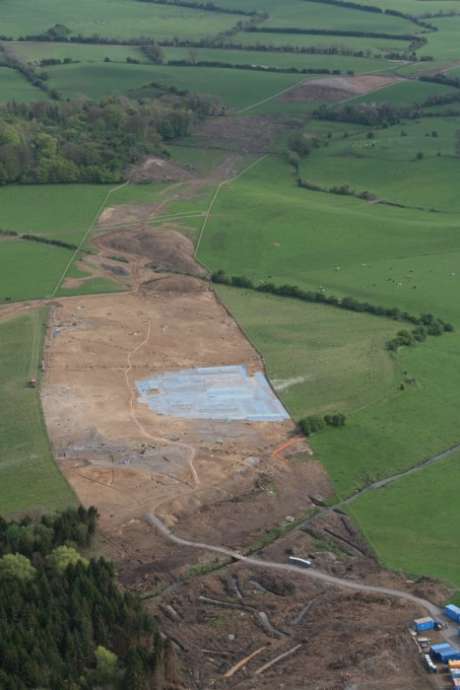
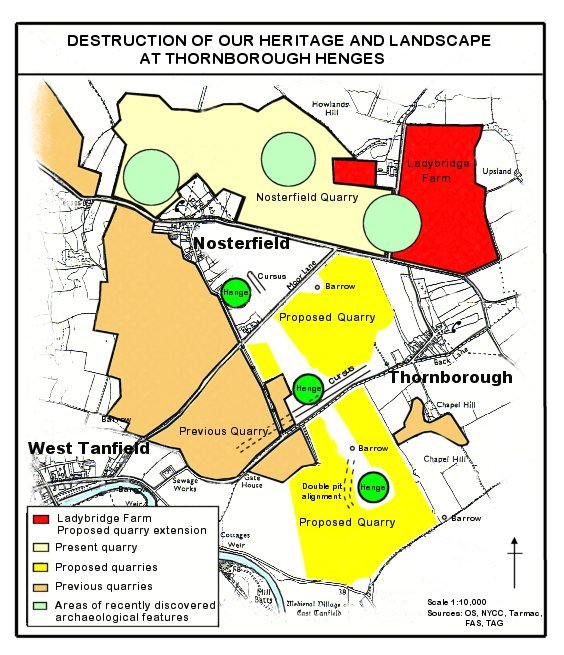
Controversial plans to extend a quarry close to the ancient
monument in North Yorkshire have recently (Aug 2008), been
given the go-ahead for the second time, according to the BBC...
(Link
to article).
The mighty
'Tarmac' organisation have highlighted the importance of the
Thornborough complex again recently through their plans to
continue excavating the periphery of this site. Considering
the value of the site, as confirmed by the statement from
English Heritage that Thornborough is 'The most important
site between the Orkneys and Stonehenge', ones imagination
boggles at the fact that contractors have been once again
given the go-ahead to continue quarrying.
What seems to
be eluding the organisers of this project is that the three
henges are not in isolation here. On the contrary, they are
the centre of an important sacred landscape, which was used
for over a thousand years. The result of quarrying the
surrounding area is the wholesale destruction of parts of this
landscape, which will be irreversibly lost to future (and
perhaps wiser), generations.
April 1st 'prank'. - Yellow Gloss paint
was found the next morning splattered across stones around the
circle damaging around 70 stones; In some cases on both sides.
The paint could still be seen clearly over two years later,
and traces remain to this day.
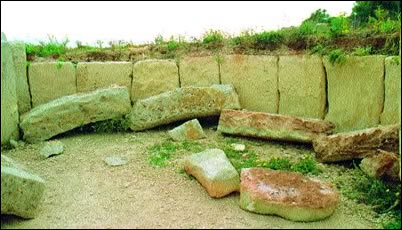
'During
the night of Friday 13th (Good Friday), 2001 around 60
megalithic stones at the Mnajdra temple site were toppled over
and sprayed with graffiti in what was described by a museums
department official as the worst criminal act ever inflicted on
Maltese heritage... Only days before the vandal act was carried
out, the Planning Authority had handed out about 20 stop notices
to hunters, ordering them to demolish the illegally constructed
huts in the vicinity which were being used regularly as trapping
hides. Since the fields close to the temple are being considered
as a conservation zone by the Planning Authority, the orders to
demolish might have irked some individuals into taking drastic
and destructive action'.
Two of the ancient standing stones at the Avebury World Heritage
site in Wiltshire have been damaged by vandals in what may have
been a protest against genetically-modified (GM) crops.
The attack happened on the eve of the summer
solstice, when Avebury becomes a shrine for hundreds of Druids
from all over the UK. Historian Professor Ronald Hutton said the
attack was "appalling" and was akin to desecrating a church on
Good Friday.
The stones were painted red, green and white
by a gang who struck in the early hours of Friday morning. An
anonymous caller to the BBC in Manchester said the attack was
undertaken as a protest against GM foods. A National Trust
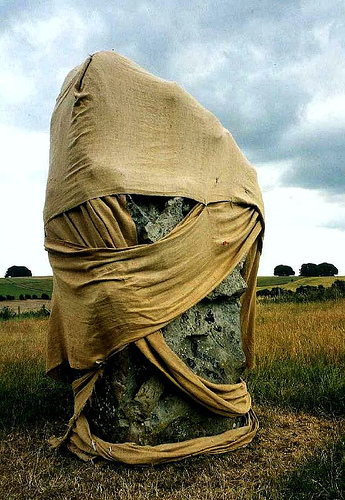
spokeswoman said the two stones in question had been "wrapped"
to prevent further damage.
Two years before strange symbols were painted
on the stones by vandals.
Napalm was
poured over two of Cornish (England) most ancient monuments
and then set ablaze. In an anonymous letter sent to The
Cornishman - the local newspaper - a group calling themselves
Friends of the Stone said they had ceremoniously burnt the
famous Men-an-Tol holed
stone and the nearby Lanyon
Quoit. The writer of the anonymous letter to The
Cornishman included three photographs of the two ancient
monuments covered in burning oil and ablaze with flames.
The police at Penzance are taking the matter seriously.
"We have to assume it is napalm, so I will be talking to the
council about getting the sites cordoned off for public safety
reasons until the monuments can be cleaned," one of the police
officers said. "Until we know exactly what the substance is
that was used to burn the stones, no one should touch it, or
go near the monuments."
Cheryl Straffon, a member of Penwith Council's Sacred
Sites Committee, confirmed that the stones were indeed badly
damaged on November 5 and that the incident had been reported
to the Cornwall Archeological Unit, English Heritage and the
National Trust. She said that "Something did occur on November
5 at the Men-an-Tol and discovered the next day. It looks as
if resin of some sort has been poured over the holed stone and
an attempt made to set it alight."
When a Cornishman reporter visited the Lanyon Quoit he
found three of the upright supports badly burnt by a blackened
substance and the huge roof stone also blacked and covered in
a sticky mess of black and white gunge.
The writer of the anonymous letter stated: "You do not
deserve the heritage these monuments hold and therefore we
intend to act further. By this time next week, Men-an-Tol will
be gone. It shall be set up again, correctly aligned with
pertinent sacred stones, in my back garden."
Anne Preston-Jones of English Heritage said that she would be
inspecting the monuments. "I will be compiling a damage
report," she said. "We can't even remove the substance until
permission is given as these are ancient monuments."
1). Chapman, John (1997)
Places as timemarks�the social construction of prehistoric
landscapes in Eastern Hungary. In G.Nash
(ed.) Semiotics of Landscape: Archaeology of Mind, pp. 31�45. British
Archaeological Reports, International Series 661. Oxford: Archaeopress.
2).
https://tspace.library.utoronto.ca/citd/holtorf/7.3.html4).
R. Castleden, Neolithic Britain.

 Desecrated Megaliths: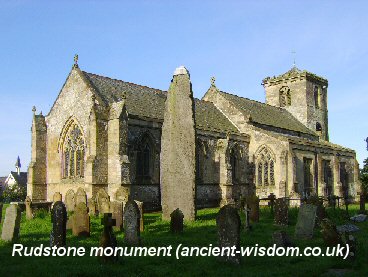

 'During
the night of Friday 13th (Good Friday), 2001 around 60
megalithic stones at the Mnajdra temple site were toppled over
and sprayed with graffiti in what was described by a museums
department official as the worst criminal act ever inflicted on
Maltese heritage... Only days before the vandal act was carried
out, the Planning Authority had handed out about 20 stop notices
to hunters, ordering them to demolish the illegally constructed
huts in the vicinity which were being used regularly as trapping
hides. Since the fields close to the temple are being considered
as a conservation zone by the Planning Authority, the orders to
demolish might have irked some individuals into taking drastic
and destructive action'.
'During
the night of Friday 13th (Good Friday), 2001 around 60
megalithic stones at the Mnajdra temple site were toppled over
and sprayed with graffiti in what was described by a museums
department official as the worst criminal act ever inflicted on
Maltese heritage... Only days before the vandal act was carried
out, the Planning Authority had handed out about 20 stop notices
to hunters, ordering them to demolish the illegally constructed
huts in the vicinity which were being used regularly as trapping
hides. Since the fields close to the temple are being considered
as a conservation zone by the Planning Authority, the orders to
demolish might have irked some individuals into taking drastic
and destructive action'.