|
Location:
Salisbury, England.
(O/S - SU
122 422) |
Grid Reference:
51� 10' 42" N, 1� 49.4' W. |
 Stonehenge:
(Henge-Circle).
Stonehenge:
(Henge-Circle).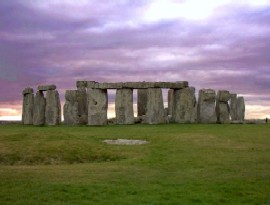
The best known (and
most expensive) stone circle in the world.
The monument we see today
is the result of several different construction phases with the same
area having been used long before Stonehenge itself existed as testified
by the adjacent Cursus and large post-holes, both dated from well before
any of the acknowledged construction phases.
The importance of the
location itself is also illustrated through the transportation of the 80
'Bluestones' to the site over 250 miles.
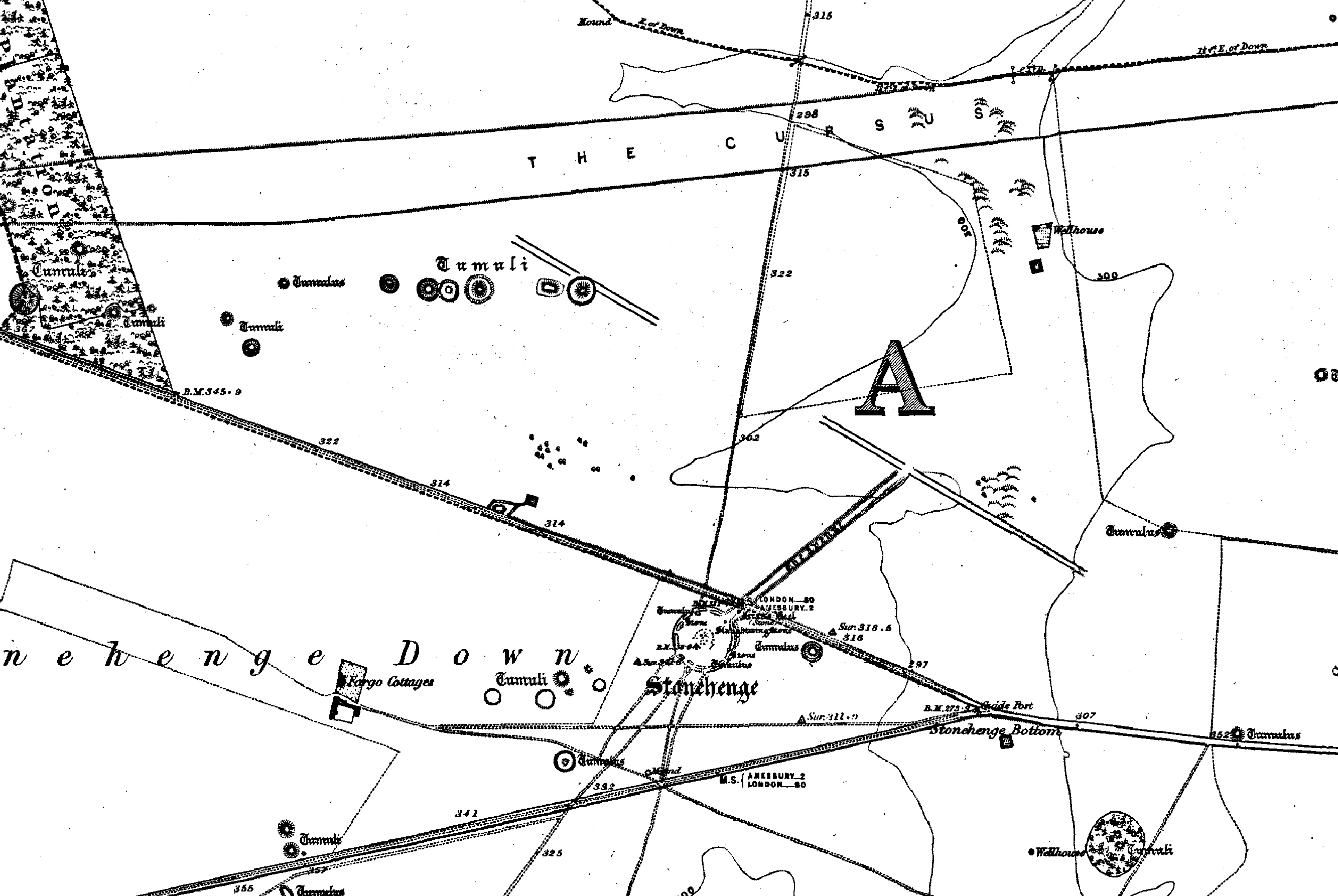
(1887
Map of Salisbury Plain)
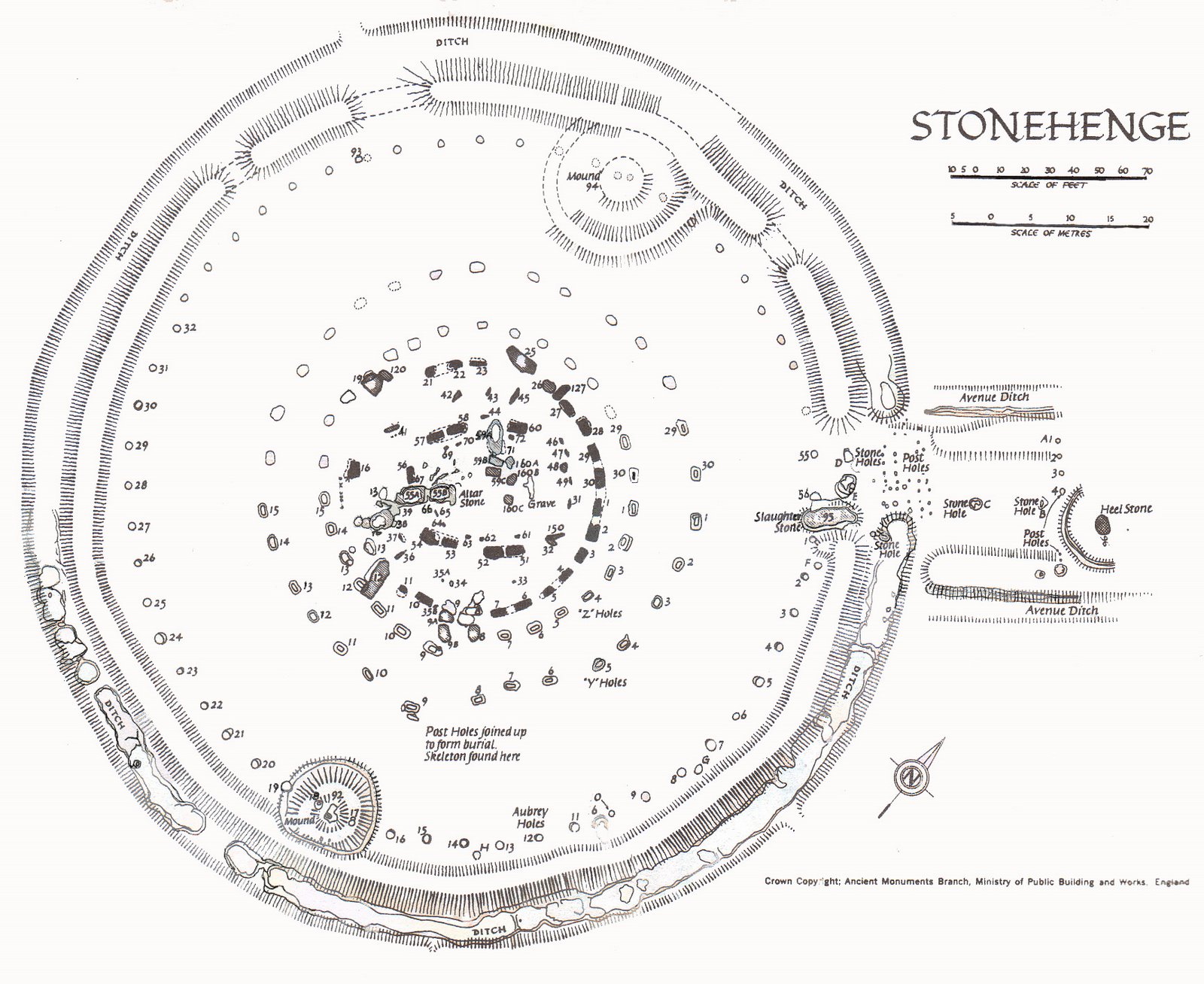
(Stonehenge
site-plan)
The Stonehenge monument is now recognised as
being a single
part of a larger, inter-connected prehistoric 'ceremonial'
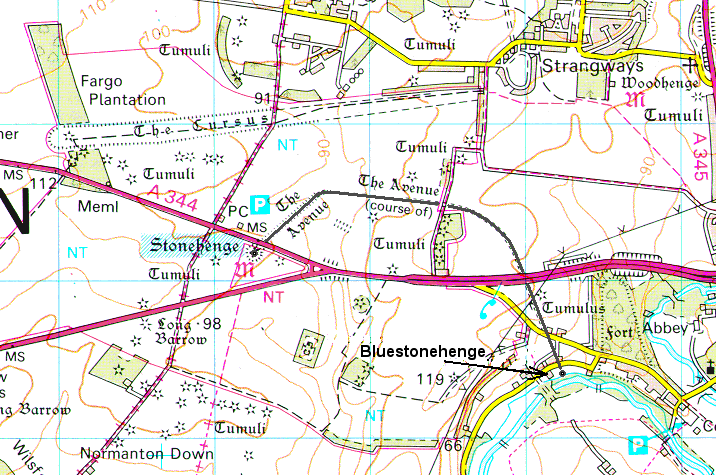
landscape. The recent discovery of another henge-circle (Bluestonehenge),
at the other end of the 'Avenue', along with several other
significant finds are revealing indications that the whole area east
of the Avon was used at one time as a vast funerary-complex.
|
Physical Description of Stonehenge: |
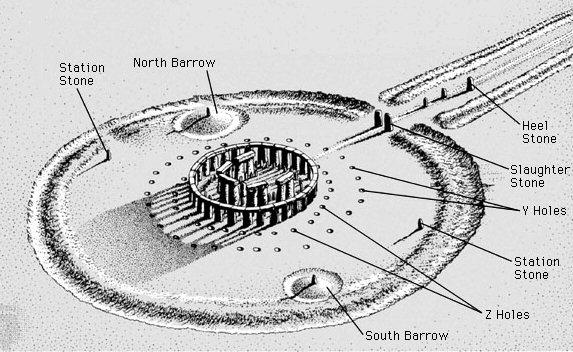
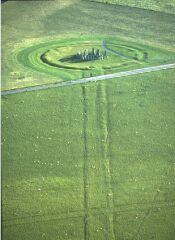 The 'Avenue' -
The outermost element of the site is the
'Avenue' that runs away from the site down a gentle slope for 530m into
Stonehenge Bottom (and the River Avon). The 'Avenue' -
The outermost element of the site is the
'Avenue' that runs away from the site down a gentle slope for 530m into
Stonehenge Bottom (and the River Avon).
The Avenue consists of twin banks about 12m (40ft) apart with internal
ditches which begin at the entrance to the earthwork enclosure and
terminate at the River Avon. The Stonehenge end of the avenue is aligned
to the summer solstice sunrise, with the other end terminating at
another henge/circle by the River Avon.
A similar
ceremonial route/avenue (The 'West-Kennet' Avenue), ran from the River
Avon past 'The Sanctuary' and on to Avebury. It was marked along its route
by large sarsen-stones alternating between thin (male) and lozenge
(female).
(More about the
Avebury/Silbury complex)
The other end of the Avenue - 'Bluestonehenge'
...
It has been recently realised (2009), that the
other end of the 'Avenue' also once had a henge-circle at its
terminus. This newly discovered part of the Stonehenge landscape has
been dubbed 'Bluestonehenge', due to the fact that it was formed of
24/25 'Bluestone' menhirs, currently thought to have been later moved to
Stonehenge during the second phase of construction. The discovery
another such monument on the supports the idea of an intimate connection
between the megliths, the landscape, the visible heavens and the
after-life.
(More about
'Bluestonehenge')
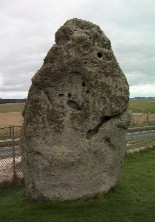
The Heel-Stone - (See Photo, right) - At 20ft long (4ft
underground), around 8ft wide by 7ft thick
(3), this stone is a classic
example of an
outlier, standing at the entrance to the earthworks, and in line with
'The Avenue'. The 'Heel-stone' is a
large upright, un-worked sarsen (hard sandstone) which lies immediately
adjacent to the A344 road. The nearest source of stones of the size
represented by the large sarsens at Stonehenge is on the Marlborough
Downs, near
Avebury, about 30km to the NE.
 Extract
from Burl - 'The heel-stone is popularly thought to stand in line
with the midsummer sunrise but it does not and never did... Astronomical
analysis has shown instead that the stone is in-line with rising of the
moon halfway between its northern minor and major positions'
(11). Extract
from Burl - 'The heel-stone is popularly thought to stand in line
with the midsummer sunrise but it does not and never did... Astronomical
analysis has shown instead that the stone is in-line with rising of the
moon halfway between its northern minor and major positions'
(11).
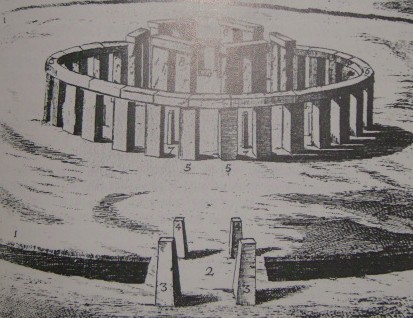
The 'Heel-stone is
thought by some to be one of an original four stones that once
stood at the entrance to the henge. In 1620, Inigo Jones sketched the
proposed sarsens in-situ. (see diagram, left).
The Slaughter Stone -
This stone is about 21-ft long, un-worked. Although it was
originally upright, it is now fallen and has now sunk so deep
that only its upper face shows. It is believed that it is one of
a pair of 'portal' stones that would have marked the entrance to
the circle from the earliest phase of building.
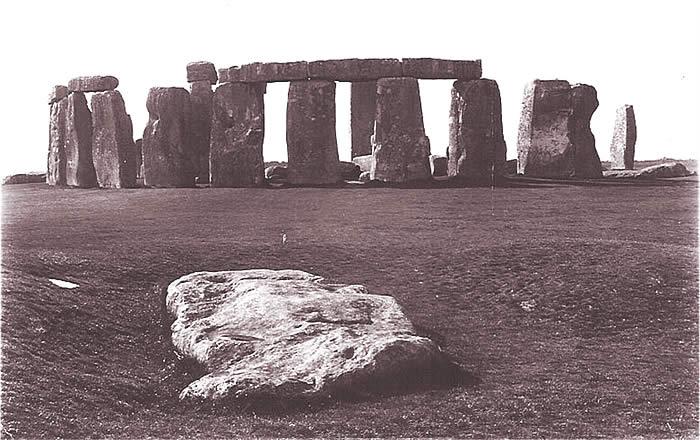
The high content of Iron Oxide in the stone results
in puddles of red water which led to the stone being called the
'slaughter stone' although there is no actual evidence of sacrifice.
The Ditch and
Bank
or The 'Henge' - (Stonehenge I): Moving inwards from the Heel Stone is a
large earthwork enclosure that consists
of a ditch and an interior bank, the original height of which was
calculated by Professor Atkinson as being about 1.8m (6ft).
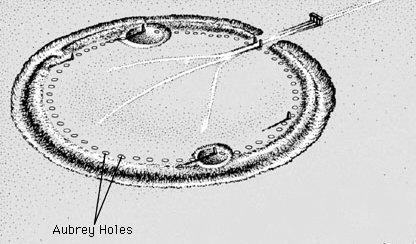
It is known
that there were once two entrances, the one now visible (facing NE) and
one to the south.
(More about Henges)
The Station Stones
- Also a part of the first design, and originally four
upright-stones, the 'Station-stones form a quadrangle in the inner edge
of the earthwork bank. Apart from sharing the same orientation as the
'Avenue', the specific significance of these stones has defied any
traditional explanation by archaeologists in the past as they are unique
in British prehistoric architecture.
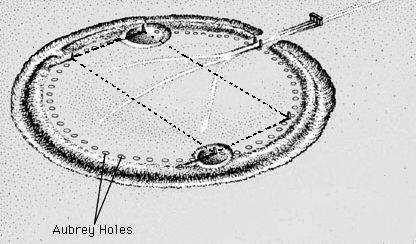
There are however, two other examples of megalithic
quadrangles in Europe, (one at Carnac in
France and the other at Xarez in
Portugal), both of which share several factors in common: Perhaps
significantly, both are also associated with astronomy, alignments,
stone-circles and all were positioned at astronomically significant latitudes.
(More about Quadrangular
Structures).
|
Stonehenge Fact:
Stonehenge lies on the exact latitude at which the Midsummer Sunrise and
Sunsets are at 90� of the Moons
Northerly setting and Southerly rising. This particular phenomena
is only possible within a band of less than one degree, of which
Stonehenge lies in the middle-third.
(17)
|
In Addition:
The only latitude where the four station stones which
determine lunar and solar alignments can form an exact rectangle within
the limits of the Aubrey circle is at the latitude of Stonehenge
(14)
The 'Station-stone-rectangle' has a perimeter the same
length as one side of the great pyramid.
(4)
The angle created by connecting
SS93 to SS91, the rectangle's hypotenuse, is at an angle of 118�
degrees, which has been noted as the same azimuth one would follow to
reach Giza in Egypt.
(3)
The Aubrey Holes
-
(Recently assigned a C14 date of 3,000 BC- 2,300 BC)
(15).
Immediately adjacent to the bank is a ring of 56 pits,
known as the Aubrey Holes, marked by circular concrete spots. The Aubrey
holes were suggested by Prof. G. Hawkins
(3), to have been used for
calculating the phases of the moon and also for predicting the month of
the year in which eclipses would take place. The area between the inner
edge of the bank and the outermost stone settings includes at least two
further settings of pits: the Y and Z holes. These are currently believed to
have originally held the stones for the newly discovered 'bluestonehenge'.
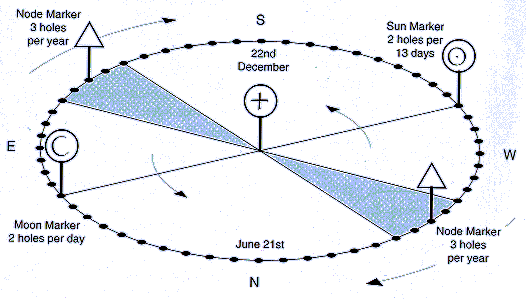
The Aubrey Holes as a Lunar eclipse
predictor:
It is now well known that the simplest
means of modelling the movements of the Sun and Moon (Tides) is
with a circle of 28 markers around a central earth. Moving a
'Moon-marker' one position per day and a 'Sun-marker' once every 13
days, provides a calendar accurate to 98%. By doubling the sun-moon
calendar to 56 markers, one can obtain an accuracy of 99.8%, with the
additional benefit of being able to predict eclipses to high
accuracy. (17)
The combination of astronomically
relevant orientations and means of accurate calculating both solar and
lunar cycles with the same 'monument/device' offers the clear
possibility that the (original) builders were already aware of 'Metonic'
cycle, whereby both the cycles of the sun and moon synchronise over a
period of 18.6 solar years or 235 lunations with an error of only
2 hours.
(Corrected for over a period of
223.2 solar years or 2820 lunations).
(More
about Megaliths and the Metonic cycle)
The Y and Z holes
- Almost every one of the 59, Y and Z holes had fragments of bluestone in
them.
...'Both the Y and Z circles
are irregularly spaced. The holes are generally rectangular in
shape, with the long axis following the circumference of their
circles; and the depths average 3 feet for the Y holes, and 5 inches
more for the Z's. There were no pressure marks on the bottom of any
of these holes which have been excavated-about half the holes of
each circle...'
...'The filling material of
these holes has been rich with archaeologically interesting finds.
At the bottom and sides of them the diggers have unearthed a thin
layer of chalk rubble, presumably the result of a few years of
weathering before deliberate filing of the holes took place. In this
earliest layer there usually was also found a single bluestone
fragment of the variety called "rhyolite"...The rest of the
filling of these holes was a rather uniform mass of fine dirt... Why
was there at the bottom of practically every one of them that
solitary bluestone fragment?...'
(3)
The Sarsen Stones - In its hypothetical complete form the outermost stone
setting would have consisted of a circle of 30 upright sarsens, of which
17 still stand today, each weighing around 25 tons. The tops of these
uprights were linked by a continuous ring of another 30 horizontal
sarsen lintels, only a small part of which is now still in position. The
stones in the sarsen circle were carefully shaped and the horizontal
lintels were joined not only by means of mortise-and-tenon joints, but
were also locked using what is effectively a dovetail joint. The edges
were smoothed into a gentle curve which follows the line of the entire
circle.
In the late 19th century Wiliam Petrie Flinders suggested
that the stone circle was never completed and left open to the south
west. He cited as evidence 'the small, half size sarsen, Stone 11, and
Stones 21, 23 being defective in size compared to the other sarsens'.
The evidence from the recent laser
survey of Stonehenge supports this early conclusion, suggesting that
the monument was actually constructed as a large arc in a similar
fashion to the arrangement of the bluestones in the Q&R Holes.
All that was needed at the south west sector was Stone 16 to mark the
axis. Furthermore, 'groundscans and probing have failed to reveal
sockets for the missing south-west sector sarsens, providing no evidence
for continuation of the sarsen circle from stone 14 to 20 in the
north-west, with the exception of the monolith (16) marking the axis'.
(23)
|
Stonehenge Fact:
Stonehenge is
now recognised as having the largest single collection of
prehistoric carvings in southern Britain.
'The laser-scan survey carried out
in March last year for English Heritage by the Greenhatch
Group, revealed 72 previously unknown axe and dagger carvings
etched into the faces of five of the giant sarsen megaliths,
trebling the number of carvings known at Stonehenge. Prior to this
laser survey, 44 prehistoric carvings had been identified at
Stonehenge on Stones 3, 4, 5, and 53 commencing with Richard
Atkinson's discovery of a number of Bronze Age carvings in 1953
(23).
|
According to Peter Le Mesurier
(The Stone Measurer), the
Sarsen-ring (whose official inner diameter is 97ft or 1162.8 primitive
inches), has a circumference of 3652.4 primitive inches, which he
suggested as indicating a knowledge of the Solar year, it is also
exactly one 'quarter-aroura',
as measured in ancient Egypt
(1).
Flinders Petrie calculated the diameter at 1167.9 (+/- 0.7 British
inches) (13), which works out at 1166.6 Primitive inches (giving a
circumference of 3663.1 primitive inches), which although still accurate
to within .03%, is not as exact as Le Mesurier suggested.
The Sarsen-ring has the same dimension as the flattened-top of nearby
Silbury hill.
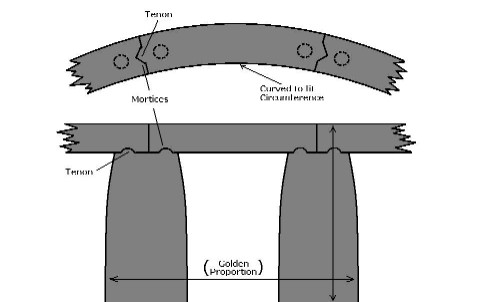
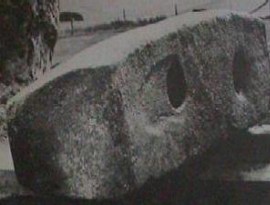
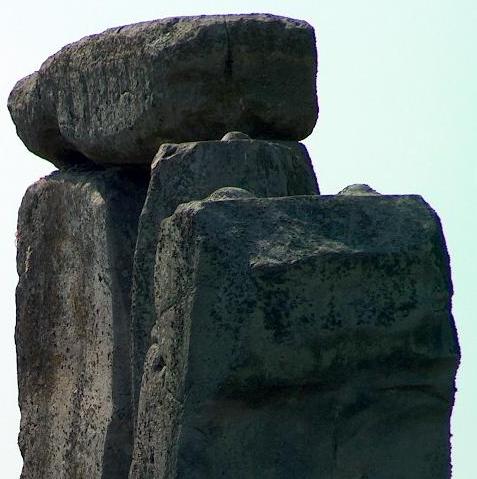
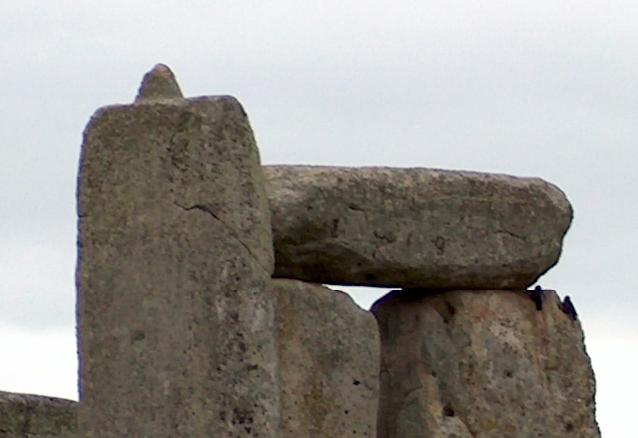
Evidence of the sophisticated construction techniques applied to
the sarsen circle.
(Other
prehistoric masonry techniques)
The Sarsen Horseshoe -
Inside these two circles lies the sarsen horseshoe, consisted originally
of five sarsen trilithons (a Greek word that means three
stones), each comprising two uprights with a horizontal lintel.
Although now fragmentary, the arrangement shows the careful grading of
the five trilithons, the tallest of which is 6.7m (22ft) high above
ground level. Enfolded within this massive horseshoe lies a smaller
horseshoe arrangement of upright bluestones.
|
Stonehenge Fact:
The tallest upright stone at Stonehenge is 6.7m (22ft) high, with another
2.4m (8ft) below ground = 9.1m long and has an estimated weight of 40-50
tons.
|
The Bluestones
-
As many as 85 of the 5+ton bluestones were erected around the centre of
the old ridge system, with the stones being placed 6 ft apart and approx
35 ft from the centre point. It appears that the stones formed a double
circle, with a pattern of radiating spokes of two stones each. The
stones were transported at least 200 miles to the site, from the eastern
end of the Preseli Mountain in Wales.
(9)
(The distance from the quarry
to Stonehenge is 140 miles
as the crow flies
(10), and various routes have been suggested both
over-land and by sea.
The radius of the 'Bluestone' circle (39.6
ft) is the same as the diameter of the 'Bluestone horseshoe'
(4).
The newly discovered
'Bluestonehenge' circle has same dimensions as the inner bluestone
circle.
The significance of
the 'Bluestone' is not yet fully understood. Heath suggested that the
location of the quarry was determined through a geometric or geodetic p rocess
while
Darvill and Wainwright (below), have suggested that the Preseli rock
might have been considered to have 'magical' properties, based on
inscriptions at the quarry (based
on their interpretation of Neolithic rock-carvings).
New research suggests that the bluestones have acoustic
properties which may have played a part in the 'veneration' of the
prehistoric Presily landscape.
(The
Area of the Source of the Bluestones: Carn Menyn, Presely)
Although it has been
suggested recently that the Bluestones were 'Glacial Erratics', and were
therefore not transported by hand, there are two
specific evidences which suggest otherwise: Firstly, there have been no
other discoveries of 'Erratic' bluestones in the area, and
secondly, the quarry in Preseli from which the stones originated, still
show remains of unfinished blocks and several Neolithic engravings.
'There were also a small number of limestone blocks and slabs
used in the construction of Stonehenge brought to the site for the specific
purpose of packing material to support the much larger sarsen uprights. The
limestone quarries have been identified as Chilmark, 12 miles west, and 3
miles southeast at Hurdcot'.
(19)
This debate has now
been put to rest by the official discovery in 2011 of the source of the
first stones used at Stonehenge. The exact location has now been
determined to be a 70m outcrop called Craig Rhos-y-Felin in northern
Pembrokeshire.
(Quick-link)
Wiltshire
archaeologist J F S Stone in 1947, excavated an area near the Cursus and
discovered a scatter of bluestone fragments with a marked concentration
near the Cursus itself, and in 2006 a sizeable fragment of
spotted dolerite,
or bluestone was discovered in the south-western quadrant of Woodhenge.
At almost exactly the same time, a member of the archaeological team
under the direction of Colin Richards discovered another much smaller
piece in a test pit in a field close to the western end of the Cursus.
Other samples of the same Bluestone granite have been found at other
ancient and sacred sites as far removed as Denmark
(18)
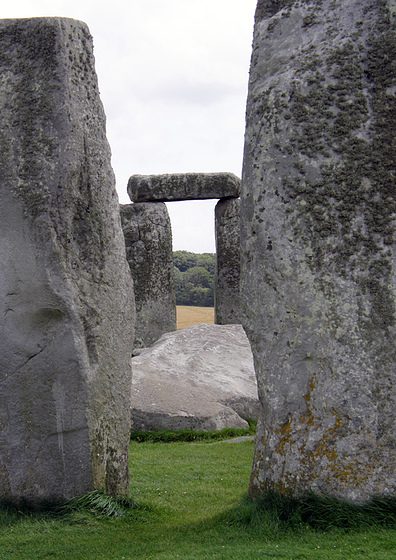 The Altar Stone -
Lying in the geometric centre of the monument is a worked
recumbent megalith.
It was most recently excavated in the 1950s, but no written records of the
excavation survive. The Alter Stone measures 16 feet long, 1 foot 9
inches deep and 3 feet 4 inches wide. Hawkins (3) makes note that while all the
other stones were either bluestone or sarsen, the so called
altar-stone is 'of fine-grained pale green sandstone, containing
so many flakes of mica that its surface, wherever freshly exposed, shows
the typical mica glitter'. The stone when standing would have
reflected the sunlight enhancing the effect of the summer solstice
sunrise. The Altar Stone -
Lying in the geometric centre of the monument is a worked
recumbent megalith.
It was most recently excavated in the 1950s, but no written records of the
excavation survive. The Alter Stone measures 16 feet long, 1 foot 9
inches deep and 3 feet 4 inches wide. Hawkins (3) makes note that while all the
other stones were either bluestone or sarsen, the so called
altar-stone is 'of fine-grained pale green sandstone, containing
so many flakes of mica that its surface, wherever freshly exposed, shows
the typical mica glitter'. The stone when standing would have
reflected the sunlight enhancing the effect of the summer solstice
sunrise.
This stone seems to have come from the Cosheston Beds,
composed of old red sandstone, at Milford haven on the coast of Wales,
some 30miles to the southwest of the Prescilly quarries and is another
example of the specific selection of stones by the builders of the
European megaliths.
Stonehenge has three different
types of stone in the overall structure: Over 80 5-10 ton
'Bluestones'' from Wales, The huge 20-50 ton Sarsens from 20km north
near Avebury and the mica-sandstone 'Altar stone'.
( More
about Specific Stone Selection)
|
Chronology of Stonehenge: |
Archaeological research has determined that the site
was constructed and modified over several various phases, spanning over
several centuries.
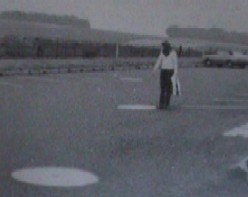 Pre-Stonehenge: Archaeologists have found four, or possibly five, large
Mesolithic postholes (one may have been a natural tree throw),
which date to around 8,000 BC, beneath the nearby modern tourist
car-park. These held pine posts around 0.75 metres (2 ft 6 in) in
diameter which were erected and eventually rotted in situ. Three
of the posts (and possibly four) were in an east-west alignment which
may have had ritual significance; no parallels are known from Britain at
the time but similar sites have been found in Scandinavia. Salisbury was
then still wooded but 4,000 years later, during the earlier Neolithic,
people built a causewayed enclosure at Robin Hood's Ball and long-barrow
tombs in the surrounding landscape. In approximately 3500 BC, a
Stonehenge Cursus was built 700 metres (2,300 ft) north of the site as
the first farmers began to clear the trees and develop the area. Pre-Stonehenge: Archaeologists have found four, or possibly five, large
Mesolithic postholes (one may have been a natural tree throw),
which date to around 8,000 BC, beneath the nearby modern tourist
car-park. These held pine posts around 0.75 metres (2 ft 6 in) in
diameter which were erected and eventually rotted in situ. Three
of the posts (and possibly four) were in an east-west alignment which
may have had ritual significance; no parallels are known from Britain at
the time but similar sites have been found in Scandinavia. Salisbury was
then still wooded but 4,000 years later, during the earlier Neolithic,
people built a causewayed enclosure at Robin Hood's Ball and long-barrow
tombs in the surrounding landscape. In approximately 3500 BC, a
Stonehenge Cursus was built 700 metres (2,300 ft) north of the site as
the first farmers began to clear the trees and develop the area.
Archaeological evidence indicates that just under a thousand years later
(c. 6,000 BC), two more posts were erected only 350 metres away, also
aligned east-west
(16).
(Diagram with location of post-holes)
Aubrey Burl had the following to say on the
matter:
'When the car park was extended in 1966 three, large and
deep postholes were noticed about 250 metres north-west of the circle.
Their positions are marked by white rings today (now concrete posts).
They had held tall posts and aroused much enthusiasm. The late Peter
Newham, author of an excellent, highly regarded booklet on the astronomy
of Stonehenge, wrote, 'These can be regarded as the most positive
"astronomical" discovery yet made at Stonehenge ... they align on sun and
moon setting positions with an extreme accuracy' ... 'The solution lies in the
unpublished Carbon-14 dates for the Stonehenge postholes. One was for
6,140 BC (uncorrected), and the other for 7,180 BC (uncorrected), long
before Stonehenge ... If the posts near Stonehenge were Mesolithic,
erected several thousands of years before the Henge, then their
extreme astronomical accuracy was entirely accidental'.
(1)
The Discovery of a
similar Henge at Goseck in Germany (c.
5,000 BC), and both astronomically orientated and placed on the same
latitude supports the idea that the placement of the posts was NOT
accidental.
Article:
BBC News -
April, 2013
'Stonehenge Occupied 5,000 years earlier than thought'
'An excavation funded with redundancy money
shows Stonehenge was a settlement 3,000 years before it was built. The
archaeological dig, a mile from the stones, has revealed that people
have occupied the area since 7,500BC. The findings, uncovered by
volunteers on a shoestring budget, are 5,000 years earlier than
previously thought. Dr Josh Pollard, from Southampton University, said
the team had "found the community who put the first monument up at
Stonehenge". Over the past seven years, the site has yielded the
earliest semi-permanent settlement in the Stonehenge area from 7,500 to
4,700BC. And carbon dating of material found at the site show people
were there during every millennium in between'.
(Link
to Full Article)
The Stonehenge Cursus - Before the creation of the Stonehenge monument,
the landscape would have been dominated by the nearby
'major' cursus, which is over
a mile long and is orientated towards Wood-henge. This cursus was
recently radio-carbon-dated at (c. 3,500 BC
(8)),
(c.3,630 and 3,375 BC
(21)) and can
indications from this cursus and others suggest that they can be
regarded as
precursors in the evolution towards the circular design of henges and
stone-circles that became the fashion in Britain following a short
period of cursus construction c. 3,500-3,000 BC. The same
evolution in design (from elongated cursus to circular henges) can also
be seen at Thornborough
in Northern England.
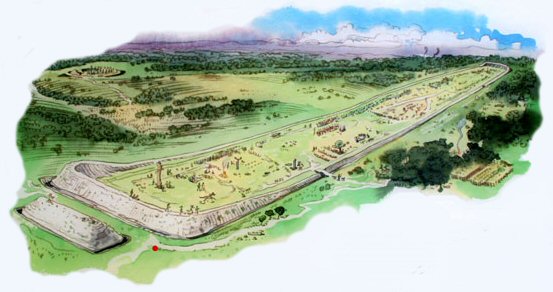
An artistic representation of the Stonehenge cursus (including both
sites?).
(More about Cursus)
Stonehenge 1
-
(3,200 BC)
(11): Construction of the circular
bank and ditch 'The Henge', the 56 Aubrey Holes, and the
'Station stones'. (At this stage, the elements of Stonehenge
indicate a lunar observation).
In the first construction, the sun apparently, 'did not interest
the henge builders'.
(11)
Traces of the Welsh 'Blue-stone' have been found in the Aubrey
Holes suggesting that they originally held stones in them, and might
have been an element of the monument even at this early time.
(15)
Recent discoveries by the
Stonehenge Riverside Project have produced radiocarbon dates from
cremations within the area bounded by the henge monument. The
earliest, 3030-2880 BC, comes from a cremation of an adult within
one of the Aubrey Holes. The most recent dates to between 2570 and
2340 BC. It was the remains of a woman in her mid twenties buried in
the northern ditch. In all, around 240 people were buried within the
henge.
(More about Henges)
Stonehenge II -
(c. 3,000 BC): Widening of the old ditch-bank
(3)
with pottery, animal bones, and cremated human remains placed back in the
ditch; cremations also deposited in some of the partially filled Aubrey
Holes and a complex of posts in the interior and in the entrance causeway.
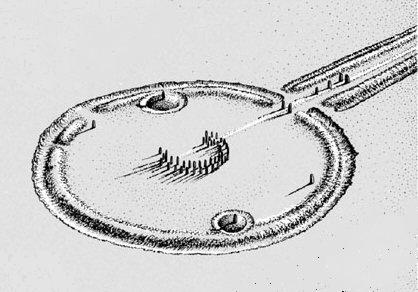
The major structural addition
at this time was the erection of roughly 80 bluestones, weighing up to 5
tons each, which were set up in two concentric circles around the centre. It
is currently believed that the original 56 stones from the Aubrey holes were
used, along with another 24 from the recently discovered 'Bluestonehenge',
at the other end of the 'Avenue'.
Stonehenge III -
(c. 2,400-2,600 BC): Double circle of bluestones taken down
and replaced with around 80 sarsen stones, weighing between 25 and 50 tons
each. These were formed into a circle of continuous trilithon's, with a
Horse-shoe of five larger independent Trilithon's
were erected in the centre. The stones were quarried from the Marlborough
Downs about 20 miles north.
(9).
Article: Antiquity (Volume 81 No. 313 September
2007), by Mike Parker Pearson
et al entitled �The age of Stonehenge�. It is a summary of
progress so far on the
Stonehenge Riverside Project
and the
Beaker isotope project, and contains some interesting and important
revelations about the Stonehenge and its landscape.
It is now thought that the trilithon's were erected
not circa 2,300 BCE, but between 2,600-2,400 BCE, making
them contemporary with Durrington Walls. They now predate the earliest
Beaker burials in Britain, shaking our understanding of the late
Neolithic and early Bronze Age....
(Link
to summary).
The architectural uniqueness of this design has led many to
suggest a 'foreign' influence.
|
A Mycenaean Connection with
Stonehenge?
For a while it was debated as to
whether or not there may have been a connection between the builders of
Stonehenge and the Mycenaean's. Current dating suggests that while
the Mycenaean civilisation existed from around 1,600 BC - 1,100 BC, the
Stonehenge sarsen's were erected around 600 years earlier and the debate has
now been been
laid to rest.
The curved Mycenaean
lintels have been compared to the Stonehenge lintels, which have
no precedent in British prehistoric architecture.
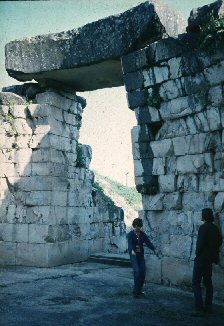
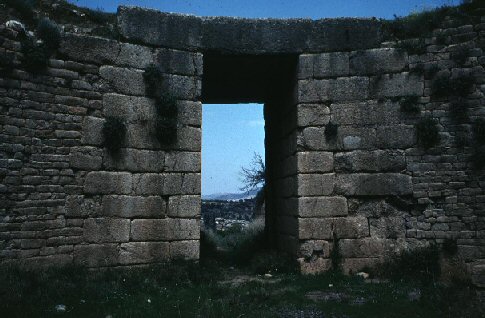
The Mycenaean tombs or Tholos
all had curved lintels over the entrances.
In 1953, a
carving of what appears to be a Mycenaean dagger (below, left),
was found carved onto a stone at Stonehenge.
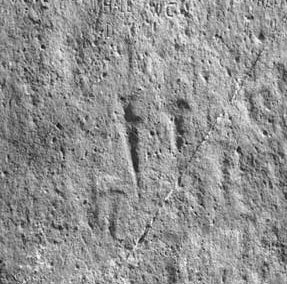
This discovery raised the suggestion
that the stones were raised by Mycenaean architects as the nearest
artefacts with any similarity to this dagger are those found in Mycenae.
However, the date for the
erection of the bluestones at Stonehenge has since been revised, as
pointed out in the book Hengeworld by Mike Pitts, (0-09-927875-8), on
page 341 he states that the "large sarsen structures" of Stonehenge have
been dated with 95% confidence to between 2461 & 2205 bce., at the
inside more than 600 years earlier .. It also seems to place these
carvings well after the bluestone circle & oval, said to date from
between 2267 & 1983 bce. (page 342).
At best then, the dagger might
represent a Mycenaean visit to Stonehenge, but no more. (Click here for more about Mycenaea)
|
|
Traditions, Myths and Legends:
Early mention of
Stonehenge was made in 1135 by chronicler Geoffrey of
Monmouth, who claimed that it was brought by a tribe of
giants from Africa to Ireland, and from there flown
by the wizard Merlin across the sea. Another legend
claims that the stones were stolen from an Irish woman
by the Devil, and re-erected on Salisbury Plain by
Merlin for Ambrosius Aurelianus, the King of Britons.
Diodorus Siculus wrote in 50 BC -
'...The moon when viewed from this island appears to be but a little
distance from the Earth. The account is given also that the god visits
the island every 19 yrs, the period in which the return of the stars to
the same place in the heavens is accomplished. There is also in the
island both a magnificent sacred fane of Apollo, and a notable
temple...'
(14)
|
|
The Astronomical Significance of Stonehenge: |
Apart from the inherent prejudice against the
Neolithic awareness of astronomy and geometry, there are several
stubborn and irrefutable facts about Stonehenge which suggest exactly
that...
The
Latitude of Stonehenge: Firstly, and perhaps most importantly, is
the location of the site itself which happens to be on the
exact latitude so as to encompass several important astronomical
observations from the same location. Indeed, the earliest evidence of
construction at Stonehenge are the 'car-park post-holes', which are
accurately aligned east-west, and can therefore be considered likely
astronomical in nature.
The 'Avenue' leading
from Stonehenge is orientated at the same angle as the latitude
upon which Stonehenge sits.
Stonehenge lies at the exact latitude at which the Sun and the Moon have
their maximum settings at 90� of each other as illustrated by the
station-stones.
There are only two latitudes in the world
it which, the full moon passes directly overhead on its maximum Zeniths,
these are at Stonehenge and Almendres in Portugal (The oldest circle in Western-Europe).
The Design of Stonehenge: In
addition to having been built on a particularly significant latitude, the layout of the site also
incorporates several other intrinsic astronomical features. In
particular, from the earliest phase of construction (c.
3,200-3,000 BC).
Prof. Hawkins
(3),
determined that the 56 'Aubrey holes' were placed so as to calculate
both the 18.6 year lunar cycle and eclipses.
The 'Station-stone' quadrangle, placed
into the circumference of the 'Aubrey-holes', can be used to measure the
extremes of both the lunar and solar cycles.
These two design features make it
possible to measure the 'Metonic cycle'.
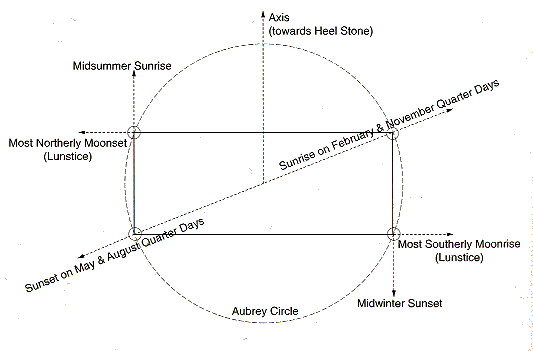
With regard to the astronomical significance of the
�Station stones,� the lines joining 91 (east-south-east) to 92
(south-south-east) and 93 (west-north-west) to 94 (north-north-west)
are parallel to the axis of the monument. They point to mid-summer
sunrise in one direction, to the North-East, and to mid-winter
sunset in the opposite direction, to the South-West. In addition,
the diagonal line joining 93 to 91 points to the position where the
sun rose, in ancient times, on November 8th and February 4th.
Looking in the opposite direction, 91 to 93, the line points to
sunset on May 6th and August 8th. These four dates were �the
four great festivals of the Druids,� and represented important
turning points in the seasons.
As well as this, the alignment
formed by the 'Avenue', continues in both directions to connect several
prominent megalithic sites
along the azimuth of the summer solstice sunrise.
In 1965, with the use of computers, Steven
Hawkins proposed with regards to the the specific alignments to the
Sun and the Moon, that it was ".....less than one chance in ten
thousand that the stones had been aligned by accident" (Hawkins
1965, p-136).
New Pits Discovered in the Cursus.
Article: BBC News: Nov 2011.
Two previously undiscovered
pits have been found in the Stonehenge
Cursus which point to it
once being used as a place
of sun worship long before the
stones were erected. The
pits are positioned in such
a way that when viewed from
the 'Heel-Stone' at
Stonehenge, they would have
marked the rising and
setting positions of the sun
on the summers solstice.
(20)
(Link
to Full BBC Article)
(Link
to Birmingham University Article)
(More about Archaeoastronomy)
The last phase of development (Phase III), at Stonehenge shows a clear
geometric foundation, with the 30 equally spaced
upright sarsen-stones set in a perfect circle.
According to Peter Le Mesurier,
the Sarsen-ring (whose official inner diameter is 97ft or 1162.8
primitive inches), has a circumference of 3652.4 primitive inches, which
he suggested as indicating a knowledge of the Solar year, it is also
exactly one 'quarter-aroura', as measured in ancient Egypt
(1).
Stonehenge is geodetically aligned with several other ancient sites.
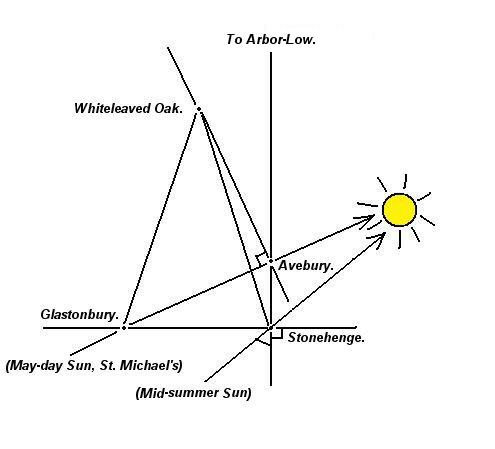
Stonehenge,
Avebury and
Glastonbury form a right angled triangle, of which
the Glastonbury-Avebury follows the azimuth of the sun on 'May-day'
A li ne
extended
from Stonehenge to
Arbor-low
extends exactly 2� north. (Avebury lies exactly 1/4 of a degree
north of Stonehenge along the same line).
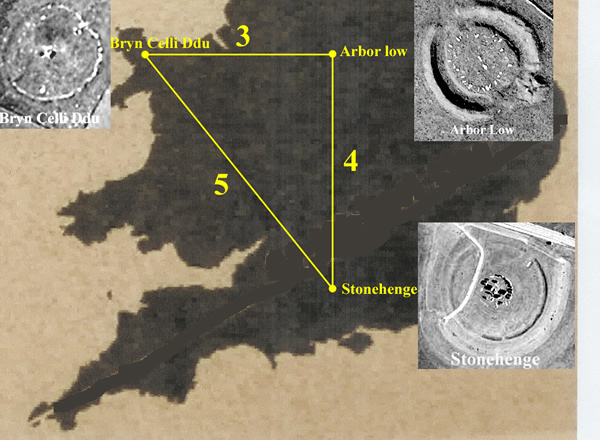
The three
Henge-circles of Stonehenge, Arbor Low
and Bryn Celli Ddu form together
to make a 3:4:5 Triangle.
Perhaps
also of interest is the recently excavated
Goseck Henge (c. 5,000 BC)
in Germany, which is of similar design and lies on the same
latitude as Stonehenge.
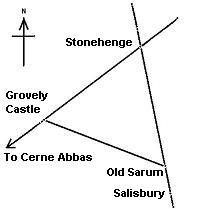
Sir Norman Lockyer, the Astronomer
Royal, noticed that Stonehenge, Grovely Castle and Old Sarum formed
a near-perfect equilateral triangle, with each side 6 miles in
length. The Stonehenge-Old Sarum alignment continues south past
Salisbury cathedral (built 1220 AD), Clearbury ring and Frankenbury
(6). The Stonehenge-Grovely castle alignment
extends to the North-East beyond St Peters mound, Inkpen beacon, and
the Neolithic 'Winterbourne camp'. To the South-West the line
continues past Grovely Castle, Castle ditches and the 'Cerne-Abbas'
giant to Puncknowle beacon on the South coast.
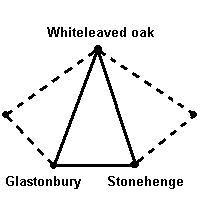
Stonehenge is also a part of the
proposed Landscape 'Decagon'
discovered by John Michell.
The Lundy Triangle:
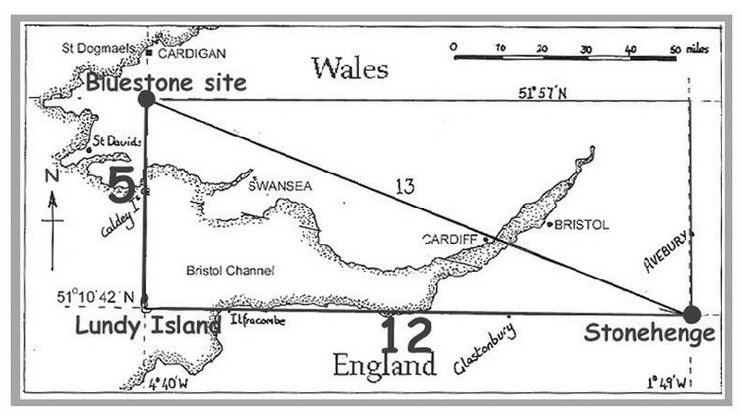
Robin Heath and
John Mitchell suggested that Stonehenge, Lundy Island and Preseli
form together to make a 5:12:13 Triangle, the second in the
Pythagorean set. The dimensions are 2,500 times the size of the
'Station Stone' rectangle.
It is
noticeable that the Rollrights
stone-circle is located at (51� 58′ 20″ N,
1� 34′ 19″ W), which is almost exactly
on the top right-hand corner of the rectangle.
(More about
English Geodesy).
Article:
Stonehenge Codes: The
Geometric and Astronomic Significance of Stonehenge. (Prof. D.P.
Gregg)
Stonehenge and The Flower
of Life.
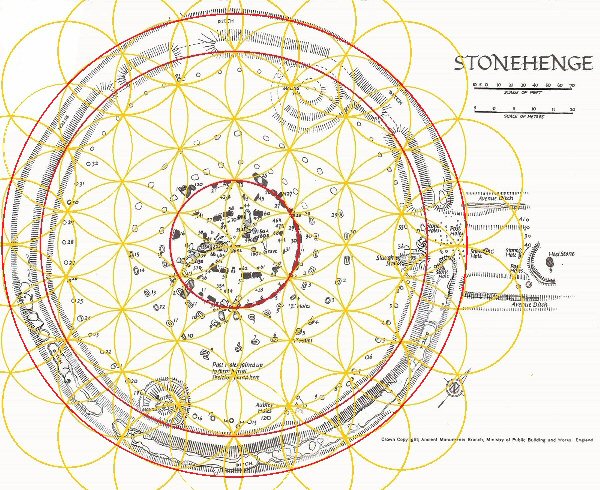
The geometry of
the 'Flower of Life' was recognised in the dimensions of Stonehenge.
Photo Credits: Andrew Monkman.
(The World Grid: The invisible Made Visible)
|
What's New at Stonehenge: |
Article:
BBC News -
April, 2013
'Stonehenge Occupied 5,000 years earlier than thought'
'An excavation funded with
redundancy money shows Stonehenge was a settlement 3,000 years
before it was built. The archaeological dig, a mile from the
stones, has revealed that people have occupied the area since
7,500BC. The findings, uncovered by volunteers on a shoestring
budget, are 5,000 years earlier than previously thought. Dr Josh
Pollard, from Southampton University, said the team had "found
the community who put the first monument up at Stonehenge". Over
the past seven years, the site has yielded the earliest
semi-permanent settlement in the Stonehenge area from 7,500 to
4,700BC. And carbon dating of material found at the site show
people were there during every millennium in between'.
(Link
to Full Article)
Article:
Independent.co.uk: October 2012.
Results of Greenhatch Laser Scan of Stonehenge:
The results of the Grenhatch Laser survey at Stonehenge in 2011, have
revealed that Stonehenge represents the largest concentration of
Prehistoric rock art in Southern England. It has also shown that
different methods of dressing the stone were applied to different
stones and perhaps more importantly, that the trilithon stone-circle
was never completed, and was likely originally intended as a
horseshoe shape monument.
(Link
to Results of Survey)
Article: Heritage Daily (Feb, 2012)
'Stonehenge Design Based on Auditory Illusion'.
'Steven Waller, an independent researcher in
California, said the layout of the stones corresponded to the
regular spacing of loud and quiet sounds created by acoustic
interference when two instruments played at the same note
continuously.
In Neolithic times, the nature of sound waves
- and their ability to reinforce and cancel each other out
- would have been mysterious enough to vergew on the magical,
Waller said. Quiet patches created by acoustic interference
could have created the "auditory illusion" that invisible
objects stood between a listener and the instruments being
played, he added'
(Link
to Full Article)
Scientists Discover
Source of Rock Used in Stonehenge's First Circle:
Article:
Independent.co.uk: Dec 2011.
'Scientists have succeeded in locating the exact source of some of the rock believed to have been used 5000 years ago to create Stonehenge's first stone circle. By comparing fragments of stone found at and around Stonehenge with rocks in south-west Wales, they have been able to identify the original rock outcrop that some of the Stonehenge material came from. The work - carried out by geologists Robert Ixer of the University of Leicester and Richard Bevins has pinpointed the source as a 70 metre long rock outcrop called Craig Rhos-y-Felin, near Pont Saeson in north Pembrokeshire. It's the first time that an exact source has been found for any of the stones thought to have been used to build Stonehenge'.
(Link
to Full Article)
New Pits Discovered in the Cursus.
Article: BBC News: (Nov 2011).
Two previously undiscovered
pits have been found in the Stonehenge
Cursus which point to it
once being used as a place
of sun worship long before the
stones were erected. The
pits are positioned in such
a way that when viewed from
the 'Heel-Stone' at
Stonehenge, they would have
marked the rising and
setting positions of the sun
on the summers solstice.
(20)
It is thought the pits, positioned within the Neolithic Cursus pathway, could have formed a procession route for ancient rituals celebrating the sun moving across the sky at the midsummer solstice. Also discovered was a gap in the northern side of the Cursus, which may have been an entrance and exit point for processions taking place within the pathway. These discoveries hint that the site was already being used as an ancient centre of ritual prior to the stones being erected more than 5,000 years ago, the team said.
(Link
to Full BBC Article)
(Link
to Birmingham University Article)
New Henge Discovered Near Stonehenge:
Article: BBC News: July 2010.
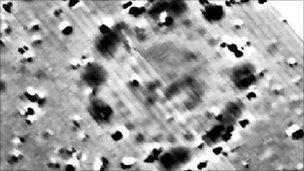 Archaeologists
have discovered a second Henge
at Stonehenge, described as the
most exciting find there in 50
years. Archaeologists
have discovered a second Henge
at Stonehenge, described as the
most exciting find there in 50
years.
The circular
ditch surrounding a smaller
circle of deep pits about a
metre (3ft) wide has been
unearthed at the world-famous
site in Wiltshire.
Archaeologists conducting a
multi-million pound study
believe timber posts were in the
pits. It is orientated towards
the great Stonehenge monument.
Project leader
Professor Vince Gaffney, from
the University of Birmingham,
said the discovery was
"exceptional".
The new "henge" -
which means a circular monument
dating to Neolithic and Bronze
Ages - is situated about 900m
(2,950ft) from the giant stones
on Salisbury Plain.
"It's
a timber equivalent to
Stonehenge� said
Professor Vince Gaffney
University of Birmingham
Images show it
has two entrances on the
north-east and south-west sides
and inside the circle is a
burial mound on top which
appeared much later, Professor
Gaffney said.
'You seem to
have a large-ditched
feature, but it seems to be
made of individual scoops
rather than just a straight
trench," he said. 'When we
looked a bit more closely,
we then realised there was a
ring of pits about a metre
wide going all the way
around the edge. When you
see that as an
archaeologist, you just
looked at it and thought,
'that's a henge monument' -
it's a timber equivalent to
Stonehenge. From the general
shape, we would guess it
dates backs to about the
time when Stonehenge was
emerging at its most
complex. This is probably
the first major ceremonial
monument that has been found
in the past 50 years or so'.
Archaeologists
say the find is
"exceptional"
"This is
really quite interesting and
exceptional, it starts to give
us a different perspective of
the landscape."
(Link to
full article)
Bluestonehenge: The Second Stone Circle.
Article: New henge-circle
discovered near Stonehenge (2009)
British archaeologists have found the remains of a
massive stone henge, or ceremonial circle, that was part of the
ancient and celebrated Stonehenge complex, a find that is shedding
new light on how the monument was built and its religious uses.
The new henge, called 'Bluestonehenge' because it was built
with blue Preseli dolerite mined more than 150 miles away in Wales,
was on the banks of the River Avon, where ancient pilgrims carrying
the ashes of their dead relatives began the journey from the river
to Stonehenge, nearly two miles away. Some are calling it the
"little sister" of Stonehenge.
The approximately 25 massive bluestones were erected in a circle about
5,000 years ago, and eventually were encircled by a ditch and an
earthen embankment. About 500 years later, however, the stones were
moved and incorporated into Stonehenge itself. All that is left of
the circle are the holes where the stones sat in the ground and a
few chips of dolerite.
The fact that the monument was found at the beginning of an avenue
leading to Stonehenge and near the river "not only solidifies the
view that Stonehenge covers the entire landscape, but also the
sacred importance of the river itself," said archaeologist Christine
Hastorf of UC Berkeley, who was not involved in the research.
"It means that there was a link between Stonehenge and the water, out
to the ocean," she said.
So far, they have found nine holes that they believe
were part of a 30-foot-wide circle of about 25 standing stones. The
holes are too wide and shallow for them to have contained wooden
posts. The holes are also too small to have held sarsen stones, the
larger limestone rocks that form part of Stonehenge and that were
mined at Marlborough Downs 25 miles to the north.
But the dimensions correlate precisely with those of bluestones in the
inner circle of Stonehenge.
The stone circle at 'Bluestonehenge' was eventually replaced by a
henge, a circular ditch nearly 74 feet across with an external bank.
Broken antler pickaxes in the ditch date its construction to about
2470 BC to 2280 BC. At least one entrance has been discovered, on
the east side, and it contained a specially placed deposit of
antlers, an antler pickaxe, cattle bones and stone and flint tools.
The team also found the riverside end of the avenue to Stonehenge. It
was marked by two parallel ditches about 54 feet apart. These
originally held posts, forming a small palisade on either side. The
avenue apparently terminated at or close to the outer bank of the
newly discovered henge.
Archaeologist Josh Pollard of Bristol University, a co-director of the
project, noted that the circle "should be considered an integral
part of Stonehenge rather than a separate monument, and it offers
tremendous insight into the history of its famous neighbour."
Previous research had shown that Stonehenge originally consisted of 56
bluestones set in a circle inside a ditch and bank. Sometime about
2500 BC, those stones were moved to their current location, leaving
behind the holes now known as Aubrey holes. But there are 80
bluestones in Stonehenge and only 56 Aubrey holes, Parker Pearson
said.
"Where did the other 24 stones come from? I think we have solved that
problem. They uprooted the other circle and moved the stones. Why
they did it, we don't know."
But "what it tells us for sure is that the river is essential to
understanding Stonehenge," Parker Pearson added, because why else
would the ancient builders have erected a monument there? Burning
ceremonies appear to have been important rites at the site as well.
When the stones at Bluestonehenge were pulled out, a lot of topsoil
fell in, and that topsoil, the team found, is full of charcoal.
"They were building a lot of fires there. That may have been where
they were cremating bodies" before burying them at Stonehenge,
Parker Pearson said.
But the work is not done. For example, Parker Pearson said the team
thinks it has located the quarry where the sarsen stones were
excavated and is now working to confirm the identification.
The discovery was announced by the National Geographic Society, which
funded much of the research.
(Link to full article)
Stonehenge Dig:
BBC 'Timewatch' (2008)
Following the archaeological dig by BBC Timewatch at Stonehenge in
2008, a new theory emerged suggesting that the site may have once
acted as a prehistoric 'Lourdes'.
Prof's Darville
and Wainwright are convinced that the primary purpose of the
circle was akin to a "Neolithic Lourdes" - a place where people
went on a pilgrimage to get cured:
'A significant proportion of the newly
discovered Neolithic remains show clear signs of skeletal
trauma. Some had undergone operations to the skull, or had
walked with a limp, or had broken bones. Modern techniques have
established that many of these people had clearly travelled huge
distances to get to south-west England, suggesting they were
seeking supernatural help for their ills'.
'Darvill and Wainwright have also traced
the bluestones - to the exact spot they came from in the Preseli
hills, 250km away in the far west of Wales. Neolithic
inscriptions found at this location indicate the ancient people
there believed the stones to be magical and for the local waters
to have healing properties'.
Q. Has someone managed to decipher a
Neolithic script?
While this theory may well have substance, it
fails to take into account the astronomical significance of the
location of Stonehenge, namely: There are only two
latitudes in the world at which you get the full moon on the
Zenith, at Stonehenge and
Almendres (Portugal),
in addition to which Stonehenge lies at the exact latitude at
which the Sun and the Moon have their maximum settings at 90 �
of each other.
Following the 2008 dig on the Aubrey Hole No 7,
it was announced that the compacted chalk showed signs of the
hole once having held a stone in it. The same compacted chalk
marks have been found in other Aubrey holes, which revives the
old theory that they were the original sitting places for the 56
Bluestones, which according to this report, would have been
there since Stonehenge I. c. 3,000 BC.
'Contrary to claims made in the recent BBC
Timewatch film, which promoted a theory of Stonehenge as a
healing centre built after the practice of cremation burial had
ceased, standing stones and burial of the dead may have been
prominent aspects of Stonehenge�s meaning and purpose for a
millennium'.
(15)
(Link to article on BBC Website)
Bluestones in the Aubrey Holes:
Article: Arts and Humanities Research
Council. (2008) -
A new excavation of Stonehenge, funded by the Arts and Humanities
Research Council, has revealed that one of the Aubrey holes probably held a
standing stone.
'The excavation of Aubrey Hole 7 was directed
over one week in August 2008 by Mike Parker-Pearson, Mike Pitts and
Julian Richards for the Stonehenge Riverside Project... The pit had
already been excavated twice: when discovered in 1920, and again in
1935 when all the cremated human bone found earlier at Stonehenge
was reburied. Recovery of this bone for modern examination was the
prime goal of the new dig (the bone was in excellent condition, and
study will begin over the winter).
Another reason was to look at the Aubrey Hole
itself � the first to be seen open since 1950. It was believed that
these pits had been dug for oak poles, but Parker-Pearson had
revived an old interpretation that they had held bluestones: the
evidence of crushed and compacted chalk had been recorded in 1920 in
three of the pits. He says, �Aubrey Hole 7 had crushed chalk on its
base indicative of a standing stone. This had been missed by
archaeologists twice before: it seems likely that similar evidence
still survives in other Aubrey Holes. We propose that very early in
Stonehenge�s history, 56 Welsh bluestones stood in a ring 285 feet 6
inches (87m) across�. He concludes, �This has sweeping implications
for our understanding of Stonehenge.�
Professor Mike Parker-Pearson at the University
of Sheffield says, �If all 56 pits had held stones, this would have
been one of the first and largest stone circles in the country, made
of Welsh bluestones in 3,000 BC. A recent claim that these stones
arrived at Stonehenge in 2,300 BC would then relate to the time when
the bluestones were moved into the centre of the site 700 years
later. Stonehenge�s history as envisaged since the 1950s is
overturned.�
The new evidence from Aubrey Hole 7 suggests
megaliths were present throughout Stonehenge�s existence. The first
three radiocarbon dates for human cremation burials, obtained in May
from the only bones then available for study, range between about
3,000 and 2,300 BC'.
(Link to full article)
The Amesbury Archer:
Article:
The 'Amesbury Archer' - King of Stonehenge: (2002)
'The latest
tests on the Amesbury Archer, whose grave astonished
archaeologists last year with the richness of its contents, show
he was originally from the Alps region, probably Switzerland,
Austria or Germany. The tests also show that the gold hair
tresses found in the grave are the earliest gold objects found
in Britain.
The grave of
the Archer, who lived around 2,300BC, contained about 100 items,
more than ten times as many objects as any other burial site
from this time. When details were released, the media dubbed the
Archer �The King of Stonehenge�.
The grave
was found three miles from Stonehenge, near Amesbury in
Wiltshire, last May during an excavation by Wessex Archaeology,
based nearby at Salisbury, in advance of the building of a new
housing scheme and school.
The Archer
was obviously an important man, and because he lived at the same
time that the stones at Stonehenge were first being built,
archaeologists believe he may have been involved in its
creation.
Tests were
carried out on the Archer�s teeth and bones and on the objects
found in the grave, which included two gold hair tresses, three
copper knives, flint arrowheads, wrist-guards and pottery. They
show that he came from the Alps region, and that the copper
knives came from Spain and France. This is evidence of the wide
trade network that existed in the early Bronze Age. The gold
dated to as early as 2,470 BC, the earliest gold objects found
in Britain'.
(Link to full article)
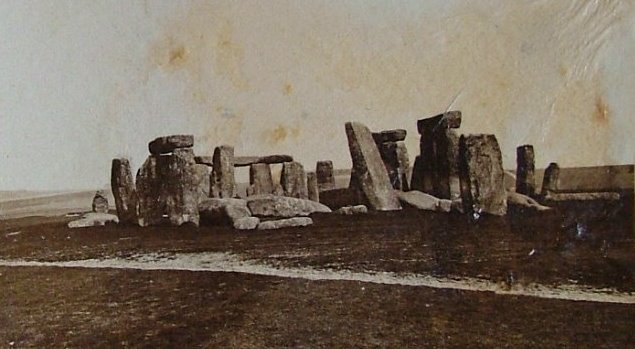
Early Image of Stonehenge from 1877.
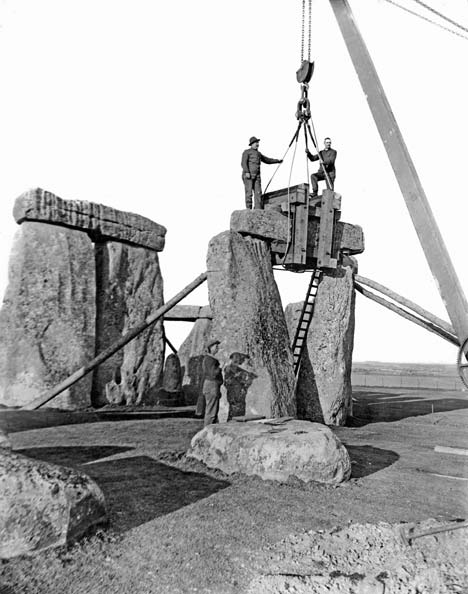
1920's Reconstruction.
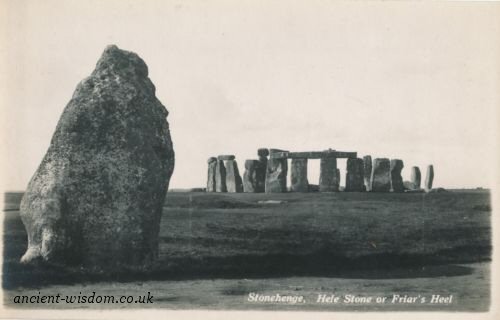
Old Postcard showing Silhouette of Face on the 'Hele' or
'Friars' stone.
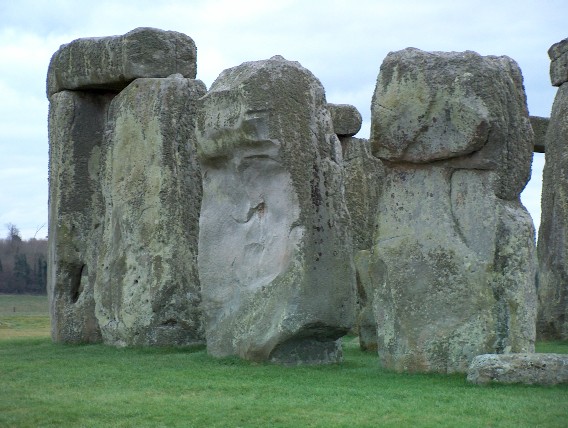
One of the newer 'faces' at Stonehenge.
(More about Simulacrum)
(Stone Circles)
(Henges)
(Archaeoastronomy)
(Megalithic Complexes)
(The Salisbury Complex)
(Prehistoric English Geodesy)
(Other Prehistoric English sites)
|