|
Location:
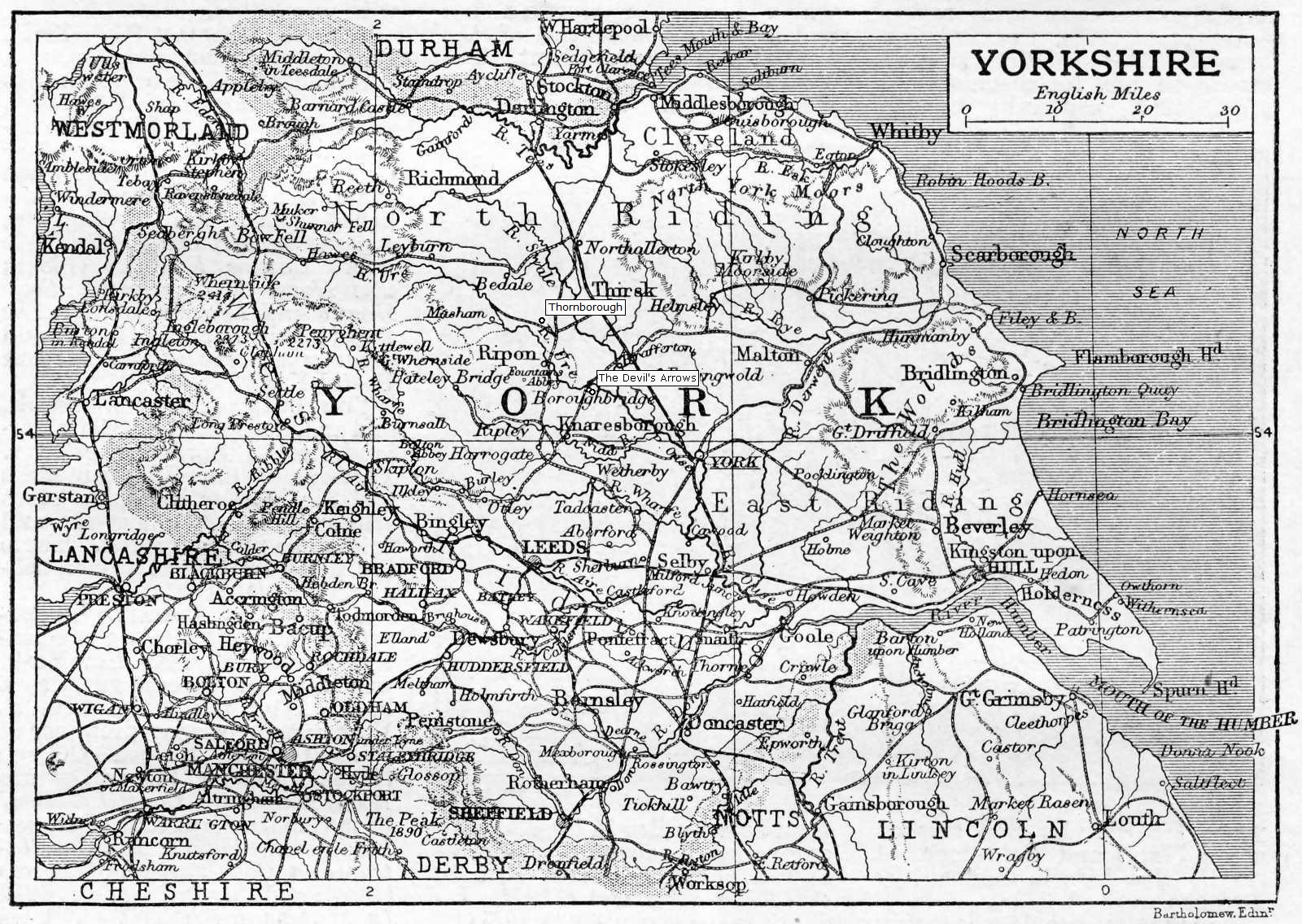
Yorkshire, England. |
Grid Reference:
54� 12' 13.9" N. 1� 33' 24.84" W |
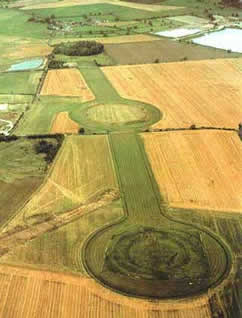
 Thornborough:
(Megalithic Complex).
Thornborough:
(Megalithic Complex).
Described by English Heritage as the most important ancient site between
Stonehenge and the Orkneys.
The Thornborough
Henges are part of a larger, sacred Neolithic landscape
which was used for over a thousand years. The Henges were built over a
pre-existing Cursus, which is no longer visible above ground; a part of which
has been irreversibly lost through the continued efforts of 'Tarmac PLC', to extract
the spirit of the site by quarrying around it.
Knight and Butler
proposed that the complex was positioned at 1/10th the planets
circumference from the pole (Based on a division of 366�).
The Henges all have circumferences of 732 megalithic yards (366 x
2), and the distance between the centres of the three Henges is 366
MR and 360 MR (4)
(1856
Map
with position of Cursus)
(Map of Location)
| The
Thornborough Complex: |
'The Stonehenge of the North'...
The
three Henges at Thornborough are a part of the ancient English
landscape. They follow the same
off-centre alignment seen at
other triple-circles in England. Even before the Henges were built, the
triple-circle was built over an existing Cursus,
suggesting that Thornborough was already
an important ritual
centre to the Neolithic residents between 4,000 and 2,000 BC, and
although we have little or no idea of what the rituals were, it is
proposed that they were partly astronomical in nature.
Description of the Site:
The Cursus: The central
Henge
was built over a previously existing Cursus, which is 1.1km long and 44m
wide. although nothing is visible of the Cursus now, and digging has
unfortunately ruined the western end of the Cursus, the eastern end is
hopefully going to be protected under new agreements.
The Henges: All three are
unusual in that the banks are constructed from the earth of two ditches;
one dug around the outside of the Henge, and the other excavated inside.
In all case the internal ditch was of neater, better construction and a
broad
berm
lies between it and the bank. A small excavation at the
central circle revealed that the banks had once been covered with a
layer of gypsum. This would have made them appear gleaming white.
The Geodetic Placement of Thornborough.
The realisation
that the circumference of the Thornborough Henges were 722 MY,
led Knight and Butler (4)
to propose that the Henges
were used as an 'observatory' for viewing the motions of Orion
in particular. They also pointed out that the Henge at
Stonehenge has a circumference of 366 MY (as does the Dorchester
Big-rings Henge). In accordance with their 366� theory,
the authors show that Thornborough sits at exactly 1/10th of the
planets circumference from the pole, and remarkably, that the
three Henges are separated from each other by 360 MR and 366 MR.
The apparent relationship between Triple
Henges/Stone Circles and Orion is continued at several other
sites in UK and around the ancient world.
|
An Orientation to
Orion...?
It has been
suggested that the three Henges at Thornborough were constructed
so as to imitate the three stars of Orion's belt.
(4) Should this be
the case, then one has to question if other triple circles/Henges
in Britain may have also been constructed for the same purpose.
The first major
monument on the site was built around 3,500 BC. This was a 1.2 km
long processional way, aligned so its western end pointed towards
the mid-winter setting of Orion. This also meant the eastern end
aligned to the midsummer solstice.
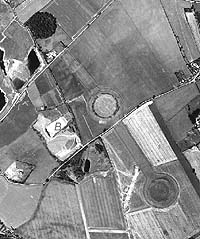 Then,
around 3000 BC, when the three Henges at Thornborough were
constructed, they appear to have been deliberately laid out to
mirror Orion�s Belt. Not only this, but their southern entrances
framed the rising of the bright star, Sirius, which in turn meant
their axis aligned on the midwinter solstice. Then,
around 3000 BC, when the three Henges at Thornborough were
constructed, they appear to have been deliberately laid out to
mirror Orion�s Belt. Not only this, but their southern entrances
framed the rising of the bright star, Sirius, which in turn meant
their axis aligned on the midwinter solstice.
In an article
by Dr Harding, he explained: �Thornborough was a sacred landscape,
a place of religious worship, and we should try to interpret these
astronomical orientations within that context.
�This
astronomical association was emphasised by the banks of the Henges
being coated in brilliant white gypsum. Neolithic people surely
felt they were at the centre of the very cosmos as they worshipped
the heavens above.�
Professor Clive
Ruggles, author of Astronomy in Prehistoric Britain and
Ireland, was not so convinced by the Orion's belt layout of
the Henges.
In 2003,
following a television documentary on Thornborough, he wrote on
his
website: �The idea that the configuration of the Henges
themselves formed a spatial representation of the three stars is
something that I view with considerable scepticism.� He did,
however, concede that it is plausible that the rising of the
stars, in relation to the local landscape, may have been
significant. He said:
� For
the record, it is the other aspects of the astronomical arguments
at Thornborough, notably the various alignments upon the horizon
rising position of Orion's Belt, combined with the other evidence
for Thornborough being some sort of pilgrimage centre, that
combine to make a plausible case that the heliacal rising of
Orion's Belt was the trigger that caused people to set out on
their journey to the site from afar for an autumn ceremony.�
(Orion
Worship and Triple Circles)
The Hurlers Stone
Circles, Cornwall.
The 'Hurlers' triple stone circles
in England have also been observed to have been laid so as to be
aligned to mirror Orion's belt which would have risen through
the southern circle on the winter solstice at the time it was
built c. 1500 BC. They lie on the Eastern end of the
St. Michael's Leyline.
(More
about the Hurlers) |
Alignments:
All three of the
Thornborough Henges have two entrances which are aligned, like the Henge alignment
itself, roughly NW-SE, which again is typical, and were laid out at
approximately equal intervals along an alignment about 1.6 km (1 mile) in
length.
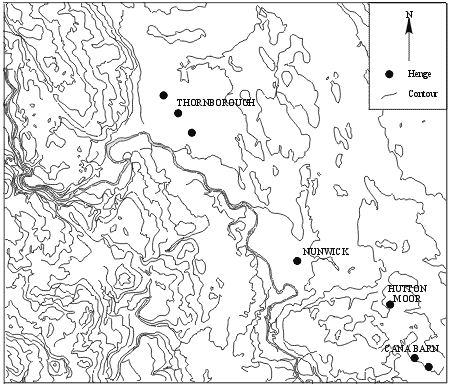
The Thornborough henges alignment
continues south through Nunwick henge to meet the 'Devil's arrows'
around 10 km S.E. There are also another four henges in the vicinity,
which one assumes were also a part of the sacred landscape around
Thornborough.
|
Quarrying at
Thornborough:
Controversial
plans to extend a quarry close to an ancient monument in North
Yorkshire have recently (Aug 2008), been given the go-ahead for
the second time, according to the BBC (Link
to article).
The mighty
'Tarmac' organisation have highlighted the importance of the
Thornborough complex again recently through their plans to
continue excavating the periphery of this site. Considering the
value of the site, as confirmed by the statement from English
Heritage that Thornborough is 'The most important site between
the Orkneys and Stonehenge', ones imagination boggles at the
fact that contractors have been once again given the go-ahead to
continue quarrying.
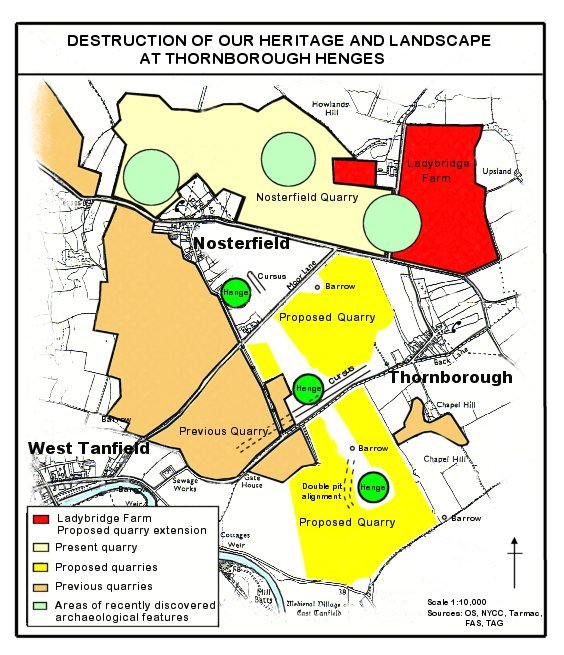
What seems to be
eluding the organisers of this project is that the three henges
are not in isolation here. On the contrary, they are the centre of
an important sacred landscape, which was used for over a thousand
years. The result of quarrying the surrounding area is the
wholesale destruction of parts of this landscape, which will be
irreversibly lost to future (and perhaps wiser), generations.
(More
about Desecrated Megaliths)
(www.friendsofthornborough)
( www.worldheritage.org)
|
|