The Maltese islands possess a rich selection of prehistoric remains.
It is home to over 40 pre-historic temples
(including those on Gozo and Camino)
(2).
Their frequency and attention to detail leave no doubt as to Malta's
importance in the past.
Quick Links:
|
Malta has
been host to several ancient cultures and is
home to some of the oldest free-standing structure in the world. (See
Skorba Temples,
estimated at 5,200 BC). It was home to a race of Neolithic builders whose
temples show several specific similarities to the western
European megaliths and at the same time, have a unique style of their
own, suggested to have been the result of a phase of independent
'evolution' on the islands.
'By
10,000 B.P. the Maltese archipelago was as we see it today'.
Most of the temples are believed to have
built between 3,600 and 2,500 BC, with the 'bulk
of the work finished before 3,200 BC' (2).
(Click here for Map
of Prehistoric Malta).
|
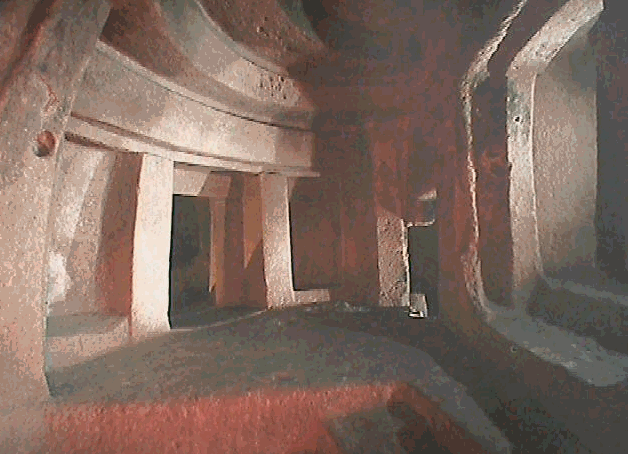 The Hypogeum (of Hal-Saflieni) - Probably the most well known
megalithic site on Malta is the
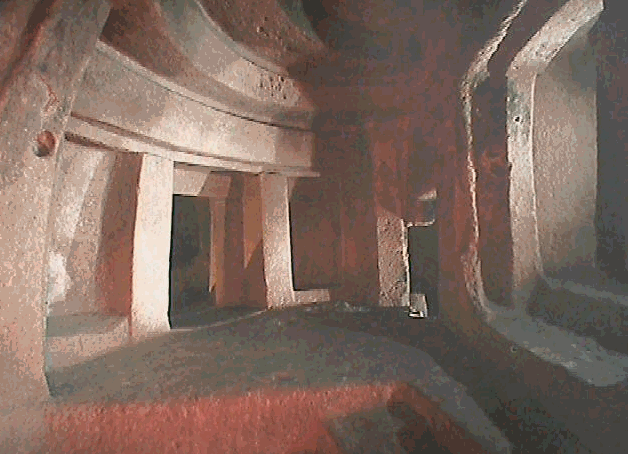
Hypogeum, a carved-out underground complex
from which the remains of 7,000 human skeletons were found (although
only a hand-full now remain). The Hypogeum (of Hal-Saflieni) - Probably the most well known
megalithic site on Malta is the
Hypogeum, a carved-out underground complex
from which the remains of 7,000 human skeletons were found (although
only a hand-full now remain).
The
Hypogeum offers a unique insight into the mind of the Maltese temple
builders, and the discovery of a second Hypogeum on Gozo (Hypogeum
II), reinforces the image of a people preoccupied with the rituals of
life and death.
(More about the Hypogeum)
|
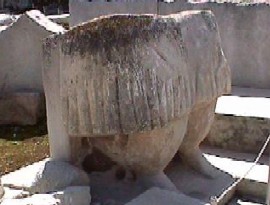
Hal Tarxien - The
22 acre 'partner-site' to the
Hypogeum, the Hal-Tarxien has yielded an incredible array of sophisticated
skills and images including an immense 'mother earth' figure, spirals,
trilithons, holed stones and more.
The quality of work at this site betrays the existence of
an extremely sophisticated and skilled culture.
(More
about Hal Tarxien)
|
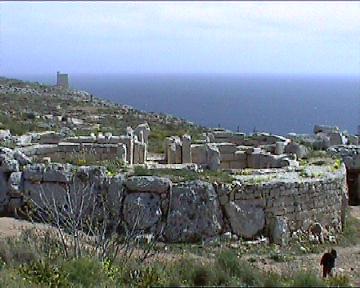
Mnajdra and Hagar Qim - These two temple
complexes were constructed in close proximity of each. They are a good
example of the 'paired-temple' theory which is prevalent across
Malta.
The temples at both sites are filled with 'Holed Stones'
and 'Mushroom' altars, suggesting a 'ceremonial' function. They are
shaped as most Maltese temples in the shape of the Earth-mother, and
were built with their entrances facing towards the sea and winter
solstice sun.
(More about
Mnajdra)
(More
about Hagar Qim) |
|
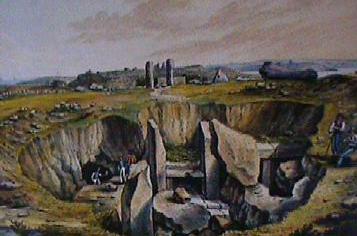
Ggantija
and the Xaghra stone-circle - These two
sites are the most prominent on the island of Gozo, and their close
proximity to each other classifies them as another example of 'paired
sites'. Of extreme interest is the fact that within and under the Xaghra
circle, a second hypogeum was discovered (The Hypogeum II), from which
the remains of approximately 700 human skeletons was recovered. The
obvious similarity to Hal Tarxien and the Hypogeum on Malta has led some
to consider the idea that other hypogea may be one day found on Malta.
(More about -
Ggantija,
Xaghra stone-circle,
Hypogeum II ) |
Malta is believed by some to be
the legendary island of Calypso that Homer's Odysseus landed on.
The strong ritualistic aspects of the
temples and it's position in the centre of the 'Medi-terra- nean'
(Middle of the earth, confirms Malta's
ancient status as an 'Earth-Navel'.
( Other
Earth Navel's)
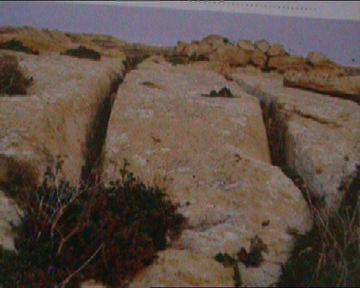 There are several excellent examples of
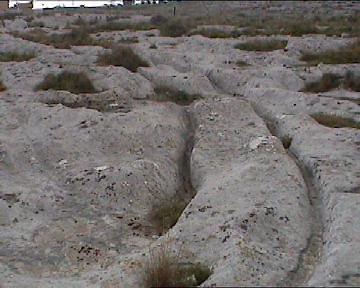
'Cart-ruts' on Malta (and Gozo), and in the waters surrounding the
islands too. For a long time now these rock-carved features have been
judged on their appearance only, and they certainly appear superficially
to have been the result of multitudes of passing vehicles. There are several excellent examples of
'Cart-ruts' on Malta (and Gozo), and in the waters surrounding the
islands too. For a long time now these rock-carved features have been
judged on their appearance only, and they certainly appear superficially
to have been the result of multitudes of passing vehicles.
Although this theory is likely to be correct in essence,
there are several stubborn contentions to this idea, such as:
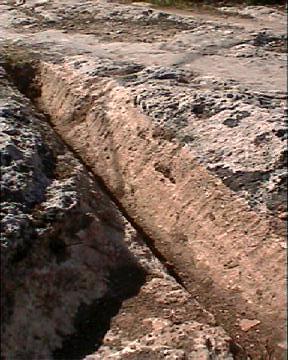
There is no evidence of the wheel at any time in
Maltese history.
There are examples of single ruts in the water around the island.
(2)
In one case, the ruts can be seen to run at an angle
of 45�.
(1)
The ruts invariably have smooth, almost polished
surfaces.
The deepest ruts are claimed to be around a metre deep
and a metre wide at the surface.
(2)
In 2005, the European commission sponsored an
international research program to identify the true nature of these
ruts, which have now been found in several other countries, but nowhere
more prolific than in Malta.
(More about Maltese
cart-ruts)
(Cart-ruts from other countries)
It can been seen that many of the sites
were often sited in pairs (i.e. Hal Tarxien/Hypogeum, Mnajdra/Hagar-Qim,
Ggantija/ Xaghra), and that
at some of these sites, the temples themselves were also constructed in pairs.
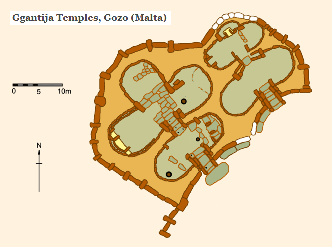
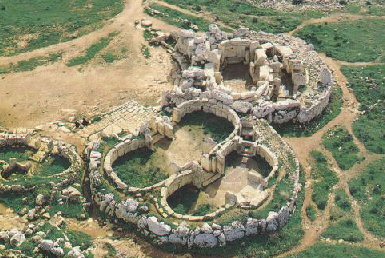
(Ggantija-left and
Mnajdra-right)
The interior shape of the temples is in fact 'cruciform', and similar in
principle to several astronomically orientated passage-mounds across Europe.
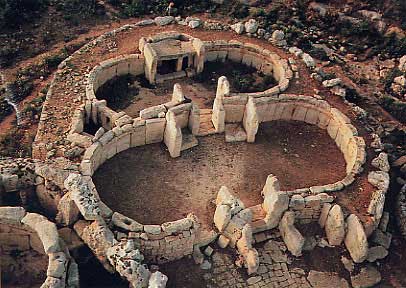
The Maltese temples, whilst retaining an internal cruciform shape, are rounded in
the same way as the 'headless' earth-mother figurines found across the island.
It was once claimed of Malta
that (with
the exception of
Mnajdra), 'There
are no significant astronomical alignments, they are all inward facing' (1).
However, in the light of new research which shows a clear
predominance for the orientation of most temples to the winter solstice,
and other other obvious discrepancies to this sweeping generalisation, this statement can no longer to be considered valid.
It seems, as with nearly all megalithic structures, that the
builders had a preference for orientating their structures towards key moments
of the celestial cycles. So frequent is this association that it becomes
tempting to suggest that the original function of the temples may have even been
to mark these events.
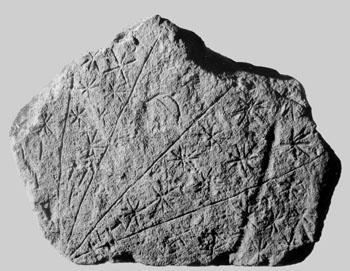
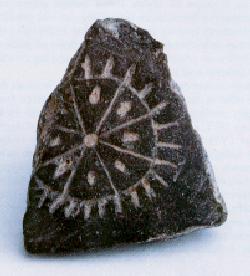
The best evidence that the inhabitants of Malta and Gozo were interested in
astronomy come in the form of discoveries of everyday objects such as this broken limestone slab from the Tal-Qadi Temple
(left) which has what certainly appears to be a representation of the heavens,
showing the moon and stars as well as a number of radiating lines dividing
it into quadrants, and the solar-wheel from a pottery shard found in
Hagar Qim
temple. With regards the temples themselves, at
Mnajdra in particular, there are several significant alignments to mark
moments of the solar year.
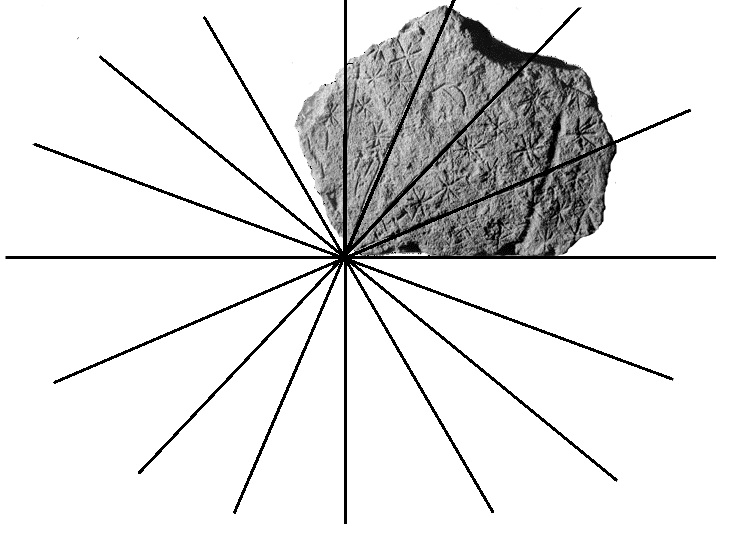
The Tal Qadi stone is believed to have
once been a disc. A projection shows that the sky was divided into
sixteen sections. The 'Solar-wheel' above is divided into eight
sections.
It is now
considered probable that most, if not all of the large prehistoric
temples on Malta would have originally been covered over. Combined with
an invariable orientation of the passages to either the equinoxes or the
solstices, the builders would have been able to use the temples
as a means of measuring the solar year exactly (in the same way as the
builders of the Irish and Scottish Passage-mounds did).
(Similarities with Western-European Neolithic
Complexes)
(More about Archaeoastronomy)
A common construction feature found in many of the Maltese temples are
the variously shaped holed-stones which perforate the structures in
various shapes and sizes.
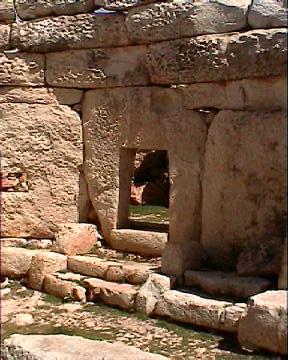
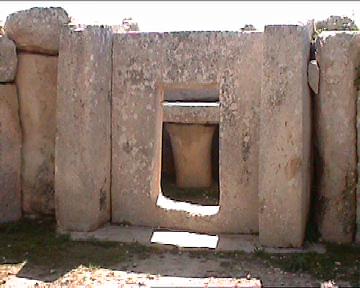
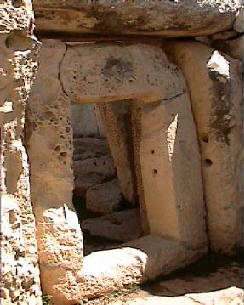
Some of these are easily recognisable as portals
(doorways), through which one passes from one chamber to another within
the temples.
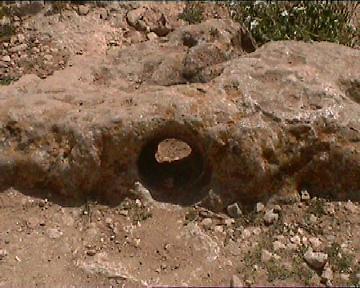
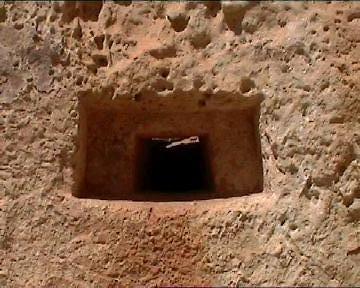
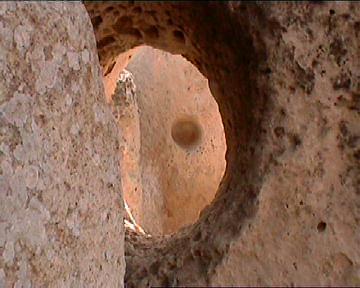
While the larger holes are easily explained, there are several smaller
holes in the temples that presumably served other functions.
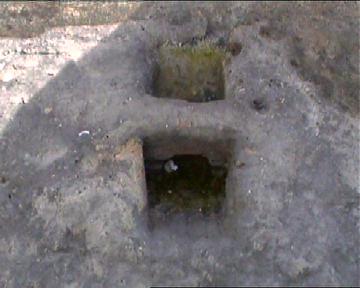 The
feature in the photo on the left was carved in a stone beside the sea, and was
presumably designed as a 'Hitching-point' for a boat. It is a curious fact that
many of the Maltese temples have similar 'Hitching points' on the
ground in front
of the main entrances. The
feature in the photo on the left was carved in a stone beside the sea, and was
presumably designed as a 'Hitching-point' for a boat. It is a curious fact that
many of the Maltese temples have similar 'Hitching points' on the
ground in front
of the main entrances.
The same design feature can also be seen on the vertical faces
of stones inside the temples, where they appear to have functioned as 'door hinges', a
construction technique
which can also be seen in several constructions throughout
ancient Egypt.
Holed stones are found in several other ancient and sacred sites from
around the world - and in each case, they carry with them a tradition of
healing or benefit.
(More about Holed-Stones)
Maltese
Facts -
The Xewkija church on Gozo has the third largest dome
in Christendom, and was built on the site of an earlier Christian
structure, which in turn was built on the site of a large dolmen,
last recorded in the 17th century, and which was used as the
foundations of the church.
(3)
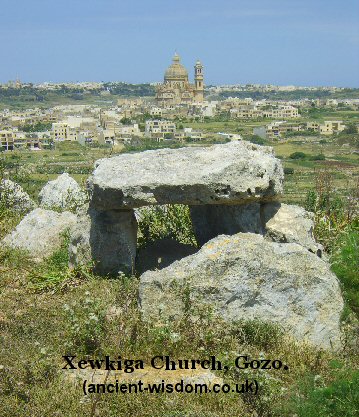
Xewkija Church, once itself the site of a large dolmen,
is aligned with the Ggantija/Xaghra complex and the dolmen (Above).
(More
about Ta' Cenc Dolmen)
|
Maltese Concrete (Torba): |
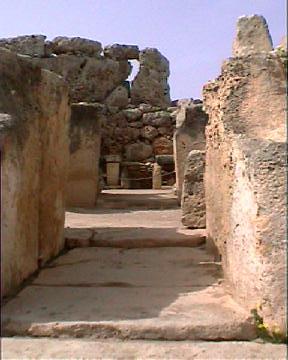
Ggantija, Malta
-
The
temples on Malta are claimed to be some of the oldest free-standing temples in the
world.
A. Service (6), mentions the 'contemporary cement of the floor'
in the pavement of the Ggantija temple on Gozo, Malta (see
left), and although
the idea was not accepted for a long time,
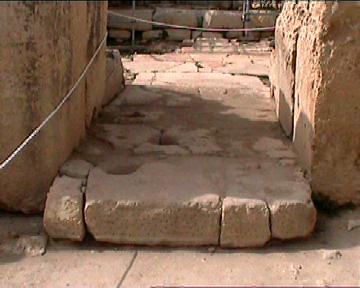
The pictures below show how some of the
temple floors
were lined with huge stones, a process visible at several Maltese temples (Tarxien,
left and
Ggantija,
right).
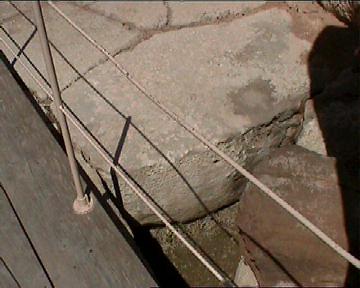
Unfortunately, today, the temple floors are covered over with planking
making it impossible to see the original floor.
(Other examples of
prehistoric 'concrete')
Several 'Venus
figurines' have been found on Malta.
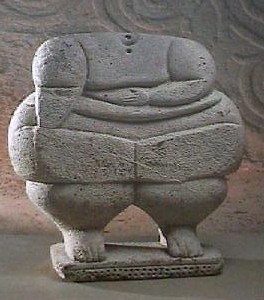
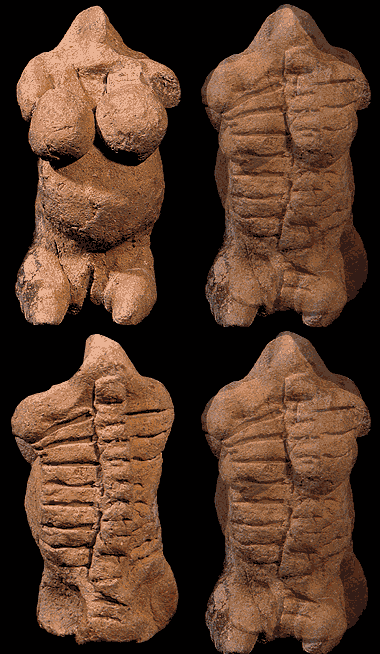
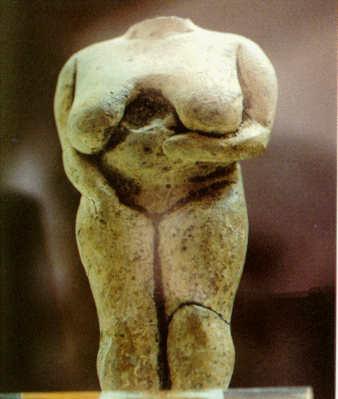
(left) One of the larger
statues, it is made from a broad shallow rectangular block of
globigerina limestone. Between the shoulders is a hole pierced
through from the front and one from the back. It seems that this
socket must have been used for the attachment of (different?)
heads to the body. In the pitted holes that cover the four sides
of the rectangular pedestal is the remains of a red pigment. The
statue was found during the restoration of 1949, with another
three headless statues and a fragment of a forth, from a hollow
under the raised threshold leading to the high room of the temple.
(centre) from Mnajdra, the back-bone and ribs are marked correctly
on the back. (Right) from Hagar Qim. Made from hard-fired buff
clay with a grey core its head and feet are broken off. The
modelling of the figurine is extremely good, especially on the
back. It was found in the first room of the temple, next to the
spiral slab, in 1839. Its size is 13 cm (5 inches) high and 6.5 cm
(2.5 inches) wide at the shoulders.
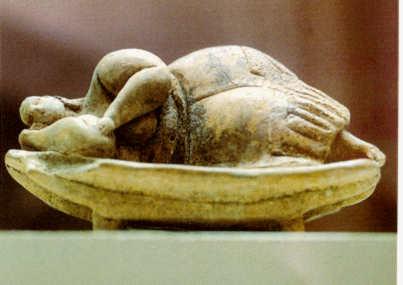
The sleeping Lady from
the Hypogeum of Hal Saflieni is made of brown clay and on the
surface it has traces of red ochre. The clothed figure has
abnormally fat limbs and hips. She is naked to the waist and has a
skirt with a fringed lower part. The feet are broken away. The
wooden framework of the bed and the rush mattress is clearly
visible underneath the statuette. According to Sir Temi Zammit, it
was found in the 'snake/votive pit' in the main level of the
Hypogeum of Hal Saflieni.
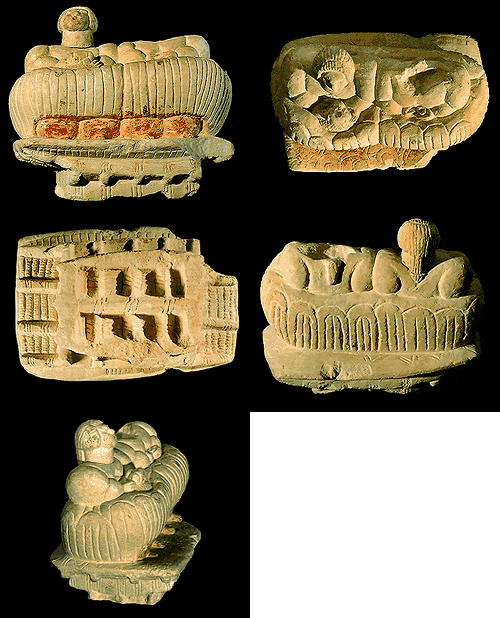
This limestone statuette was found during
the excavation of the Xaghra Circle.
It was found close to what would have been the entrance into the
underground chambers. The obese figures lie on a 'bed' similar to
the 'bed' that supports the Hypogeum Sleeping Lady clay statuette.
On this particular 'bed', spiral designs are visible. Parts of the
body are covered with red ochre and the skirts show the remains of
black ochre. The obese couple are similar to the big statue of
Tarxien, and also have the same type of pleated dress and obese
calves. Only one head was found and it had broken from the main
body of the sculpture. On the lap of the left figure is a tiny
(also headless) obese baby figure similar to the two 'bigger'
figures. The other figure holds a small pot.
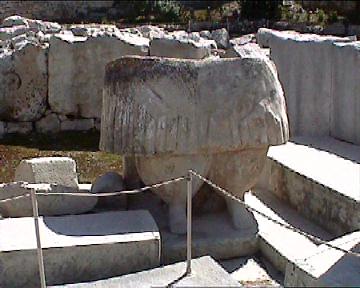
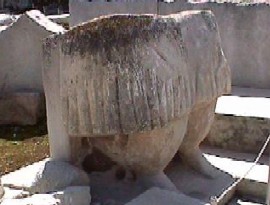
The discovery of the large
Earth-mother figure in Hal-Tarxien, near the Hypogeum confirms the
idea that the builders of the megaliths on Malta worshipped a
female deity or were governed by females.This larger-than-life female statue stands on
the right as one enters the Hal-Tarxien temple complex. The top half is missing, as is the
head of several of the figurines.
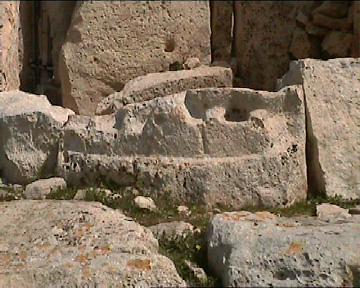
Hagar Qim (left),
Xhagra (right)
It is interesting to note that the Goddess
figurines also come in pairs. Something seen at �atal H�y�k in turkey.
As yet there is no reasonable explanation for this (in terms of the
'mother-goddess' theory). At both �atal
H�y�k and on Malta, the small figurines were made with removable
heads.
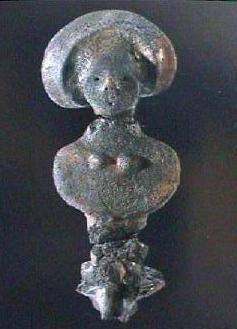
This female form (of a completely different
style) was found in the Hypogeum II,
on Gozo island..
(More about Venus Figurines)
|
The Mysterious Disappearance of the Maltese
Skulls.
It was public knowledge that until 1985 a number of skulls,
found in pre-historic Maltese temples at Taxien, Ggantja and Hal
Saflienti, were exposed in the Archaeological Museum in Valletta.
They have since disappeared without a trace.
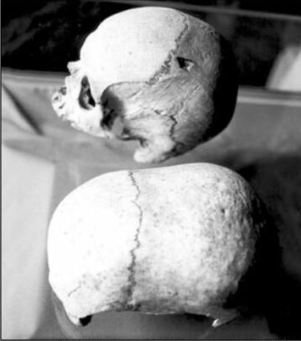 'Only the photographs taken by the Maltese
researcher Dr. Anton Mifsud and his colleague, Dr. Charles Savona
Ventura, remain to testify the existence of the skulls and
prove their abnormality. Books written by the two Maltese doctors,
illustrate a collection of skulls
that show peculiar abnormalities and/or pathologies. Sometimes
inexistent cranial knitting lines, abnormally developed temporal
partitions, drilled and swollen occiputs as following recovered
traumas, but above all, a strange, lengthened skull, bigger and more
peculiar than the others, lacking of the median knitting. The
presence of this finding leads to a number of possible hypotheses in
consideration of other finds of similar skulls, from Egypt to South
America, the particular deformity, unique in the panorama of medical
pathology referred to such distant times, (we are talking about
approximately 3000 BC) could be an exceptional discovery. 'Only the photographs taken by the Maltese
researcher Dr. Anton Mifsud and his colleague, Dr. Charles Savona
Ventura, remain to testify the existence of the skulls and
prove their abnormality. Books written by the two Maltese doctors,
illustrate a collection of skulls
that show peculiar abnormalities and/or pathologies. Sometimes
inexistent cranial knitting lines, abnormally developed temporal
partitions, drilled and swollen occiputs as following recovered
traumas, but above all, a strange, lengthened skull, bigger and more
peculiar than the others, lacking of the median knitting. The
presence of this finding leads to a number of possible hypotheses in
consideration of other finds of similar skulls, from Egypt to South
America, the particular deformity, unique in the panorama of medical
pathology referred to such distant times, (we are talking about
approximately 3000 BC) could be an exceptional discovery.
The skulls were all found in the Hal Saflienti
hypogeum, where a sacred well was dedicated to the Mother Goddess
and where also the small statue of a sleeping goddess was found,
associated to a relic with a snake inscription on it. One in
particular had a cranium showing a
very pronounced dolichocephalous, in other words, a lengthened
posterior part of the skullcap, besides the lack of median knitting,
technically named "sagitta". This last detail has been
considered "impossible" by medics and anatomists, not having
analogous pathological cases in international medical literature. It
is a characteristic that emphasizes the anomaly of this finding with
the result of producing a natural lengthening of the cranium (not
due to bandaging or boards as used in pre-Colombian civilizations)'.
It is proposed, on the basis of these findings,
that the group of skulls found in the Hypogeum were representative
of a group of peoples who were considered of importance (as attested
to by the location of their discovery), and who had a natural
genetic tendency for elongated skulls, were integrally involved in
the activities of the temple builders of the time. Other skulls
found in the
Brochtorff
circle (Hypogeum II), are considered to have had
their heads bandaged in order to produce their cranial deformities.
(Extract from Hera Magazine, Italy: 1999)
From
NATIONAL GEOGRAPHIC MAGAZINE January to June, 1920 VOLUME XXXVII
"From an examination of the skeletons of the polished-stone age,
it appears that the early inhabitants of Malta were a race of
long-skulled people of lower medium height, akin to the early people
of Egypt, who spread westward along the north coast of Africa,
whence some went to Malta and Sicily and others to Sardinia and
Spain."
(More
about Prehistoric Malta)
|
|
List and Description of Featured Maltese Sites: |
(Click here for Map
of Prehistoric Malta).
The following sites are also found on Malta.
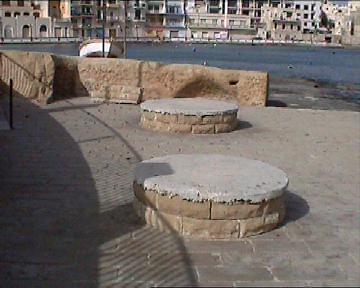
These covered over holes are actually rock-cut vases or
cisterns.
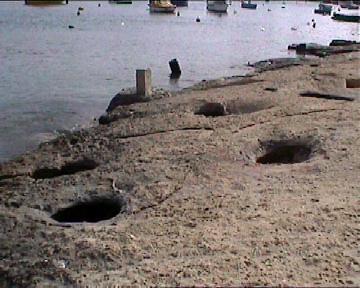
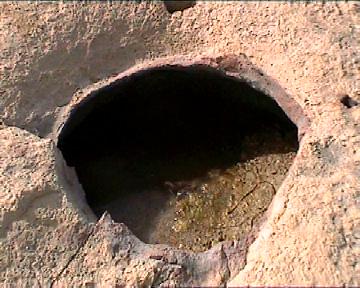
There are several of them cut into the rocks near St.
Georges bay next to a set of cart-ruts that runs into the sea. They are now
permanently filled with sand and shingle.
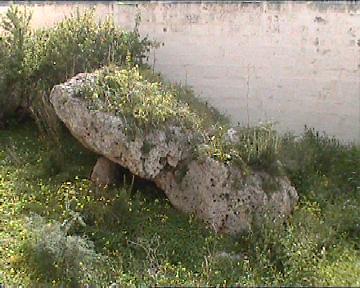
This collapsed dolmen is called the 'Sansuna' dolmen,
it lies in private ground between two houses.
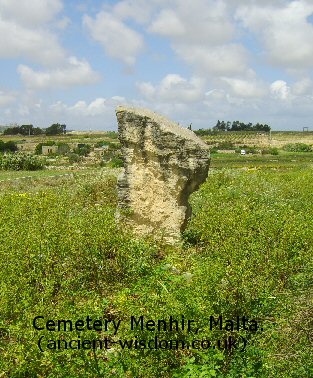
This menhir is obscured by the wall of a cemetery. It
stands over 3m high and is unmarked on the map or side of the road.
|


 Prehistoric Malta:
