|
Location: Gozo Island,
Malta. |
Grid Reference:
36� 2' 48 N, 14� 16' 10 E |
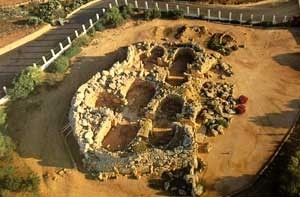
 Ggantija:
('The Work of Giants').
Ggantija:
('The Work of Giants').
The Ggantija temples are amongst the oldest temple structures on Malta.
Once the most prominent site on Gozo Island. The importance of this temple complex is only now outweighed
by the discovery of the 'Hypogeum II'
within and below the nearby
Xaghra Stone-Circle.
Numerous figurines and statues were found at
Ggantija, suggesting it served as a place of ritual or worship
(Click
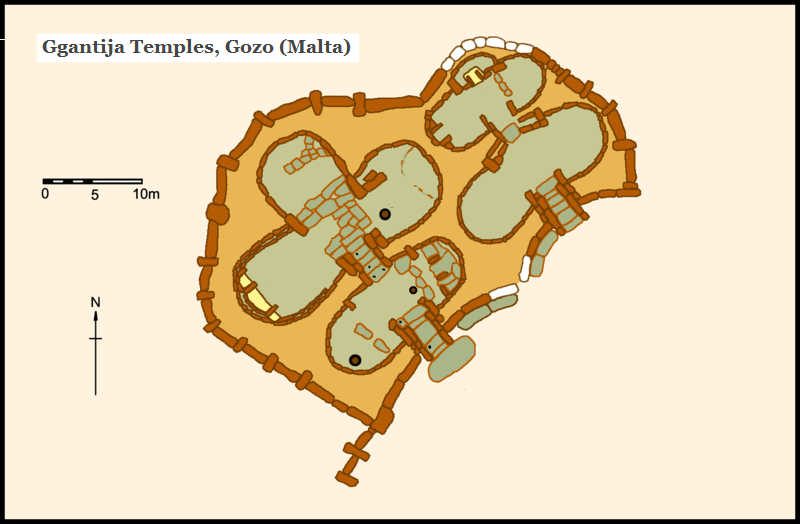
here for site-plan)
|
The Ggantija Temple Complex: |
The Ggantija temples stand at the end of the Xaghra plateau, facing towards
the south-east.
They are amongst the earliest of series of temples built c. 3,600 -
3,000 BC. They were first excavated in 1827.
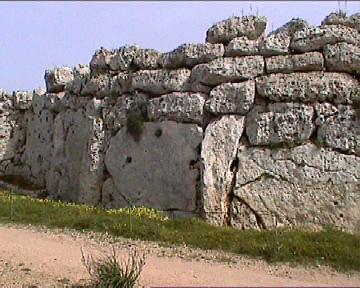
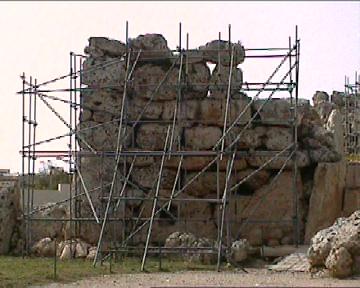
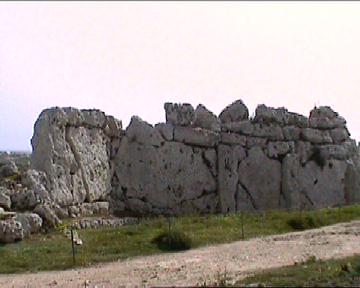
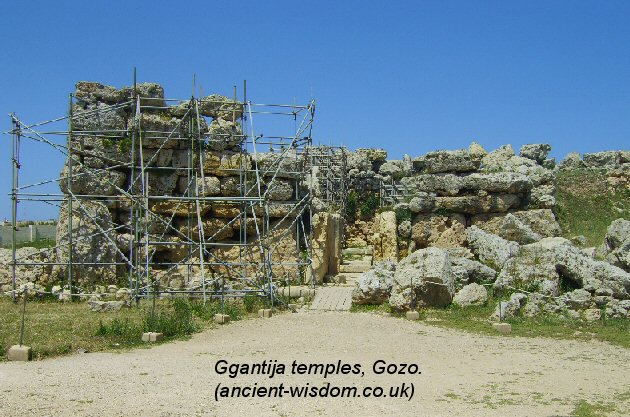
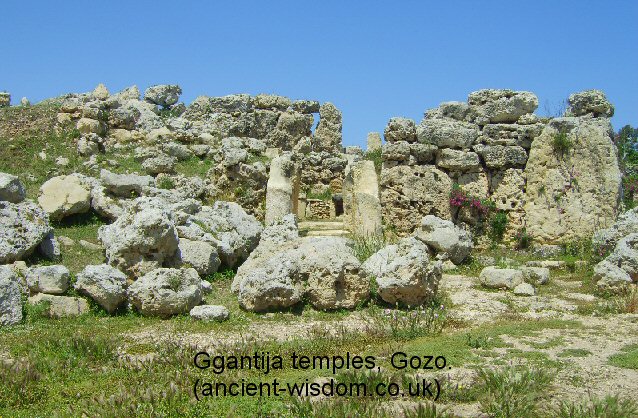
The exterior was built of immense limestone blocks, placed in a distinctive
style and covered with close fitting, horizontal limestone slabs rising to a height of 26ft
at the front. Because the temple was built into a hill, the rear walls
appear to be smaller from the outside. Malta is just visible between a notch
in the horizon offering the suggesting that the temple was built where it
was because of this (and the presence of several underground springs).
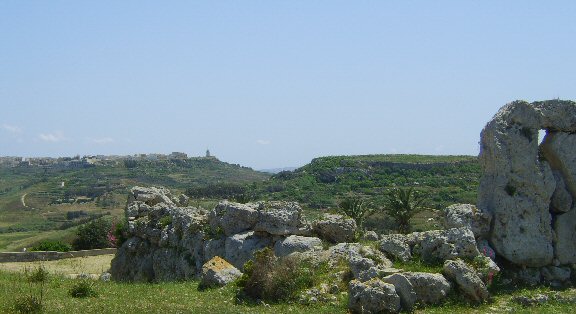
Malta can just be seen between the
two hills directly in front of Ggantija.
The temple complex was built
'into' the prehistoric landscape.
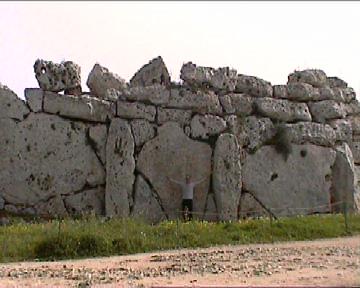
The
largest stone at Ggantija measures 5m x 8m x 4m = 160m�
(50 tons). As at the Tarxien on
Malta, a number of stone balls were discovered at the site and it is
believed that they were used for manipulating and supporting the stones.
(The top-50 largest stones)
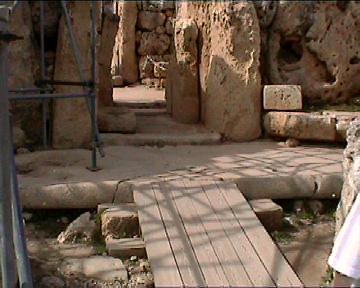
The massive floor slab at the
entrance to the temple.
(A. Service (1),
mentions the 'contemporary cement on the floor')
(Other examples of the prehistoric
use of cement)
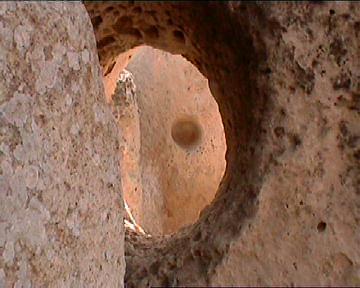
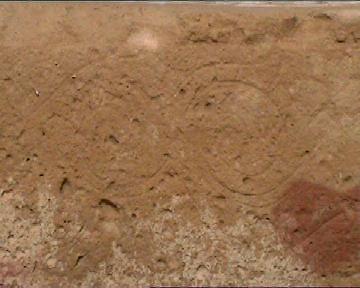
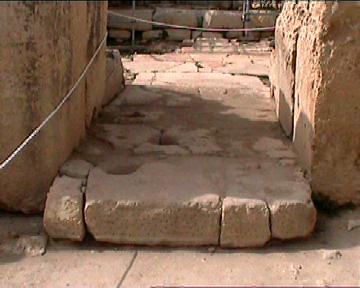
Many of the features
common to the other Maltese temples can also be found here.
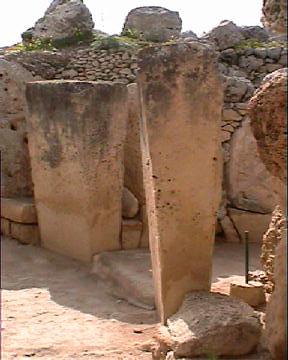
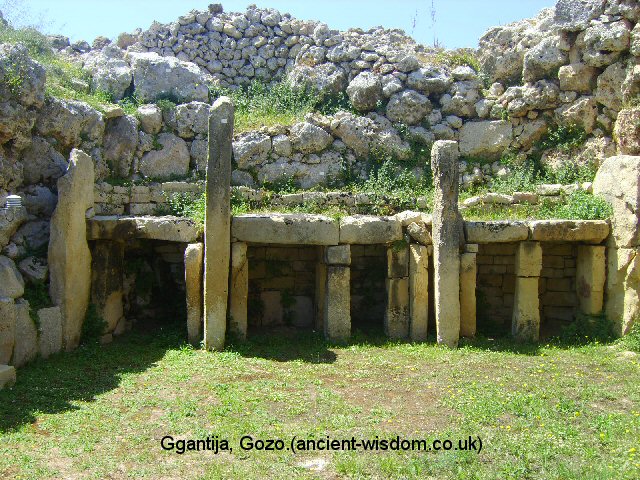
And other features which are unique to the site...
The southern temple is believed to be the older of the two,
dating back to 3,600 BC
(2), 3,400
(3).
The smaller northern temple and the external facade have been dated to
around 3,000 BC demonstrating their use over a long period of time.
The walls of the temples
rise to a height of six metres and are thought to have once been covered
over. The interior walls are not built in the same style as at other
temples, having a rough interior made of smaller, globulinous
limestone chunks, and without internally curved walls. The rough walling of the temple interior was originally smoothed by an
application of clay and coated with a thin layer of lime plaster.
|
The Ggantija complex.
Noticeably, the Ggantija complex is the only site of its kind on Gozo, and significantly, it is twinned with the Xhagra
circle, making the pair a classic example of the 'primal mound' / stone circle
combination commonly seen at many other Western European Neolithic complexes.
The deliberate orientation and placement of the temples is reminiscent of
Maes Howe on the Orkneys.
(More about the Western-European
Complexes)
|
Archaeo-astronomy.
The
temples are both orientated south-east with two slightly different azimuths
(125� and 135�).
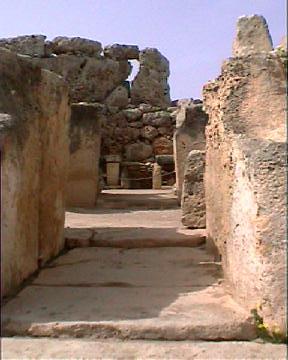
The altar at the far end of the southern temple
aligns to the winter solstice (see photo below), which would have
simultaneously set between the notch made by the two level hills on the
horizon .
Gallery of Images:
(Other Maltese sites) |