|
Location:
Tarxien, Paola, Malta. |
Grid Reference:
14� 30' 05" E, 35� 50' 00" N. |
 Hal Tarxien:
(The Tarxien temples).
Hal Tarxien:
(The Tarxien temples).
This temple complex lies close to the famed
Hypogeum. Dated to about
3,100-2,500 BC.
(2), 5,500
BC. (1).
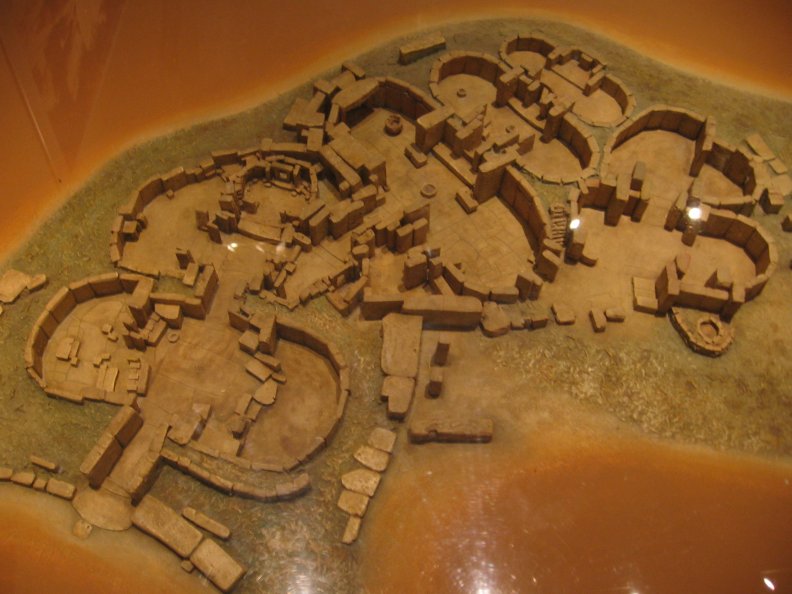
Several rooms have been excavated from a site that covers
several acres. Inside the monumental main entrance (which is a
modern reconstruction) of the temple, is the lower portion of a
'fertility goddess'. The South face of the temple houses a
spring-fed cistern. The central temple contains relief carvings
of bulls and running spirals. When first excavated, the interior
of these temples was noted to have been 'reddened by fire'
(1).
(Click
here for map of the site)
(Click here for
location on Malta)
This temple lies only several hundreds of yards from the Hal-Saflieni
Hypogeum, leading many to consider it the 'pair'
to the underground temple. While other temples on the islands were certainly
built with more grandiose stones, the wide variety of features and uses for
stone seen at Hal-Tarxien cannot be matched anywhere else.
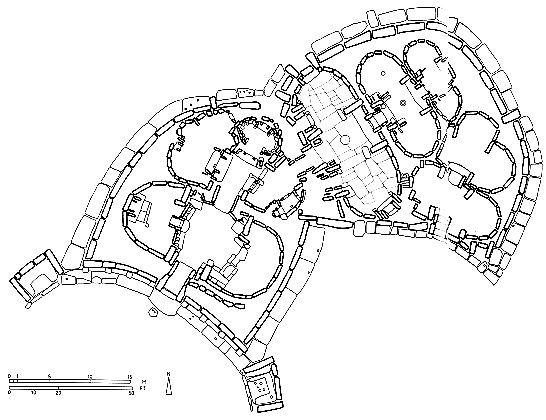
There are four distinct
temple units at Tarxien. The oldest one, smaller of size an separated from
the others, was built in the Ggantija phase and has the typical five-asped
plan, just like Ggantija temple itself. The other three are joined together
by a common outer wall. The middle temple was the last one to be erected and
was wedged between the other two, spoiling the symmetry of the complex
itself.
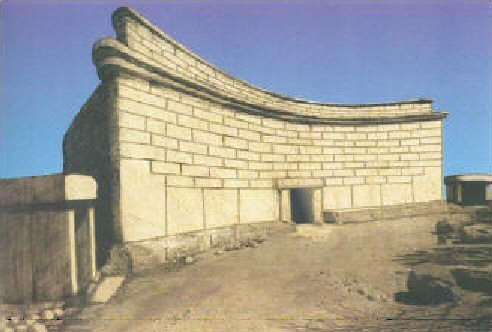
Reconstruction of the original facade
based on fragments of a small clay temple found in the ruins.
(Article on the reconstruction of the
original facade)
The Divination Blocks.
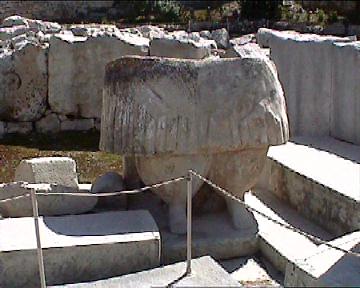
These huge rectangular blocks which lie to the
extreme right of the
entrance and to the left about 50ft each way are yet to be fully
understood. Originally, large
slabs stood at the back of these rectangular stones to form the
front wall of the building. Of these wall slabs only a fragment,
about 5ft wide remains behind the first block on the right. Each end
of the semi-circular front wall ends in a remarkable structure, of
which we can only conjecture a purpose. Zammit named these
structures 'Divination Blocks' due to a lack of similar features on
the island.
Only the stones on the right survives in any
reasonable condition. Zammit
(3)
described them as follows:
'...A step is cut in front, and a barrel-shaped stone stands before it.
The surface of this block is slightly concave in the middle, with a flat
ledge round three of its sides. Six conical pits, about 1 foot deep, are cut
deeply into this block, one on the edge and five on the square surface. The
use for which this block of stone was intended is not apparent.
As a great number of stone balls, varying between two and three inches in
diameter were found heaped up in the vicinity of this curious stone block,
one is induced to believe these balls were in some way connected with the
curious structure. The stones may have been thrown from a distance on the
surface o the block, wither in the course of some game or, better still, or
the purpose of divination... The line in which these pits were dug out has
suggested to some the idea of the constellation of the Southern Cross, for
example, which at the time when the temples were in use, was seen easily in
our hemisphere'.
(3)
The Trilithon Entrance to the temple
complex.
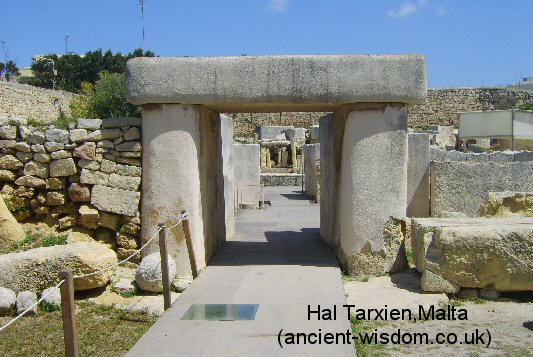
The
Trilithon entrance to the temple, now entirely restored in concrete..
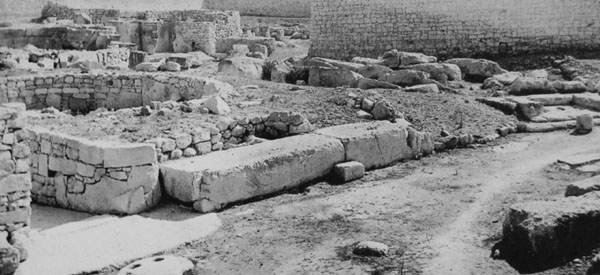
Original image - before restoration.
(Spot the difference).. Note the 'Divination' block on right.
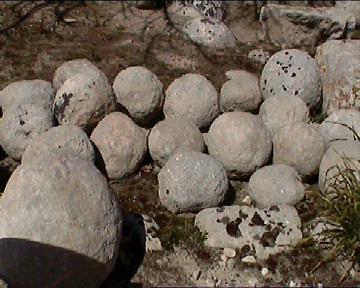
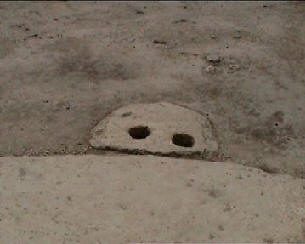
(left) A selection of stone balls, found
near the entrance, believed to have been used to 'roll' the larger stones
and/or for divination, (right) the stone 'hitching point'
in front of the temple, a feature common to all the temples across Malta.
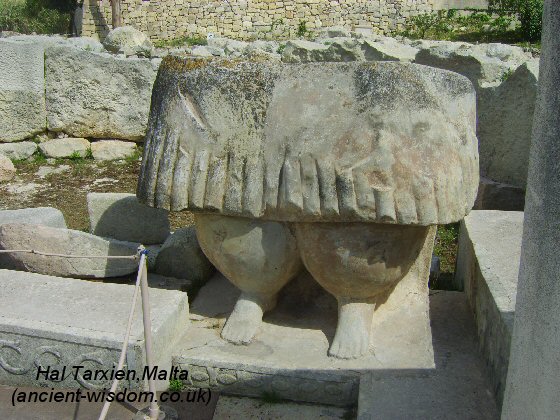
The reconstructed lower portions of the figure found on the inside right of
the entrance.
This is THE earth-mother-earth figure. The full-size model
would have stood over 3m high. It has been suggested that it may have represented
a male figure, but the numerous other female figurines found on Malta make
this idea very unlikely indeed. The original is balanced delicately in the
museum of archaeology, Valleta.
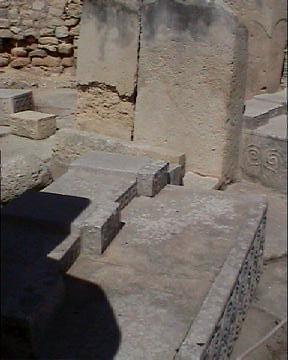
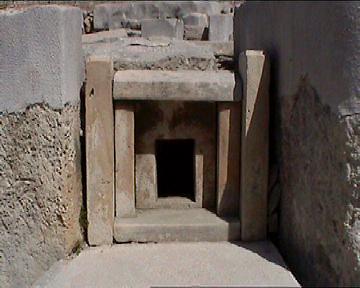
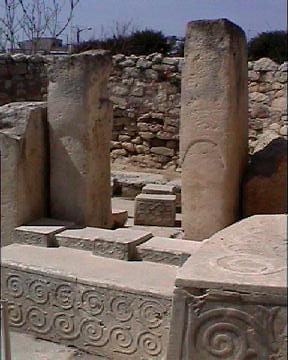
A plethora of sophisticated construction skills
(Note the pillars in the right hand photo have engravings
of ships on them)
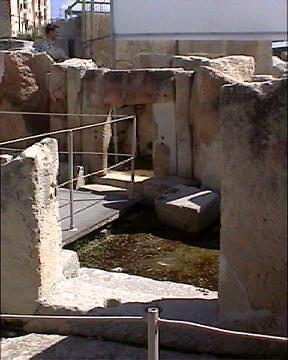
Familiar door-cut stones separate several of the chambers.
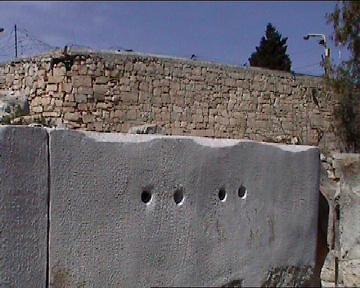
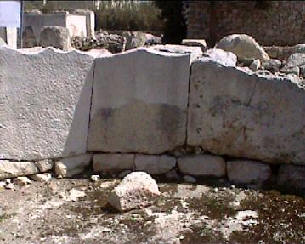

The tops of the stones are now concrete and were shaped like
this as their original height is unknown. They were destroyed by farming
while the site lay 3ft underground in Government fields.
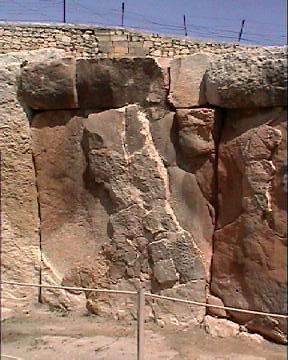
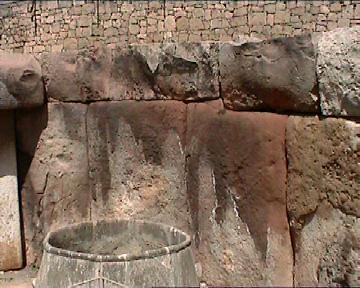
...but those still standing are fitted together with
beautifully squared corners.
(The stones of this apse have been fire damaged, and are
deteriorating).
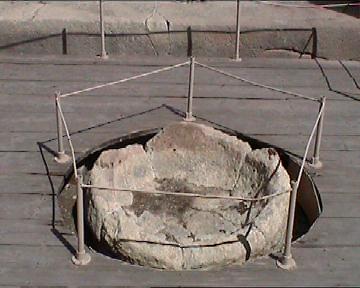
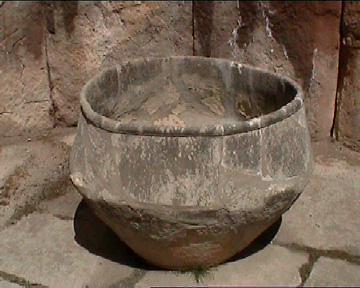
Left: Stone Hearth in the central area
between apses. Right: A huge stone-cut 'libation bowl', a
feature seen at several other prominent European megalithic sites such as
Newgrange and Knowth in Ireland, and
Maes Howe on the Orkneys, where they
are associated with cruciform chambers in passage-mounds.
(More about Cruciform Chambers)
The stone bowl was originally crushed by
the deteriorating temple, and then again in 1925 by 'evil
intentioned persons'.
(3)
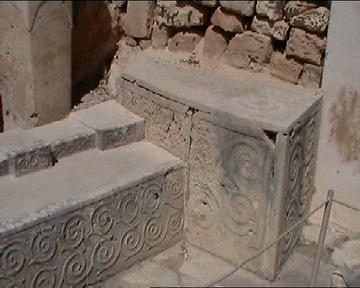
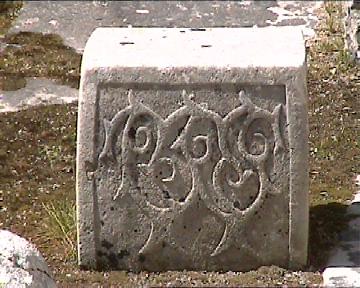
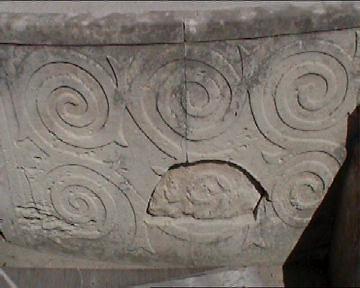
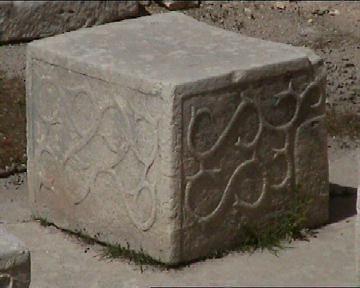
The
spiral was not present in the commonly known
European form. However, these numerous floral examples were similar to later Celtic
and Norse styles.
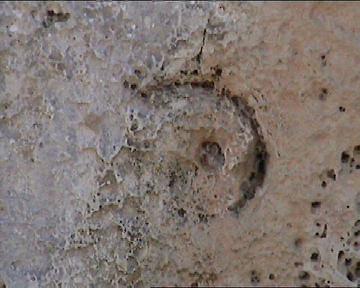
This spiral
(?) on the wall of the earth-mother
chamber, although less well preserved, follows the
traditional 'megalithic' design.
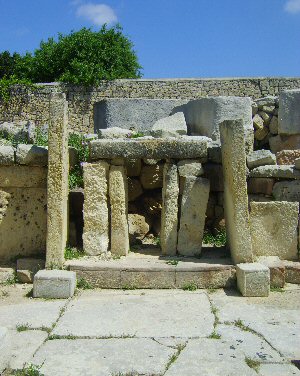
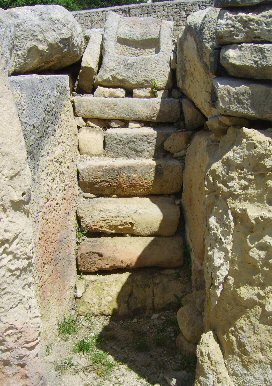
This site
is loaded with
terrific stone features. (left) The 'Holiest of holy's', (right) Secret stairs to
the 'second temple'. According to Zammit (3),
this flight of stairs once lead to the top of the walls. He Said of
them:
'Six of the steps are
laid between the walls, the last two in a block of stone
placed at the top of the stairs. These steps lead to a
terrace laid with beaten earth ending in the inner most
chambers of the second temple ... This stairway was used
as a secret passage to the second temple supplementing
the entrance obstructed by the decorated slabs ... The
recess in which the stairs are constructed was
originally part of the western apse, now reduced in
size, formerly as deep as the eastern apse'.
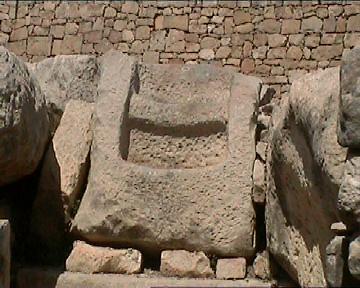
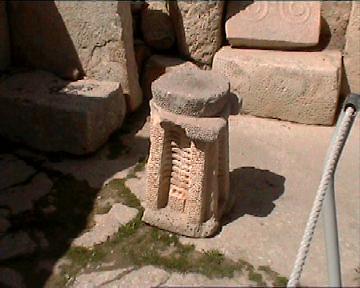
The stone now at the top of the stairs (left) shows a vague similarity to the
one found at
Hagar Qim
(Photo right). Are these the two 'steps' Zammit mentions
above.
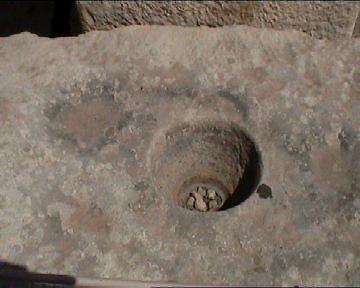
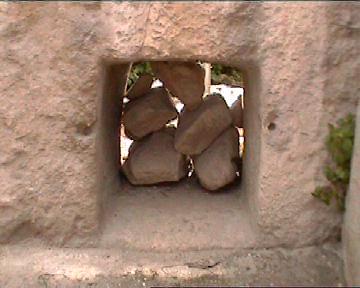
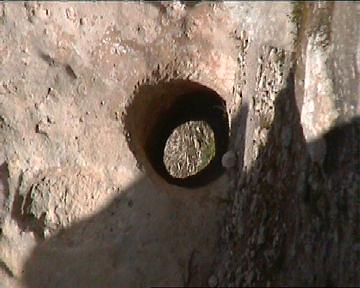
Numerous
'oracular'
holes-in-stones. (and
even some stones in a hole)
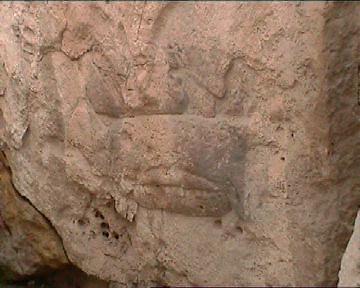
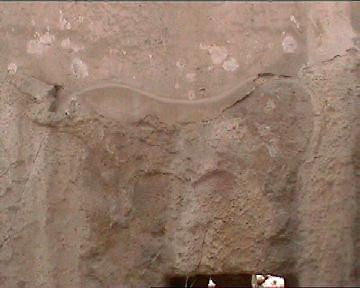
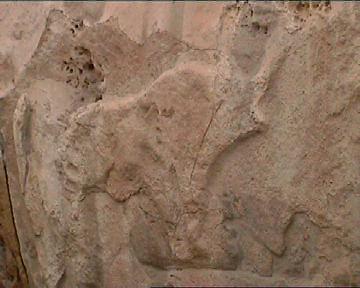
Several exquisite 3-dimensional animal engravings
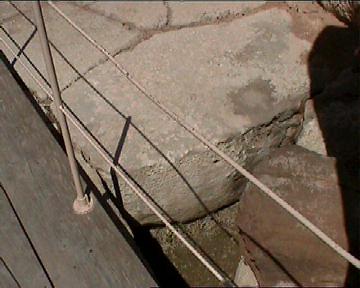
The immense paving stones that compose the floor are around a metre deep.
Many still have the small rounded stones under them from where they were
rolled into position. They were all neatly carved to fit each other.
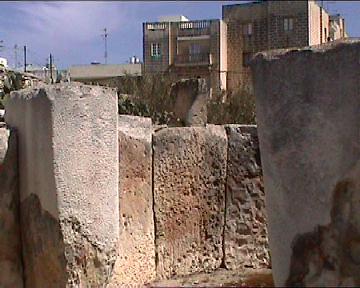
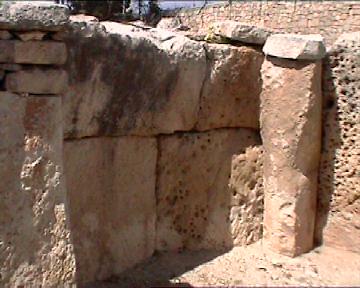
The walls were built with an inwards curve, a feature un-common
at other Maltese temple complexes.
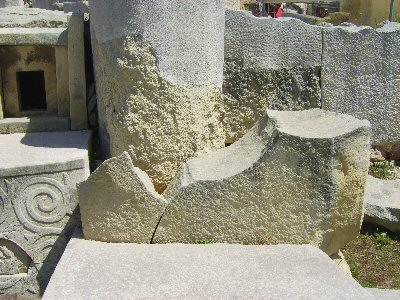
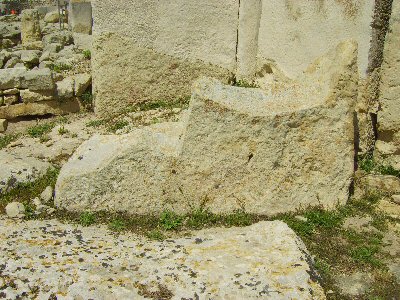
Some of
the stones appear to have been similarly carved in preparation to receive
other stones..
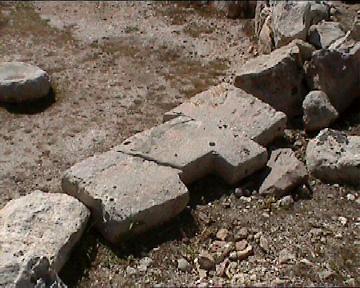
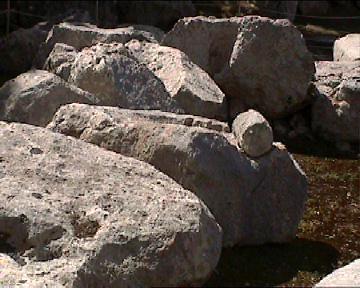
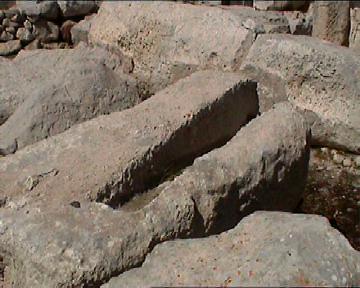
The site is littered with objects of lost
significance.
|