|
Location: Tarxien, Malta. |
Grid Reference:
35� 52' 05" N, 14� 05' 45" E. |
 The Hypogeum
of Hal Saflieni.
The Hypogeum
of Hal Saflieni.
Carved
from solid rock. When discovered it contained the bodies of over 7,000
people
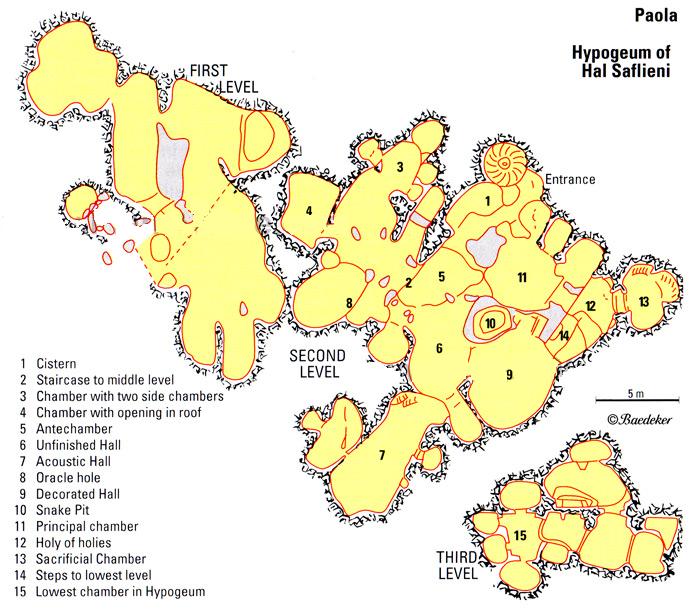
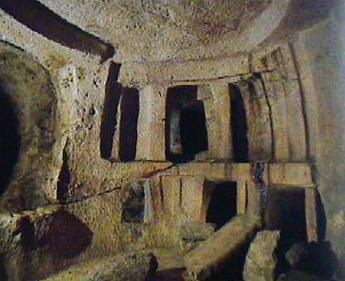
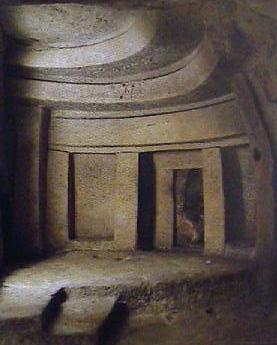
(5). It is at least three storey's deep, and contains rock-cut features
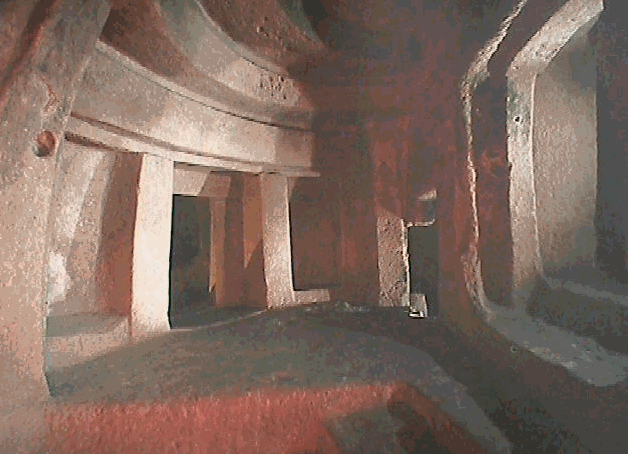
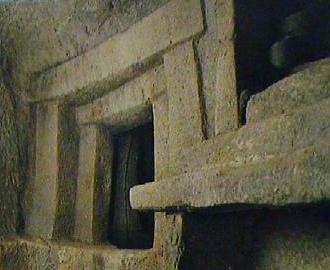
such as a 'speaking chamber', trilithons,
lintelled-doorways, a large cistern and a 'holy of holies' surrounded
by 'embryonic' chambers.
T he Hypogeum is one of the greatest
remaining structures from prehistory. Its pristine condition allows us to
see the past through the eyes of our ancestors.
(Click
here for map of the site)
|
The Hypogeum - An Overview: |
Chronology
At
its earliest, the Hypogeum' is dated at around 4,000 BC
(1).
What was the purpose of the Hypogeum:
The hypogeum offers us a rare glimpse at the prehistoric synthesis of
funerary, solar-worship and shamanic traditions. The central chamber has several
small rounded cubicles carved into the walls which it is currently suggested, were
originally intended for 'living' people as part of a ritual, in which
they would have had to lie inside in a foetal position (out of
necessity). It
is reported that from within these small cubicles, echoes from the 'speaking'
chamber reverberate into a rhythm that is similar to the human heartbeat.
The Skeletons:
When it was first discovered, the skeletons of over 7,000 people were found
near the inside chambers at the entrance. Today apparently only six skulls
survive. They appeared 'elongated' and one lacked the Fossa median
(the join that runs along the top of the skull)
(2).
Peet
(4)
says of Hal Saflieni that: 'When the museum authorities took
over the Hypogeum practically all the chambers were filled to within a short
distance of the roofs with a mass of reddish soil, which proved to contain
the remains of thousands of human skeletons. In other words, Hal Saflieni
was used as a burial place, though this may not have been its original
purpose. The bones lay for the most part in disorder, and so thickly that in
the space of about 4 cubic yards lay the remains of no less than 120
individuals. One skeleton, however, was found intact, lying on the
right side in the crouched position, i.e. with arms and knees bent up...The
bodies themselves were so damaged with damp that only ten skulls could be
saved whole'.
'That the bones at Hal Saflieni were placed there when free from flesh is
probable from the closeness with which they were packed together.
(4)
|
The Mysterious Disappearance of the Maltese
Skulls.
It was public knowledge that until
1985 a number of skulls, found in pre-historic Maltese temples at
Taxien, Ggantja and Hal Saflienti, were exposed in the Archaeological Museum in Valletta.
They have since disappeared without a trace, along with the 7,000
from the Hypogeum.
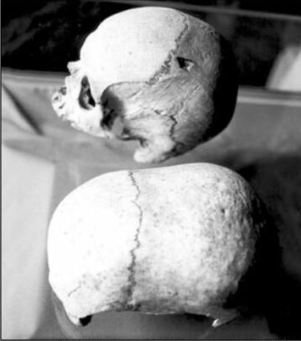 'Only the photographs taken by the Maltese
researcher Dr. Anton Mifsud and his colleague, Dr. Charles Savona
Ventura, remain to testify the existence of the skulls and
prove their abnormality. Books written by the two Maltese doctors,
illustrate a collection of skulls
that show peculiar abnormalities and/or pathologies. Sometimes
inexistent cranial knitting lines, abnormally developed temporal
partitions, drilled and swollen occiputs as following recovered
traumas, but above all, a strange, lengthened skull, bigger and more
peculiar than the others, lacking of the median knitting. The
presence of this finding leads to a number of possible hypotheses in
consideration of other finds of similar skulls, from Egypt to South
America, the particular deformity, unique in the panorama of medical
pathology referred to such distant times, (we are talking about
approximately 3000 BC) could be an exceptional discovery. 'Only the photographs taken by the Maltese
researcher Dr. Anton Mifsud and his colleague, Dr. Charles Savona
Ventura, remain to testify the existence of the skulls and
prove their abnormality. Books written by the two Maltese doctors,
illustrate a collection of skulls
that show peculiar abnormalities and/or pathologies. Sometimes
inexistent cranial knitting lines, abnormally developed temporal
partitions, drilled and swollen occiputs as following recovered
traumas, but above all, a strange, lengthened skull, bigger and more
peculiar than the others, lacking of the median knitting. The
presence of this finding leads to a number of possible hypotheses in
consideration of other finds of similar skulls, from Egypt to South
America, the particular deformity, unique in the panorama of medical
pathology referred to such distant times, (we are talking about
approximately 3000 BC) could be an exceptional discovery.
The skulls were all found in the Hal Saflienti
hypogeum, where a sacred well was dedicated to the Mother Goddess
and where also the small statue of a sleeping goddess was found,
associated to a relic with a snake inscription on it. One in
particular had a cranium showing a
very pronounced dolichocephalous, in other words, a lengthened
posterior part of the skullcap, besides the lack of median knitting,
technically named "sagitta". This last detail has been
considered "impossible" by medics and anatomists, not having
analogous pathological cases in international medical literature. It
is a characteristic that emphasizes the anomaly of this finding with
the result of producing a natural lengthening of the cranium (not
due to bandaging or boards as used in pre-Colombian civilizations)'.
It is proposed, on the basis of these findings,
that the group of skulls found in the Hypogeum were representative
of a group of peoples who were considered of importance (as attested
to by the location of their discovery), and who had a natural
genetic tendency for elongated skulls, were integrally involved in
the activities of the temple builders of the time. Other skulls
found in the
Brochtorff
circle (Hypogeum II), are considered to have had
their heads bandaged in order to produce their cranial deformities.
(Extract from Hera Magazine,
Italy: 1999)
"From an examination of the skeletons of the polished-stone age,
it appears that the early inhabitants of Malta were a race of
long-skulled people of lower medium height, akin to the early people
of Egypt, who spread westward along the north coast of Africa,
whence some went to Malta and Sicily and others to Sardinia and
Spain."
From
NATIONAL GEOGRAPHIC MAGAZINE January to June, 1920 VOLUME XXXVII
(More
about Elongated Skulls and Cranial Deformation)
|
The Structure:
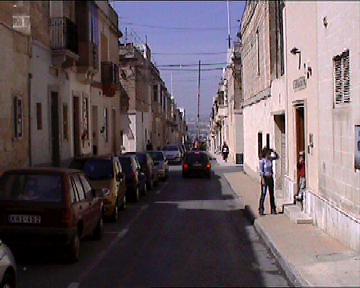 The
entrance to the Hypogeum is through an unsuspecting doorway in an
unsuspecting street. It was first discovered in 1902, when
builders broke through whilst building foundations for a house. At first,
the hole was covered over and the event was kept quiet but word of the
discovery soon got out and the museum authorities moved in to protect it.
Note from the photo (right), that the Hypogeum, although underground, was
built near the top of a natural hill overlooking the Marsa. The nearby
Hal
Tarxien,
temple complex was
was
built higher still on the same face of the hill.
Although most of the Hypogeum is underground, the entrance to it was built
with megaliths, placed in what was presumably the natural entrance of
the original cave. Agius (5)
mentions that the original entrance consisted of a large square
opening in its centre (a porthole slab). This slab was later smashed
and disposed of to make way for the new housing estate.
The first excavations in 1902 were
performed by Fr. Magri, S.J. but unfortunately shortly after its
commencement, he left the island to take a missionary post abroad
where he died, leaving no records of his observations. Following
this, the work was passed on to Prof. Themi Zammit, who worked on it
for the next five years.
 The 1990-1992 excavations suggested that there may have
once been a monumental structure built directly on top.
(3)
The 1990-1992 excavations suggested that there may have
once been a monumental structure built directly on top.
(3)
The
'speaking chamber' is a hole in the wall carved with a rounded interior
surface. The result is an echo which reverberates throughout the hypogeum.
It is speculated that this hole was part of a ceremonial process.
A design was painted in
red-ochre onto the ceiling of one chamber which starts off on one side with a
honeycomb design and transforms into an collection of 'floral' spirals on
the other.
The hypogeum includes replicas of features
from megalithic structures above ground on
Malta.
It is possible to see
both trilithons and 'doorways' in
the same style as those found in the numerous temples on the islands. It
was also the place where the famous terracotta figure called the 'Sleeping
Lady' was found (in a 'cistern' containing numerous offerings).
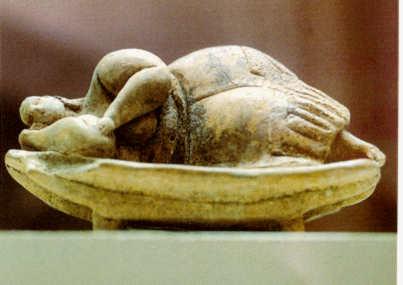
We can assume from the 'sleeping goddess' and the
similarity in its design to other temple complexes that the Hypogeum is contemporary with the
several large temple structures found on Malta.
Two of these clay figurines were found in the Hypogeum.
One (right) in a sleeping position, and the other of similar design, but
with the woman lying face down. They were both found in the main chamber .
It has been observed that the Maltese temples are often 'paired', which
makes the nearby
Tarxien
temple the most likely candidate as a partner.
Acoustics in the Hypogeum:
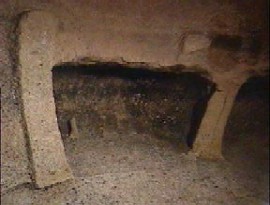
The
Hypogeum on Malta contains a 'speaking chamber' which is a hole in the
wall carved with a rounded interior surface. The result is that
anything spoken into it produces an echo which reverberates
throughout the hypogeum. It is speculated
that this hole was part of a ceremonial process.
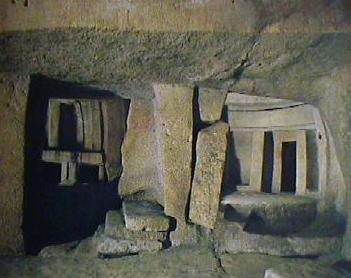
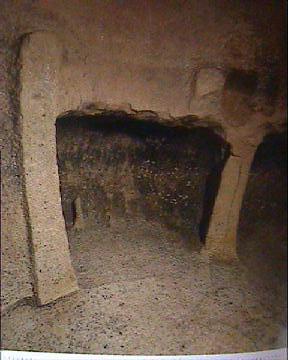
Several small chambers (right) in the Hypogeum are also suspected of
being used for ritual purposes as from within these cubicles, as
from within them, echoes
from the 'speaking' chamber reverberate into a rhythm that is
similar to the human heartbeat.
Research into the archaeoacoustic properties of the Hypogeum have
recently been examined by the SBRG,
using
different study parameters to re-discover forgotten technology which
operates on the human emotional sphere. The
effect on the psyche of ancient people through the acoustic
proprieties suggests the builders of these sites had knowledge of
this process and probably used it to enhance their rituals.
(Link
to Article)
(More about Archaeo-acoustics)
Archaeo-astronomy:
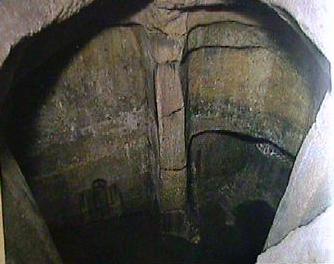
The 'Holy of holies' within the heart of the
hypogeum was designed so as to be illuminated by the annual winter
solstice sunrise (the shortest day of the year), which would have
originally shone through the entrance (as was the case with most other
Maltese temples), and directly onto the furthest parts of the
underground complex.
Engravings and Graffiti in the Hypogeum:
There are several noticeable examples of
red-ochre 'spiral' and 'floral' patterns on the walls and ceilings
of the Hypogeum. Variations on this theme can be seen in different
chambers. In the main hall the decorations appear as spirals
enclosed in pentagons, whilst the design extends to the roof
becoming composed of spirals interwoven with a honeycomb pattern.
The five small 'side chambers' were painted with broad bands of red
and black pigment. In addition to these designs, there are other
less well known images including the following three:
The first
noticeable item of ancient 'Graffiti' in the Hypogeum is carved onto
a rock wall situated 'directly over the Trilithon that leads into
a small cave'. The 'Graffiti' represents an abbreviated image of
a 'fat lady' holding an axe: 'the axe is very clearly discerned
but, owing to the weary state of the rock the fat lady is less easy
to distinguish'.. Agius
(5)
states that 'Fat ladies' holding axes were found scratched in some
ancient tombs in Spain and Portugal. Others are also found
Sculptured and painted in Chieftains Chamber tombs in Champagne in
France, they represent ladies holding an axe (see Gordon Childe
Prehistory of European Society p. 139). Taken in this context, 'The
Graffiti under discussion suggests that the chamber above is the
resting place of a warrior'.
The second
significant item of Graffiti is the sculpted imprint of a hand. It
is found on the right sidewall within the entrance of a room under
the heading of 'decorated room'. Agius
(5)
says:
'Similar
hands, painted in positive in positive or negative, singles or
grouped in a particular spot were found at Gargas and Castillo
caves in Spain. Actually engraved hands are found in Montespan
cave... It will be remembered that the hands of initiates were
laid in or above a cave entrance to let the spirits know, they
said, in the case of Churingas (spirit houses)'.
The third rarely
mentioned item is a Bull, schematically painted in black pigment. It
is situated on the right hand side wall of the Hoy of Holies. The
bull has a hunch on its back, with short horns and a tail, resembles
the bulls found carved on the stone blocks at the Tarxien Temples,
and also is about the same size.
(5)
The
Hypogeum II:
A second Hypogeum (The Hypogeum II),
has been discovered underneath the
Xaghra Circle
on Gozo Island.
|
Important Notice:
The Hypogeum is open on a
Restricted Viewing
basis only.
It is generally necessary to book ahead, possible via the following link:
WWW.heritagemalta.org
(During my last visit in April 2009 there was a six week waiting list.) |
Gallery of Images: The Hypogeum.
 |
 |
 |
 |
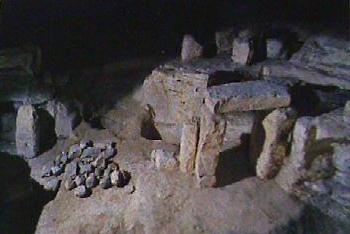
| The
Trilithon Entrance. |
The
Holiest of Holies. |
The
'Central' chamber. |
The
offering pit or 'cistern'. |
 |
 |
 |
 |
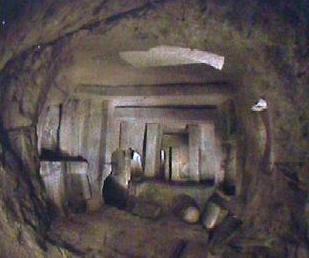
| Connected
chambers. |
Doorway and steps. to
nowhere. |
Carved
ceiling lintels. |
Side
chambers. |
(Other Prehistoric
Underground Structures)
(The
Earth-Mother-Earth Goddess)
(Other Maltese sites)
|