|
 Prehistoric Mexico:
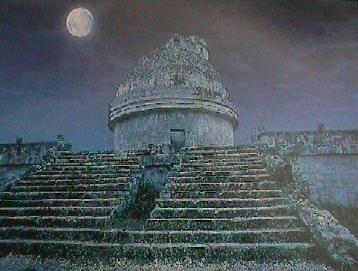
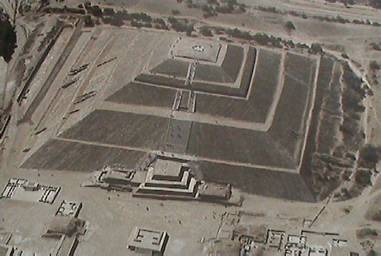
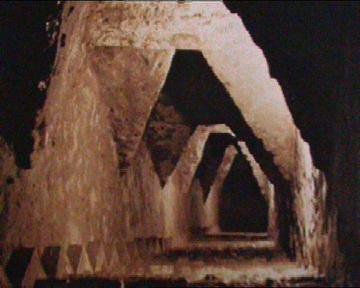
Mexican civilisation is
recorded as beginning with the 'Nahua' (Those who live by the rule),
now associated with the people known as the 'Toltecs'. Spence
(1), says that in Nahua tradition, the name of the locality from whence the race commenced its
wanderings was called Aztlan (The place of reeds). The first capital of the
Toltec empire was called 'Tollan', now occupied by the modern city of
Tula. The destruction of the Toltec
empire was attributed to the constant offensive by the
Chichimec's, who occupied most of the abandoned Toltec cities
and began an empire of their own.
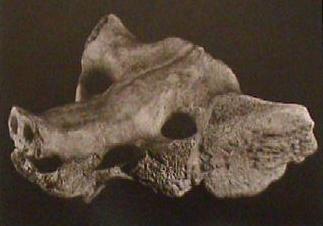
The now fossilised, worked
bone in the photo (below), was found nearly 40ft deep in upper Pleistocene
deposits dating from about 10,000 - 8,000 BC, at Tequixquiax, in the north of
the valley of Mexico. Height 6 inches (15.4cm). (Present location: Museo Nacional de Antropologia,
Mexico).
|
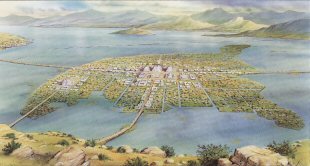 Tenochtitlan:
The Aztec Capital. Tenochtitlan:
The Aztec Capital.
Tenochtitlan, the
Capital of the Aztec empire, was built on a cluster of small natural
islands on Lake Texcoco in the Valley of Mexico. The founding of
capital city in the middle of a marshy lake may at first seem
absurd, but its exact location was foretold and fulfilled by
prophesy, and Tenochtitlan indeed grew to become the largest and
most powerful city in Mesoamerica, and at its height was one of the
largest cities in the world.
(More
about Tenochtitlan) |
|
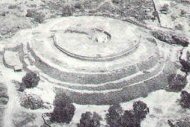
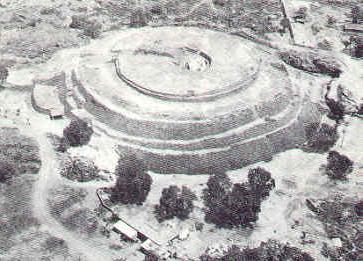 Cuicuilco Pyramid: Cuicuilco Pyramid:
The
Cuicuilco settlement was abandoned when it was covered with
volcanic lava around 2,000 years ago. It is the only
circular pyramid in Mesoamerica, and the earliest.Although
there has been much debate over the age of this pyramid,
Radiocarbon dating has determined that the earliest date of
settlement was no earlier that around 2,000 B.C. making it
contemporary with the Olmecs. Following
the final eruption of the nearby Xitli Volcano, the
population is believed to have travelled north to
Teotihuacan.
(More
about Cuicuilco) |
|
Chichen Itza -
Abandoned Mayan city.
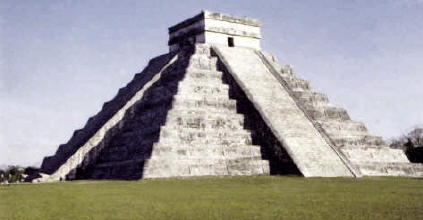 The
stepped pyramid-temple (Right), records the equinoxes in a unique way. The
sun creates a shadow of a huge 'snake' to ascend the steps in spring, and
descend again in autumn (2).
Whether or not this was a deliberate design feature is speculative, but
other astronomical features at the site certainly lend weight to the idea
that it was intentional.
Each step corresponds to a day, each platform to a Mayan month. The temple
is erected above the 365 steps.
(17). The
stepped pyramid-temple (Right), records the equinoxes in a unique way. The
sun creates a shadow of a huge 'snake' to ascend the steps in spring, and
descend again in autumn (2).
Whether or not this was a deliberate design feature is speculative, but
other astronomical features at the site certainly lend weight to the idea
that it was intentional.
Each step corresponds to a day, each platform to a Mayan month. The temple
is erected above the 365 steps.
(17).
(More about Chichen Itza) |
|
La Venta:
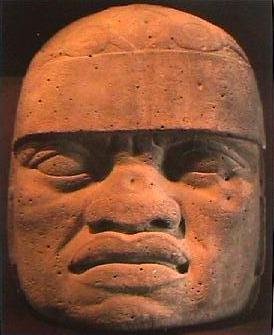 Perhaps one of the most convincing arguments in favour of
Old world-New world contact comes in the form of the several large Negroid
stone-heads at La-Venta, an Olmec culture which also
has several examples of images of bearded people.
The huge proportions of the heads suggests that
they were important people, and their association with the Olmec culture at
around (800-600 BC) places them long before the Maya, Inca or Columbus's arrival
in America.
The La Venta
heads showed several similarities to the Tres Zapotes heads, and it
emerged that they dominated the ceremonial plaza, a feature which suggests
that they were in some way 'revered'. Four heads were found at La Venta,
all of them faced the Atlantic, and the largest at 9ft high had its domed
top flattened so that it could function as an altar. A speaking tube was
found going in at the ear and out at the mouth; a possible oracle or
talking god. Radio carbon dates from the site were published in 1957 and
they give an average reading of 814 BC +/- 134 yrs. These figures
were among the oldest at the La Venta site.
La Venta was not alone in its depiction
of Negroid faces in stone. Apart from the four found there, two were
excavated in Tres Zapotes and a further five at
San Lorenzo in Vera Cruz,
one of which, the largest known, is nine feet, four inches high, and is
estimated to weigh around 40 tons. (3)
(More about La Venta)
(More
about the Stone Heads)
|
|
Teotihuac�n
- The 'City of the Gods'.
It was suspected by Stansbury Hagar, that the city had been built as a 'map of heaven'. During
the 1960's and 1970's a comprehensive mathematical survey was carried out by
Hugh Harleston Jr. He found that the principle structures line up along the
street of the dead (and beyond), and that the city was a precise scale model
of the solar system, including Uranus, Neptune and Pluto (not rediscovered
until 1787, 1846 and 1930 respectively. (21).
The Pyramid of the sun (Right), has the
same base dimensions and half the height of the great pyramid in Egypt.
(More about Teotihuacan) |
|
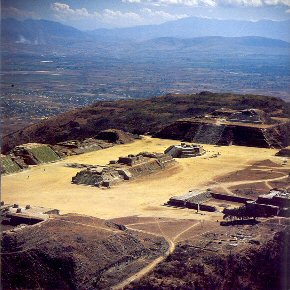 Monte
Alban. Monte
Alban.
Believed to have been built
around 600 BC, this is one of the largest and earliest cities in
Pre-Columbian America. This Zapotec complex of ceremonial
buildings was built on the levelled top of Monte Alban mountain.
It has some of the most oddly shaped structures of the ancient
world. No two sides or angles of the building are equal. Slabs
on the outside are inscribed with symbols and hieroglyphs that
are still not fully deciphered today. (32)
There are a large number of carved stone monuments at Monte
Alban. The earliest examples are the so-called "Danzantes" (dancers),
which represent naked men in contorted and twisted poses, some of
them genitally mutilated. The 19th century notion that they depict
dancers is now largely discredited, and these monuments, dating to
the earliest period of occupation at the site (Monte Alb�n I),
clearly represent tortured, sacrificed war prisoners, some
identified by name.
(More about Monte Alban)
|
|
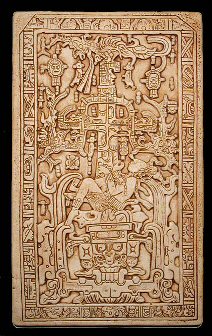 Palenque -
Mayan pyramid complex. Palenque -
Mayan pyramid complex.
The
only known
example of an original burial within a pyramid.
The tomb of Pakal was found deep within the
'Temple of Inscriptions' (which also houses the second longest
Glyphic text from the Mayan world). The photo (left) is the famous
lid of Pakal's tomb, suggested to represent Pakal in the guise of
one of the manifestations of the Maize God emerging from the
underworld.
Spence
(1), says: 'The entire city of Palenque was
solely a priestly centre, a place of pilgrimage'. The city is laid out in
the shape of an amphitheatre, with a central pyramid. The city was deserted
in the 8th century AD, along with several other Mayan centres.
In the last 15 or 20 years, a
great deal more of the site has been excavated, but currently,
archaeologists estimate that only 5% of the total city has been
uncovered.
(More about Palenque) |
|
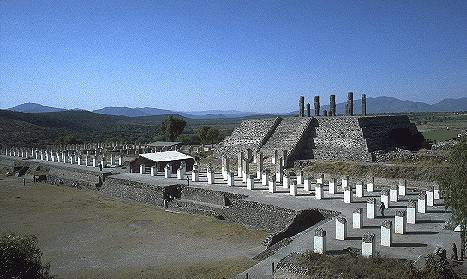 Tula
(Tollan):
Toltec Ceremonial Site: Tula
(Tollan):
Toltec Ceremonial Site:
Tula is generally
accepted as the legendary capital 'Tollan' of the Toltec empire, founded
around 750 AD, at the same time as the Teotihuacan empire was in decline.
During the height of Tula's power,
between AD 900 and 1100, it included an area of some five square miles, with
an occupation estimated as high as 60,000.
(More
about Tula)
|
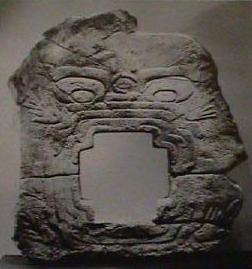
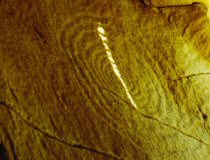
The 'Jaguar stone' -
(Photo, Left. 72 in, 1.8m high). This 'Holed-stone' was found at the entrance to
a natural cave. It is dated from 800 to 100 BC, and is from Chalcatzingo,
Morelos.
(More about Holed Stones)
Astronomy - Aztec theology postulated an eternity which was broken into
a number of aeons each of which depended on the duration of a 'sun'.
Most traditions suggest that four 'suns' have already passed, the end of
each which was marked by disaster - flood, famine, tempest and fire. The
period of time from the first creation to the current age was calculated
at 15,228, 2386, or 1404 solar years (1920)
(1)
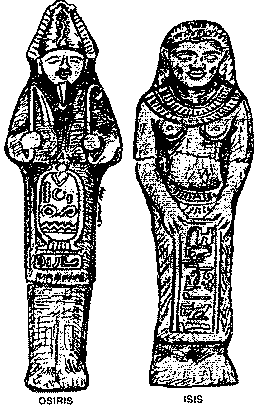
In issue #8 of The Ancient American, G. Thompson
translated a few paragraphs from Mariano Cuevas' 1940 book: Historia de
la Nacion Mexicana, which told of a discovery in Mexico.. The following
is a summary of that translation.
In August 1914, Professor M.A. Gonzales was
excavating Mayan ruins in the city of Acajutla, in Mexico. The two
illustrated statuettes were uncovered (Left). On the male, the
headdress, the beard, and the cartouche are all typically Egyptian in
style. The male is thought to represent Osiris, the female Isis.
(Ref: Thompson, Gunnar; "Egyptian
Statuettes in Mexico," Ancient American, 2:12, no. 8, 1995.)
There are several other striking similarities between old-world and
pre-Columbian Mexican cultures.
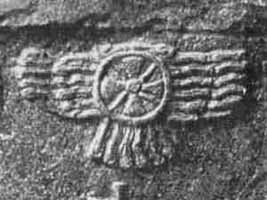
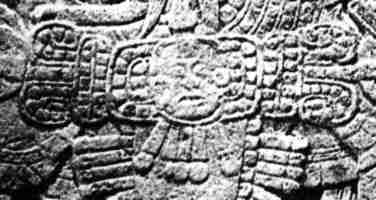
Left: Zoarastan Sun-god. Right: Mexican Sun-god.
(Pre-Columbian
Old World - New World Contact)
|
Pre-Columbian Literature: The Codices. |
There are only three remaining 'Codices'
( Texts), that survive the European 'conquest' of the America's:
-
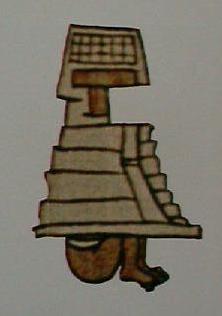 The 'Oxford' codex, in the Bodlean
Library, England, which is of a historical nature, and contains a full list of
the lesser cities which were subservient to Mexico in its 'palmy' days. The 'Oxford' codex, in the Bodlean
Library, England, which is of a historical nature, and contains a full list of
the lesser cities which were subservient to Mexico in its 'palmy' days.
-
The 'Dresden' codex (once
the 'Paris' or 'Tellerio-Remensis' codex),
so called because it was once the property of Le Tellier, the Archbishop of
Rheims, which embodies many facts concerning the early settlement of the
various Nahua states.
-
The Mexican 'Book of
the Dead' - One of the last pages of the Vatican manuscript concerns
the journey of the soul after death and through the other-world. This book
has been called the 'Mexican book of the Dead', in which 'The corpse
is dressed for burial, the soul escapes ...by way of the mouth'. The dead
person is given over to the tests which proceed the entrance to the abode of
the dead...'He first passes between two lofty peaks, then a 'terrible
serpent' intercepts his path'...etc etc...
This text has several
striking similarities to the 'Egyptian book of the dead'.
-
The 'Teo-Amoxtli' (The
Divine book) - A piece of Nahua literature , which is alleged by
certain chroniclers as having been the work of the ancient Toltecs, is
surrounded by mystery, as it no longer exists... It is described by by Ixtilxochitl, a native Mexican historian, as having been originally written by
'Tezcucan' a wise man, at the turn of the seventh century, and concerned the
pilgrimage of the Nahua from Asia, their laws, manners, and customs, and their
religious tenets, science and arts. In 1838, the Baron de Waldeck stated in
his 'Voyage Picturesque' that he had it in his possession, and the Abbe
Brasseur de Bourbourg identified it with the 'Dresden codex'....(1)
The mythological deity Quetzalcoatl was
regarded in Nahua myth as 'The king of the Toltecs'
(1)
|
Mayan Portal to the
Underworld, Mexico
A labyrinth filled with stone temples and
pyramids in 14 caves�some underwater�have been uncovered on Mexico's
Yucat�n Peninsula, archaeologists announced in Aug 2008.
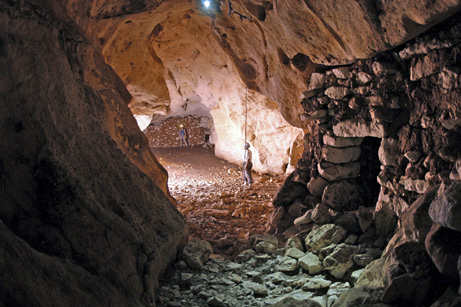
According to Maya myth, the
souls of the dead had to follow a dog with night vision on a
horrific and watery path and endure myriad challenges before they
could rest in the afterlife.
In one of the recently found
caves, researchers discovered a nearly 300-foot (90-meter)
concrete road that ends at a column standing in front of a body of
water.
"We have this pattern now of
finding temples close to the water�or under the water, in this
most recent case," said Guillermo de Anda, lead investigator at
the research sites.
Saturno said the discovery of
the temples underwater indicates the significant effort the Maya
put into creating these portals.
In addition to plunging deep
into the forest to reach the cave openings, Maya builders would
have had to hold their breath and dive underwater to build some of
the shrines and pyramids.
Other Maya underworld entrances
have been discovered in jungles and aboveground caves in northern
Guatemala Belize.
(Other
Underground Sites)
(More about This Discovery)
|
Extreme Mexican Masonry.

Tlaloc
Statue, Mexico: Found in the town of Coatlinchan near Tlaloc Mountain in the State of Mexico and weighing
168 tons, this is the largest existing monolith in the Americas.
This statue was made of Basalt and weighed an
estimated 168 tons
(24). It was moved to the
National Museum of Anthropology in Mexico City in 1964.
Tlaloc, the
provider, had attributes of the rain. He created and brought down
the rain and the hail. He caused the trees, the grasses, the maize
to blossom, to sprout, and to grow. Also attributed to Tlaloc was
the thunderbolts and the drowning of people.
Some scholars
believe that the statue may not have been Tlaloc at all but his
sister or some other female deity.
Acosta,
in his "History of the Indes," lib. vi., p.459, quoted by Maurice
("Observations connected with astronomy and the ancient history of
Babylon"), states that some of the stones in the Mexican temples to Sun and
Moon measure 38 feet by 18 feet by 6 feet.
(12)
Quirigua: ��the largest Mayan stele, at Quirigua, measuring 10.7
x 1.5 x 1.27 meters, and weighing 65 tons.� �the site of Quirigua is
where the largest monolith in the Maya world stands. It is the Stella E,
weighing 65 tons and standing 35 feet high. It was quarried about three
miles away.�
(Other
Examples of Extreme Masonry)
| Sonic Effects in
Pre-Columbian Structures: |
There are several interesting accounts of sonic effects from Mayan
ceremonial structures as
the following examples illustrate:
At least two structures at the Mayan ruins of
Chichen Itza display
unusual and unexplained acoustical properties.
The Great Ball-court:
The Great Ball-court is
545 feet long and 225 feet wide overall. It has no vault, no
continuity between the walls and is totally open to the sky.
Each end has a raised "temple" area. A whisper from
end can be heard clearly at the other end 500 feet away and through
the length and breath of the court. The sound waves are unaffected by
wind direction or time of day/night. Archaeologists engaged in the
reconstruction noted that the sound transmission became stronger and
clearer as they proceeded. In 1931 Leopold Stokowski spent 4 days at
the site to determine the acoustic principals that could be applied to
an open-air concert theatre he was designing.
The Castillo:
This structure is a
temple that looks like a pyramid and is the one most commonly pictured
on travel brochures for the Mexican Yucatan. Apparently if you stand
facing the foot of the temple and shout the echo comes back as a
piercing shriek. Also, a person standing on the top step can speak in
a normal voice and be heard by those at ground level for some
distance. This quality is also shared by another Mayan pyramid at
Tikal.
If a person stands at the bottom of the
Castillo and shouts, the sound will echo as a shriek that comes from
the top of the structure. If someone stands on top and speaks in a
normal voice, they can be heard on the ground at a distance of 150
metres away.
(2)
At
Palenque,
also in Mexico, it is apparently the case that if three
people stand on top of the three pyramids, a three-way conversation can
easily be held.
It is said that if a person
stands at the base of the pyramid-like Temple of the Magician and claps
their hands the stone structure at the top produces a 'chirping sound'
(2)
(Prehistoric
Acoustic Phenomena)
| List and
Description of Mexican Sites: |
|
List and description of featured Mexican sites.
|
|

