|
Location:
Yucatan
peninsula, Mexico. |
Grid Reference:
20� 40' N,
88� 32' W. |

 Chichen
Itza:
(Ceremonial Centre). Chichen
Itza:
(Ceremonial Centre).
Abandoned sacred Mayan city, once covering over
six square miles.
Chichen Itza is considered by many as one
the most important Mayan complexes in Mexico.
It is generally agreed that Chichen Itza was first populated between 500
and 900 AD by Mayans then abandoned around 900, the city
was resettled 100 years later and subsequently invaded by Toltecs
from the North. There are numerous relief's of both Mayan gods including
Chac and the Toltec gods including Quetzacoatl.
For some reason the city
was abandoned around 1300 AD, although it remained a pilgrimage centre
until the time of the conquest.
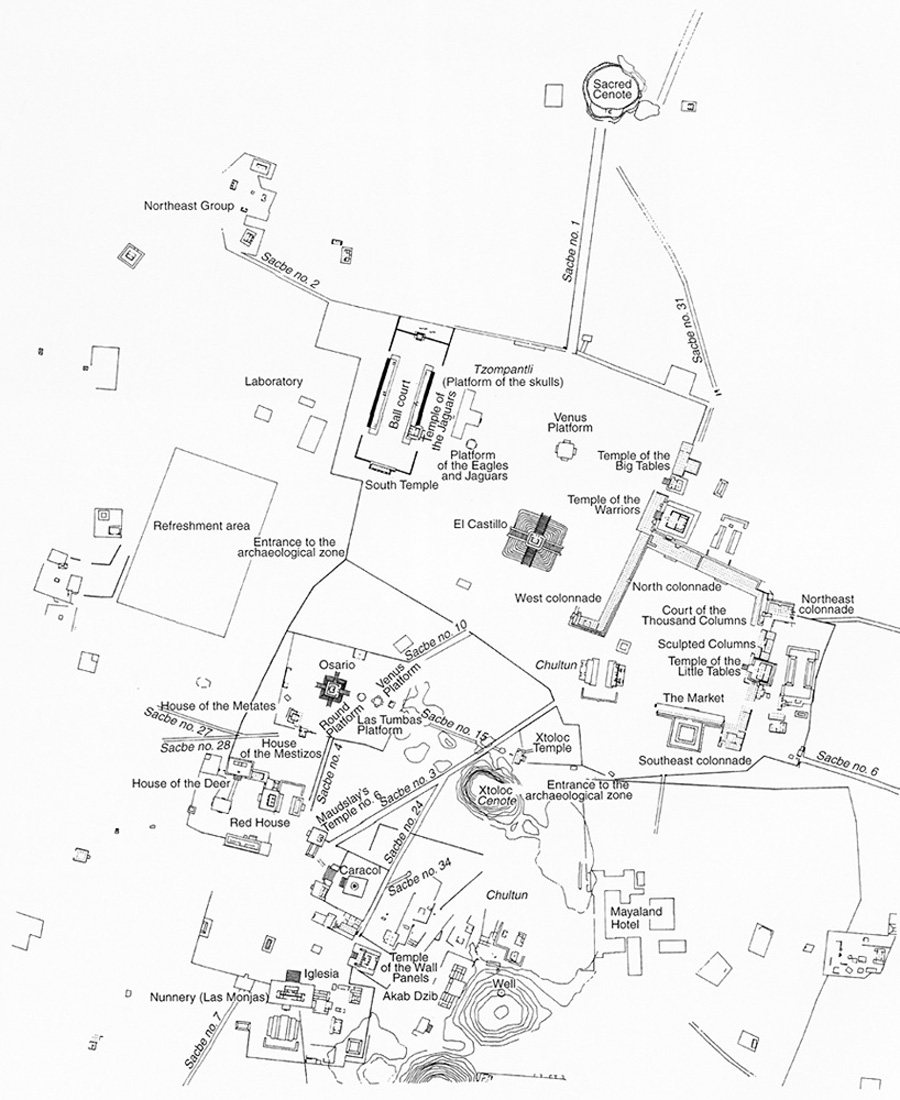
(Click here for
Map of the Site)
The Mayan name "Chich'en Itza"
means "At the mouth of the well of the Itza."
Much of the reason for the placement and construction of Chichen Itza
is explained in terms of the several 'Cenote's' or 'sink-holes' in
the area. These geological features provided the Mayans (and the
city itself), a unique connection to the underworld, as demonstrated
by the numerous discoveries of skeletons and funerary rights in most
of the nearby cenotes and caves in the region.
The Cenote Sagrado:
(The Sacred Well).
Natural
Sink -holes (Cenotes) - A long,
white limestone road or sacbe, extends north from the
base of the north staircase of the great pyramid,
El Castillo. The road
passes the Temple of Venus
and continues for a thousand feet to a large, limestone sinkhole
the Maya call "cenote." This is El Cenote Sagrado, the Sacred
Well, found at the northernmost point of the Chichen Itza
archaeological zone. This large cenote was likely one of the
major reasons why the Maya built such an immense city here. The
cenote is fed by an underground river, and supplied water for
the city as well as served as a location where the Maya
conducted religious rites. Almost perfectly circular, the
Chichen Itza cenote is more than 50 meters in diameter, and its
upper rim stands more than 20 meters from the waters surface.
The water itself is almost 15 meters deep with a thick layer of
muck at the bottom that has so far proven too deep to measure,
or to allow for easy exploration of its depths.
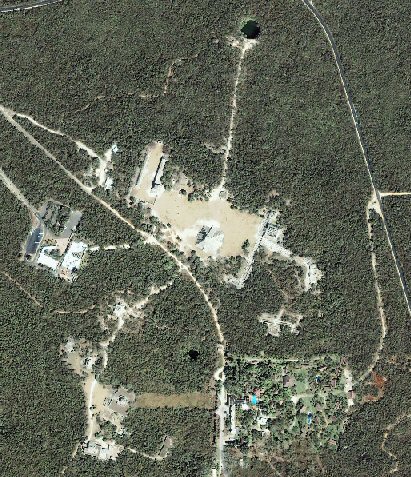
It can be seen from this
satellite photo that Chichen Itza lies directly between two
Cenotes: One deemed 'sacred' and the other 'profane'
'In 1894, Edward
Thompson, the United States Consul in Merida, purchased
the plantation which included the ruins of Chich�n Itz�. Ten
years later he dredged the cenote, recovering artifacts of gold,
copper, carved jade and pottery, as well more fragile items such
as textiles, spears, and rubber containers that held a form of
incense. The artifacts are believed to have been thrown in as
offerings to the Maya rain god Chaak.
(Note* Some were determined to have come from as far away as
Columbia).
Thompson shipped the
artifacts to the Peabody Museum at Harvard University. In 1926,
the Mexican government demanded the return of the artifacts and
tried Thompson on charges of theft. The case went up to the
Mexican Supreme Court, which in 1944 found in favor of Thompson.
Beginning in 1959, the Peabody Museum gave many of the valuable
artifacts but some of it remains on display at Chich�n Itz� near
a plaque in Spanish that condemns to the Mexican government,
which displays some of them in Mexico City.
Thompson also recovered
numerous skeletons, which lends credence to the early Spanish
chroniclers who said the cenote was the scene of human
sacrifice. It is known that the Toltec influence on the Maya
introduced the concept of human sacrifice to Yucatan.
Chich�n Itz� also has a
sister cenote called the Xtoloc Cenote. Unlike
the turgid waters of the Sacred Well, Xtoloc is relatively fresh
and pure, prompting the belief that it served as the major water
supply for the city while the Cenote Sagrado was reserved for
ritual purposes'.
(http://www.americanegypt.com/feature/cities/chichenitza/cenote.htm)
There are several other natural 'Cenotes'
nearby to Chitchen Itza, stairs leading down the sides of the
natural 'sink-holes' and relics discovered inside testify
to their importance to the Mayans.
In the wells around Chich�n Itz� have been found scores of
skeletons. Mayan petroglyphs depict human sacrifices at these
sites. many have yet to be investigated.
'Kulkulkan' - 'El Castillo' (Structure
5B18):
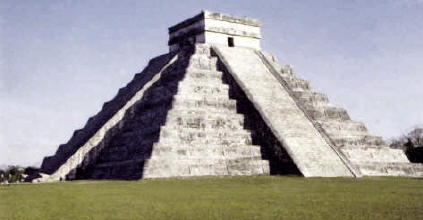 A
24m high stepped pyramid-temple, which records the equinoxes in a unique
way. A
24m high stepped pyramid-temple, which records the equinoxes in a unique
way.
The sun creates a
shadow of a huge 'snake' to ascend the steps in spring, and descend
again in autumn
(1). Whether or not this was a
deliberate design feature is speculative, but other astronomical
features at the site certainly lend weight to the idea that it was
intentional.
Each step corresponds to a day, each
platform to a Mayan month. (17).
The architecture of the pyramid encodes precise
information regarding the Mayan calendar. Each face of the four-sided
structure has a stairway with ninety-one steps, which together with the
shared step of the platform at the top, add up to 365, the number of
days in a year. These stairways also divide the nine terraces of each
side of the pyramid into eighteen segments, representing the eighteen
months of the Mayan calendar. The pyramid is also directionally oriented
to mark the solstices and equinoxes. The axes that run through the
northwest and southwest corners of the pyramid are oriented toward the
rising point of the sun at the summer solstice and its setting point at
the winter solstice.
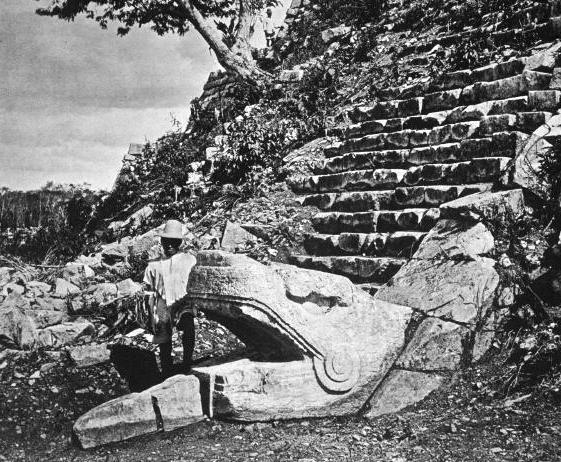
Photo of the Northern stairwell, 1880. The pyramid was built during the eleventh to thirteenth
centuries directly upon the multiple foundations of previous
temples.
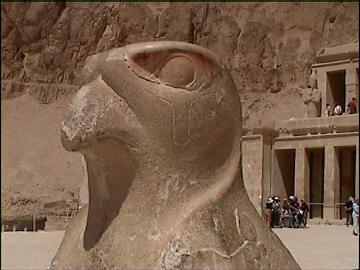
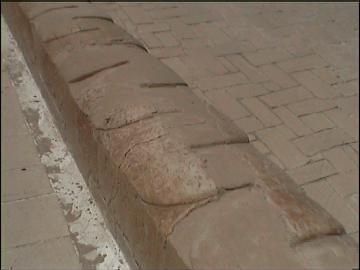
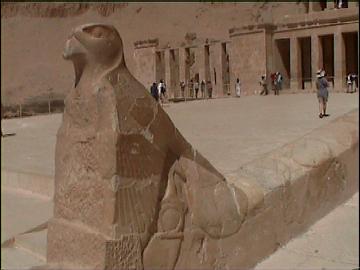
Curiously, the same symbolism can be seen on either
side of the huge stairwell leading to the Temple of Queen Hashepsut,
in Egypt.
(More about Feathered Serpents)
Acoustic Phenomena at El
Castillo:
'If you
stand facing the foot of the temple and shout the echo comes back as
a piercing shriek. Also, a person standing on the top step can speak
in a normal voice and be heard by those at ground level for some
distance. This quality is also shared by another Mayan pyramid at
Tikal'.
Or on a lighter note...
'Handclaps evoke chirped echoes from the
staircases of the Mayan Pyramid of Kukulkan at Chichen Itza. The
physics of the chirped echo can be explained quite simply as
periodic reflections from step-faces. What is interesting is that
the chirped echo sounds arguably like the primary call of the Mayan
sacred bird, the resplendent Quetzal. This magnificent bird, now
near extinction, has for thousands of years represented the 'spirit
of the Maya'.
The Great Ball
Court:
Juego de Pelota Principal
(Principal Ball Court) is the main one of eight ball courts, and the
largest games court in all of Mexico's archaeological sites. Here, you
will see the famous 7m-high stone hoops. It is believed that contestants
of pelota (ball) needed to get a rubber
ball through them during the game. At least one image of a ball with a
skull in it is reported at Chichen Itza.
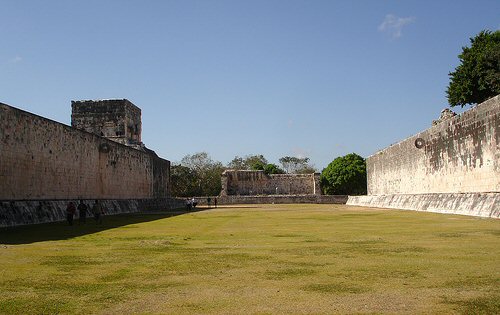
Accoustic
Properties of the 'Ball Court': Each end has a raised "temple"
area. A whisper from end can be heard clearly at the other end 500
feet away and through the length and breath of the court. The sound
waves are unaffected by wind direction or time of day/night.
Archaeologists engaged in the reconstruction noted that the sound
transmission became stronger and clearer as they proceeded. In 1931
Leopold Stokowski spent 4 days at the site to determine the acoustic
principals that could be applied to an open-air concert theatre he
was designing. Stokowski failed to learn the secret. To this day it
has not been explained.
(Other
examples of Acoustic phenomena)
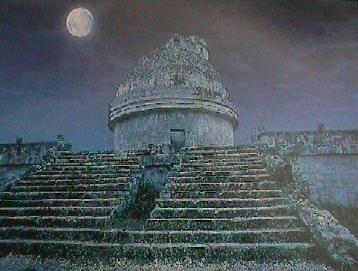
The Carocal
(Observatory):
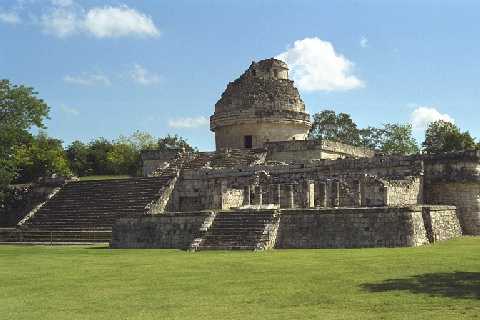
Recent
studies at Chichen Itza by archaeo-astronomers have revealed that other
structures, besides the Pyramid of Kukulkan, have significant
astronomical alignments. For example, several of the windows in the
unique circular building known as the Caracol were positioned to be in
alignment with key positions of the planet Venus, particularly its
southern and northern rising extremes on the horizon and with the
equinox sunset.
The
combined alignments and orientations of El-Castillo and El-Caracol leave
no doubt as to the importance of astronomy to the Mayans.
(More about Archao-astronomy)
|
The Chacmool:
(The Temple of Warriors).
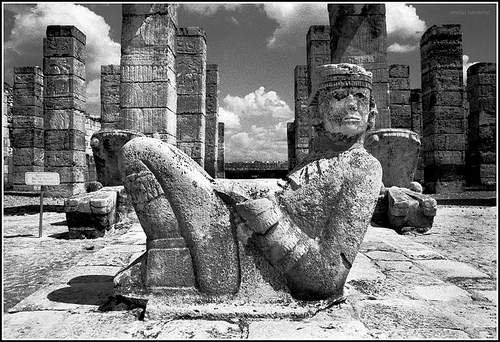
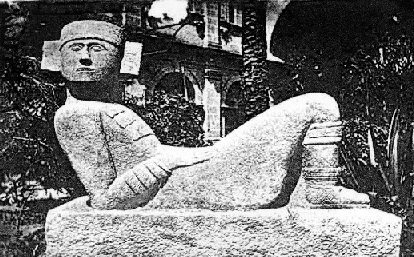
'The Temple of a Thousand
Pillars': This complex is analogous to Temple B at the Toltec
capital of Tula, and indicates some
form of cultural contact between the two regions. The one at Chichen
Itza, however, was constructed on a larger scale. At the top of the
stairway on the pyramid�s summit (and leading towards the entrance
of the pyramid�s temple) is a ChacMool. There are several other
broken Chacmool around the site. |
The Ossario: This
step-pyramid temple dominates the platform, on a small scale.
Like its larger neighbour, El Castillo, it has four sides with
staircases on each side. There is a temple on top, but different
from El Castillo, at the centre is an opening into the pyramid
which leads to a natural cave 12 m. below. Edward H. Thompson
excavated this cave in the late 1800s, and because he found
artefacts such as jade beads and several skeletons. The same
phenomena was reported at both
Teotihuacan and the Great pyramid at Giza.
(Other underground sites)
Roughly all sources agree that from
approximately 550 AD to 800 AD, Chichen Itza existed mainly as a
ceremonial center for the Maya civilization. The area was then
largely abandoned for about a hundred years (no one knows reason ),
to be resettled around 900 AD again. Shortly before 1000 AD, it was
invaded by a people from the north (The Toltecs).
Mayan historical sources mention that
a man who called himself Kukulkan arrived in Chichen Itza from the west
(Kukul means �feathered� and kan means �serpent�) in the period that
ended in 987 AD. A strong case has been made that Kukulkan and Topiltzin
Quetzalcoatl were most likely the same person, and that he brought the
Toltec practices and beliefs to Chichen Itza, including the practice of
human sacrifice.
It is estimated
that the Temple of the warriors was built around 1,100 AD.
(12)
Caves of Balankanche: (Cenote)
Approximately 4 km (2.5 mi) west of
the Chichen Itza archaeological zone are a network of sacred caves known
as Balankanche (Sp: Gruta de
Balankanche).
On 15 September 1959, Jos� Humberto G�mez, a local
guide, discovered a false wall in the cave. Behind it he found an
extended network of caves with significant quantities of undisturbed
archaeological remains, including pottery and stone-carved censers,
stone implements and jewelry. INAH converted the cave into an
underground museum, and the objects after being catalogued were returned
to their original place so visitors can see them in situ.
(Other
Mexican sites)
(Archaeoastronomy)
(Pre-Columbian Americas Homepage)
|