|
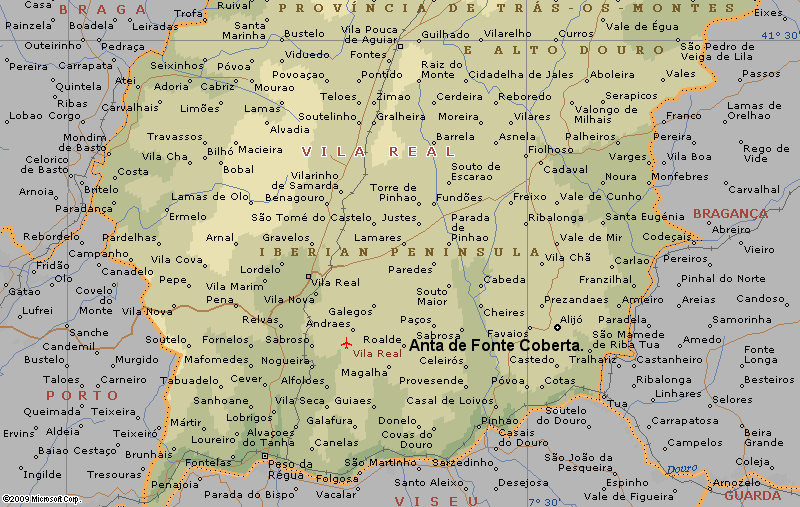
Location:
Vila Cha,
Alijo, Portugal. |
Grid Reference:
41�
20� N, 7� 28� W. |
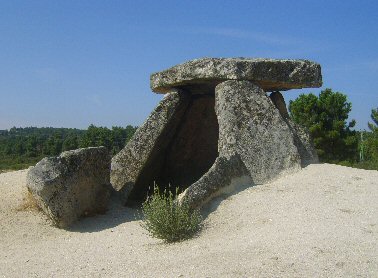
 Anta de Fonte Coberta:
(Passage Mound).
Anta de Fonte Coberta:
(Passage Mound).
Commonly considered
as one
of the most important 'Anta's' in Northern Portugal.
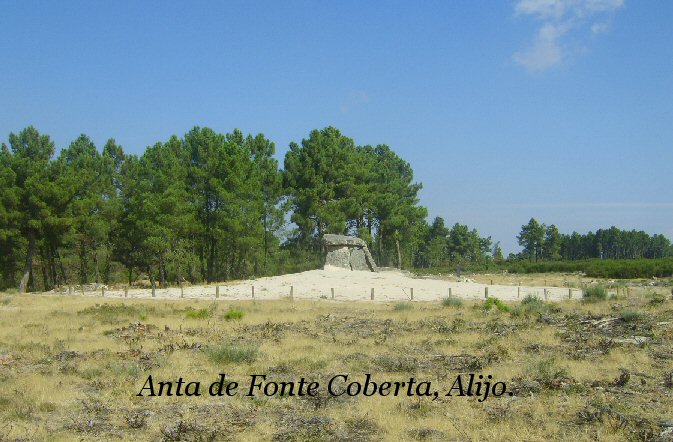
This anta stands isolated on a plateau
at around 3m high, has the 'standard' seven uprights and flattened
capstone on the underside, but also contains traces of Red Ochre and
Cup-marks.
Traces of a mound suggest that this monument was once, at least,
partially covered.
(Click
here for map of the site)
The name 'Ante de Fonte Coberta' translates
as the 'Dolmen of the covered spring'. The folklore of the
Pyrenees, France, Spain and Portugal regarding sacred wells is
very similar to that of Ireland, Scotland and England. Borlase
(1) writes:
"It is interesting to notice that the
pre-Christian custom called dessil, or circuit around a
venerated spot; which is practised in Ireland in the case of one
dolmen at least, as well as at wells and Churches innumerable,
is found also in Portugal... It is not in Ireland alone that
dolmens are associated with the notion of wells and water
springs. The Portuguese names, Anta do Fontao, Fonte Coberta,
Anta do Fonte-de Mouratao, and the French names, Fonte de Bourre,
and Fonte nay le Marmion, show this to be the case".
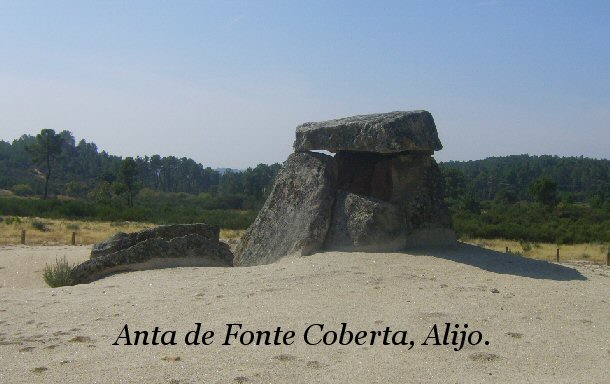 The Eastern upright has been broken in
half, a feature common to many Portuguese Anta's.
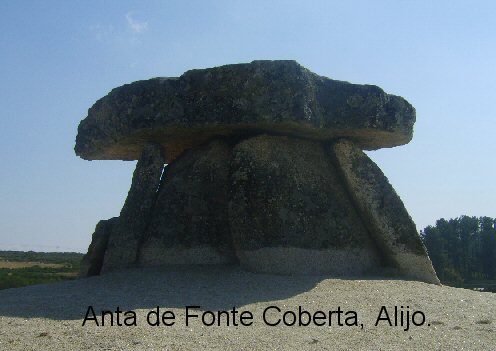
The tide-line around the bottom shows the erosion
of the mound over the last few years only ... before which (i.e. 2006),
the ground surrounding the Anta was covered in grass.
Gallery of Images:
(Passage Mounds)
(List of Prehistoric Portuguese
sites)
(Portugal Homepage) |