|
 Prehistoric Scotland:
|
The Orkney complex - (Brodgar,
Maes-Howe,
Stennes,
Skara Brae).
The complex of megalithic sites on Mainland Orkney's is now seen as
a connected set of structures with which we are able to see the
landscape through our ancestors eyes. To the modern eye, there seems
little reason why anyone would choose such an isolated location for
such splendid monuments, but the constant backdrop of the hills of
Hoy, and a combination of specific astronomical features, made this
the perfect place for Neolithic people to express themselves and
communicate their thoughts to the universe.
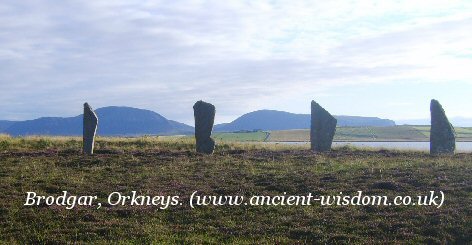
(More about the Orkneys Complex)
|
|
Ring of Brodgar:
The ring of Brodgar is one of Britain's most spectacular stone circles.
It is the biggest stone circle in Scotland, and is 103m in diameter. The
original 60 stones were equally spaced apart.
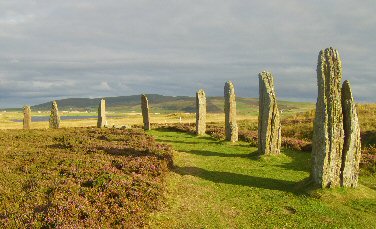 Recorded in 1563 as "Broager", it seems likely that
the Orcadian pronunciation led to the gradual inclusion of a "d" when the
name came to be written. On June 5, 1980, the second highest megalith in the Ring of Brodgar
was shattered after being struck by lightning. Recorded in 1563 as "Broager", it seems likely that
the Orcadian pronunciation led to the gradual inclusion of a "d" when the
name came to be written. On June 5, 1980, the second highest megalith in the Ring of Brodgar
was shattered after being struck by lightning.
The Henge, which was
there long before the stone-circle was determined to have been cut
through solid rock, an accomplishment which has led to the suggestion
that the act of henge making might have been brought to the islands from
elsewhere.
(More about Brodgar)
|
|
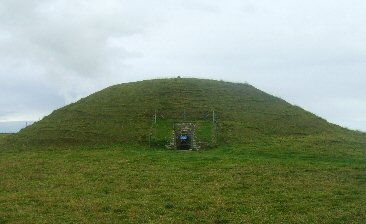 Maes Howe: The
entrance to the Maes-Howe
passage-mound is orientated towards the setting winter solstice sun behind the
prominent Hills of Hoy in the distance. The chamber was placed so
that for several days before and after the winter solstice, the
sunlight flashes directly into the passage not once, but twice, with
a break of several minutes between each illumination.
The cruciform
chamber in the centre of the mound is vaulted by a corbelled roof,
and has three small sub-chambers leading from it. Each of these
chambers was sealed with a stone which only covered 2/3rds of the
opening, a feature seen at the entrance of the main passage of the
mound, where a blocking stone was fitted into a cavity in the wall,
which when closed (from inside), is small enough to allow a small
amount of sunlight to still pass over the top and into the chamber.
This particular astronomical feature is similar to 'light-boxes'
found in other passage mounds in Ireland and Wales (Newgrange,
Carrowkeel,
Bryn Celli Ddu). A similar
feature is believed to have been found on the Orkneys at the
recently destroyed/restored Crantit
Tomb.
(More
about Maes Howe) (More
about light-boxes) |
|
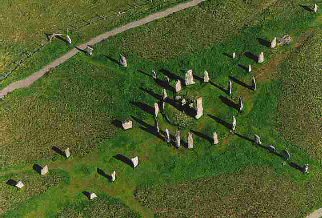 Callanish,
Isle of Lewis, Outer Hebrides:
The Callanish
stone circle on the Isle of Lewis is one of the best known circles
in Scotland. The circle is 12m diameter with a huge monolith in
the centre and four avenues leading North (double avenue),
South, East and West, suggestive of a huge cruciform observatory.
Much work has
been done on the astronomy of the site with several suspected
lunar and solar alignments.
A tradition still current in the
twentieth century called for all the fires on the island of Lewis
to be extinguished on May 1st (Beltane). Priest's then started a
new fire and distributed it to any people within the circle.
(More about Callanish) |
|
Stones of Stennes:
The few remaining gigantic stones of Stennes still manage to evoke a
moment of contemplation with the Hills of Hoy looming like the
prehistoric ghost of memory in the background.
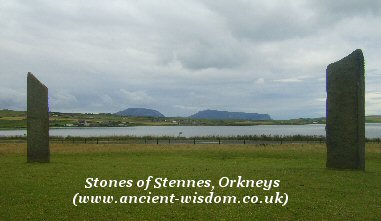
The Stennes circle
is connected to both Brodgar and Maes Howe through alignments. Of
the once 12 equally spaced stones, now only 4 remain, with the
tallest standing at 5.7m high. The circle has suffered the ravages
of time, with the last reported desecration on Christmas day in
1814, when it is recorded that the local farmer destroyed the nearby
'Stone of Odin', and toppled one of the stones in the ring before he
was stopped.
The nearby
'Watch-stone' is one of an original pair which would have formed a
portal to the causeway that leads directly to the Ring of Brodgar
and beyond. The whole landscape is now seen a a single ceremonial
centre.
(More about the stones of Stennes)
|
| The
French / Irish Connection: |
There are several noticeable
similarities between the megalithic structures of Ireland and those from
both France and Scotland. Similar construction features, carvings,
and orientation of passages makes it difficult to ignore the idea that
they might have been built by the same extended cultural group.
-
Both Gavr'inis in France and
Maes-Howe
on the Orkneys were built at the same
time as Newgrange (dated at 3,300 BC).
-
Newgrange,
Gavr'inis and
Maes-Howe all had their passages aligned
to the winter solstice. (Close to the Moons eastern major standstill).
-
The interior floor-level of
Gavr'inis and
Newgrange were raised
towards the centres. At Newgrange, the upwards-sloping passage narrows
the beam of light into a thin strip. In fact, the only light that would
have originally been able to enter the internal chambers would have come
through the 'light-box', above the passage entrance.
-
Light-boxes are a megalithic construction feature
that have so far only been recorded at three (possibly four) sites
in the UK, with two in Ireland (Newgrange and
Carrowkeel
- see below)
both having the same design, and the other two on the
Orkneys in Scotland.
This particular connection is very specific.
There are examples of 'spiral-art' at the Boyne-valley which
are identical to that found at both Gavr'inis and the Orkneys.
Stone SE4 at Knowth has a series of
crescents running down the side, a design similar to that found on the
rear stone inside Le Table des
Marchands' passage mound, (nearby and contemporary with
Gavr'inis).
A further connection between the two cultures
came from Hencken's excavations of 1935, when a chalk ball was
discovered at
Creevykeel, which is an item
similar to those found in Brittany and on the
Orkneys.
The lintel stone over the light-box at
Newgrange (see below), has a series of crosses engraved on it and there is a similar
stone on the floor of the Gavr'inis passage mound, and
others at
Fourknocks in Ireland.
The Irish Recumbent Stone Circles (RSC's) have
been mentioned above. The only other place these particular
constructions are found is in Scotland.
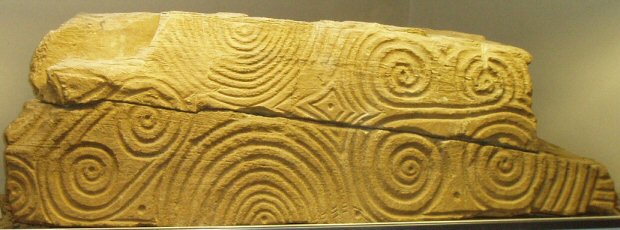
(The Westray Stone:
Symbolic Art. Scottish-Irish Connections).
Scotland is home to over 400
small, round stone carved balls.
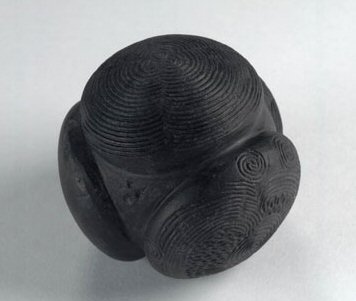 The
majority of the balls were discovered in Aberdeenshire, an area also
associated with a high concentration of recumbent stone circles.
Most of the stone balls conform to a standard size and over half
have six embossed geometric knobs carved onto them, although as many
as 160 dimples engraved on them. The
majority of the balls were discovered in Aberdeenshire, an area also
associated with a high concentration of recumbent stone circles.
Most of the stone balls conform to a standard size and over half
have six embossed geometric knobs carved onto them, although as many
as 160 dimples engraved on them.
Very little is
known about the stone balls at present, although there is much
speculation that they served some kind of prestigious function. In
reality however, very few have been found in a context which might
support this theory, with most being found in agricultural settings.
(More
about Carved Stone Balls)
|
Recumbent Stone Circles (R.S.C's): |
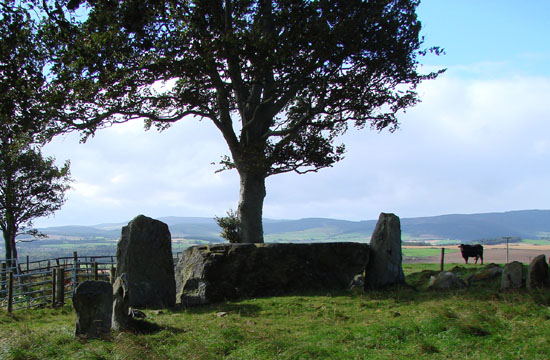 The recumbent stone-circle is a feature
almost unique to Scotland. The area of Aberdeenshire has the largest
concentration in Scotland. They were was used to measure the lunar cycle (Apart from a
few examples in Ireland (i.e. Drombeg)
which were in fact, solar). The recumbent stone-circle is a feature
almost unique to Scotland. The area of Aberdeenshire has the largest
concentration in Scotland. They were was used to measure the lunar cycle (Apart from a
few examples in Ireland (i.e. Drombeg)
which were in fact, solar).
The recumbent stone at
Old Keig, Aberdeenshire, is the
largest in Scotland weighing in at over 50 tons. The
top surface of the stone is perfectly horizontal and
covers 27˚ of the horizon, enabling viewers to mark both the major
standstill of the midsummer full moon setting over the left-hand side
of the recumbent and the minor standstill of the midsummer full moon
over the right-hand side. In addition to this, the midwinter sun sets
over it as seen from the centre of the circle.
The stone was quarried from around
ten Kilometres from the site.
(More about
Recumbent stone circles) |
|

