|
 Trilithons:
(Ancient Constructions)
Trilithons:
(Ancient Constructions)
The word trilithon is derived from the
Greek 'having three stones' (Tri - three, lithos
- stone) and was first used by William Stuckley.
A trilithon is a structure consisting of two
large vertical stones (posts) supporting a third stone set horizontally
across the top (lintel). Commonly used in the context of megalithic monuments. the most famous trilithons are those
seen at
Stonehenge,
Malta, and the Osirion
in Egypt.
There are several well-known examples of Trilithons around the
world ...
|
Featured Items.
|
|
- The Classic Trilithons.
Hypogeum, Malta
- Underground Trilithons.
|
- Two of Egypt's most ancient temples.
The Pacific Isles
- The Pacific Trilithon.
|
...Scroll down
for more...
In its final stage, Stonehenge consists of five separate Trilithons, surrounded by a continuous
lintelled circle. It is a unique structure to British isles, and shows
closer constructional similarities to Mycenaean and
Egyptian structures have been found in the area suggesting overseas influences.
The Sarsen Stones - In its complete form the outermost stone setting consisted of a
circle of 30 upright sarsens, of which 17 still stand, each weighing about
25 tons. The tops of these uprights were linked by a continuous ring of
horizontal sarsen lintels, only a small part of which is now still in
position. The stones in the sarsen circle are carefully shaped and the
horizontal lintels are joined not only by means of simple mortise-and-tenon joints, but they are also locked using what is
effectively a dovetail joint. The edges were smoothed into a gentle curve
which follows the line of the entire circle.
(Other
Prehistoric Construction Techniques).
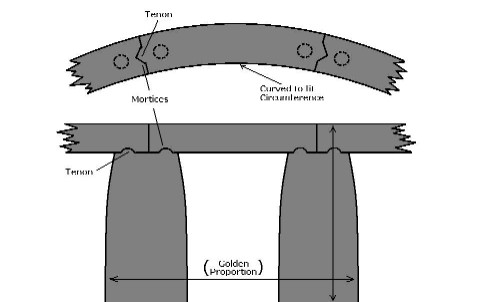
The Sarsen-ring (whose official inner
diameter is 97ft or 1162.8 primitive inches), has a circumference of
3652.4 primitive inches. As well as indicating a knowledge of the Solar
year, it is also exactly one 'quarter-aroura', as measured in ancient
Egypt (1).
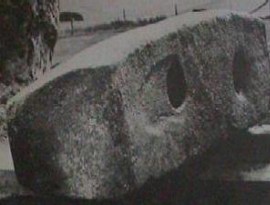
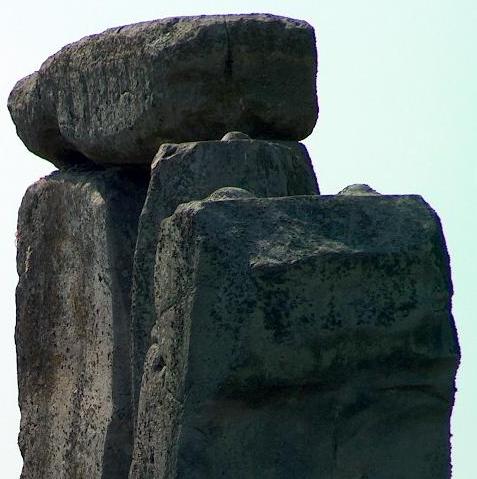
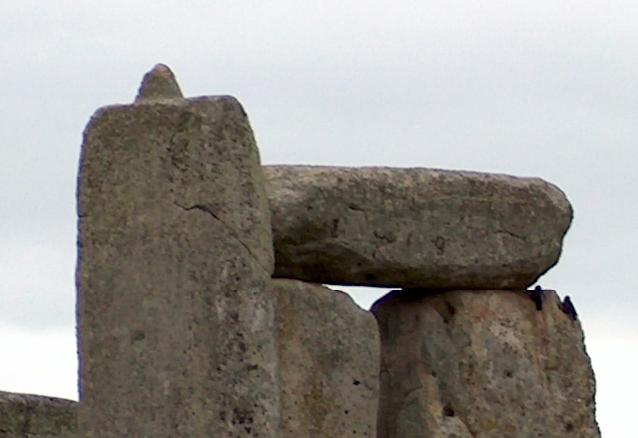
The
pictures above illustrate the sophisticated construction techniques
applied to the sarsen circle .
The Sarsen Horseshoe
-
Inside these two circles lies the sarsen horseshoe,
consisted originally of five sarsen trilithons (a Greek word that
means three stones), each comprising two uprights with a horizontal
lintel. Although now fragmentary, the arrangement shows the careful
grading of the five trilithons, the tallest of which is 6.7m (22ft) high
above ground level. Enfolded within this massive horseshoe lies a smaller
horseshoe arrangement of upright bluestones.
The latest edition of the
archaeology journal, Antiquity (Volume 81 No. 313 September 2007,
link to summary) contains an article by Mike Parker Pearson et
al entitled �The age of Stonehenge�. It is a summary of progress
so far on the
Stonehenge Riverside Project and the
Beaker isotope project, and contains some interesting and
important revelations about the Stonehenge and its landscape.
It is now thought that the
trilithons were erected not circa 2300 BCE, but between
2600-2400 cal BCE, making them contemporary with Durrington Walls.
They now predate the earliest Beaker burials in Britain, shaking our
understanding of the late Neolithic and early Bronze Age
(More about Stonehenge)
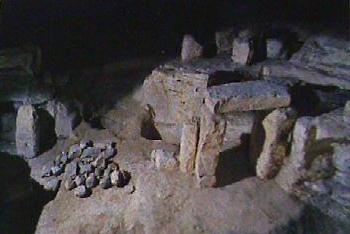
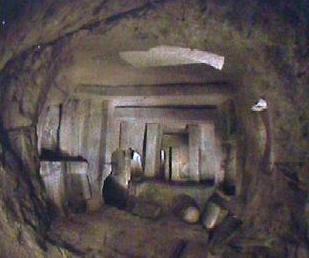
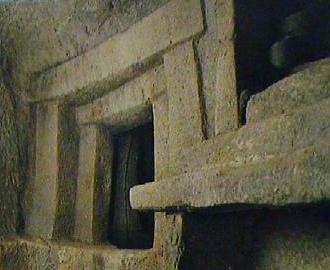
The trilithon features in several of
the Maltese temples. They were commonly used as entrances and as
small 'alter' areas within the structures themselves.
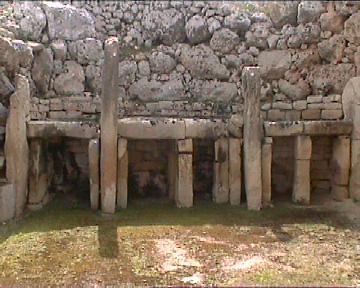
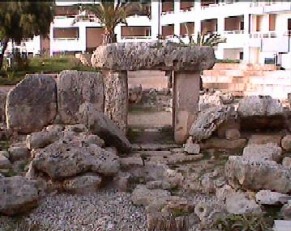
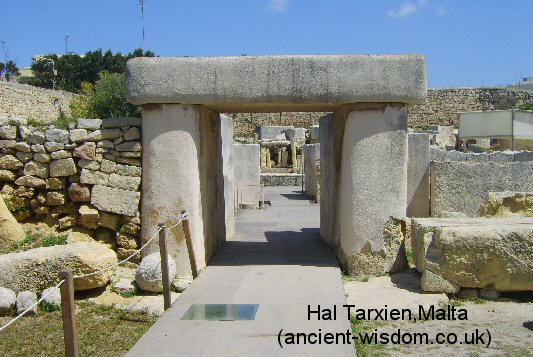
This same
design feature is repeated underground in the
Hypogeum, where the trilithons are carved from the living rock.
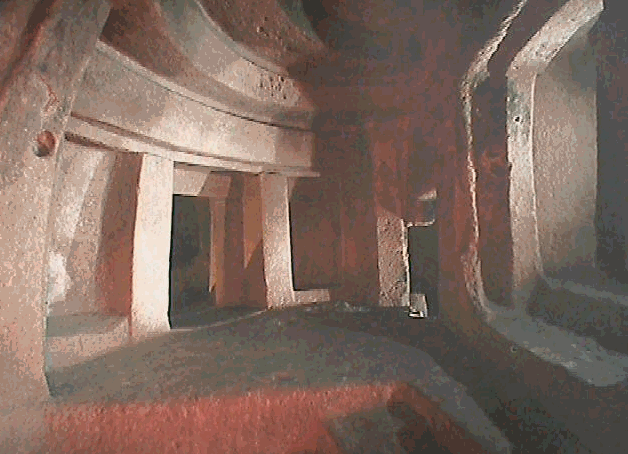
(More about the Hypogeum, Malta)
There are two particular examples of trilithons in ancient
Egyptian temples which stand out. Both structures are associated with the
early dynasties and they both share the same construction feature seen at
Stonehenge (multiple columns joined together with continuous lintels).
Abydoss: The Osirion (Strabo's well).
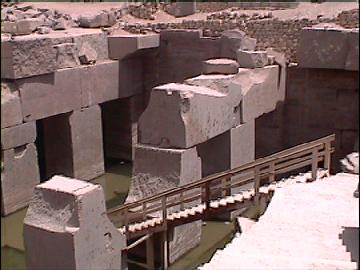
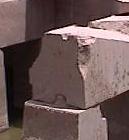
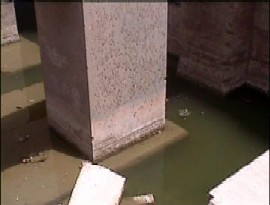
Almost the exact same style was used at the
'Valley Temple' (Below), at Ghiza,
Northern Egypt.
The 'Valley Temple', Ghiza.
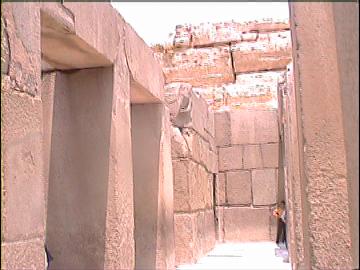
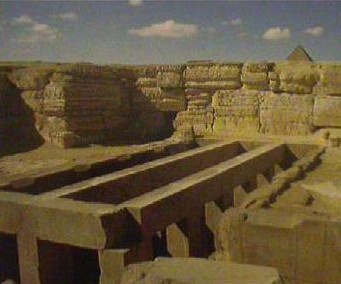
The Valley Temple is called the 'House of Isis', as
shown in the 'Inventory Stela' (below), while the Osirion
at the other end of Egypt, was associated with her consort, Osiris. This
forms one of the backbones of Egyptian mythology.
|
The 'Inventory
Stella'
- (Found by Auguste Mariette in the 1850's).
Long live The King of Upper and Lower Egypt, Khufu, given life...
He found the house of
Isis, Mistress of the Pyramid, by the side of the hollow of Hwran (The
Sphinx)
and he built his pyramid beside the temple of this goddess and he built a
pyramid for the King's daughter Henutsen beside this temple.
The place of Hwran Horemakhet is on the South side of the House of Isis,
Mistress of the pyramid
He restored the statue, all covered in painting, of the guardian of the
atmosphere, who guides the winds with his
gaze.
He replaced the back part of the Nemes head-dress, which was missing with
gilded stone
The figure of this god, cut in stone, is solid and will last to eternity,
keeping its face looking always to the East.
|
(More
about The Giza Complex)
|
Pacific Isles Trilithon,
(Ha'amonga 'A Maui): |
The archaeologically rich area
of Lapaha on the eastern side of the main island of Tongatapu offers
the largest terraced tombs (langi) in the South Pacific. About five miles further along
the north point of Tongatapu is the hugely impressive trilithon of
Ha'amonga 'A Maui. This ancient trilithon is a massive 12-ton stone
archway made from three single limestone slabs. How they got there
and what it was used for is uncertain but two of the more creditable
theories are a gateway to the Royal Gardens or a shrine for
observing the seasons. Other similar but smaller structures can be
found within the Kingdom's ancient empire
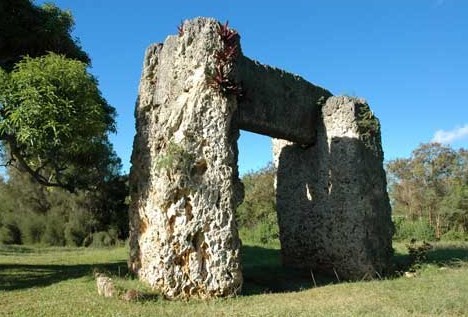
Ha'amonga
'a Maui
(Burden of Maui) - is a 12-ton stone
trilithon located in
Tonga, Heketā, near the
village of
Niutōua, in the north of
the island of
Tongatapu, in the Pacific
ocean.
It is constructed from of three limestone slabs, and is about 5m
high, 2m wide, 6m long. Ha'amonga 'a Maui was built at the beginning
of the
13th century under the
11th Tu'i Tonga
Tu'itātui
(king strike the knee), most likely as a gateway to his royal
compound Heketā. One can pass through the portal and walk the short
distance towards the 'esi maka
faakinanga (stone to lean against), which served as the king's
throne. Sitting with his back to that stone he was safe from
assassins from behind and with his long stick he could hit every
potential foe from the front on his knees.
In popular myths the Ha'amonga
is believed to have been made by the demigod Maui, as the stones would be too huge for mortals to handle. The
word ha'amonga
means: a stick with loads on both ends, carried over the shoulder.
Maui was supposed to have the stones obtained from 'Uvea
(Wallace Island) and carried on to Tonga. In reality the stones are of coral-rock,
whose structure matches that of old quarries along the
neighbouring coasts.
The king of Tonga,
Tāufaʻāhau
Tupou IV came in
1967 with the theory that the
Ha'amonga
had an astronomical significance too, telling the position of
sunrise at
solstices and
equinoxes.
Because he was the king, this account is still quoted nowadays,
although there is no evidence for it.
In fact there is only one 'proof': According to the road-sign,
there is a V shaped mark on the top of the lintel, whose 2 legs
point towards the solstice directions, and it is copied on the
ground below. Refute: the V on top is an arrow directed along the
main axis of the lintel (about ESE, 117�5 E of N), only 10 cm long,
too short to be a reliable indicator of any direction. The copy on
the ground disappeared before 1990. It was rotated to point in the
right directions, though, but with 6 cm size it was even smaller.
Some people claim that another V mark was meant. Striations on the
top of the stone would be the direction pointers. Refute: The
northwest pier had clearly sagged over the centuries, rotating the
lintel by about 5�. Any mark supposedly pointing in the right
direction now, could never have done so at construction. The
striations only match the structure of the stone.
A reference to a 19th century manuscript from Elia Malupō,
corrected by the last
Tu'i Tonga,
Laufilitonga himself, is sometimes
quoted: tu'u
'a e Ha'amonga
ko e mātanga (the Ha'amonga
stands as an observatory). But the daily meaning of the word
mātanga is, and always has been, a scenic spot to look at,
not to look from.
Reference: (K. Velt; Stars over Tonga; 1990)
(More
about the Prehistoric Pacific)
| Other
Examples of Trilithons: |
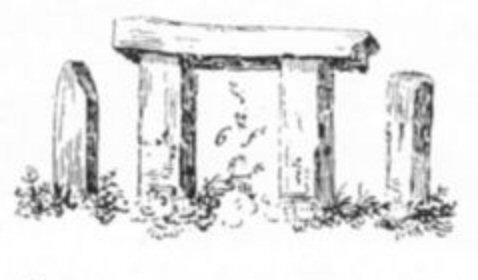
This Trilithon (6ft wide x 12 ft high),
was recorded in Kasya Village, Northern India (2).
Most 'Trilithons'
are actually 'Lintel's'. At Stonehenge, Trilithons proper were
constructed on the inside, while the exterior circle stones were covered
with a continuous lintelled circle. Its architectural use for portals
appears to have been its most common and perhaps in this we can see its
origin, followed by a symbolic portal composed of just three stones.
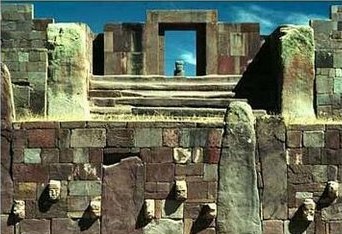
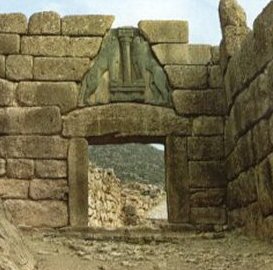
Tiahuanaco,
South America (left), The 'Lions gate', Mycenae. Greece
(right).
'Lintelled' doorways are found at the
entrances of passage mounds around the
ancient world, demonstrating the symbolism of free-standing trilithons as
Portals.
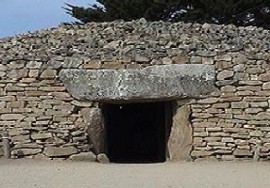
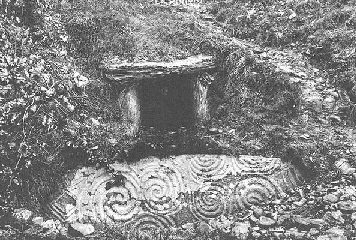
Table des Marchands, France (left), and
Newgrange, Ireland (right).
|

