|
Location:
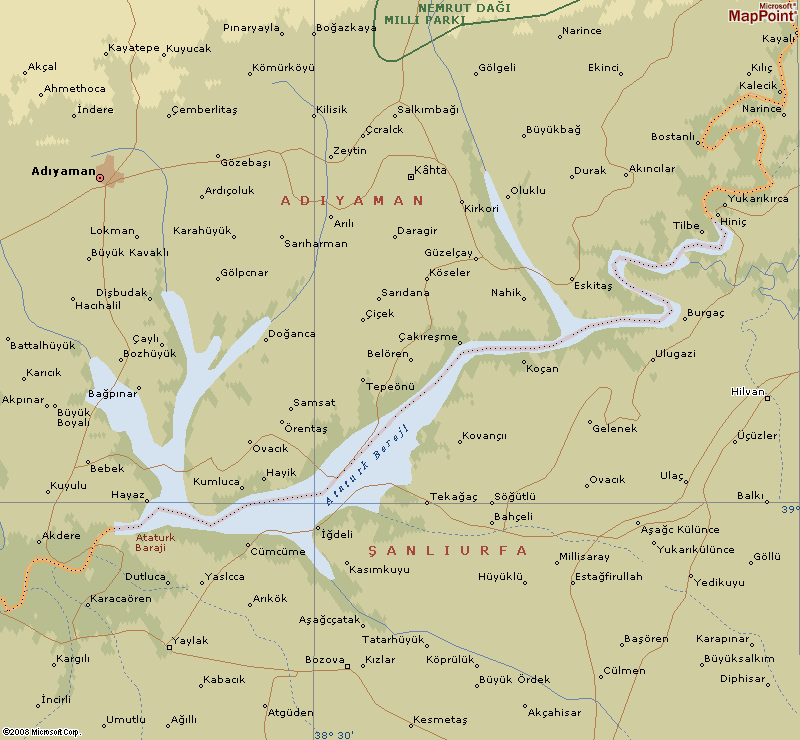
West of Kantara, village of Hilvan, Turkey. |
Grid Reference:
37.58�
N, 38.63� E |
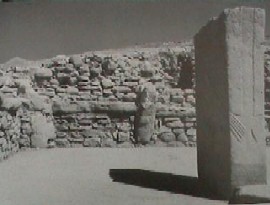
 Nevali
�ori:
(Cult Buildings).
Nevali
�ori:
(Cult Buildings).
The discoveries at
Nevali Cori have contributed to an emerging picture of Neolithic progress
in the middle-east that is pushing the date of
The site was examined in 1993
during the erection of the Attaturk Dam. Excavations were conducted by
a team from the University of Heidelberg under the direction of
Professor Harald Hauptmann. Together with numerous other
archaeological sites in the vicinity, Nevali Cori has since been
inundated by the dammed waters of the Euphrates.
(Map of
site - How to get there)
|
Nevali �ori:
(Pron. Chor-ree). |
This site,
together with numerous others in the vicinity are now underwater and
no longer visible.
(Various
remains, including the monolith are now on display in the nearby 'Urfa'
museum).
The
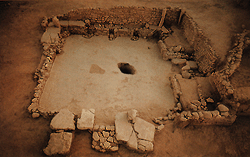
site of one of the oldest carved monoliths in the world. The temples
were lost when the Ataturk dam was established and flooded the area. The
central cult building has been carbon dated to 8,000 BC, and consisted
of a temple built with 13 stone uprights in the walls, and with an
enormous monolith in the centre (once a pair). The design of the temple
has been compared to the Kalasaya at
Tiahuanaco, Bolivia, while the hands on the
monolith are reminiscent of those on the
Easter island
statues.
Of the 22 buildings uncovered at Nevali
Cori, only one appears to have been used as a dwelling. The presence of
decorated skulls inside the shrines, as at several other Neolithic sites
in the middle east (�ay�n�,
�atal Huyuk
etc), suggests that the site was used for the practice of a common
ritual. The evidence emerging from this site strongly suggests the 'the
sculpted figures and carvings depict
shamanic
individuals adorned in coats and
head-dresses of vulture feathers'. (1)
Chronology:
According to carbon dating, the earliest occupation of the site
began at about 8,400 BC. The settlement was continuously in use
until the middle of the sixth millennium BC.
(1)
In terms of
absolute dates, 4 radiocarbon dates have been determined for Nevalı
�ori. Three are from Stratum II and date it with some certainty to the
second half of the 9th millennium BC, which coincides with early dates
from �ay�n� and with Mureybet IVA and
thus supports the relative chronology above. The fourth dates to the
10th millennium.
(Ref:
wikipedia.org)
Farming and
Agriculture-
Analysis of the
seeds discovered from the site shows that farming in the form of
domesticated wheat was practised at Nevali Cori as early as 7,200 BC.
(2)
The Statues and Carvings.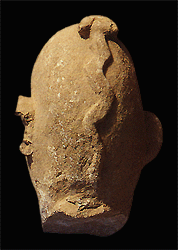
The local limestone was carved
into numerous statues and smaller sculptures, including a more than
life-sized bare human head with a snake or sikha-like tuft. Some of
the pillars also bore relief's, including ones of human hands. The
free-standing anthropomorphic figures of limestone excavated at Nevali
Cori belong to the earliest known life-size sculptures. Comparable
material has been found at G�bekli Tepe
(Currently considered to be the oldest temple in the world at c. 9,500
BC).
Several hundred small clay
figurines (about 5 cm high), most of them depicting humans, have been
interpreted as votive offerings. They were fired at temperatures
between 500-600�C, which suggests the development of ceramic firing
technology before the advent of pottery proper.
This particular sculpture (right)
is claimed to be the head of an Indian Vedic priest by B. G.
Sidhartha, who whilst researching the early (similar) date of the
Rig Veda, came across it in the archaeological literature. He said
of it:
"Even a not-too-well
informed Indian can make this out to be the sculpture of a Vedic
priest, because such a hairstyle is a dying, but still alive
tradition in India today". (3)
(More
about ancient India)
Alignments:
-
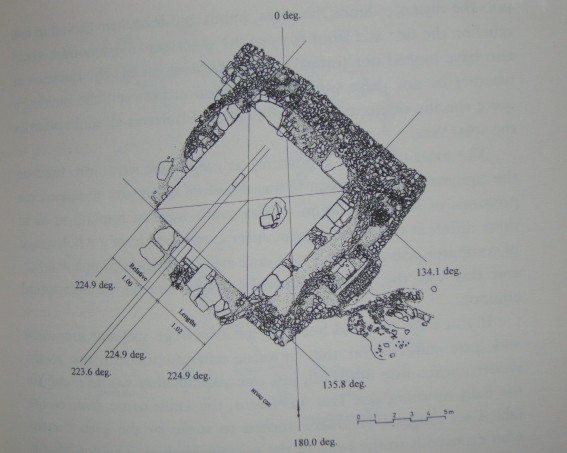
The corners of
the main 'cult' building are aligned cardinally, leaving the temple facing
almost exactly SW. The monoliths inside (originally there were two), were
both orientated so as to face out of the building and along the Euphrates
river. Nevali Cori is suggested by Collins
(1), to be orientated towards
Giza, 1080
Km away.
(Other Prehistoric Turkish sites)
|