 The Great Puzzle of Giza -
(Appendices)
The Great Puzzle of Giza -
(Appendices)
|
Appendix A. The Great Pyramid of Giza: Physical Statistics:
|
|
Appendix B The Chronologies of Kings. Manetho's Chronology: The divine and pre-dynastic dynasties: From Manetho, according to Eusebius, extracted from Pochan (16).
And on for 4,497 yrs until :-
The Abydoss Kings list: Third Dynasty.
Fourth Dynasty.
Other Chronologies. 1st Dynasty.
2nd Dynasty.
3rd Dynasty.
4th Dynasty.
5th Dynasty. The first three monarchs of the 5th dynasty were Userkaf, Sahure, and Neferirkare. At least 6, 5th dynasty monarchs built their sun-temple at Abu Gorab. (18)
6th Dynasty
|
|
Appendix C Historical Texts about Giza.
|
|
Extract from Herodotus - c. 430 BC. 'The Histories', Vol II: 124. By Sir. Henry Rawlinson. Till the death of Rhampsinitus, the priests said, Egypt was excellently governed and flourished greatly; but after him Cheops succeeded the throne, and plunged into all manner of wickedness. He closed the temples, and forbade the Egyptians to offer sacrifice, compelling them instead to labour, one and all, in his service. Some were required to drag blocks of stone down to the Nile from the quarries in the Arabian range of hills; others received the blocks after they had been conveyed in boats across the river, and drew them to the range of hills called the Libyan (Note 1). A hundred thousand men laboured constantly, and were relieved every three months by a fresh lot. It took ten years' oppression of the people to make the causeway (Note 2), for the conveyance of the stones, a work not much inferior, in my judgment, to the pyramid itself. This causeway is five furlongs in length, ten fathoms wide, and in height, at the highest part, eight fathoms. It is built of polished stone, and is covered with carvings of animals. To make it took ten years, as i said - or rather to make the causeway, the works on the mound (Note 3), where the pyramid stands, and the underground chambers, which Cheops intended as vaults for his own use: these last were built on a sort of island, surrounded by water introduced from the Nile by a canal (Note 4). The pyramid itself was twenty years in building. It is a square, eight hundred feet each way (Note 5), and the height the same, built entirely of polished stone, fitted together with the utmost care. The stones of which it is composed are none less than thirty feet in length (Note 6)'. 'The pyramid was built in steps (Note 7), battlement-wise, as it is called, or, according to others, altar-wise. After laying the stones for the base, they raised the remaining stones to their places by means of machines (Note 8), formed of short wooden planks. The first machine raised them from the ground to the top of the first step. On this there was another machine, which received the stone upon its arrival, and conveyed it to the second step, whence a third machine advanced it still higher. Either they had as many machines as there were steps in the pyramid, or possibly they had but a single machine, which, being easily moved, was transferred from tier to tier as the stone rose - both accounts are given, and therefore I mention both. The upper portion of the pyramid was finished first, then the middle, and finally the part which was lowest and nearest the ground. There is an inscription in Egyptian characters (Note 9), on the pyramid which records the quantity of radishes, onions, and garlic consumed by the labourers who constructed it; and I perfectly well remember that the interpreter who read the writing to me said that the money expended this way was 1600 talents of silver. If this then is a true record, what a vast sum must have been spent on the iron tools (Note 10), used in the work, and on the feeding and clothing of the labourers, considering the length of time the work lasted, which has already been stated, and the additional time - no small space, I imagine - which must have been occupied by the quarrying of the stones, their conveyance, and the formation of the underground apartments'. 'The wickedness of Cheops reached to such a pity that, when he had spent all his treasures and wanted more, he sent his daughter to the stews, with orders to procure him a certain sum - how much I cannot say, for I was not told; she procured it, however, and at the same time, bent on leaving a monument which should perpetuate her own memory, she required each man to make her a present of a stone towards the works which she contemplated. With these stones she built the pyramid which stands midmost of the three that are in front of the great pyramid, measuring along each side a hundred and fifty feet'. (Note 11). Notes (By Sir Henry Rawlinson):
My notes: - There are a number of issues concerning Herodotus account:-
Production rate (using Herodotus figures):- Adjust to groups of say 6 or 8 2,300,000 blocks produced over 20 years = 115,000 per year. 115,000 blocks divided by 365 days = 315.068 blocks per day. 315.068 blocks produced each 12 hours of daylight (Av) = 26.25 blocks per hour (or) 1 block produced each 2.286 minutes. (call it 2.5 mins) This equation only takes into account the production of the limestone masonry blocks, it suggests that while 1 block needed to be produced each 2.5 minutes, it also required 1 block to be transported to site each 2.5 minutes and 1 block placed on the pyramid each 2.5 minutes. As well as this this the project involved leveling the surrounding pavement (limestone and basalt), transporting and cutting the granite blocks from Aswan, carving the numerous internal blocks with specific features and cutting and fitting the estimated 115,000 casing stones. (All of which considerably cut into the 12 hrs available to the labourers each day). Conclusion - It is a reasonable assumption that one of the factors of the equation are wrong. Either there are considerably less stones (as one report suggests), (and/or) more people were involved, (and/or) it took longer than 20 years to complete.
Of course the actual distribution of labour would be more specialized; but this outline will show that such a scale of work would suffice for the complete 4 building of the Great Pyramid in twenty years as stated by Herodotus.* We thus see that the whole of the material, and not merely the casing, could readily be obtained from the eastern shore; and that the levies need not have been employed during more than the three months when all ordinary labour was suspended. * The Great Pyramid contained about 2,300,000 stones, averaging 50 x 50 x 28 inches, or 2½ tons each. If 8 men brought 10 stones, 100,000 would bring 125,000 stones each season or the total number in less than 20 years.
|
|
Diodorus Siculus (56 BC) From Book I, 63.4-64.14: (ref: 16) 'The eighth King, Chemmis of Memphis, ruled fifty years and constructed the largest of the three pyramids, which are numbered among the Seven Wonders of the World. These pyramids, which are situated on the side of Egypt which is towards Libya, are one hundred and twenty stades from Memphis and fourty-five from the Nile, and by the immensity of their structures and the skill shown in their execution they fill the beholder with wonder and astonishment. For the largest is in the form of a square and has a base length on each side of seven plethora (7 plethra = 246.26m) and a height of over six plethora (6 plethra = 211.08m (ridge)); it also gradually tapers to the top, where each side is six cubits long. The entire construction is of hard stone, which is difficult to work but lasts forever; for though no fewer than a thousand years have elapsed, as they say, to our lifetime, or, as some writers have it, more than three thousand four hundred, the stones remain to this day still preserving their original position and the entire structure undecayed. It is said that the stone was conveyed over a great distance from Arabia and that the construction was effected by means of mounds, since cranes had not yet been invented at that time; and the most remarkable thing in the account is that, though the constructions were on such a great scale and the country round about them consists of nothing but sand, not a trace remains either of any mound or of the dressing of these stones, so that they do not have the appearance of being the slow handiwork of men but look like a sudden creation, as though they had been made by some god and set down bodily in the surrounding sand. Certainly Egyptians would make a marvel out of these things, saying that, inasmuch as the mounds were built of salt and saltpeter, when the river was let in it melted them down and completely effaced them without the intervention of man's hand. However, there is not a word of truth in this, but the entire material for the mounds, raised as they were by the labour of many hands, was returned by the same means to the place from which it came; for three hundred and sixty thousand men, as they say, were employed on the undertaking, and the whole structure was scarcely completed in twenty years. Upon the death of this King his brother Cephren succeeded the throne and ruled fifty-six years; but some say that it was not the brother of Chemmis, but his son Chabreys, who took the throne. All writers, however, agree that it was the next ruler who, emulating the example of his predecessor, built the second pyramid, which was the equal of the one just mentioned in the skill displayed in its execution but far behind it in its size, since its base length on each side is only a stade (1 stade = 211.08m). And an inscription on the larger pyramid gives the sum of money expended on it, since the writing sets forth that on vegetables and purgatives for the workmen there were paid out over sixteen hundred talents. The smaller bears no inscription but has steps cut into one side. And though the two kings built the pyramids to serve as their tombs, in the event neither of them was buried in them; for the multitudes, because of the hardships which they had endured in the building of them and the many cruel and violent acts of these kings, were filled with anger against those who had caused their sufferings and openly threatened to tear their bodies asunder and cast them in despite out of the tombs. Consequently each ruler when dying enjoined upon his kinsmen to bury his body secretly in an unmarked place. After these rulers Mycerinus, to whom some give the name Mencherinus, a son of the builder of the first pyramid, became king. He undertook the construction of a third pyramid, but died before the entire structure had been completed. The base length of each side he made three plethora (3 plethra = 105.54m), and for fifteen courses he built the walls of black stone like that found at Thebes, but the rest of it he filled out with stones like that found in the other pyramids. In size this structure falls behind those mentioned above, but far surpasses them in the skill displayed in its execution and the great cost of the stone; and on the north side of the pyramid is an inscription stating that its builder was Mycerinus There are also three other pyramids, each of which is one plethrum (1 plethrum = 35.18m) long on each side and in general construction is like the others save in size; and these pyramids, they say, were built by the three kings named above for their wives. It is generally agreed that these monuments far surpass all other constructions in Egypt, not only in their massiveness and cost but also in the skill displayed by their builders. And they say that the architects of the monuments are more deserving of admiration than the kings who furnished the means for their execution; for in bringing their plans to completion the former called upon their individual souls and their zeal for honour, but the latter only used the wealth which they had inherited and the grievous toil of other men. But with regard to the pyramids there is no complete agreement among either the inhabitants of the country or the historians; for according to some the kings mentioned above were their builders, according to others they were different kings; for instance, it is said that Armaeus built the largest, Amosis the second, and Inaros the third. And the last pyramid, some say, is the tomb of the courtesan Rhodopis, for some of the monarchs became her lovers, as the account goes, and out of their passion for her carried the building through to completion as a joint undertaking.' |
|
Strabo c. 24 BC. (Extract from (16). Taken from 'The geography of Strabo' (Trans. By H. L. Jones) (New York: G. P. Putnam's Sons) Vol. III, p. 84-5). On proceeding forty stadia from the city, one comes to a kind of mountain-brow; on it are numerous pyramids, the tombs of kings, of which three are noteworthy; and two of these are even numbered among the seven wonders of the world, for they are a stadium in height, are quadrangular in shape, and their height is a little greater than the length of each of the sides; and one of them is only a little larger than the other. High up, approximately midway between the sides, it has a movable stone, and when raised up there is a sloping passage to the vault. Now these pyramids are near one another and on the same level; but further on, at a greater height of the hill, is the third, which is much smaller than the two, though constructed at much greater expense; for from the foundation almost to the middle it is made of black stone, the stone from which mortars are made, being brough from a great distance, for it is brought from the mountains of Aetheopia; and because of its being hard and difficult to work into shape it rendered the undertaking very expensive. It is called 'Tomb of the courtesan', having been built by her lovers the courtesan whom Sappho the Melic poetess calls Doricha, the beloved of Sappho's brother Charaxus, who was engaged in transporting lesbian wine to Naucratis for sale, but others give her the name Rhodopis. They tell the fabulous story that, when she was bathing, an eagle snatched one of her sandals from her maid and carried it to Memphis; and while the king was administering justice in the open air, the eagle, when it arrived above his head, flung the sandal into his lap; and the king, stirred both by the beautiful shape of the sandal and by the strangeness of the occurrence, sent men in all directions into the country in quest of the woman who wore the sandal; and when she was founding the city of Naucratis, she was brought up to Memphis, became the wife of the king, and when she died was honoured with the above mentioned tomb.
|
|
Extracts from Pliny 'The Elder' - c. 20 AD. - (Natural History, Book 36) Chapter. 16. (12) - MARVELLOUS WORKS IN EGYPT. THE PYRAMIDS. - We must make some mention, too, however cursorily, of the Pyramids of Egypt, so many idle (1) and frivolous pieces of ostentation of their resources, on the part of the monarchs of that country. Indeed, it is asserted by most persons, that the only motive for constructing them was either a determination not to leave their treasures to their successors or to rivals that might be plotting to supplant them, or to prevent the lower classes from remaining unoccupied. There was great vanity displayed by these men in constructions of this description, and there are still the remains of many of them in an unfinished state. There is one to be seen in the Nome of Arsinoïtes; two in that of Memphites, not far from the Labyrinth, of which we shall shortly have to speak; and two in the place where Lake Mœris was excavated, an immense artificial piece of water, cited by the Egyptians among their wondrous and memorable works: the summits of the pyramids, it is said, are to be seen above the water. The other three pyramids, the renown of which has filled the whole earth, and which are conspicuous from every quarter to persons navigating the river, are situate on the African (2) side of it, upon a rocky sterile elevation. They lie between the city of Memphis and what we have mentioned as the Delta, within four miles of the river, and seven miles and a-half from Memphis, near a village known as Busiris, the people of which are in the habit of ascending them. Notes:- 1. Ajasson thinks that they were intended as places of sepulchre for the kings, but for the concealment, also, of their treasures. 2. Or left-hand side to those coming down the stream. He alludes to the three great Pyramids of Giza, not far from Cairo. There are numerous other pyramids to be seen in Egypt. CHAP. 17. - THE EGYPTIAN SPHINX. - In front of these pyramids is the Sphinx (1), a still more wondrous object of art, but one upon which silence has been observed, as it is looked upon as a divinity by the people of the neighborhood. It is their belief that King Harmaïs was buried in it, and they will have it that it was brought there from a distance. The truth is, however, that it was hewn from the solid rock; and, from a feeling of veneration, the face of the monster is coloured red. The circumference of the head, measured round the forehead, is one hundred and two feet, the length of the feet being one hundred and forty-three, and the height, from the belly to the summit of the asp on the head, sixty-two (2). The largest (3) Pyramid is built of stone quarried in Arabia: three hundred and sixty thousand men, it is said, were employed upon it twenty years, and the three were completed in seventy-eight years and four months. They are described by the following writers: Herodotus, (4) Euhemerus, Duris of Samos, Aristagoras, Dionysius, Artemidorus, Alexander Polyhistor, Butoridas, Antisthenes, Demetrius, Demoteles, and Apion. These authors, however, are disagreed as to the persons by whom they were constructed; accident having, with very considerable justice, consigned to oblivion the names of those who erected such stupendous memorials of their vanity. Some of these writers inform us that fifteen hundred talents were expended upon radishes, garlic, and onions (5) alone. The largest Pyramid occupies seven (6) jugera of ground, and the four angles are equidistant, the face of each side being eight hundred and thirty-three (7) feet in length. The total height from the ground to the summit is seven hundred and twenty-five feet, and the platform on the summit is sixteen feet and a-half in circuit. Of the second Pyramid, the faces of the four sides are each seven hundred and fifty-seven feet and a-half in length (8).The third is smaller than the others, but far more prepossessing in appearance: it is built of Æthiopian stone (9), and the face between the four corners is three hundred and sixty-three feet in extent. In the vicinity of these erections, there are no vestiges of any buildings left. Far and wide there is nothing but sand to be seen, of a grain somewhat like a lentil in appearance, similar to that of the greater part of Africa, in fact. The most difficult problem is, to know how the materials for construction could possibly be carried to so vast a height. According to some authorities, as the building gradually advanced, they heaped up against it vast mounds of nitre (10) and salt; which piles were melted after its completion, by introducing beneath them the waters of the river. Others, again, maintain, that bridges were constructed, of bricks of clay, and that, when the pyramid was completed, these bricks were distributed for erecting the houses of private individuals. For (11) the level of the river, they say, being so much lower, water could never by any possibility have been brought there by the medium of canals. In the interior of the largest Pyramid there is a well, eighty-six cubits deep, which communicates with the river, it is thought. The method of ascertaining the height of the Pyramids and all similar edifices was discovered (12) by Thales of Miletus; he measuring the shadow at the hour of the day at which it is equal in length to the body projecting it. Such are the marvellous Pyramids; but the crowning marvel of all is, that the smallest, but most admired of them--that we may feel no surprise at the opulence of the kings--was built by Rhodopis, (13) a courtesan! This woman was once the fellow-slave of Æsopus the philosopher and fabulist, and the sharer of his bed; but what is much more surprising is, that a courtesan should have been enabled, by her vocation, to amass such enormous wealth. Notes - (1) It still exists, though the face is mutilated. It was disinterred from the sand by Belzoni, but is now again nearly covered. According to Cavaglia, the signature of the Historian Arrian was found inscribed on one of the fore-paws, when it was disinterred. (2) This reading is, perhaps, preferable to the LXI. s, (61 1/2) of the Bamberg MS. The head and neck, when uncovered, were found to be 27 feet in height. (3) Built by King Cheops, according to Herodotus, B. ii. (4) All these writers are mentioned in the list of authors at the end of the present Book. (5) For the use of the workmen. There is, probably, no foundation for a statement so exact as this; as it would be very singular that such a fact should continue to be known, and the names of the builders be buried in oblivion. (6) According to modern measurement, the sides of its base measure at the foundation 763 feet 4 inches, and it occupies a space of more than 13 acres. Its perpendicular height is 480 feet. (7) Other readings are 883, and 783. (8) Differing very considerably from the modern measurement. These variations may possibly arise, however, from a large portion of the base being covered with sand. (9) It was entirely coated with marble from the Thebaid; which, however was removed by the Arabs in the middle ages. In the vicinity there is a fourth pyramid, but of such small dimensions that some of the Egyptian obelisks exceed it in height. (10) "Nitrum." See B. xxxi. c. 46. (11) From this reason being given, it would almost appear that these "bridges" in reality were aqueducts, for conveying the water, in order to melt the mounds of salt and nitre. (12) A very improbable story, as Ajasson remarks; as if the method of ascertaining the heights of edifices was unknown to the sages of Egypt, and the constructors of the Pyramids! (13) Herodotus, B. ii.
cc. 134, 5, takes great pains to prove the absurdity of this story; and there is
little doubt that the beautiful courtesan has been confounded with the equally
beautiful Egyptian Queen, Nitocris, who is said by Julius Africanus and Eusebius
to have built the third pyramid. As to the courtesan having been a fellow-slave
of the fabulist, Æsop, it is extremely doubtful. |
|
225 A.H. (836 AD) - Papyrus of Abou Hormeis. (Extract from Ref: 24 with notes by Dr. Sprenger) (Note - Pre Al-Mamun). 'It is said, that in a tomb at the monastery of Abou Hormeis, a body was found wrapped round with a cloth, and bearing upon the breast a papyrus, inscribed with antient Coptic characters, which could not be deciphered until, a monk, from the monastery of Al Kalmun in the Faioum, explained it as follows. (Note - The story is related by Masoudi, but this relation of it by Al Kodhai is given, because he was a cadi in Egypt; and mentions the persons by whom the tradition had been handed down from former times) "In the first year of King Diocletian, an account was tken from a book, copied in the first year of Kung Philippus (Note - Moses of chorine, seems to allude to this account when he mentions that Valaraces sent to his brother Arsaces (the governor of Armenia), a learned man called Mariba to enquire into the antient history of Armenia. This person is supposed to have found, amongst the archives of Nineveh, a book, translated from Chaldaic into Greek by order of Alexander the Great, which contained historical records of the most remote antiquity. Valaraces ordered them to be inscribed upon a column; and the author derived from this monument a considerable part of this history. Cedrenus also says, upon the authority of an apocryphal work ascribed by the Egyptians to Hermes, that Enoch, foreseeing the destruction of the earth, had inscribed the science of astronomy upon two pillar; the one composed of stone to resist the operation of water, the other of brick to withstand that of fire. Cedrenus was a monk, and lived about 1050) - from an inscription of great antiquity written upon a tablet of god, which tablet was translated by two brothers-Ilwa and Yercha (Note - A French author (?) remarks, that it is possible that in the two hundred and twenty-fifth year of Ilegra an Arabic version was found of a Greek translation of an antient MS, which may have related to celestial observations and to the construction of the pyramids; and also that the two larger pyramids may, from their relative positions, have been called "eastern" and "western", and the third, from the dark colour of the granite, termed "painted". He conceives that treasures, statues, and mummies, may have been found in them. He remarks that the fonder of the great pyramid is called Surid, son of Shaluk; of the second, Herdjib; and of the third, Kemses, son or nephew of Surid: an account which agrees with the Greek historians. He observes, that the entrances, which have been discovered, are on the northern sides, and about twelve metres above the bases of the pyramids; but that at the time of the Caliph Al-Mamoun, as the accumulation of rubbish must have been less, the subterraneous passages, mentioned by the Arabian historians, may have been more apparent; and he conceives that their accounts are, to a certain degree, founded on fact) - at the request of Philipus, who asked them, how it happened that they could understand an inscription, which was unintelligible to the learned men of his capital? They answered, because hey were descended from one of the antient inhabitants of Egypt, who was preserved with Noah in the ark, and who, after the flood had subsided, went into Egypt with the sons of Ham, and dying in that country left to his descendants, (from whom the two brothers received them), the books of the antient Egyptians, which had been written one thousand seven hundred and eighty five years before the time of philippus, nine hundred and fourty-six years before the arrival of the sons of Ham in Egypt, and contained the history of two thousand three hundred and seventy-two years; and that it was from these books that the tablet was formed (785+2372 = 4057 years before year one of Philippus ?). The contents of the book were: 'We have seen wht the stars foretold; we saw the calamity descending from the heavens, and going out from the earth, and we were convinced that the waters would destroy the earth, with the inhabitants and plants. We told this to the King Ben Shulak: he built he pyramids fro the safety of us, and also as toms for himself and for his household. When Surid died, he was buried in the eastern pyramid; his brother Haukith, in the western; and his nephew Krwars, in the smaller - the lower part of which is built with granite, but the upper with a stone called Kedan'. The pyramids are described to have had doors with subterraneous porticoes or passages one hundred and fifty cubits in length. The entrance to the eastern pyramid is said to be on the side next to the sea, and that of the strong pyramid towards the Kiblah;and vast treasures and innumerable precious things are mentioned to have been enclosed in these buildings. Then the two brothers calculated what time had elapsed from the flood to the day when the translation was made by them for King Philip; and it appeared to be one thousand seven hundred and fourty-one years, fifty-nine days, and twenty three 59/400 hours." "In this manner were the pyramids built. Upon the walls were written the mysteries of science, astronomy, geometry, physics, and much useful knowledge, which any person, who understands our writing, can read. The deluge was to take place when the heart of the lion entered the first minute of the head of cancer, at the declining of the star. The other indications were the sun and moon entering into the first minute of the head of Aries and Saturn, in the first degree and twenty eight minutes of Aries; and Jupiter, in the twenty-ninth degree twenty-eight minutes of Pisces; and Hermes, i.e. Mercury, in the fifth degree and three minutes of the Lion." (Note- This statement was translated from the Coptic into Arabic 225 A.H., supposed to be four thousand three hundred and twenty-one years after the construction of the pyramids ( = 836AD = 4321 - 836 = 3485 BC) an account of the appearance of the heavens when the waters subsided, is also included).
|
|
The Coptic Accounts. - The following is a note in the margin of (Ref: 24), made by a Dr. Sprenger in relation to the Coptic accounts. 'It is said that, in the reign of Ahmed Ben Touloun, who conquered Egypt about 260 A.H. (Note = 871 AD - Al-Mamun 850 AD? which means that these MSS were written after the pyramid had been opened.), a learned old man, above one hundred years old, and of either Coptic of Nabathaen extraction, lived in upper Egypt. This person had visited many countries, and was well informed of the ancient history of Egypt, and was, by order of Ahmed Ben Touloun, examined before an assembly of learned Mohametans; and Masoudi's account of the pyramids is said to have been given upon the authority of this learned man. Masoudi also mentions certain persons who were, by profession, guides to the pyramids, with little or no variation, for above a thousand years; and they appear to have repeated the traditions of the ancient Egyptians, mixed up with fabulous stories and incidents, certainly not of Mohametan invention. The history, however, although evidently incorrect, yet seems well worthy of credit' (24).
Masoudi - (Abu'l Hassan Ma'sudi) Died 956 AD (345 A.H) (Extract from Ref: 24). The Akbar-Ezzeman MS, by Masoudi, and in the Bodleian, at Oxford, was so much decayed, that recourse has been had to the works of other authors, who have given the same account in nearly the same words - namely, to Makrizi, who quotes from Usted Ibrahim Ben Wasyff Shah; to Soyuti; to a MS (No. 7503) in the British museum, entitled "The Odour of Flowers", or "The Wonders of Different Countries", by Mohammed Ben Ayas; to a Turkish "History of Egypt" MS. (7861) in the British Museum, written 1089 AH; and to Yakut, MS in the Bodleian Library. Masoudi's account professes to relate the Coptic tradition which says, "That Surid, Ben Shaluk, Ben Sermuni, Ben Termidun, Ben Tedresan, Ben Sal, one of the kings before the flood, built the two great pyramids; and, notwithstanding they were subsequently named after a person called Sheddad Ben Ad, that they were not built by the Adites, who would not conquer Egypt, on account of the powers, which the Egyptians possessed by means of enchantment; that the reason for building the pyramids was the following dream, which happened to Surid 300 years previous to the flood. It appeared to him, that the earth was overthrown, and that the inhabitants were laid prostrate upon it; that the stars wandered confusedly from their courses, and clashed together with a tremendous noise. The king, although generally affected by this vision, did not disclose it to any person but was conscious that some great event was about to take place. Soon afterwards in another vision, he saw the fixed stars descend upon the earth in the form of white birds seizing the people, enclosing them in a cleft between two great mountains, which shut upon them. The stars were dark, and veiled with smoke. The king awoke in great consternation, and repaired to the temple of the sun, where, with great lamentations, he prostrated himself in the dust. Early in the morning he assembled the chief priests from all the nomes in Egypt, a hundred and thirty in number; no other persons were admitted to this assembly, when he related his first and second vision. The interpretation was declared to announce, "that some great event would take place." The high priest, whose name was Philimon or Iklimon, spoke as follows:-"Grand and mysterious are thy dreams: The visions of the king will not prove deceptive, for sacred is his majesty. I will now declare unto the king a dream I also had a year ago, but which I have not imparted to any human being." The king said, "Relate it, O Philimon." The high priest accordingly began:- " I was sitting with the king upon the tower of Amasis. The firmament descended from above till it overshadowed as a vault. The king raised his hands in supplication to the heavenly bodies, whose brightness was obscured in a mysterious and threatening matter. The people ran to the palace to implore the kings protection; who in great alarm again raised his hands towards the heavens, and ordered me to do the same; and behold, a bright opening appeared over the king, and the sun shone forth above; these circumstances allayed our apprehensions, and indicated, that the sky would resume its former altitude; and fear together with the dream vanished away." The king then directed the astrologers to ascertain by taking their altitude whether the stars foretold any great catastrophe, and the result announced an approaching deluge. (Note - according to Makrizi, fire was to proceed from the sign Leo, and to consume the world). The king ordered them to enquire whether or not this calamity would befall Egypt; and they answered, yes, the flood would overwhelm the land, and destroy a large portion of it for some years. He ordered them to enquire if the earth would again become fruitful, or if it would continue to be covered with water. They answered that its former fertility would return. The king demanded what would happen. He was informed that a stranger would invade the country, kill the inhabitants, and seize upon their property; and that the Nile, would take possession of the kingdom; upon which the king ordered the pyramids to be built, and the predictions of the priests to be inscribed upon columns, and upon the large stones belonging to them; and he placed them with his treasures, and all his valuable property, together with the bodies of his ancestors. He also ordered the priests to deposit within them, written accounts of their wisdom and acquirements in the different arts and sciences. (Note - On the margin of Makrizi's MSS, we read that the inscriptions of the priests were on the ceilings, roofs etc, of the subterraneous passages). Subterraneous channels were also constructed to convey to them the waters of the Nile. He filled the passages with talismans, with wonderful things, and idols; and the writing of the priests containing all manner of wisdom, the names and properties of medical plants, and the sciences of arithmetic and of geometry; that they might remain as records, for the benefit of those, who could afterwards comprehend them. He ordered pillars to be cut, and an extensive pavement to be formed. The lead employed in the work was procured from the West. The stone came from the neighbourhood of Es Souan. In this way were built the Three Pyramids at Dashoor, the Eastern, the Western and the coloured one. (Note - Makrizi and Soyuti do not mention Dashoor, so that the author probably alluded to the [pyramids of Gizeh, as Dashoor is only inserted in a MS in the Bodleian). In carrying on the work, leaves of papyrus, or paper, inscribed with certain characters, were placed under the stones prepared in the quarries; and upon being struck, the blocks were moved at each time the distance of a bowshot (about one hundred and fifty cubits), and so by degrees arrived at the pyramids. Rods of iron were inserted into the centres of the stones, that formed the pavement, and, passing through the blocks placed upon them, were fixed by melted lead. Entrances, with porticoes composed of stones fastened together by lead, were made forty cubits under the earth: the length of every portico being one hundred and fifty cubits. The door of the eastern pyramid was one hundred cubits eastward from the centre of the face, in which it was placed, and was in the building itself. The door of the westward pyramid was one hundred cubits westward, and was also in the building. And the door of the coloured pyramid was one hundred cubits southward of the centre, and was likewise in the building. The height of each pyramid was one hundred royal cubits, equal o five hundred common cubits. The squares of the bases were the same. They were begun at the eastern side. When the buildings were finished, the people assembled with rejoicing around the king, who covered the pyramids with coloured brocade, from the top to the bottom, and gave a great feast, at which all the inhabitants of the country were present. He constructed, likewise, with coloured granite, in the western Pyramid, thirty repositories for sacred symbols, and talismans formed of sapphires, for instruments of war composed of iron which could not become rusty, and for glass, which could be bent without being broken; and also for many sorts of medicines, simple and compound, and for deadly poisons. In the eastern pyramid were inscribed the heavenly spheres and figures representing the stars and planets in their forms, in which they were worshipped. The king, also, deposited the instruments, and the thuribula, with which his forefathers had sacrificed to the stars, and also their writings; likewise, the position of the stars, and their circles; together with the history and chronicles of time past, of that, which is to come, and of every future event, which would take place in Egypt. He placed there, also, coloured basins (for lustration and sacrificial purposes), with pure water, and other matters. Within the coloured pyramid were laid the bodies of the deceased priests, in sarcophagi of black granite; and with each was a book, in which the mysteries of his profession, and the acts of his life were related. There were different degrees among the priest, who were employed in metaphysical speculations, and who served the seven planets. Every planet had two sects of worshippers; each subdivided into seven classes. The first comprehended the priests, who worshipped, or served seven planets; the second, those who served six planets; the third, those who served five planets; the fourth, those who served four planets; the fifth, those who worshipped three planets; the sixth, those who served two planets; the seventh, those who served one planet. The names of these classes were inscribed on the sides of the sarcophagi (The names are given in the MS of Masoudi, but they cannot be made out); and within them were lodged books with golden leaves, which each priest had written a history of the past and a prophecy of the future. Upon the sarcophagi were, also, represented the manner, in which arts and sciences were performed, with the description of each process, and the object of it. The king assigned to every pyramid a guardian: the guardian of the Eastern pyramid was an idol of speckled granite, standing upright, with a weapon like a spear in his hand; a serpent was wreathed around his head, which seized upon and strangled whoever approached, by twisting round his neck, when it again returned to its former position upon the idol. The guardian of the western pyramid was an image made of black and white onyx, with fierce and sparkling eyes, seated on a throne, and armed with a spear; upon the approach of a stranger, a sudden noise was heard, and the image destroyed him. To the coloured (that is, the third pyramid) he assigned a statue, placed upon a pedestal, which was endowed with the power of entrancing every beholder till he perished. When everything was finished, he caused the pyramids to be haunted with living spirits; and offered up sacrifices to prevent the intrusion of strangers, and of all persons, excepting those, who by their conduct were worthy of admission. The author then says, that, according to the Coptic account, the following passage was inscribed, in Arabic, upon the pyramids. "I, Surid, the king, have built these pyramids, and have finished them in sixty-one years. (Not - Makrizi says "in sixty years" and states that he had endeavoured to find them, but in vain) Let him, who comes after me, and imagines himself a king like me; attempt to destroy them in six hundred. To destroy is easier than to build. I have clothed them in silk: let him try to cover them with mats". It is added, that the spirit of the northern pyramid had been observed to pass around it in the shape of a beardless boy, with large teeth, and a sallow countenance; that the spirit of the western pyramid was a naked woman, with large teeth, who seduced people into her power, and then made them insane, she was to be seen at mid-day and at sunset: and that the guardian of the coloured pyramid, in the form of an old man, used to scatter incense around the building with a thuribulum, like that used in Christian churches. The standard Coptics account end here.
|
|
Murtadi - (992
AD at Tithe, in Arabia). Translated in 1672.
"There was a king named Saurid, the son of Sahaloe, 300 years before the Deluge, who dreamed one night that he saw the earth overturned with its inhabitants, the men cast down on their faces, the stars falling out of the heavens, and striking one against the other, and making horrid and dreadful cries as they fell. He thereupon awoke much troubled. A year after he dreamed again that he saw the fixed stars come down to the earth in the form of white birds, which carried men away, and cast them between two great mountains, which almost joined together and covered them; and then the bright, shining stars became dark and were eclipsed. Next morning he ordered all the princes of the priests, and magicians of all the provinces of Egypt, to meet together; which they did to the number of 130 priest and soothsayers, with whom he went and related to them his dream. "Among others, the priest Aclimon, who was the greatest of all, and resided chiefly in the king's Court, said thus to him: - I myself had a dream about a year ago which frightened me very much, and which I have not revealed to any one. I dreamed, said the priest, that I was with your Majesty on the top of the mountain of fire, which is in the midst of Emosos, and that I saw the heaven sink down below its ordinary situation, so that it was near the crown of our heads, covering and surrounding us, like a great basin turned upside down; that the stars were intermingled among men in diverse figures; that the people implored your Majesty's succor, and ran to you in multitudes as their refuge; that you lifted up your hands above your head, and endeavored to thrust back the heaven, and keep it from coming down so low; and that I, seeing what your Majesty did, did also the same. While we were in that posture, extremely affrighted, I thought we saw a certain part of heaven opening, and a bright light coming out of it; that afterwards the sun rose out of the same place, and we began to implore his assistance; whereupon he said thus to us: "The heaven will return to its ordinary situation when I shall have performed three hundred courses". I thereupon awaked extremely affrighted." "The priest having thus spoken, the king commanded them to take the height of the stars, and to consider what accident they portended. Whereupon they declared that they promised first the Deluge, and after that fire. Then he commanded pyramids should be built, that they might remove and secure in them what was of most esteem in their treasuries, with the bodies of the kings, and their wealth, and the aromatic roots which served them, and that they should write their wisdom upon them, that the violence of the water might not destroy it."
|
|
Coutelle - Napoleon's Expedition. (1799-1801). Extract from Coutelle with notes from Pochan (16).
The excavation one notices to the left upon entering does not indicate any particular construction; it is simply where the Arabs tore up stones while searching for reputed treasures.
Before entering the vestibule, we noticed an opening at the top of the grand gallery, in the wall to the left, but we did not know where it might lead We had scarcely entered a passage 731 millimetres high and 650 millimetres wide when a swarm of bats descended upon us, trying to get out. For a long time we were forced to lie flat on a layer of dust and bat dung, as we were deafened by the whirring of their winged paws and suffocated by the pungent odour that they leave in the places they inhabit. WE were obliged to shield our faces in order to protect ourselves from their claws, and to cover our lamps, one of which soon went out nonetheless. We finally succeeded in crawling a distance of 8.385 meters and reached a space where no light had penetrated for many centuries. We were then right above the sepulchral chamber; but the space, as long and wide as that chamber, I only 1.002 meters high. The granite stones forming the ceiling as well as the four walls have only been dressed, not polished; and the stones forming the floor (and consequently the ceiling of the sepulchral chamber) are rough on this side and of varying heights, from 54 to 135 millimetres. The floor is entirely covered over with a layer of bat dung which is perfectly level along its entire surface; its thickness ranges from 14 centimetres on top of the highest stones to over 28 centimetres on top of the lowest stones, so that the total coating is about 21 centimetres thick along the entire floor, as well as in the passage. There can be no doubt as to the reason for building the double ceiling; it was installed solely to create a relieving mechanism, similar to the one at the pyramids entrance, so that the sacred chamber would not collapse under the weight above it. This precaution was not entirely pointless: many stones in this second ceiling are cracked not far from their bearings, and the granite blocks supporting them are split along their edges from the weight of the relieving stones placed at the edge of this ceiling and the weight of the stones above it.
The Well. - The well, whose opening is found on the landing at the entrance to the Horizontal Gallery, particularly attracted our attention. We were interested in discovering what motive there could have been for making such an irregularly shaped excavation in the bedrock and overcoming the difficulties inherent in so arduous a task as breaking up and carrying out fragments of a hard stone to a depth of about 65 meters in a space as narrow as 596by 650 millimetres. A few months before beginning my research I had already descended into the well with Mr. Alibert, by means of a rope attached to a piece of wood placed across the upper part. I was carrying - along with a lamp - a compass, a thermometer, and instruments for measuring depth and slope; but I had not been able to calculate the length of rope necessary for an unknown depth. The part of the well that should have been the easiest to descend, since it is carved in the form of steps along a slope less steep than that of the rest of the well, was obstructed by a granite block and two large limestone blocks that left a width of only 271 millimetres (and a somewhat larger breadth) in which to pass. Having overcome this difficulty and reached the end of my rope, I still had not reached the bottom. However, it was difficult to deliberate with my feet precariously lodged in small irregular holes 30 or 40 millimetres deep, one hand occupied, and a lamp in my mouth; moreover, I found myself in a nearly perpendicular shaft surrounded by air that, hardly circulating at all, grew each instant less suitable for breathing. The difficulty of the endeavor increased my desire to succeed: I did not waver.
Notes: (by A. Pochan) (38). 21.15 metres down the plumb line of the Ascending passage, which is obstructed by three granite blocks. Thus, in 1801, the Descending passage was obstructed by debris from the tunnel dug around the granite plugs. This tunnel was certainly not made by Al-Mamun, but it alerted his stonemasons to the position of the Ascending passage so that they were able to determine the location of the hole currently being used as an entrance. In my opinion, this tunnel was made long before Al Mamun came along; it must date from the Seventh, Eighth, or Ninth dynasty. (39). Actually 26° 34', corresponding to tan ½. (40). 'Al Mamun's' hole was not cleared until 1917. The members of the Commission d'Egypte Expedition were unaware of its existence. (41). Coutelle and Gratien le Pere were unable to reach the subterranean chamber, known as the 'unfinished chamber', because the descending passage and the 'well' were obstructed by debris from excavations. The length of 23.363 metres is that of the descending passage down to the point where it was broken into beneath the level of the three granite blocks closing off the Ascending passage. (42). That is, 0.162 metres. (It is actually 0.154 metres). (43). The 'well's' vertical depth, from the level of the Grand gallery's lower landing (the level of the floor of the Queen's chamber) down to where the 'well' opens on the west wall of the Descending passage, is 48.10 metres. Its real length is 57.50 metres. In order to appreciate Coutelle's exploit fully, one has to attempt the descent oneself; it is, even today, not at all easy or without risk. In fact, I myself, along with one of my colleagues at the Lycee du Cairo, experienced the same misfortune as Colonel Coutelle. Having attached the end of a 50-metre long rope to the well's entrance, we proceeded to descend; soon our flashlights could no longer pierce the thick cloud of dust raised by our descent. As we came to the end of the rope, our feet searched in vain for the floor at the bottom of the 'well'. We had to seek, by feeling bout wit our toes, notches capable of supporting our weight, and to thusly descend 8 metres before finding solid ground beneath our feet. We left the pyramid looking like baker's apprentices, covered from head to foot with a layer of dust several millimetres thick, and it took us several hours to clear out our nostrils and bronchial passages.
(44). Here Colonel Coutelle makes a mistake. According to the Survey of Egypt, the altitude of the pyramids plateau is 59.60 metres above the Mediterranean, and the Nile's average bed is 10 metres, the average water level being 12.25 metres and high water 20.63 metres. The bottom of the well is located 26.70 metres beneath the pyramid's plateau; the floor of the Subterranean chamber are located, respectively, 22.90 and 18.90 metres above the present level of the Nile. Taking into account the average alluvion coefficient of 0.130 metres per century, it can be estimated that the bed of the Nile in Cheops' time was 8.50 metres lower than it is at present. The subterranean chamber, known as the 'Abandoned chamber', was thus 27.60 metres above the bed of the Nile and 25.15 metres above the average flood level in Cheops' time. |
|
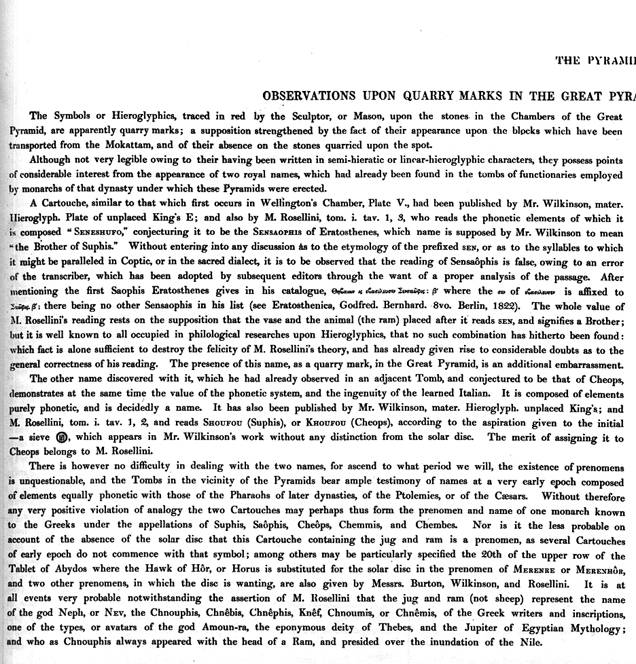
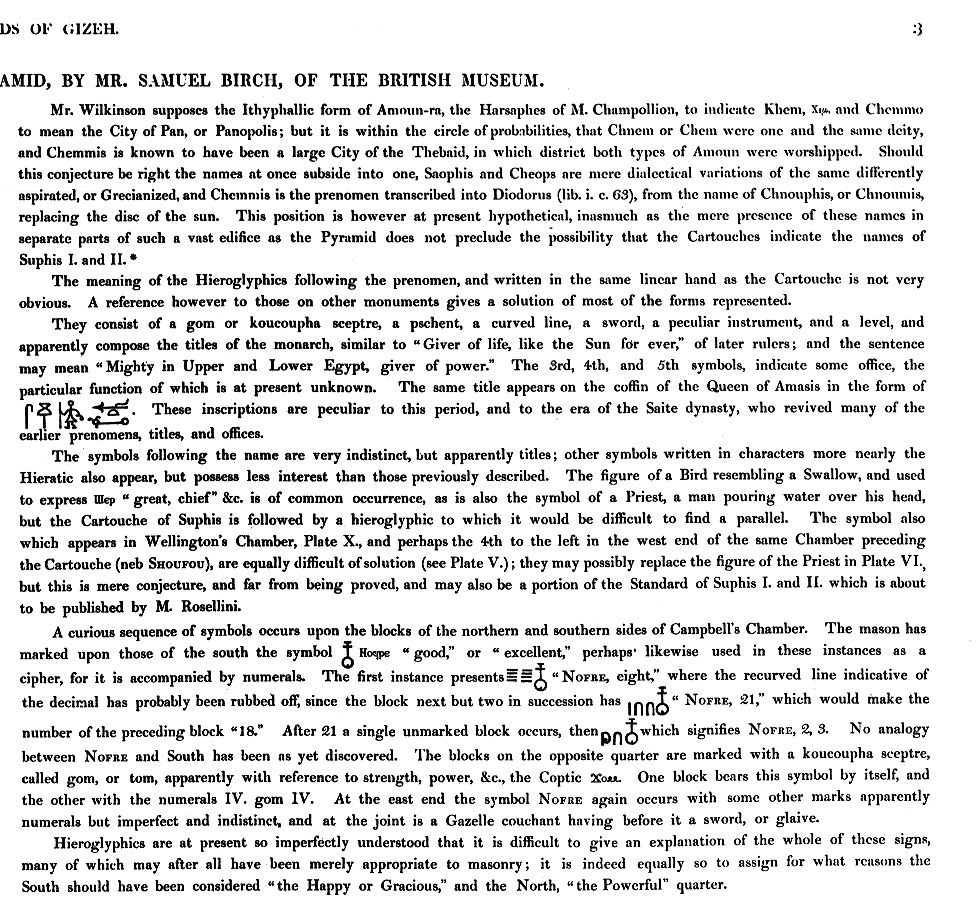
Birch-Analysis from Perrings "Pyramids of Gizeh" from 1839.
|
|
Extracts from Petrie (1882). On the Greek Historians - 'The accuracy of the descriptions of the Greek travellers deserves notice, as they are often much more accurate in their facts than modern writers. Herodotus* states the base of the Great Pyramid to be 8 plethra, or 800 feet, and it is actually 747 Greek feet; so that he is as accurate as he professes to be, within about half a plethron. The height he states to be equal to the base; and the diagonal height of the corner (which would certainly be the way of measuring it, and was the later Egyptian mode of reckoning) is 19/20 of the base, or quite as close as the statement professes. The name of the builder is given almost unaltered, Kheopa for Khufu. In describing the Second Pyramid, he states it to be 40 feet less in height than the Great Pyramid; the difference is not quite so great, but the historian's error is only 1/27 of the whole height. He is quite correct in saying that the foundations were of Ethiopian stone, i.e., red granite. Of the Third Pyramid, the statement, apparently so precise, that the base was 280 feet seems in error. It is over 340 Greek feet, and such a difference could hardly be a mere oversight. It is just possible that this measure refers to the base of the limestone part, which [p. 160] was about 275 of such feet as go 800 in the Great Pyramid base. Of the Third Pyramid casing, he says that "half of it consists of Ethiopian stone"; and actually about; 7/16 of the casing was of granite. The Rhodopis story seems akin to the ruddy Nitokris of Manetho; and there is a curious possibility of the whole description of Nitokris having been transferred from the Pyramid itself to the ruler who built it'. * The accuracy with which Herodotus states what he saw, and relates what he heard; the criticism he often applies to his materials; and the care with which he distinguishes how much belief he gives to each report; all this should prevent our ever discrediting his words unless compelled to do so. On the Great Pyramid - 'The first work that needed to be done (and that quickly, before the travellers' season set in) was to open the entrance passage of the Great Pyramid again to the lower chamber. The rubbish that had accumulated from out of Mamun's Hole was carried out of the Pyramid by a chain of five or six men in the passage..... In the passage we soon came down on the big granite stone which stopped Prof. Smyth when he was trying to clear the passage, and also sundry blocks of limestone appeared. The limestone was easily smashed then and there, and carried out piecemeal; and as it had no worked surfaces it was of no consequence. But the granite was not only tough, but interesting, and I would not let the skilful hammer-man cleave it up slice by slice as he longed to do; it was therefore blocked up in its place, with a stout board across the passage, to prevent it being started into a downward rush. It was a slab 20.6 thick, worked on both faces, and one end, but rough broken around the other three sides; and as it lay flat on the floor, it left us 27 inches of height to pass down the passage over it. Where it came from is a complete puzzle; no granite is known in the Pyramid, except the King's Chamber, the Antechamber, and the plug blocks in the ascending passage. Of these sites the Antechamber seems to be the only place whence it could have come; and Maillet mentions having seen a large block (6 feet by 4) lying in the Antechamber, which is not to be found there now. This slab is 32 inches wide to the broken sides, 45 long to a broken end, and 20.6 thick; and, strangely, on one side edge is part of a drill hole, which ran through the 20.6 thickness, and the side of which is 27.3 from the worked end. This might be said to be a modern hole, made for smashing it up, wherever it was in situ; but it is such a hole as none but an ancient Egyptian would have made, drilled out with a jewelled tubular drill in the regular style of the 4th dynasty; and to attribute it to any mere smashers and looters of any period is inadmissible. What if it came out. of the grooves in the Antechamber, and was placed like the granite leaf across that chamber? The grooves are an inch wider, it is true; but then the groove of the leaf is an inch wider than the leaf. If it was then in this least unlikely place, what could be the use of a 4-inch hole right through the slab? It shows that something has been destroyed, of which we have, at present, no idea. Soon after passing this granite, we got into the lower part of the entrance passage, which was clear nearly to the bottom. Here a quantity of mud had been washed in by the rains, from the decayed limestone of the outside of the Pyramid, thus filling the last 30 feet of the slope. This was dug out and spread narrow passage; no truck arrangement could be easily worked, owing to the granite block lying in the passage. Work down at the bottom, with two lanterns and six men, in the narrow airless passage, was not pleasant; and my visits were only twice a day, until they cut through to the chamber. Here I had the rest of the earth piled up, clear of the walls, and also of the well, and so re-established access to these lower parts. In the well leading from the gallery to the subterranean passages, there is a part (often called the "Grotto") cased round with small hewn stones. These were built in to keep Back the loose gravel that fills a fissure in the rock, through which the passage passes. These stones had been broken through, and much of the gravel removed; on one side, however, there was a part of the rock which, it was suggested, might belong to a passage. I therefore had some of the gravel taken from under it, and heaped up elsewhere, and it was then plainly seen to be only a natural part of the water-worn fissure This well is not at all difficult to visit; but the dust should be stirred as little as possible. One may even go up and down with both hands full, by using elbows and toes against the sides and the slight foot-holes. 14. The next business was to find the casing and pavement of the Great Pyramid, in other parts beside that on the N. face discovered by Vyse: the latter part had been uncovered, just when I required it, in 1881, by a contractor, who took the chips of casing from the heaps on the N. face to mend the road. Thus the tourists to the Pyramid actually drive over the smashed-up casing on their way. On the three other sides the Arabs had some years ago cut away a large part of the heaps of casing chips, in search of pieces which would do for village building. Thus the heaps were reduced from about 35 to only 20 feet in depth, over the middle of the base sides of the Pyramid; though they were not touched at their highest parts, about 40 or 50 feet up the sloping side of the Pyramid. The shafts for finding the casing were then sunk first of all about 100 feet from the corners of the Pyramid; and then, finding nothing there but rock (and that below the pavement level), places further along the sides were tried; until at last the highest parts, in the very middle of the sides, were opened. There the casing and pavement were found on every side, never seen since the rest of the casing was destroyed a thousand years ago. Thus for the North casing four shafts were tried; but no casing was found, except where known by Vyse. On the East side four shafts were sunk, finding casing in the middle one. On the South four shafts were sunk, finding badly preserved casing in one, and good casing in another, entirely eaten away, however, just at the base (see Pl. xii.). On the West side five shafts were tried, finding casing in one of them, and pavement within the casing line at the N.W. The East and South casing was seriously weathered away; on the East it was only defined by the pavement being worn away outside its ancient edge; and on the South it was found to be even hollowed out (Pl. xii.), probably by the action of sand whirled up against the base, and scooping it out like sea-worn caves...... As I did not uncover the casing on the North side, I did not Consider it incumbent on me to cover it over again; and the casing down the shafts is safe from damage, as it is too troublesome and dangerous for the Arabs to try to break it or carry it off: it would be far easier for them to work out more loose pieces from the rubbish. Besides these shafts, many pits and trenches were dug to uncover the outer edge of the pavement. For the basalt pavement, the edge of the rock bed of it was traced on N.E. and S.; but no edge could be found on the West. It was cleared at the centre, where the trenches converge, and was there found to be all torn up and lying in confusion, along with many wrought blocks of red granite. Further out from the Pyramid it was perfect in some parts, as when first laid. The trenches were cleared at the ends, where necessary; the North trench was dug into as far as nine feet below the sand at present filling it, or about eighteen feet below the rock around it, but nothing but sand was found; the E.N.E. trench was cleared by cuttings across and along it, so as to find the bottom of each part, and make certain that no passage led out of it; the N.N.E. trench was cleared by pits along it, and traced right up to the basalt pavement The trench near the N.E. corner of the Pyramid was cleared in most parts, and the rock cuttings around it were also cleared, but re-filled, as the carriage road runs over them. Thus altogether 85 shafts, pits, or trenches were excavated around the Great Pyramid. 15. At the Second Pyramid it was not so necessary to find actual casing, as it was arranged differently: the bottom course of casing had an upright foot 10 or 12 inches high, at the bottom of its slope, not ending in a sharp edge, like the Great Pyramid casing, which was very liable to injury. The end of the slope being thus raised up already some way, the pavement was built against the upright face, and to get depth enough for the paving blocks, the rock outside the casing was cut away. Thus the casing actually stood on a raised square of rock, some few inches above the rock outside it (see Pl. xii.), and the edge of this raised square was further signalized by having holes along it (5 to 10 inches long and about half as wide), to receive the ends of the levers by which the blocks were moved. This arrangement is very clearly shown near the W. end of the S. side, where a block of casing remains, but slightly shifted; and therefore, where this raised edge was found in other parts, it was accepted as being equivalent in position to the foot of the casing slope, without needing to find actual casing in each place. At the N.E. corner the raised edge was found, scarcely covered over. On the E. side two pits were sunk, and the edge was found in one at the S. end. The edge was cleared at the S.E. corner. On the S. side the edge was found at the E. end, and the casing in situ cleared at the W. end. The S.W. corner of the edge was cleared. On the W. side the edge was found at the N. end. The N.W. corner was cleared, but no edge was found there. On the N. side the edge was found at the W. end. Thus the raised edge was found and fixed at eleven points around the Pyramid. The joints of the platform of huge blocks on the E. of it were partly cleaned to show the sizes of the stones. Three pits were tried on the N.W. of the Pyramid, and the edge of the rock bed of the pavement was found in two of them. Two trenches were made to examine the edge of the great rock cutting on the N. side of the Pyramid. Twenty-three trenches and sixty-seven pits were dug to uncover parts of the great peribolus walls of this Pyramid. Thus it was found that all the heaps and ridges, hitherto called "lines of stone rubbish," were built walls of unhewn stone, mud plastered, with ends of squared stone, like antae.. The great barracks, consisting of a mile and a half length of galleries, was thus opened. Many fragments of early statues in diorite, alabaster, and quartzite, were found, as well as early pottery, in the galleries; though not a five-hundredth of their whole extent was uncovered. The great hewnstone wall, built of enormous blocks, on the N. side of the Pyramid, was examined by pits; and quarry marks were found on the S. sides of the blocks. Two retaining walls of unhewn stone, like those of the galleries, were found in the large heap of chips, which is banked against the great N. wall. These retaining walls contained waste pieces of granite and basalt. The great platform of chips, tipped out by the builders beyond the S. peribolus wall, was cut into in two places. Some early pottery was found; and it was evident, from the regular stratification, that it had been undisturbed since it was shot there in the time of Khafra. Altogether, 108 pits and trenches were opened around the Second Pyramid. 16. At the Third Pyramid it was necessary to clear the casing at the base level; and this was a more troublesome place to work on than any other. Howard Vyse reports that he abandoned his work here on account of the great difficulty and danger of it. The material to be removed consists entirely of large blocks of granite weighing a ton and upwards, which lie embedded in loose sand; hence, whenever the sand was removed in digging a hole, it ran down from the sides, and so let one of the large blocks drop into the hole......As there is no clear setting for the casing here as there is in the Second Pyramid, and as the substratum had been removed at the eastern corners, it was necessary to find the casing foot near each end of the sides, and not to trust to the corners. There was no difficulty in finding casing stones, as the casing still remains above the rubbish heaps on every side; the work was to get down to the foot of it. This was done at the E. end of the N. side, at both ends of the E. side, at both ends of the S. side, and at the S. end of the W. side. The N.W. corner was very deeply buried, and several trials were made to get down, but without finding any place sufficiently clear of the great granite blocks; here, therefore, I had to be content with fixing the edge of the fifth course of casing, which stood above ground, and projecting this down at the observed angle by calculation. Seven points in all were thus fixed, of the intended finished surface of the original casing at the bottom course. Besides this, eighty-four pits were made along the peribolus walls of this Pyramid; these holes showed that the walls were all built like those of the Second Pyramid, but less carefully. Ninety-one pits in all were made around the Third Pyramid. This makes a total of 284 shafts, pits, or trenches, sunk in the hill of Gizeh; and in almost every case the objects sought were found. 20. Since the time of the first discovery of some of the sockets in 1801, it has always been supposed that they defined the original extent of the Pyramid, and various observers have measured from corner to corner of them, and thereby obtained a dimension which was—without further inquiry—put down as the length of the base of the Pyramid. But, in as much as the sockets are on different levels, it was assumed that the faces of the stones placed in them rose up vertically from the edge of the bottom, until they reached the pavement (what-ever level that might be) from which the sloping face started upwards. Hence it was concluded that the distances of the socket corners were equal to the lengths of the Pyramid sides upon the pavement. Therefore, when reducing my observations, after the first winter, I found that the casing on the North side (the only site of it then known) lay about 30 inches inside the line joining the sockets, I searched again and again for any flaw in the calculations. But there were certain check measures, beside the regular checked triangulation, which agreed in the same story; another clue, however, explained it, as we shall see. The form of the present rough core masonry of the Pyramid is capable of being very closely estimated. By looking across a face of the Pyramid, either up an edge, across the middle of the face, or even along near the base, the mean optical plane which would touch the most prominent points of all the stones, may be found with an average variation at different times of only 1.0 inch. 21. Having, then, four lines passing through the middles of the sides, what is to define the junctions of those lines at the corners ? Or, in other words, what defines their azimuth? Was each side made equidistant (1) from its socket's sides ? or, (2) from the core side at each of its ends ? Or was a corner made equidistant (3) from the sides of its socket corner? or, (4) from the sides of its core corner? The core may be put out of the question; for if the sides followed it exactly in any way, they would run outside of the sockets in some parts. Which, then, is most likely: that the sockets were placed with an equal amount of margin allowed on the two ends of one side, or with an equal margin allowed at both sides of one corner? The latter, certainly, is most likely; it would be too strange to allow, say, 6 inches margin on one side of a socket, and only 2 inches on its adjacent side. It seems, then, that we are shut up to the idea that the socket corners lie in the diagonals of the Pyramid casing. But there is another test of this arrangement, which it ought to satisfy. Given four diagonals, as defined by the socket corners; and given four points near the middles of the sides of the Pyramid, as defined by the existing casing: if we start from one diagonal, say N.E.; draw a line through the E. casing to S.E. diagonal; from that through the S. casing, to the S.W. diagonal; and so on, round to the N.E. diagonal again; there is no necessity that the line should on its return fall on the same point as that from which we started : it might as easily, apart from special design, fall by chance anywhere else. The chances are greatly against its exactly completing its circuit thus, unless it was so planned before by the diagonals of the socket corners being identical with those of the square of the casing. On applying this test to the diagonals of the sockets, we find that the circuit unites, on being carried round through these points, to within 1 inch far closer, in fact, than the diagonals of the sockets and the line of the casing can be estimated. 26. With regard to the casing, at the top it must—by the above data—average about 71 ± 5 inches in thickness from the back to the top edge of each stone. Now the remaining casing stones on the N. base are of an unusual height, and therefore we may expect that their thickness on the top would be rather less, and on the bottom rather more, than the mean of all. Their top thickness averages 62 ± 8 (the bottom being 108 ± 8), and it thus agrees very fairly with 71 ± 5 inches. At the corners, however, the casing was thinner, averaging but 33.7 (difference of core plane and casing on pavement); and this is explained by the faces of the core masonry being very distinctly hollowed. [p. 44] This hollowing is a striking feature; and beside the general curve of the face, each side has a sort of groove specially down the middle of the face, showing that there must have been a sudden increase of the casing thickness down the mid-line. The whole of the hollowing was estimated at 37 on the N. face; and adding this to the casing thickness at the corners, we have 70.7, which just agrees with the result from the top (71 ± 5), and the remaining stones (62 ± 8). The object of such an extra thickness down the mid-line of each face might be to put a specially fine line of casing, carefully adjusted to the required angle on each side; and then afterwards setting all the remainder by reference to that line and the base. Several measures were taken of the thickness of the joints of the casing stones......These joints, with an area of some 35 square feet each, were not only worked as finely as this, but cemented throughout. Though the stones were brought as close as 1/500 inch, or, in fact, into contact, and the mean opening of the joint was but 1/50 inch, yet the builders managed to fill the joint with cement, despite the great area of it, and the weight of the stone to be moved—some 16 tons. To merely place such stones in exact contact at the sides would be careful work; but to do so with cement in the joint seems almost impossible. 27.
The works around the
Pyramid, that are connected with it, are :— The limestone pavement was found on the N. side first by Howard Vyse, having a maximum remaining width of 402 inches; but the edge of this part is broken and irregular, and there is mortar on the rock beyond it, showing that it has extended further. On examination I found the edge of the rock-cut bed in which it was laid, and was able to trace it in many parts. At no part has the paving been found complete up to the edge of its bed or socket, and it is not certain, therefore, how closely it fitted into it; perhaps there was a margin, as around the casing stones in the corner sockets. 28. The basalt pavement is a magnificent work, which covered more than a third of an acre. The blocks of basalt are all sawn and fitted together; they are laid upon a bed of limestone, which is of such a fine quality that the Arabs lately destroyed a large part of the work to extract the limestone for burning. I was assured that the limestone invariably occurs under every block, even though in only a thin layer. Only about a quarter of this pavement remains in situ, and none of it around the edges the position of it can therefore only be settled by the edge of the rock-cut bed of it. This bed was traced by excavating around its N., E., and S. sides; but on the inner side, next to the Pyramid, no edge could be found; and considering how near it approached to the normal edge of the limestone pavement, and that it is within two inches of the same level as that, it seems most probable that it joined it, and hence the lack of any termination of its bed....the plan of the basalt pavement seems to be two adjacent squares of about 1,060 inches in the side; the N. trench axis being the boundary of them, and there being a similar distance between that and the Pyramid. The outer side of the paving was laid off tolerably parallel to the Pyramid base; but the angles are bad, running 15 inches skew.* * The broken blocks of basalt, which border a track down the hill side E. of them Pyramid, are almost certainly from this pavement; they are of exactly the same stone, and have many worked faces remaining like those of the pavement. Their placing is quite rude, and looks as if done by some barbarian destroyers. 29. Next, referring to the rock-hewn trenches alone...it seems that the axial length of the E.N.E. trench outside the basalt paving is intended to be the same as the axial length of the North and South trenches. With regard to the details of these rock cuttings, the forms of the ends of the N. and S. trenches were plotted from accurate offsets (see Pl. iiia.); and there is little of exact detail in the cutting to be stated. The axes at the ends were estimated by means of the plans here given, but on double this scale; and the rock is so roughly cut in most parts that nothing nearer than an inch need be considered. The position of the inner end of the N. trench is not very exactly fixed, an omission in measurement affecting it, mainly from N. to S. In this trench I excavated to 110 below the present surface of the sand, or about 220 below the rock surface, without finding any bottom. The S. trench is more regular than the N. trench; at the outer end its width is 205 to 206, and at the inner end 134.2: it has a curious ledge around the inner end at 25 below the top surface. At the outer end the rock is cut, clearly to receive stones, and some plaster remains there; also some stones remain fitted in the rock on the W. side of this trench. Built stones also occur in the N., E.N.E., and N.N.E. trenches. From the inner end of the S. trench, a narrow groove is cut in the rock, leading into the rock-cut bed of the basalt pavement; this groove was filled for a short way near the end of the trench by stone mortared in. It was evidently in process of being cut, as the hollows in the sides of it were the regular course of rock-cutting. The rock beside the trenches is dressed flat, particularly on the E. of the [p. 49] N. trench, and the W. of the S. trench, where the built stones occur. There is a short sort of trench, on the E. side of the S. trench (not in plan); it is about 25 wide, 70 long, and 50 deep, with a rounded bottom; the length E. and W. The E.N.E. trench is very different to the others; it has a broad ledge at the outer end, and this ledge runs along the sides of the trench, dipping downwards until it reaches the bottom towards the inner end: the bottom sloping upwards to the surface at the inner end. There are stones let into this ledge, and mortared in place, and marks of many other stones with mortared beds, all intended apparently to make good the ledge as a smooth bed for some construction to lie upon. The bottom of this trench I traced all over, by excavations across and along it; looking from the outer end, there first came two ledges—the lower one merely a remainder of uncut rock, with grooves left for quarrying it—then the bottom was found about 200 inches below ground level; from this it sloped down at about 20º for about 200 inches; then ran flat for 300 or 400; and then sloped up for 300 or 400; then rose vertically, for some way; and then, from about 120 below ground level, it went up a uniform slope to near the surface, where it was lost at the inner end under high heaps of chips. At the outer end the width near the top is 152.8, and at 25 down 148.2; the lower space between the sides of the ledge widens rapidly to the middle, from the end where it is 43.0 wide above and 35.0 below. Towards the inner end the rock is very well cut; it has a row of very rough holes, about 6 diam., in the dressed rock along the N. edge of the trench, near the inner end. This dressed side of the trench ends sharply, turning to N. at 1603.6 from outer end of the trench axis; the width here is 170.I, or 172.3 at a small step back in S. side, a little E. of this point. The trench had not been clear for a long time, as many rudely-buried common mummies were cut through in clearing it; they were lying only just beneath the sand and rubbish in the bottom. The N.N.E. trench was traced by excavations along the whole length of 2,840 inches, up to where it is covered by the enclosure wall of the kiosk. It is fairly straight, varying from the mean axis 2.1, on an average of five points fixed along it. The depth varies from 14 to 20 inches below the general surface. It is 38, 40, 39.2, and 36 in width, from the outer end up to a point 740 along it from the basalt pavement; here it contracts roughly and irregularly, and reaches a narrow part 18.2 wide at 644 from the pavement. The sides are built about here, and deeply covered with broken stones. Hence it runs on, till, close to the edge of the basalt pavement, it branches in two, and narrows yet more; one line runs W., and another turning nearly due S., emerges on the pavement edge at 629.8 to 633.4 from the N.E. corner of the pavement, being there only 3.6 wide. From this remarkable forking, it [p. 50] is evident that the trench cannot have been made with any ideas of sighting along it, or of its marking out a direction or azimuth; and, starting as it does, from the basalt pavement (or from any building which stood there), and running with a steady fall to the nearest point of the cliff edge, it seems exactly as if intended for a drain; the more so as there is plainly a good deal of water-weanng at a point where it falls sharply, at its enlargement. The forking of the inner end is not cut in the rock, but in a large block of limestone. The trench by the N.E. socket is just like the N.N.E. trench in its cutting and size; and it also narrows at the inner end, though only for about 20 inches length. It has a steady fall like the N.N.E. trench; falling from the S. end 5.5 at 50, 8.5 at 100, 14.3 at 190, 21.0 at 300, and 27.0 at 400 inches. The inner end is turned parallel to the Pyramid, the sides curving slightly to fit it. The rock cuttings by it are evidently the half-finished remains of a general dressing down of the rock; the hollows are from 3 to 6 inches deep, and so very irregular that they do not need any description beside the plan (Pl. ii.). The trench beside the trial passages is slight, being but 6 deep at N. and 17 at S.; it is 29.0 wide at N., 26.5 in middle, and 27.9 at S. Its length is 289, with square ends. The sides are vertical at the N., narrowing 3.5 to bottom at S.; ends shortening 3.0 to bottom. The bottom dips slightly to the S., the levels from the N. running 0, - 1.7, - 2.2, - 3.2, and - 5.8. 30. The trial passages (Pl. iii b). are a wholly different class of works to the preceding, being a model of the Great Pyramid passages, shortened in length, but of full size in width and height. The details of the measurements of each part are all entered on the section (Pl. iiib.). The vertical shaft here is only analogous in size, and not in position, to the well in the Pyramid gallery; and it is the only feature which is not an exact copy of the Great Pyramid passages, as far as we know them. The resemblance in all other respects is striking, even around the beginning of the Queen's Chamber passage, and at the contraction to hold the plug-blocks in the ascending passage of the Pyramid (see section 38). The upper part of the vertical shaft is filled with hardened stone chips; but on clearing the ground over it, I found the square mouth on the surface. The whole of these passages are very smoothly and truly cut, the mean differences in the dimensions being but little more than in the finely finished Pyramid masonry. The part similar to the gallery is the worst executed part; and in no place are the corners worked quite sharp, generally being left with radius about .15. The N. end is cut in steps for fitting masonry on to it; and I was told that it was as recently as 1877 that the built part of it was broken away by Arabs, and it appeared to have been recently disturbed; in Vyse's section, however, the roof is of the present length, so the removal must have been from the floor. 31. Having thus finished the statement of the outside of the Pyramid and the works surrounding it, the next subject is the connection of the outside and inside of the building. To determine the exact place of the passages and chambers in relation to the whole Pyramid, a station of the triangulation was fixed in a hollow just on the end of the entrance passage floor and this was thoroughly connected with three main stations. Levelling was also carried up from the casing and pavement below, to this station, and to the courses near it. Thus the inside, as far as Mamun's Hole, is completely connected with the outside; and in the ascending passages beyond that, there is only 2' of azimuth in doubt. 32. The original length of the entrance passage has not hitherto been known, except by a rough allowance for the lost casing. But after seeing the entrances of the Third Pyramid, the South Pyramid of Dahshur, and the Pyramid of Medum, all of which retain their casing, there seemed scarcely a question but that the rule was for the doorway of a Pyramid to occupy the height of exactly one or two courses on the outside. That the casing courses were on the same levels as the present core courses, is not to be doubted, as they are so in the other Pyramids which retain their casing, and at the foot of the Great pyramid.* * The awkward restoration of the casing that Prof, Smyth adopted (Life and Work, P1. iii., 3) was forced on him by his mistaken assumption of the pavement level 20 inches under the truth (L. and W. ii. 137); hence by Vyse's casing stone measures he made the casing break joint with the core, in defiance of Vyse's explicit drawing of its position; and was obliged to reduce the pavement to 5 or 10 inches, in place of the 21 inches recorded by Vyse. The drawing of "hacking stones," at the foot of P1. 1., vol. iii., L. and W., is equally at fault; the casing stones which remain in the middle of the side, ending directly against the core masonry; and the core at the corners only leaving 34 inches for the casing thickness, No backing stones exist behind the casing of the Third Pyramid or the cased Dahshur Pyramid. The next step is to see if there is a course equal to the vertical height of the doorway; and, if so, where such a course occurs. Now the vertical height of the doorway on the sloping face of the Pyramid (or difference of level of its top and base) would be 37.95 if the passage mouth was the same height as the present end, or 37.78 if the passage was exactly the same as the very carefully wrought courses of the King's Chamber, with which it is clearly intended to be identical. On looking to the diagram of courses (Pl. viii.) it is seen that at the I9th course is a sudden increase of thickness, none being so large for 11 courses before it and 14 after it. And this specially enlarged course is of exactly the required height of the doorway. Here the agreement is so exact that it is far within the small uncertainties of the two dimensions. Hence, if the passage emerged at the 19th course it would exactly occupy its height (see Pl. xi).* Besides this, it will be observed that there are two unusually small courses next over this, being the smallest that occur till reaching the 77th course. The explanation of these is clear, if the doorway came out in the 19th course; an unusually thick lintel course was needed, so two thinner courses were put in, that they might be united for obtaining extra thickness, as is done over the King's Chamber doorway. These two courses are also occasionally united in the core masonry. * It should be explained that this is called the 20th course by Prof. Smyth, owing to his error about the 1st course and pavement level. His measure of it is 38 inches, and the two French measures give it as 37 and 38 inches. The crucial test then is, supposing the passage prolonged outwards till it intersects this course, how will its end, and the face of the casing, stand to the casing stones at the foot of the Pyramid? The answer has been already given in the list of determinations of the casing angle. It requires an angle of slope of 51º 53' 20" ± 1'; and this is so close to the angle shown by other remains that it conclusively clenches the result to which we are led by the exact equality of the abnormal course height with the doorway height. 33. By a similar method the air channels give a determination of the angle of the faces. It is true that the channels did not occupy a whole course like the entrance; but as they are uniformly cut out as an inverted trough in the under side of a block' which is laid on a broad bed, it is almost certain that they similarly continued to the outside, through the one-or perhaps two-stones now stripped off; and also that their floors thus started at a course level (see Pl. xi.).* If this, then, were the case (as the N. channel cannot by its position have come out in any but the 103rd course on the face, and the S. channel in any but the 104th), they would show that the casing rose on the N. face at 51º 51' 30", and on the S. face at 51º 57' 30", as before stated. The various data are entered on the diagram of the channel mouths. The levels were fixed by measuring several courses above and below the present mouths, and thus connecting them to the course levelling at the corners of the Pyramid. With regard to the main part of these air channels, the details are given further on in the measures of the King's Chamber (section 56); and it is disappointing that they vary so much in azimuth and altitude, that they are useless for connecting the measures of the inside and outside of the Pyramid. * In the section of the S. air channel mouth published by Prof. Smyth, certainly "the joints are not put in from any measure," nor is any other feature of it. The passage, its bed, and top, are all about half of their true size, and the form of it is unlike anything that has been there, at least since Vyse's time. 34. The sloping blocks over the entrance to the Pyramid, and the space below them, were examined (partly by means of a ladder), and measured; but the details are not worth producing here, as the work of them is so rough. These blocks are much like a slice of the side of a casing stone in their angle; but their breadth and length are about half as large again as any of the casing stones. Their mean angle from 12 measures is 50º 28' ± 5'. The thickness of these blocks is only 33 inches, and there are no others exactly behind them, as I could see the horizontal joints of the stones running on behind them for some inches. On the faces of these blocks are many traces of the mortaring which joined to the sloping blocks next in front of them. These were placed some 70 inches lower at the top, and were not so deep vertically. By the fragment left on the E. side, the faces of these blocks were vertical. In front of these came the third pair, similar, but leaning some 7½º or 8º inwards on the face, judging by a remaining fragment. Probably a fourth and fifth pair were also placed here (see Pl. ix.); and the abutment of the fifth pair shows an angle of 70½º or 73º in place of 50º. The successive lowering of the tops, leaning the faces in, and flattening the angle of slope of the stones as they approach the outside, being apparently to prevent their coming too close to the casing. These sloping blocks were probably not all stripped away, as at present, until recently, as there is a graffiti, dated 1476 (half destroyed by the mock-antique Prussian inscription) on the face of the remaining block where it is now inaccessible, but just above where the next pair of blocks were placed. The sloping blocks are of remarkably soft fine-grained limestone, about the best that I have seen, much like that of the roofing of the chamber in Pepi's Pyramid; and it is peculiar for weathering very quickly to the brown tint, proper to the fine Mokattam limestone, darkening completely in about twenty years, to judge by the modern-dated graffiti. 36. The azimuth and straightness of the passage were carefully measured. The azimuth down the built part was taken by reference to the triangulation, which in its turn was fixed by six observations of Polaris at elongation, from a favourable station (G). The azimuth to the bottom of the rock-cut passage was observed independently, by five observations of Polaris at elongation. The observations of the straightness throughout gives a check by combining these two methods, and they are thus found to agree within 19", or just the sum of their probable errors, equal to only .09 inch lineally on the azimuth of the built part. But the passage in the built part, and indeed for some 40 feet below that, is far straighter in azimuth than the lower part. These offsets only being read to 1/20th inch (the 1/100ths merely resulting from computation) it is remarkable that the errors of the mid-line of the passage are so minute; and it shows that in this particular we have not yet gone within the builder's accuracy; readings to 1/100th inch or to 1" on the longer distances, are now required. 37. The Subterranean chambers and passages are all cut roughly in the rock. The entrance passage has a flat end, square with its axis (within at least 1º), and out of this end a smaller horizontal passage proceeds, leaving a margin of the flat end along the top and two sides. The side chamber is an enlargement of the passage, westward and upward, as are all the chambers of the Pyramid; it is very rough and uneven, and encumbered now with large blocks of stone. The large chamber is most clearly unfinished, both in the dressing of the walls, and more especially in the excavation for the floor. The walls have an average irregularity estimated at ±.7 and projecting lumps of rock are left untouched in some parts. The roof is more irregular, estimated average variation ±3. The floor is most irregular, at the W. end it rises at the highest to only 10 inches from the roof; and over all the western half of the chamber it is irregularly trenched with the cuttings made by workmen to dislodge blocks of the rock. It is, in fact, an interesting specimen of quarrying, but unfortunately now completely choked up, by Perring having stowed away there all the pieces of limestone taken out of his shaft in the floor. After dislodging several blocks, I crawled in over the knobs and ridges of rock, until jammed tight from chest to hack in one place; and thence I pushed about one 140-inch rod, by means of the other, so as to measure the length up to the Western end. To measure along the W. side is impossible, without clearing away a large quantity of stones; and as there is no place to stack them safely without their going down the shaft, I could only measure the width at 100 from the W. end, perhaps somewhat askew. The lower—eastern—part of the floor, 140 below the roof, which is comparatively flat, is, nevertheless, very irregular and roughly trenched, quite unfinished. The best worked floor surface is just around the square shaft, 198 below the roof, and about 40 below the main part of the floor, which is 155 below roof on a knob of rock beside the shaft. The square shaft is not parallel to the chamber, but is placed nearly diagonally.* ..... it is, in fact, a smaller shaft descending out of the N. corner of the larger........The original depth of the smaller shaft I could not see, it was apparently about 40 inches according to Vyse, when Perring sunk his round shaft down in the bottom of the ancient square shaft. This hole in the dimly-lighted chamber, about 30 feet deep (with water in it after heavy rains have rushed down the entrance passage), and with a very irregular and wide opening, makes measurement about here somewhat unpleasant. I avoided filling the shaft with the earth removed from the passage, or with the stones which Perring excavated from it, in case anyone should afterwards wish to excavate farther at the bottom. The southern passage is very rough, apparently merely a first drift-way, only just large enough to work in, intended to be afterwards enlarged, and smoothed; its sides wind 6 or 8 inches in and out. * Like the shaft of the tomb chamber of Ti at Sakkara; an unusual plan. 38. The Ascending passage from the entrance passage is somewhat troublesome to measure, owing to the large plugs of granite that fill some 15 feet of its lower part; and also to the irregular way in which much of its floor is broken up. The granite plugs are kept back from slipping down by the narrowing of the lower end of the passage, to which contraction they fit. Thus at the lower, or N. end, the plug is but 38.2 wide in place of 41.6 at the upper end: the height, however, is unaltered, being at lower end 47.30 E., 47.15 mid, 47.26 W.; and at upper, or S. end 47.3. In the trial passages the breadth is contracted [p. 64] from 41.6 to 38.0 and 37.5 like this, but the height is also contracted there from 47.3 to 42.3. These plug-blocks are cut out of boulder stones of red granite, and have not the faces cut sufficiently to remove the rounded outer surfaces at the corners: also the faces next each other are never very flat, being wavy about ± .3. These particulars I was able to see, by putting my head in between the rounded edges of the 2nd and 3rd blocks from the top, which are not in contact; the 2nd having jammed tight 4 inches above the 3rd. The present top one is not the original end; it is roughly broken, and there is a bit of granite still cemented to the floor some way farther South of it. From appearances there I estimated that originally the plug was 24 inches beyond its present end. It has been a favourite idea with some, that two horizontal joints in the passage roof just south of the plugs, were the beginning of a concealed passage: I therefore carefully examined them. They are 60.5 (or 60.1 second measure) apart vertically, and therefore quite different to the passages of the Pyramid, which are 47 perpendicularly or 52 vertically. Further, there is no possibility of the blocking up of a passage existing there; as the stone of the roof is continuous, all in one with the sides; the three roof-blocks between the two horizontal joints are all girdle-blocks, either wholly round the passage, or partially so; and the block N. of these is a long one, over 125 inches from E. to W., and continuous into both walls. These vertical girdle-blocks are a most curious feature of this passage (first observed and measured by Mr. Waynman Dixon, C.E.), and occur at intervals of 10 cubits (206.3 to 208.9 inches) in the passage measuring along the slope. All the stones that can be examined round the plugs are partial girdle-blocks, evidently to prevent the plugs forcing the masonry apart, by being wedged into the contracted passage. Many of the stones about the blocks in Mamun's Hole are over 10 or 11 feet long; the ends are invisible, but probably they are about 15 feet over all. 39. For the angle of the passage, and its straightness, it will be well to consider it all in one with the gallery floor, as they were gauged together all in one length. The angle of slope I did not observe, as I considered that that had been settled by Prof Smyth; but the azimuth was observed, by a chain of three theodolites, round from the entrance passage. The straightness was observed by offsets to floor and side all along it, read from a telescope at the upper end of the plug-blocks......gives 26º 12' 50" for mean angle of both passage and gallery together. The surfaces are so much decayed and exfoliated, that it is only just at the ends that two original faces can be found opposite to one another; hence the width and height cannot be measured, and the offsets can only be stated to one surface. 40. The horizontal passage leading to the Queen's Chamber is the next part to be considered. 41. In the Queen's Chamber it seems, from the foregoing statement, that the ridge of the roof is exactly in tbe mid-place of the Pyramid, equidistant from N. and S. sides; it only varies from this plane by a less amount than the probable error of the determination. The size of the chamber (after allowing suitably in each part for the incrustation of salt ) is on an average 205.85 wide, and 226.47 long, 184.47 high on N. and S. walls, and 245.1 high to the top of the roof ridge on E. and W. walls. 42. In the matter of height, the courses vary a good deal; and far more care was spent on the closeness, than on the regularity of the joints. For a starting point in measurement, the general floor is hopelessly irregular, consisting plainly of rough core masonry; and furthermore, it has been built over with similar rough masonry, which was afterwards stripped down to insert the chamber walls. This is proved by there being no fewer than eight edges of sunken spaces upon it, made (according to the universal habit of pyramid builders) to let in the inequalities of the upper course into the surface of the course below it. These sunken edges are well seen in other parts of the core masonry, and their meaning here is unequivocal. But all round the chamber, and the lower part of the passage leading to it, is a footing of fine stone, at the rough floor level; this projects 1 to 4 inches from the base of the walls, apparently as if intended as a support for flooring blocks, which have never been introduced. It is to this footing or ledge that we must refer as the starting point; though what floor was ever intended to have been inserted (like the floor of the King's Chamber, which is inserted between its walls) we cannot now say. Certainly, a floor at the level of the higher part of the passage, would not reconcile everything; as that higher floor is also not a finished surface, but has sundry large round holes in it, like those in the chamber floor and elsewhere; intended, apparently, for use in process of building. These roof blocks are seen—where Howard Vyse excavated beneath one at the N.W. corner—to go back 121.6 on slope, behind the wall face; this, coupled with the thickness of these blocks (which is certain, by similar examples elsewhere, to be considerable) throws the centre of gravity of each of the slabs well behind the wall face,* so that they could be placed in position without pressing one on another. Hence there is never any arch thrust so long as the blocks are intact; they act solely as cantilevers, with the capability of yielding arched support in case they should be broken. * As at Sakkara, in the Pyramid of Pepi. The projection on the western side of the doorway, mentioned by Professor Smyth, is really a surplus left on both sides of the corner; in order to protect the stone in transit and in course of building. This undressed part in the chamber, is cut away down to the true surface at the top and at the middle joint, in order to show the workman exactly to where it needed to be dressed in finishing it off 43. The niche in the eastern wall of this chamber, from its supposed connection with a standard of measure, was very closely examined. Its original depth back was certainly only 41 inches at every part from the bottom upwards. The surface that might be supposed to belong to the side of a deeper part, is only that of a joint of masonry, one stone of which has been broken up and removed; this is evident as there is mortar sticking to it, and as it is pick-dressed, quite different to the fine surfaces of the niche sides; beside this, it is not flush with the side, or any of the overlappings of the niche; and moreover, all down the niche sides are the traces of the edge of the back, at 41 from the front, where it has been broken away. 44. The channels leading from this chamber were measured by the goniometer already described (h, section 10); they are exactly like the air channels in the King's Chamber in their appearance, but were covered over the mouth by a plate of stone, left not cut through in the chamber wall; no outer end has yet been found for either of them, though searched for by Mr. Waynman Dixon, C.E., who first discovered them, and also by myself on the N. face of the Pyramid. I observed something like the mouth of a hole in the 85th course on the S. face, scanning it with a telescope from below; but I was hindered from examining it closely. 45. Returning now to the gallery from which we diverged to the Queen's Chamber, the length of the gallery was measured like the other passages, with the steel tape, but not many joints were measured, and those were on the E. ramp, on which the tape was laid at 6 inches from the edge. The axis, though different in azimuth and altitude from that of the ascending passage, is reckoned to start from the end of it; hence the offsets are a continuous series, though measured from a line which is bent on passing from the passage to the gallery. The first-stated floor offset here (in brackets) is not what the continuation of the floor of the ascending passage actually is at the point; but it is the virtual floor of the gallery, i.e., where it would come if the trend of the rest of the gallery was continued, and also (judging by the altitude observations of Prof Smyth) where it would come if continued parallel to the ramp top. 46. The holes cut in the ramps or benches, along the sides of the gallery (see section of them in Pl. ix.), the blocks inserted in the wall over each, and the rough chopping out of a groove across each block—all these features are as yet inexplicable. One remarkable point is that the holes are alternately long and short, on both sides of the gallery; the mean of the long holes is 23.32, with an average variation of .73, and the mean of the short holes is 20.51, with average variation .40. Thus the horizontal length of a long hole is equal to the sloping length of a short hole, both being one cubit. The roof of the gallery and its walls are not well known, owing to the difficulty of reaching them. By means of ladders, that I made jointing together, I was able to thoroughly examine both ends and parts of the sides of the gallery. The roof stones are set each at a steeper slope than the passage, in order that the lower edge of each stone should hitch like a paul into a ratchet-cut in the top of the walls; hence no stone can press on the one below it, so as to cause a cumulative pressure all down the roof; and each stone is separately upheld by the side walls across which it lies. The width of the top of the gallery is 40.9 at N., and 41.3 at S. end. The remarkable groove in the lower part of the third lap,. along the whole length of the sides, was measured thus, perpendicularly :— At the S.W. it is cut to a depth of .8 inch, at the S.E. to .6 (?); the upper edge of it is often ill-defined and sloping. According to Prof. Smyth the mean height of this lap above the gallery floor is 166.2 ± .8 vertically; hence the groove is at 172.1 to 179.0 vertically over the floor, and its lower edge is there-fore at half the height of the gallery, that varying from 167 to 172. The pick-marks in the groove on the S. end of the W. side are horizontal, and not along the groove, showing that it was cut out after the walls were built, which agrees with its rough appearance. It belongs to the same curious class of rough alterations as the blocks inserted in the sides of the gallery and the rude grooves cut away across them. At the top of the N. end is a large forced hole, cut by Vyse in 1837, and still quite fresh-looking. The whole of the top lap of stone is so entirely cut away there that I could not decide to where it had come, and only suppose it to project 3 inches, like the others. 49. Coming now to details of the walls, the rough and course workmanship is astonishing, in comparison with the exquisite masonry of the casing and entrance of the Pyramid; and the main object in giving the following details is to show how badly pyramid masons could work. The great variation in the foregoing measures illustrates this. The N. wall is all rough picked work, with .2 variation commonly; there is a great irregular flaw, and a piece broken out of the stone about the level of the top of the leaf, as much as 1 inch deep. The E. wall has the granite by the side of the leaf wavy and winding, and bulbous at the base, projecting 1.4. On the wainscot block at the S. end of this wall, which is all in one with the S. end of the chamber, are two conjoined deep scores or scrapes nearly vertical, much like the beginning of a regular groove; their distance from the S. wall is 3.6 to 7.2 at 90, and 2.6 to 6.4 at 52 from floor, where they end; they are .48 deep at maximum. The S. wall has all up the E. side of it, over the wainscot, a projection, just equal in width to the wainscot, and varying in thickness from .31 at top to 1.7 half-way down, and thence fading off down to the top of the wainscot. On the W. side of the S. wall the granite has been daubed over for 2 to 6 inches in breadth, with a thin coat of cement; this, at 1 inch from the side is .35 thick; also at 13 from the W. side is a slight sinking of the granite, from .34 to .60 in depth, all quite ill-defined. The W. wall has the top of the granite wainscot uneven, rising toward the front, and there sinking suddenly .35 at 1.4 from the front edge. The southern of the three semicircular hollows on the top of this wainscot (see Pl. xii.)* has the granite defective at the back of it, and is backed with rough limestone there. The southernmost stone over the wainscot is dressed very flat and true, but rough, + or - .03. The next block has a raised edge to it on the S. side (figured by Prof. Smyth), and along the base of it, which consists of granite left rough, not dressed away in finishing; about 4 inches wide, and .4 projection along the lower edge of the block; and 2 wide and 1.2 maximum projection at the side. The other edges of this block were marked out by saw-cuts in the granite, about .2 deep, to guide the workmen in dressing the face. * The forms of the curves are plotted from offsets taken at every inch along them. The various courses and stones of the chamber were measured, but, the only points of interest are the following. The south wall has four vertical grooves all up it, which have been hitherto supposed to have extended down to the top of the passage to the King's Chamber. This was not the case, however; for, though much broken away, it is still clear that they became shallower as they neared the bottom, and probably ended leaving an unbroken flat surface over the doorway. 50. The granite leaf which stretches across the chamber, resting in grooves cut in the granite wainscots, must be somewhat less in width than the breadth between the grooves, i.e., 48.46 to 48.76. Its other dimensions were carefully ascertained, as much theoretic importance had been attached to them; though to anyone looking at the object itself, the roughness and irregularity of it would put any accuracy of workmanship out of the question. The thickness of the two stones that form it was gauged by means of plumb-lines at 33 points; it varies from 15.16 to 16.20, but the details are scarcely worth printing. This leaf is not simply a flat slab of granite, but on both its upper and lower parts it has a projection on its N. side, about 1 inch thick, where it is included in the side grooves. The edge of this projection down the W. side has been marked out by a saw cut; and the whole of the granite on the inner side of this cut has been dressed away all over the face of the leaf, leaving only one patch or boss of the original surface of the block. This boss, of which so much has been made by theorists, is merely a very rough projection, like innumerable others that may be seen; left originally for the purpose of lifting the blocks. When a building was finished these bosses were knocked away (I picked up a loose one among waste heaps at Gizeh) and the part was dressed down and polished like the rest of the stone. It is only in unimportant parts that they are left entire. This boss on the leaf is very ill-defined, being anything between 4.7 and 5.2 wide, and between 3.3 and 3.5 high on its outer face; at its junction with the block it is still less defined, and might be reckoned anything between 7.2 and 8.2 wide, and 5.6 to 6.6 high. It projects .94 to 1.10 from the block, according to the irregularities of the rough hammer-dressing. Anything more absurdly unsuited for a standard of measure it would be difficult to conceive. I write these remarks with a sharp plaster cast of it before me that I took in 1881. Traces of another boss remain on the W. wall of the Antechamber, above the wainscot; here there has been a boss 12 inches wide and 9 high, which has been knocked away, and the surface rough dressed, though the rest of the face of the stone is ground down elsewhere. The block has been turned in building, so that the flat under-edge of the boss is toward the N. Remains of another boss may be seen on a block in the passage to the King's Chamber; remains of 15 or 16 others in the King's Chamber; 5 others complete in the spaces above that; and many on the casing of the Third Pyramid and elsewhere (see Pl. xii.). The E. to W. breadth of the leaf between its side ledges in the grooves, varies from 40.6 to 41.2 at different heights up the middles of the ledges; but furthermore, the edges are not square, and we may say that 40 to 42 will about represent its irregularity. Yet this was another so-called "standard of measure" of the theorists. The top of the upper block of the leaf is a mere natural surface of the granite boulder out of which it was cut, utterly rough and irregular; and not materially broken away as it dips down deeply into the grooves, and is there plastered over. It varies from 51.24 to 59.0, and perhaps more, below the ceiling. Yet the cubic volume of this block was eagerly worked out by the theorists. These openings or cracks are but the milder signs of the great injury that the whole chamber has sustained, probably by an earthquake, when every roof beam was broken across near the South side; and since which the whole of the granite ceiling (weighing some 400 tons), is upheld solely by sticking and thrusting. Not only has this wreck overtaken the chamber itself, but in every one of the spaces above it are the massive roof-beams either cracked across or torn out of the wall, more or less, at the South side; and the great Eastern and Western walls of limestone, between, and independent of which, the whole of these construction chambers are built, have sunk bodily. All these motions are yet but small-only a matter of an inch or two-but enough to wreck the theoretical strength and stability of these chambers, and to make their downfall a mere question of time and earthquakes. The top course of both the E. and W. walls consists of a single stone; 53. The roof of the chamber is formed of nine granite beams The column of "skew" shows the difference in the position of the joints on the opposite sides of the chamber; and the "difference of end widths" the variation between the two ends of the same beam. From this table it seems probable that the roofing in of the chamber was begun at the W end, as the skew of the beams increases up to the E. end; and also as the largest beams, which would be most likely to be first used, are at the W. end. The numbering of the slabs in the top space above the King's Chamber also begins at the W. end. Vyse, however, states that these "chambers of construction" were begun at the E. end. These roofing-beams are not of "polished granite", as they have been described; on the contrary, they have rough-dressed surfaces, very fair and true so far as they go, but without any pretence to polish. Round the S.E. corner, for about five feet on each side, the joint is all daubed up with cement laid on by fingers. The crack across the Eastern roof-beam has been also daubed with cement, looking, therefore, as if it had cracked before the chamber was finished. At the S.W corner, plaster is freely spread over the granite, covering about a square foot altogether. 54. The floor of the chamber, as is well known, is quite disconnected from the walls, and stands somewhat above the base of the lowest course. It is very irregular in its level, not only absolutely, but even in relation to the courses; its depth below the first course joint varying 2.29, from 42.94 to 40.65. This variation has been attributed to the sinking caused by excavation beneath it, but this is not the case; it has been only undermined at the W. end beneath the coffer,* and yet the floor over this undermined part is 1½ inches higher in relation to the first course, than it is at the SE. corner; and along the S. side where it has not been mined it varies 1½ inches in relation to the first course. In these cases I refer to the first course line, as that was the builder's conception of level in the chamber, to which they would certainly refer; but if we refer instead to absolute level, the anomalies are as great and the argument is unaffected. * I know the hole well, having been down into it more than once. It appears, then, that the floor never was plane or regular; and that, in this respect, it shared the character of the very variable floor of the passage that led to the chamber, no two stones of which are on the same level. The passage floor, even out to the great step in the gallery, is also inserted between the walls, like the floor of the chamber. 55. Among peculiarities of work still remaining, are the traces of 15 bosses or lugs on the faces of the granite blocks , all on the lower course. Those best seen are two on the fourth block of the N. wall, counting from the door; they have been about 12 inches wide and the same high, 14 inches apart, and their flat bottom edges 3 inches from the base of the block (see Pl. xii.). They may be very plainly seen by holding a candle close to the wall below them; this shows up the grinding around them, and the slight projection and very much less perfect grinding of the sites of the bosses. There is a remarkable diagonal drafted line across the immense block of granite over the doorway; it appears not to run quite to the lower corner on the E. side; but this is doubtless due to the amount by which the block is built into the E. wall, thus cutting off the end of the diagonal line. This sunken band across the stone appears to have been a true drafted straight line cut in process of working, in order to avoid any twist or wind in the dressing of the face; this method being needful as the block was too large to test by the true planes otherwise used (see section 135). The N. channel has been forced open as a working passage for some way inwards, only leaving the floor and W. side perfect. The channel is now blocked, just below the end of the enlarged part, and on working a rod 4½ feet into the sand, it ran against limestone. The sand in the hole has blown in during gales, which sweep up sand like mist. The remains of the original channel show it to have varied from 8.9 to 9.2 (mean 9.0) in width, and to have been 8.72 and 8.74 in height. The S. channel is blocked by sand at 76 feet down. It is not straight in the clear length, curving more than its own width to the east; and the sides often shift a few tenths of an inch in passing from one stone to another. These details were seen by examining it with a telescope on Feb. 8, and by photographing it on Nov 2, 1881; these being the days on which the sun shines down it at noon. Its width at the top is 8.35 and 8.65, and its height 8.7 to 8.9. 57. The coffer
in the King's Chamber
is of the usual form of the earliest Egyptian sarcophagi, an approximately
flat-sided box of red granite. It has the usual under-cut groove to hold the
edge of a lid along the inside of the N., E., and S. sides; the W. side being
cut away as low as the groove for the lid to slide over it; and having three
pin-holes cut in it for the pins to fall into out of similar holes in the lid,
when the lid was put on. On raising the coffer no trace of lines was to be found to mark its place on the floor, nor any lines on the floor or bottom of the coffer. The flint pebble that had been put under the coffer is important If any person wished at present to prop the coffer up, there are multitudes of stone chips in the Pyramid ready to hand. Therefore fetching a pebble from the outside seems to show that the coffer was first lifted at a time when no breakages had been made in the Pyramid, and there were no chips lying about. This suggests that there was some means of access to the upper chambers, which was always available by removing loose blocks without any forcing. If the stones at the top of the shaft leading from the subterranean part to the gallery had been cemented in place, they must have been smashed to break through them, or if there were granite portcullises in the Antechamber, they must also have been destroyed; and it is not likely that any person would take the trouble to fetch a large flint pebble into the innermost part of the Pyramid, if there were stone chips lying in his path. 62. The spaces, or "chambers of construction," as they have been called, which lie one over the other above the King's Chamber, are entered from a small passage which starts in the E. wall of the gallery, close under the roof. This is apparently an original passage, and leads into the lower chamber; the other four spaces above that can only be entered by the forced ascent cut by Col. Howard Vyse. This latter passage is not so easy to go up as it might be, as it is nearly all in one continuous height, so that a slip at the top chamber means a fall of thirty feet; and as there are no foot-holes, and the shaft is wide, and narrows upwards, an Arab guide of Dr. Grant's refused to venture up it, alleging that he had a wife and family to think of. Ah Gabri, however, was quite equal to the business, and held a rope ladder to help me, which he and I together held for Dr. Grant. All these chambers over the King's Chamber are floored with horizontal beams of granite, rough dressed on the under sides which form the ceilings, but wholly unwrought above. These successive floors are blocked apart along the N. and S. sides, by blocks of granite in the lower, and of limestone in the upper chambers, the blocks being two or three feet high, and forming the N. and S. sides of the chambers. On the E. and W. are two immense limestone walls wholly outside of; and independent of; all the granite floors and supporting blocks. Between these great walls all the chambers stand, unbonded, and capable of yielding freely to settlement. This is exactly the construction of the Pyramid of Pepi at Sakkara, where the end walls E. and W. of the sepulchral chamber are wholly clear of the sides, and also clear of the sloping roof-beams, which are laid three layers thick; thus these end walls extend with smooth surfaces far beyond the chamber, and even beyond all the walls and roofing of it, into the general masonry of the Pyramid. 63. In the first chamber the S. wall has fallen outwards, dragging past some of the roof-beams, and breaking other beams at the S.E. corner. The E. and W. end walls have sunk, carrying down with them the plaster which had been daubed into the top angle, and which cracked freely off the granite roofing. On the E. end one block is dressed flat, but all the others are rough quarried. In the second chamber are some bosses on the N. and S. wall stones; and several of the stones of the N. wall are smoothed, and one polished like those in the King's Chamber, seeming as if some spare blocks had been used up here. The S.E. corner shows cracks in the roof .52 wide. The masons' lines, drawn in red and black, are very remarkable in this and the upper chambers, as they show, to some extent, the methods of working. Some of the lines in this chamber, drawn in red on the S. wall blocks of granite, are over some of the plastering, but under other parts of the plaster. These lines, therefore, were drawn during the building, and while the plaster was being laid on, and slopped like whitewash into the joints. The red lines are always ill-defined and broad, about ¼ to 1½ inch; but, to give better definition, finer black lines were often used, either over the red or alone, about 1/10 inch wide. On the S. wall, starting from a drafted edge on the W. wall, 4 inches wide, there is a vertical mason's- line at 22.3, a very bad joint at 51.5, another line at 70.5, another at 435.8, and the E. wall at 471.8. Thus the two end lines are 413.5 apart, evidently intended for the length of the King's Chamber below them, and define the required limits of this upper space. On the E. wall is a vertical mid-line drawn, with a cross line and some signs; from this mid-line to a line at the S. end is 101.8, and to a line at the N. end of the wall is 102.85; total, 204.65, intended for King's Chamber width. There is a large cartouche of Khnumu-Khufu, nearly all broken away by Vyse's forced entrance; but this and other hieroglyphs need not be noticed here, as they have been already published, while the details of the masons' marks and lines of measurement have been neglected. In the third chamber, the N. and S. sides are of granite as before; but they rest on pieces of limestone, put in to fill up hollows, and bring them up to level: this showing, apparently, that the stock of granite supporting blocks had begun to run short at this stage of the building, and that any sort of pieces were used up, being eked out by limestone, which in the upper chambers supplied their places altogether. The flooring beams are very unequal in depth. and hence the sides of many of them are exposed, and show us the masons' marks. On the 1st beam from the E. end is a mid-line on the W. face at 98 from the S. On the 4th beam is a mid-line on the E. face, 102.8 to N., and 101 to S. [p. 93] On the 6th beam is a mid-line on W. face, 100 to N. and 101.5 to S.; these N. and S. ends being merely the rough sides of the chamber. There are two bosses on the S. side of the chamber. The chamber sides are much slopped over with liquid plaster. On the N. side is a vertical line on the western granite block, over the edge of a limestone block beneath it, apparently to show the builders where to place it. From the W. end of the chamber this line is at 10 inches, joints at 210 and 246, a red line at 260, chamber end at 479 (?), and end of granite blocks at 503. In the fourth chamber the supporting blocks along the N. and S. sides are all of limestone, and are much cracked and flaked up by top pressure. The great end walls, between which all these chambers stand, have here sunk as much as 3 inches in relation to the floors and sides; as is shown by the ledges of plaster sticking to them, which have originally fitted into the edges of the ceiling. The roof-beam by the forced entrance has been plastered over, then coloured red, and after that accidentally splashed with some thin plastering. ..... Along both sides of the chamber is a red line all the way, varying from 20.6 to 20.2 below the ceiling; with the vertical lines just described crossing it near each end. Remembering the Egyptian habit of building limestone courses in the rough, and marking a line to show to where they were to be trimmed down level, this line seems to have been put on to regulate the trimming down of these lime- stone sides; either as a supplemental line, like those one cubit from the true marks on the granite beams, or else placed a cubit lower than the trimming level, in order that it should not be effaced in the cutting........The rough tops of the floor-beams of this chamber show most interestingly the method of quarrying them; exactly as may be seen on the rough tops of the granite roofing inside the Third Pyramid. On the top of each stone is a hollow or sinking running along one edge; and branching from this, at right angles across the stone, are grooves 20 to 25 inches apart, about 4 [p. 94] wide, and 1½ deep. These seem to show that in cutting out a block of granite, a long groove was cut in the quarry to determine the trend or strike of the cleavage; and then, from this, holes were roughly jumped about 4 inches diameter and 2 feet apart, to determine the dip of the cleavage plane. This method avoids any danger of skew fractures, and it has the true solidity and certainty of old Egyptian work. In the fifth or top chamber, the width is quite undefined.....The end walls are very rough, being merely the masonry of the core. On the second floor-beam are two horizontal lines 20.6 to 20.7 apart, with three vertical lines across them, 103.1 and 103.5 apart. They have triangles drawn in black on both the vertical and horizontal lines, the triangle on the horizontal being 12.5 from the end vertical line, and therefore not apparently at any exact distance along it. On the fourth beam from the E. is a horizontal line on its W. side, with four vertical lines: these are a mid-line, others at 102.6 and 102.6 from it, and a supplemental line 20.0 from one of these. On the E. side of the same is a horizontal and three vertical lines; the two end ones 206.3 apart, and a supplemental line 2I.0 from one end. Both of these horizontal lines have a small black triangle, with one side on the line. The third beam from the E. has four verticals, with a triangle beyond the last. These are 103.3 and 103.25 from a mid-line, with a supplemental line 20.95 from one end. The E. beam has five verticals, 103.0 and 102.7 from the mid-line, with supplemental lines at 20.7 and 19.4 from the ends; it has also a horizontal line, with a large red triangle on the lower side of it, and a smaller black triangle inside the red. On the S. side is a line 29.3 from the W. end, apparently one terminal of the 412 -inch length. The roofing-beams are all numbered, beginning at the W. end of the N. side, going along to the E., turning to the S. side, and so back to the W. end. The numbers visible on the under-sides of the beams are 4, 18, 21, and 23; probably the numbers of the others are on the sides now covered. From all these details of the lines, it seems that the roofing-blocks had usually a mid-line and two end lines marked on their sides as a guide in placing them; and, in case of obliteration, extra lines were provided, generally a cubit (20.6) from each end, but sometimes at other points. The horizontal lines were probably to guide the workman in cutting the straight under-sides of the beams; and it would be desirable to measure through some cracks to find their distances from the ceiling side. The flooring of the top chamber has large holes worked in it, evidently to hold the butt ends of beams which supported the sloping roof-blocks during the building. |
|
Extract from the explorations of John and Morton Edgar in 1909 - "There is but one original entrance to the interior of the great pyramid. High up the face of the northern flank, and nearly twenty-four feet to the east of the middle line of it, a small doorway leads into the descending passage, which, like all the passages, runs from north to south. So low is the roof of this passage (barely four feet), that we required to stoop considerably, and the difficulty of progression was increased by it slipperiness and step downward inclination. A few feet further down the passage we noticed a depression in the roof, into which a rectangular, dark granite block is fitted. This is the lower end of a series of three large granite stones, named collectively the granite plug, because they completely stop up the lower end of the ascending passage. The lower portion of the descending passage is in direct continuation of the part above, but instead of being built with masonry, it bores through the solid rock on which the pyramid is erected. It ends in a small horizontal passage which, in its turn, leads past a small ante-chamber or recess on its west side, to a large subterranean chamber. Hewn in the solid rock a hundred feet vertically below the base-line of the pyramid. In the unfinished floor of the subterranean chamber appears the large, squarish mouth of a deep vertical shaft. We had always to avoid walking to near its edge, for the rough uneven floor of the chamber is covered with loose crumbling debris. Directly opposite the doorway of the passage through which we had gained access to the chamber, we perceived by the light of our candles another low doorway. On investigating this we found it to be the beginning of a small-bore passage, running horizontal southward for fully 50 feet to a blind end. To proceed up the ascending passage, we required to stoop uncomfortably low, for like the descending passage, its roof is scarcely four feet above its floor. When, however, we reached the southern upper extremity of the passage, we emerged into a large place, where to our joy we found a level floor and abundance of room to stand erect and so relieve our aching backs. We were now at the lower end of the noblest passage in the great pyramid, which has been named the grand gallery. The grand gallery is narrow, being only seven feet in width, but with the aid of a good light its lofty vaulted roof, twenty-eight feet in vertical height, is seen sloping upward into deep obscurity, a most impressive sight. About 160 feet away from us at a level of 70 feet above us, there was the dark square opening of still another low passage. This low passage, which is only three and a half feet square, leads horizontally southwards to a small peculiarly marked apartment called the ante-chamber. From its south wall, a similar low passage leads to a large rectangular hall known as the King's chamber. Morton Edgar is here stopping to enter the King's Chamber The King's chamber, constructed entirely of immense beautifully squared and leveled blocks of dark polished granite, is the chief apartment in the great pyramid. The granite coffer is near the west wall of the chamber, and is the only movable article of furniture in the building. Above the King's chamber there are five shallow spaces called "chambers of construction", the lowest is known as "Davidson's chamber" after its discoverer. Access is gained to these chambers by a small passage entering from the top south-east corner of the grand gallery. We did not get an opportunity to explore these upper chambers; and a visit to them is attended with danger. "
Extracts from Edgar Brothers -Great Pyramid Passages - PART II - LETTERS - FROM EGYPT and PALESTINE Revised, Enlarged, and Re-written Second Edition. 212 As mentioned in the beginning of Part I, it was in Spring of the year 1906 that we began a systematic study of the symbolisms, and the time-measurements, of the Great Pyramid, using as our text-book the third volume of Scripture Studies by Charles Taze Russell. 213 Being convinced that further careful and reverential investigation would reveal yet other important features still stored up in the dark recesses of this wonderful structure, we procured Professor C. Piazzi Smith's three large volumes entitled Life and Work at the Great Pyramid, and his Our Inheritance in the Great Pyramid. With the additional data thus gathered we were enabled, by the Lord's grace, to discover many more beautiful faith-inspiring corroborations. 214 Subsequently, we were so fortunate as to procure, among other books on the Pyramid, the rare work of Col. Howard Vyse, Operations at the Pyra, mids of Gizeh, in three large volumes, and also the equally rare volume of Professor W. M. Flinders Petrie, Pyramids and Temples of Gizeh (the identical volume presented by Professor Petrie to Professor C. Piazzi Smyth, and containing Professor Smyth's marginal notes). These works enabled us to become well acquainted with the interior construction of the Pyramid, excepting the lower rock-cut parts (the Descending Passage, the Small Horizontal Passage leading to the Subterranean Chamber, the Subterranean Chamber, the Well-shaft, and the Grotto), of which parts none of these books pretends to be accurate, nor describes so fully as our present study requires. 215 We therefore decided that a personal inspection of the Great Pyramid was necessary to enable us to arrive at correct conclusions in connection with the lower rock-cut sections of the monument. According to arrangement, one of us (Morton Edgar) left for Egypt on the 13th of May, 1909, a fortnight before the other (Professor John Edgar, who was accompanied by his younger son, Stanley). A fortnight after the latter's departure, his wife and elder son Jack came to join us. We all five returned to Scotland at the end of July.-Morton Edgar. LETTER I ARRIVAL IN EGYPT. PERMISSION IS OBTAINED TO INVESTIGATE THE GREAT PYRAMID HEAVING its anchors into the shallow waters of the Suez Canal, the S.S. Martaban came to rest off Port Said-Plate XXXVI. The voyage from Scotland had been calm and uneventful; and I had employed the time in 'reading-up" in connection with the Great Pyramid of Gizeh, that my mind might be prepared to profit by every impression made upon it by my personal inspection of that wonderful monument. After the necessary preliminaries incident to disembarkation, I experienced the Pyramid-enthusiast's thrill of expectancy when he sets foot in Egypt, the land of Pyramids! 217 Unwilling to delay my arrival at the Great Pyramid, I set off for the railway station and secured my seat in the Cairo train. I did, however, take the opportunity while in Port Said to call upon the manager of the Sailors' Rest, Mr. Locke, with whom I had an agreeable discussion regarding the Lord's gracious Plan of the Ages, which the Great Pyramid so wonderfully corroborates. Mr. Locke evidenced an intelligent appreciation of the proofs brought to bear upon the subject. 218 The journey to Cairo was both interesting and instructive. For the first two hours the train travels through the sandy desert alongside the Suez Canal, but at Ismailia the track leaves the canal and traverses cultivated land. Every now and again we passed villages built of dried mud. Such of the houses as are in ruins seem to crumble away very easily. In a brickfield quite close to the railway I noticed that the bricks were sun-dried. Here and there men and boys were irrigating the fields by raising water from canals through rotating tubes, and I also saw water-wheels used for the same-purpose, but worked by oxen and camels. 219 It was not long before the scenery around caused me to realize that I was indeed in a foreign land. A blazing sun shone down from an almost cloudless sky. Palm trees, tall and short, stood in little clusters. Heavily-laded camels attended by dusky natives walked along in single file with great swinging steps, with their heads poised on their long arched necks. Donkeys, with and without riders, were everywhere. The harvest is in full swing at present. In those fields in which the wheat had been reaped, a portion of ground with a hard surface had been prepared as a threshing floor, and yokes of oxen were being driven round and round dragging a threshing machine, a sledge-like contrivance on which the driver is seated-Plate XXXVII. From time to time the straw is drawn to the outside of the circle, and the grain heaped up in the center. The harvesters, I noticed, threw the grain into the air so that the wind might blow the chaff away. 220 When I was settled in a hotel in Cairo, I called on Professor Alex. Ferguson. He told me that on receipt of my brother John's letter he had arranged with M. Maspero, the Director-general of Antiquities in Egypt, to grant us a permit to work at the Great Pyramid of Gizeh, and that consequently we shall have no difficulty in this respect. Professor Ferguson accompanied me to the Museum, and introduced me to M. Maspero. He was very pleasant with me, and answered some questions I put to him in connection with our work at the Pyramid, and offered useful advice. He also gave orders for me to receive a letter written in Arabic to present to the 'Reis" (chief or overseer) of the excavation works in Egypt. This is to apprise the Reis that we are duly authorized to employ workmen in and around the Great Pyramid. Professor Ferguson thinks we are sure to have difficulties with the Arabs, and he volunteered to accompany me on my first visit to the Pyramid. 221 I suppose we shall require to take things as they come. Our trust is in the Lord, and we know that all things work together for good to those who love him. I have permission to photograph in the interior of the Pyramid by flashlight, and to take photographic pictures generally. I have also full powers to proceed without delay in the work of clearing out the debris from the Descending Passage of the Great Pyramid, and other work of a like nature. As the season for tourists is now nearly closed, it is not probable that many visitors will enter the Pyramid and interrupt the workmen.-Morton Edgar. LETTER II ARRIVAL AT THE GREAT PYRAMID OF GIZEH, AND DESCRIPTION OF THE CASING-STONES EXCELLENT work has just been completed at the base of the northern flank of the Great Pyramid, by an American excavator who has been resident in the neighborhood for some time. You will appreciate my pleasant surprise when I inform you that, on my arrival at the Gizeh plateau in company with Professor Alex. Ferguson, I beheld, not only the three historic casing-stones discovered many years ago by Col. Howard Vyse, but sixteen others! all of them in one continuous row along the center of the northern base-side of the Great Pyramid-Plate XXXVIII. These stones demonstrate that the Pyramid was at one time entirely covered, or encased, with beautiful smooth casing-stones, a fact which some have professed to disbelieve. 223 But before I proceed to describe the casing-stones, I must first mention that soon after my arrival in Egypt, I learned that Professor C. Piazzi Smyth's faithful Arab attendant, Ali Gabri, or, as Professor Smyth misspelt his name, Alee Dobree, died four years ago (December, 1904. Professor Smyth died on 21st February, 1900). His son, Hadji Ali Gabri, is following in his father's steps, and so I have engaged his services, and hope to find him useful in my work. 224 It was in May of the year 1837 that Col. Howard Vyse sunk a shaft down through the fifty feet of debris immediately in front of the Entrance, and discovered the three casing-stones at the eastern extremity of the row-Plate VIII. He was greatly impressed with their size, and considered that the workmanship displayed in them was unrivaled. When they were first uncovered, they were perfect; but during the short time they remained exposed while he was at the pyramids, they were, to his regret, much defaced by vandalism. He therefore felt it his duty to protect them by covering them again with a large quantity of sand and stones; but he wrote: 'I am sorry to add, that my precautions were unsuccessful, and that the blocks have again been uncovered and much injured." (See Plate VI). 225 Happily, however, the Colonel's informant was wrong; for Professor Flinders Petrie wrote that in the year 1881, just when he required them for the purpose of measuring, etc., the three stones were again uncovered by a contractor who was using the debris for mending the road to the pyramids, and he found them in the condition in which they were when covered in 1837. From then until now, these three stones have remained exposed. The American informs me that he uncovered the fourth one in the year 1902, and that the four stones are illustrated by Professor Breasted of Chicago University in his New History of Egypt, 1904. But now, in the latter end of May of this year (1909), exactly 72 years after Col. Howard Vyse's celebrated discovery, 15 more of these stones have been excavated, besides a fair area of the pavement and leveled rock in front. I think I am indeed fortunate to have come just in time to see these, and to be the first to have had the privilege of photographing them as they now appear. 226 The first three or four of these stones are immediately under the Entrance of the Pyramid, and are still in excellent preservation, though I notice that the small portion referred to by Colonel Howard Vyse as adhering with such tenacity (Par. 86), has disappeared-Compare Plate VIII, with one of my photographs which shows a very near view of the largest stone-Plate XXXIX. The others to the west of these show more or less signs of surface wear, especially the last five to the extreme west which are much broken-Plate XL. When I stand at the east end of the line of the casing-stones, and look squarely along the upper and front surfaces of the long row extending about 86 feet, I cannot help being impressed with the smooth and almost glossy appearance which both surfaces present, and cannot but marvel at the skill which the builders of the Pyramid possessed. The upper surface is as level and even as a billiard table. Even the core masonry immediately behind the casing-stones preserves the same wonderful level. Professor Petrie, by means of his special apparatus, found that in a length of forty feet to the east of the three casing-stones then uncovered, the upper surface of the first course of core masonry differed from a dead level by only one-fiftieth part of an inch! 227 The casing-stones rest on a Platform nearly twenty-one inches in thickness, which, in its turn, rests on the leveled natural rock. This Platform projects sixteen inches beyond the comparatively sharp bottom edge of the beveled casing-stones. A peculiar feature of the Platform is that its front edge is not quite at right-angles with its upper surface, but is beveled after the manner of the casing-stones, though only to the extent of two or three degrees. This is well seen in Plate XL. Continuous with the Platform to the distance of over thirty feet northward (outward) from the line of the casing-stones, are the fragmentary remains of a pavement, the level upper surface of which is flush with that of the Platform, and still preserves here and there a smooth appearance. The flat stones of which it is composed approximate to the same thickness as the stones of the Platform; but as the natural rock on which they lie is not exactly level, they are not all of a uniform thickness. They vary also in length and breadth. The abutment joints between the beveled front edge of the Platform and the stones of the pavement, are very close. 228 In one of the photographs, which shows a front and partly top view of the best preserved of the casing-stones, a large open fissure in the rock can be seen in the foreground-Plate XLI. According to the account of Col. Howard Vyse, this fissure had originally been filled with rubble stone-work, and covered over with large inset stones, one of which may be seen in the photographs, partly fallen in. Over these inset stones which were flush with the leveled rock, the beautifully fitted pavement had been laid. It has been Col. Howard Vyse's intention to have blasted the rock to a considerable depth at this part in hope that he might discover a subterranean communication with a secret tomb-chamber under the Pyramid, supposed to have been alluded to by the Greek historian, Herodotus. He chose this part because it is in line with the Entrance Passage of the Pyramid, but the discovery of the fissure saved him considerable trouble and expense. He caused it to be cleared to a depth of 47 feet, and to a length of 74 feet from east to west, but without discovering a passage. He was therefore satisfied that there was no subterranean passage in connection with the Great Pyramid, save that of the well-known Descending Passage leading down to the Pit, a hundred feet below the base of the Pyramid-Plate XI. In the Second Pyramid, however, he did discover a second and lower communication, the entrance of which was hidden under that pyramid's pavement about 40 feet out from the base-XLIII. This lower subterranean passage, which is in direct line with the upper entrance passage, besides being hidden by the pavement, was also completely blocked up in its length by large well-fitted and cemented stones. Col. Howard Vyse had most of these removed. 229 In another view of the casing-stones of the Great Pyramid, taken with my camera erected a little more to the east, Hadji Ali Gabri sits some distance up the side of the Pyramid, pointing to the entrance of Al Mamoun's forced passage, which is situated in the seventh course of the Pyramid's horizontal core masonry-Plate XLII. The relative positions of the casing-stones, Al Mamoun's forced passage, and the Entrance to the Pyramid can better be judged, however, by a picture which I secured with the camera erected at a greater distance from the base of the Pyramid-Plate XLIV. In the upper part of this photograph the great angular limestone blocks above the doorway of the Entrance Passage can be seen. But the doorway of the Entrance, which lies some distance in from the face of the Pyramid, cannot be seen from the ground below; also the angular blocks above the Entrance appear much lower down than they are in reality-Compare with Plate XLV. 230 This latter photograph (Plate XLIV) shows the ruinous and dilapidated condition to which the great monument has been reduced by the ruthless hands of the spoiler. According to historical evidence, beautiful smooth limestone blocks, similar to those at the north base, encased the entire Pyramid until 820 A.D., when Caliph Al Mamoun, in his greed to gain possession of supposed hidden treasure, forced his way into the Pyramid's interior. This was the beginning of the destructive work; and in the years that followed, the outer casing was torn off piecemeal for building purposes-See Pars. 95-99. 231 The existence of the forced passage, which extends inward in a horizontal direction until it meets the junction of the Descending and Ascending Passages, proves that the position of the doorway of the true Entrance, though evidently will known in earlier times, was unknown to Al Mamoun. Professor Petrie claims that, originally, the Entrance must have been closed by a stone door, swinging horizontally on side pivots, and having its outer surface flush with the general angle of the casing. He instances the entrance of the South Pyramid of Dashur, which bears evidence of having been closed in this manner. A door such as this would possess no external marks by which its situation could be identified; and knowledge of it having been lost, Al Mamoun was compelled to force an entry for himself. That the Great Pyramid was closed by a pivoted stone door, is borne out by the writings of the ancient geographer Strabo (1st century B.C.). Referring to the Pyramids of Gizeh, he wrote: 'The Greater [Pyramid], a little way up one side, has a stone that may be taken out, which being raised up, there is a sloping passage to the foundations"-Plate XI. 232 I went round by the east side of the Great Pyramid to view the Sphinx, accompanied by Hadji Ali Gabri-Plate XLVI. Pictures of this andro-sphinx (half-man, half-animal) are so common, it is hardly necessary to describe it. In photographs the pyramids are often included in the background in such a manner, that one who has not visited the locality might get the impression that the Sphinx is almost as large-Plate XLVII. This is far from being the case. Nevertheless, though so small when compared with the pyramids, it is itself so huge, weird, and uncanny that many wonder why it was made, and speak of the 'riddle" of the Sphinx. It is not surprising that poets have exclaimed 'Ah! if only these lips could speak, what could they not reveal to us of an age long gone by!" But these lips have no message to divulge, for the simple reason that the Sphinx is but a dumb idol. On the contrary, the Great Pyramid which to some minds it seems to eclipse, can speak, and in no uncertain voice! To those who have 'hearing ears" it speaks with a marvelous certainty by means of its symbolical passages and chambers, not only of the distant past, but of the present and even also of the far-reaching future! The Great Pyramid has, in these latter days, revealed many things, and probably it has yet more secrets stored up in its dark passages and chambers. They are like the 'dark sayings" of our Lord; which only those who have the 'Key" can understand and appreciate. We thank our heavenly Father daily that he has opened the eyes of our understanding to see thie Key, the Divine Plan of the Ages. 233 The majority of visitors walk right past the Great Pyramid, and go round to admire the Sphinx. As usual, the 'Idol" receives the most attention and worship. They are no doubt impressed by the immense size of the Great Pyramid; but everything there bespeaks toil and labor, and comparatively few ascend to its summit; fewer still venture within.-Morton Edgar. LETTER III THE DESCENDING PASSAGE IS CLEARED OF DEBRIS THROUGHOUT ITS ENTIRE LENGTH GREAT and important truths, we are convinced, are to be won from the Pyramid by concentration, and attention to detail. It is essential that the operator should have access to the building at any time, while investigating it; and for this reason it is inconvenient to live in Cairo, or even in the Arab village below the Pyramid plateau, because of the loss of time this entails in journeyings to and fro. To facilitate our work, I applied for and obtained permission to erect tents on the plateau, as close to the Great Pyramid as the nature of the ground will allow. The Reis, Abraheem Faid, accompanied me to Cairo to interview the authorities in this connection. He has charge of the excavating works from Cairo, up the Nile to Fayoum, 70 to 80 miles distant. His son Judah, who assists him in the work of overseer, is attentive and obliging, as, indeed, are all the Arabs with whom I require to deal. I have not experienced the trouble predicted by Professor Ferguson, I am thankful to say. 235 I instructed Judah to employ nineteen men to clear out the stones and sand (limestone dust) from the Subterranean Chamber and Descending Passage-Plate XI. About six or seven years ago an American excavator cleared out thirty feet of the lower end of this passage, and also the lower end of the Well-shaft. But when I crept down the Descending Passage on my first visit to the interior, I found not only half of the passage blocked with debris throughout the greater part of its length, but the lower third of the part which had previously been cleared was again filled. 236 This excavator and the Reis almost persuaded me not to do anything in the way of clearing the Descending Passage. I would require to lay rails along the floor if I wished to do the work properly, they said, and run the rubbish up to the Entrance in small wagons, and then it would be necessary for a large number of men, arranged in a line from the Entrance down to the edge of the plateau on which the Pyramid is built, to pass the debris along and deposit it clear of the Pyramid itself. The cost would be great; and I felt downcast, for I knew I could not afford it. However, as it is important that accurate measurements be made, not only of the Descending Passage, but also of the Small Horizontal Passage leading to the Subterranean Chamber, I decided to get at least this latter passage cleared. Accordingly, I commissioned Judah to engage and superintend three men to clear this limited portion. 237 They finished with three hours still to spare, before their day was done. So, by way of trial, to see what could be accomplished in a humble way with three men, I directed Judah to ascertain how much of the rubbish in the Descending Passage could be carried out in baskets in the three hours. They commenced at the top a few feet below the point where the First Ascending Passage leaves the Descending Passage-Plate XI. At this place there is a large granite block which was discovered by Professor Flinders Petrie in 1881, and is mentioned in his book. From here downward, according to Professor Petrie, the Descending Passage measures, approximately, 235 feet. 238 One of the men filled basket after basket with the debris, and the other two carried these up the passage to the Entrance, and then down to the great mound of broken stones and dust in front of the Pyramid where they emptied them. It is wonderful how much they did in those three hours. I felt encouraged, and asked Judah's advice about carrying on the work next day. He recommended me to engage nine men, and to leave it to him, and he would see that the work was done. Judah was as good as his word. The men did so well that I determined to continue the same method until the passage was free of debris throughout its entire length. The number of men was increased each day, as more ground had to be traversed the further down we went. 239 This part of the work is now completed, and it has not cost more than five pounds (25 dollars). The American excavator is astonished! Judah impressed upon me several times during the work, that I was to trust him and he would see that it was done. He said: 'Me and my father are going to deal straight with you. Trust Judah. We have received two letters from M. Maspero, saying that we are to take care of you, and we would be afraid not to please you. We want you to be pleased." He is constantly asking me if I am pleased, and I always answer that I am satisfied, as indeed I am, for everything has gone on much better than I had been led to expect. 240 It is customary for excavators in Egypt to employ child-labor, but I employ men only; for although their wages are higher, they can do the work much more quickly and satisfactorily. They begin work at half-past six in the morning, and continue until noon, and then, after an interval of two hours, they resume work until six in the evening. Thus they work for nine and a half hours, for which they are paid the sum of six piastres, or one shilling and three pence (30 cents). This is a good wage according to the scale in Egypt. I understand that a common wage for unskilled labor, such as this, is four to five piastres per day. To Judah I give ten piastres, or two shillings and a penny (fifty cents), though he asked for only seven. Seventy-two years ago Col. Howard Vyse paid his men one piastre, and the overseers two! 241 In very early times, the Descending Passage appears to have been sufficiently clear to allow of venturesome travellers making occasional visits to the Subterranean Chamber; but in 1763, Davison, when describing the Descending Passage, wrote: 'At the end of one hundred and thirty-one feet [from the junction of the First Ascending Passage] I found it so filled up with earth, that there was no possibility of proceeding." It remained in this condition until the year 1817, when, by the efforts of M. Caviglia, access to the Subterranean Chamber was restored; and at the same time the whole length of the Well-shaft was cleared. M. Caviglia was afterward for a short time in the employment of Col. Howard Vyse. ——————— 1 It was Davidson who discovered the lowermost of the five hollows or "Chambers of Construction" above the King's Chamber. Col. Howard Vyse discovered the other four—Pars. 110-112. ——————— 242 M. Caviglia did not completely clear out the Descending Passage, for, twenty years afterward (in 1837), Col. Howard Vyse, in his description of the state in which he found the Great Pyramid previous to commending his extensive operations on it and the other Pyramids of Gizeh, wrote that, though open, it was 'much encumbered with stones and rubbish." This no doubt explains why he measured the passage along the roof-line, and not along the floor. When Professor C. Piazzi Smyth visited the Pyramid in 1865, the passage below its juncture with the First Ascending Passage appears to have again become so blocked with dust and large stones, that he did not visit the lower sections at all. The measurements of these parts given in his Pyramid books were derived from Col. Howard Vyse's publication, and are, unfortunately, inaccurate. 243 In 1881, Professor Flinders Petrie caused the obstructing debris to be removed sufficiently for him to descend. It was during these operations that he discovered the large granite stone, which lies on the floor a little lower than the entrance to the First Ascending Passage. He did not disturb it. The parts which he found most encumbered were those at and below the granite block, and the lowermost thirty feet of the slope where the rains had washed down much sand. He did not have this material carried out, but instructed his men to distribute it more or less uniformly deep along the length of the passage. Thus we see that the floor of this Descending Passage has never been so thoroughly cleared, at least in modern times, as it now is. The debris which my men carried out was found to have embedded in it several small fragments of green-colored idols. Whether or not the idols originally belonged to the Pyramid it is difficult to say. They may have been deposited in the Pyramid by others than the builders. 244 When my brother John arrives we shall measure the Descending Passage very carefully. It will be the first continuous, or connected, measurement of this long passage ever taken. To measure this part of the Pyramid with accuracy constitutes one of the chief purposes of our investigations. As the Great Pyramid is God's stone 'Witness" in Egypt, in which he has outlined by its passages and chambers his glorious plan of salvation, and as the Descending Passage represents the course of 'this present evil world" (Ga 1:4), it is of importance that it should be carefully examined and measured. 245 Our tents are situated right on the edge of the Pyramid plateau, overlooking the large Mena House Hotel, and the tramway car terminus. From here I can see a long distance over the flat Delta of lower Egypt, and eight miles to the east the domes and minarets of Cairo. Behind the city, and therefore on the other side of the broad, sluggish Nile, the long range of the while Mokattam Hills stretches away southward. The limestone blocks which form the beautiful outside-casing of the Great Pyramid, and much of the core-masonry also, as well as all the blocks which form the walls of the interior limestone parts of the monument, were quarried from these hills. It is believed by some that the bulk of the core-masonry is composed of the coarser nummulitic limestone of the Pyramid hill itself. But while it is true that limestone impregnated with nummulites (i.e., fossil shells resembling coins) are built into the core-masonry everywhere, Professor Flinders Petrie draws attention to the fact that no quarryings exist on the Pyramid (western) side of the Nile in the least adequate to yield the stones necessary for the huge mass of the Great Pyramid; and he also shows that, in general, the core-limestone is different in its character from the rock of the Pyramid plateau. It resembles, rather, the qualities usually found on the east of the Nile. He believes that the whole of the stones were quarried in the cliffs of Turra and Masara, and brought across the Nile to the plateau of the Pyramid. 246 The air on the Gizeh cliff is sweeter and cooler than in Cairo. I have not been much troubled by mosquitoes, as the breeze which is constantly blowing here drives them away. Every day there are plenty of clouds in the sky, sometimes obscuring the sun, but no rain. Rain falls seldom in Egypt; at long intervals, however, it descends in torrents. 247 One beautiful moonlight night I took a stroll to the Great Pyramid. I went down the Descending Passage as far as its juncture with the First Ascending Passage, and then, turning and looking up toward the Entrance, saw the North Star with no other star near it. I sat on a limestone block which lies on the floor of the Descending Passage under the Granite Plug, a few feet above Petrie's granite block. I had come without a light and sat in the darkness. I had not been there long, when I was startled to hear a deep organ-like sound, growing louder and louder, and afterward a small bell-like sound. I wondered at these sounds, and listened intently. The explanation soon came. It was nothing more than a number of bats flying past me; I could feel the wind from their wings. The beating of their wings in the narrow passages of the Pyramid caused the air to vibrate, producing the organ-like sound; and the bell-like sound was only their little alarmed chirps as they flew swiftly along.-Morton Edgar LETTER IV THE SECOND AND THIRD PYRAMIDS OF GIZEH; THEIR TEMPLES AND CASING-STONES RECENT excavatings at the eastern sides of the Second and Third Pyramids have laid bare the ruins of the temples connected with them. Attended by Judah I went round to view these temples, and to examine at close quarters the two pyramids. As will be seen from the photograph of the northern face, the summit of the Second Pyramid is covered with a smooth casing of limestone, and is very steep-Plate XLVIII. According to Col. Howard Vyse, the two lowest courses of casing immediately above the base are of granite, though Professor Flinders Petrie reports having observed only one during his investigations in 1881. After climbing to the lower edge of the upper casing-stones, I thought it too dangerous to proceed higher, and from this point I took a photograph giving a bird's-eye view of the ruined foundations of its temple-Plate XLIX. 249 I walked among these ruins, and also among the ruins of the temple of the Third Pyramid, and marveled at the immense size of many of the limestone blocks with which, for the most part, they have been built. Some of them are beautifully white, and cleanly cut to very sharp arris edges. From some viewpoints the Second Pyramid, which is very large though smaller than the Great Pyramid, presents a picturesque appearance-Plate L. While strolling through the remains of the temple of the Second Pyramid, I was surprised to see about fifty human skulls arranged in rows on a ledge. They were discovered during the work of excavating-Plate LI. 250 The Second Pyramid has two entrance passages, both on the north side, and meeting each other below the base-Plate XLIII. One of them is similar in position and inclination to the Entrance Passage of the Great Pyramid, but its walls are composed of granite instead of limestone, and the wide joints and other details of construction are not to be compared with the fine workmanship which the Great Pyramid displays. As already mentioned, the entrance of the lower passage was discovered in 1837 by Col. Howard Vyse, concealed under the level pavement some distance out from the north base; but it is now hidden once more under a large mound of debris. I photographed the irregular outer end of the upper entrance. It is in the same condition as it was in 1818, when Belzoni found it by digging down through the heap of sand and stones, which had accumulated upon it at the time when the greater part of the pyramid's casing was removed, thus concealing it for centuries. Belzoni's name and the date of his discovery can be distinguished, carved on the outer face of the granite roof-stone, and are visible in the photograph-Plate LII. 251 When the casing of the Second Pyramid was intact, the mouth of its upper entrance must have been concealed in some way, probably by a pivoted stone door like that which is believed to have closed the Entrance to the Great Pyramid; for it also has a long forced passage. 252 A photograph which I secured of the northwest corner of the Second Pyramid shows the great extent of rock-cutting which was necessary before the builders could gain a level surface for its erection-Plate LIII. On the right side of this photograph is seen the north flank of the Third Pyramid, in which appears the deep chasm made by the Mamelukes in an unsuccessful attempt to discover the entrance. Col. Howard Vyse was much interested in the Third Pyramid, and spent a large amount of money and time forcing passages into its solid masonry, before he finally discovered the entrance hidden under the debris in the middle of the north side, a short distance above the base-Plate LIV. The previous operations of the Mamelukes had misled him; for he concluded that before cutting so large a chasm in their search for the entrance, they would first have thoroughly examined every part of the pyramid's northern face, which in their time must have been comparatively clear of debris. Col. Howard Vyse wrote: 'As there were no accounts, ancient or modern, respecting the entrance of this pyramid or of its having ever been opened, notwithstanding the attempts that from time to time had been made, it was an object of the greatest curiosity, and I fully expected to discover the interior chambers and passages, by carrying on the gallery [or forced horizontal passage] to the center, and by afterwards sinking a large shaft to the foundation." This operation proved that the Third Pyramid is devoid of chambers constructed within the body of the building. 253 Col. Howard Vyse stated it as his opinion that the upper passage which ascends northward from the top of the large rock-cut chamber under the base of the Third Pyramid (See Plate LIV), is an abandoned entrance passage. From certain indications on its walls, it appears to have been cut inwards through the rock from the north; whereas the present entrance passage shows evidence of having been cut outwards from the chamber. The upper passage must therefore have been made first. Professor Flinders Petrie's examination of these passages caused him to share Col. Howard Vyse's opinion; and he believes that certain granite stones which at present block half the height of the upper passage, were placed there by the ancient builders for the purpose of blocking it up when they decided to cut the new entrance passage. The upper end of the old passage terminates abruptly against the masonry, which was added for the purpose of increasing the originally contemplated dimensions of the pyramid. The huge carved sarcophagus which Col. Howard Vyse found in the lower granite-lined chamber, was conveyed by him to Alexandria, where it was shipped for England to be deposited in the British Museum; but the boat must have foundered, for it was never heard of again. There is a still lower chamber than the granite-lined one, entrance to which is gained by a flight of six steps. This lowest chamber contains six niches, which were hollowed out in the rock for the purpose of containing coffins. 254 The Third Pyramid is considerably smaller than its two giant neighbours. According to the ancient historian Diodorus Siculus, it was formerly encased with 'black stone" from the base up to the 15th course; but Professor Flinders Petrie found traces of granite just one-quarter of the pyramid's height. Above this level the casing was of limestone. Diodorus also mentions that the name of the builder of the Third Pyramid, Mikerinus (or Menkaura), was inscribed on the northern side; but this name is not now on the existing casing, and is either covered up with debris, or was destroyed. The pyramid of Abu Roash, which lies away to the northwest, five miles distant from the pyramids of Gizeh (Plate III), is supposed to have been completely encased with granite. It is now almost entirely destroyed, for the Arabs in its neighbourhood have for many years treated it as a quarry! Professor Flinders Petrie was informed that its stones were being carried off at the rate of three hundred camel-loads a day. Professor C. Piazzi Smyth was of the opinion that this pyramid of Abu Roash never was finished by the builders. 255 I photographed the square entrance of the Third Pyramid, together with two or three courses of the granite casing-stones still in situ. Except at their joint edges, where narrow strips of the surface have been chiselled even and smooth, the outer faces of these stones have been left very rough and projecting-Plate LV. Another photograph of this pyramid at the part immediately connected with its temple on the east side, shows a section of the granite casing-stones dressed down to a flat surface. Adjoining these dressed stones are others only partially dressed, but the majority are rough-Plate LVI. In this photograph a portion of the granite pavement of the temple is included. Although many of these stones are large, none approaches in size the remaining casing-stones of the Great Pyramid; nor do they present so beautiful an appearance. All round the Second and Third Pyramids great numbers of granite casing-stones lie partly buried in the large mounds of debris-Plate LVII. 256 I measured the casing-stones at the north front of the Great Pyramid, and found that while they are uniform in height, they vary greatly in both width from east to west, and in depth inward toward the core masonry at the back. The first stone to the east of the long row is the largest. Measuring, like the others, about 4 feet 11 inches high, it is 6 feet 9 inches wide from east to west. In depth it measures 8 feet 3 inches along the base line to the core masonry. This is only the apparent depth, however, for it extends inward for still another two feet beyond the core block to the east on it, and thus the actual base measurement from front to back is 10 feet 3 inches. 257 The cubical contents of the block is about 200 cubic feet; and its weight is approximately 19 tons. This weight is three tons more than Professor Flinders Petrie estimated (See Par. 86), he was not aware that the stone extends beyond the core block to the east of it, the debris, now cleared away, having concealed the upper joint-lines. The extra depth is noticeable in a photograph which I took with my camera erected on top of the first course of the core masonry, some distance to the east of the casing-stones-Plate LIX. The fourth casing-stone also extends back a good distance, its base depth is even more than that of the first stone, being 11 feet 4 inches; but its width is only 5 feet as against 6 feet 9 inches for the first stone. The other stones vary in width from 3 feet 41Ú2 inches to 5 feet 3 inches, a fair average being 41Ú2 feet. 258 Herodotus says that the Great Pyramid 'is of polished and most accurately jointed stones, no single stone being less than thirty feet." Other writers have repeated this statement; but unless Herodotus was referring to bulk, and therefore meant cubical feet, which is, however, unlikely, then we must correct the statement by declaring that there is no visible stone in the entire monument which measures so much as 30 feet in length. The largest stone is in the King's chamber-See Par. 108. 259 Our tent-contractor, Abdul Salam Faid, is an experienced man, providing tents for the government-workers, doctors of Cairo, and the principal excavators in Egypt. The tents are commodious; their double roof shuts out the sun's rays, a very desirable thing in Egypt; the beds are provided with mosquito nets, and the ground covered with carpets. There is a chest of drawers in each of them. One of the tents is used as a dining-room, and a smaller one alongside as a kitchen. At sunrise a donkey carries water from the well at Mena House Hotel. 260 The water at the pyramids, though fairly pure, is not safe to drink for those unaccustomed to it, unless it has been boiled. Standing on an iron tripod I have a large earthenware jar which, being porous, allows the water to soak through to the surface where it evaporates. This causes the boiled water which has been poured into the jar to cool quickly and to remain cool. It is large enough to contain two syphons of soda-water, which it keeps almost as cool as if they had been laid on ice. 261 The temperature during the month of June, at noontime, is about 100 F. in the shade. It feels warm, but as the atmosphere is dry it is not so unbearable as such a temperature would be in Scotland. The prevailing north breeze at the pyramids is pleasantly refreshing. JOHN and Stanley have now joined me at the pyramids. On reaching Cairo they found it very warm, but beside the pyramids they feel cooler. On the road from Cairo, John was intensely interested when he caught his first glimpse of the pyramids in the distance; for they are visible for many miles around-Plate LVIII. 263 John was also much impressed with the magnitude of the Great Pyramid. We spent two and a half hours inside, inspecting the passages and chambers. So extensive is the interior system of the building, that by actual trial we found it took us fully eight minutes to descend from the King's Chamber, to the Subterranean Chamber. We did not delay at any point during this trial trip, but descended rapidly. With rubber shoes we were not in danger of falling on the slippery floors. 264 We hope to get steadily to work and secure what particulars we can. We trust that it will be to God's glory, and to our mutual edification and the strengthening of our faith in his plan of the ages; for this is the sole object of our present investigations. Our intention is to begin our measuring operations in the Descending Passage and Subterranean Chamber, from which parts our work will progress systematically. 265 Judah is our pyramid-assistant; he engages and superintends our workers, and attends to our varied requirements generally. He is a devoted servant, and it is a pleasure to have him with us. His proper name is Abdul Maujud Faid, but he is familiarly known as Judah. He has worked for many years in the Cairo Museum. Professor Ferguson of Cairo has been of great service, procuring for us the interest of M. Maspero, with the result that we are being specially well care for.-Morton Edgar. LETTER V MORE ABOUT THE GREAT PYRAMID CASING-STONES THE TRIANGULATION 'STATION MARKS" ENDURING as the Great Pyramid has proved to be, it has nevertheless suffered much at the hands of the vandal. The removal of the smooth outer casing, which began a thousand years ago, has made it difficult for the modern scientist to determine the original vertical height of the building. But it is not impossible to do so, as Professor C. Piazzi Smyth demonstrated; for the regularity of the core masonry (exposed by the removal of the casing) makes it possible to observe, with suitable instruments, the angle at which the Pyramid's sloping flanks rise from the rock. By computing with the usual trigonometric rules, and the known socket-level base-side length of the building, Professor Smyth pronounced the ancient vertical height to be slightly more than 5813 Pyramid inches. 267 At close quarters the sides of the Great Pyramid appear irregularly rough, because of the lack of the casing. But when viewed from a distance, and especially from a point in the desert due west, the steep angle of the north and south faces is clearly defined, the sloping lines of the long sides being perfectly straight, as our photograph shows-Plate LX. 268 The casing-stones which still remain are wonderful! When Morton first came to the Pyramid, an American excavator was completing the work of uncovering nineteen of them; the workmen were just in the act of removing the last few large encumbering stones-Plate LXI. Although of great size (Plates LXII and LXIII), these casing-stones are yet fitted so closely together, that the fine blade of a pocket-knife cannot be inserted between them. 269 The once sharp arris edges of these beautiful white stones are now slightly chipped and rounded off along the joint-lines, thus giving a superficial appearance of wideness. But the actual joints themselves are too close to be distinguishable in a photograph. Therefore, to make the shape and comparative dimensions of the stones forming the casing, as well as of the Platform on which they rest, appear in the photographs, the joints and also the outside arris edges were outlined with charcoal-Plate LXIV. 270 Practical builders are unable to comprehend how the workmen of four thousand years ago were able to make such fine cemented-joints as those between the casing-stones; and yet though the joints are so fine, the cement which fills them is of great tenacity, and unites all the stones as one. How well they picture the individuality and yet oneness of the members of Christ's body! They remind me of Jesus' prayer to his Father, as recorded in John's Gospel, 17th chapter: 'that they may be one, even as we are one." 271 In addition to the nineteen below the Entrance, Professor Flinders Petrie found other casing-stones in situ here and there along the base-sides of the building. He employed men to sink well-like shafts through the mounds of debris, and saw not only casing-stones, but the Platform on which they rest. By this interesting and important discovery, he demonstrated that the Platform is a distinct feature of the Pyramid's architecture, extending on all four sides, and forming a flat base for the casing to immediately rest upon. Professor C. Piazzi Smyth was reluctant to admit the existence of this Platform, but his objection cannot be sustained. We perceive now that the Great Pyramid has three distinct base-lines, namely, (1) the mean socket-floor level, which is the lowest, (2) the levelled natural rock on which the Platform sits, and (3) the top level surface of the Platform. All three base-lines are necessary in the Pyramid's symbolic and scientific teachings. The pavement, as mentioned in Par. 227, is distinct from the Platform, although level with it on the upper surface. 272 While nineteen of the Great Pyramid's casing-stones are exposed, resting side by side on a long stretch of the Platform at the northern base, Professor C. Piazzi Smyth did not have the advantage of seeing them, for they were covered with heaps of broken stones and sand when he was in Egypt. But Professor Flinders Petrie, who saw the best preserved of them in 1880, communicated the angle of their smooth outer surface to Professor Smyth by letter. As this angle was declared to be 51í, 51', Professor Smyth rightly concluded that his previous calculations for the original vertical height of the Pyramid was thus confirmed.2 For the theoretically correct angle for the casing of the Great Pyramid is only 14.3" more than 51' 51' ", and some allowance must be made for error in measuring. Professor Petrie himself made allowance for such almost inevitable error, when he published the angle as being 51' 52' " plus or minus 2'. ——————- 2 Professor C. Piazzi Smyth wrote: —"Petrie told me in his letter 51'51' " ——————- 273 Not only are the northern casing-stones now exposed, but the northwest corner socket, which formerly contained one of the four foundation socket-stones, is also laid bare-See Plate VI. During the 'Transit of Venus" expedition in the year 1874, the Astronomer Royal for the Cape of Good Hope, Mr. David Gill, with the assistance of Professor Watson, had bronze pins cemented vertically into the corner-sockets of the Great Pyramid, the tops of the pins being made flush with the leveled rock-floors of the sockets. These were employed by him as 'station marks" while surveying the site of the Pyramid, in connection with his observation of the transit of Venus. 274 A number of Mr. Gill's bronze marks are to be detected even now, where they were let into the rock in 1874 at and around the Great Pyramid. The Arab 'guides" draw attention to them, and sometimes visitors are led to think that the pins were used by the workers of four thousand years ago to fasten great stones to the rock! 275 Professor Flinders Petrie says that, when conducting his own more extensive 'triangulation" in his survey of the plateau, he could make use of only a few of Mr. Gill's bronze pin station-marks, because most of them had been damaged by the Arabs. He wrote: 'They [the bronze pins] may be very good in a law-abiding country, but I found that half of those put down by Mr. Gill, in 1874, were stolen or damaged in 1880"-The Pyramids and Temples of Gizeh, page 20. 276 No description can do justice to the Great Pyramid. Although well prepared, perhaps because so, I felt awe-inspired, particularly when I beheld the wonderful expanse of the Grand Gallery lit up with magnesum wire. My heart is brimming over with gratitude to our heavenly Father for the love and wisdom which prompted him to provide this marvelous Stone Witness in Egypt. 277 Morton has had the Descending Passage and much of the Subterranean Chamber cleared of debris, and we intend to investigate them. We ask your prayers, both now and at all times, for the Lord's blessing on our work. We know it is the meek whom our heavenly Father guides in judgment-John Edgar. LETTER VI PHOTOGRAPHING, AND MEASURING IN THE DESCENDING PASSAGE OF THE GREAT PYRAMID At sundown each night, I develop the negatives gained during the day. My tent serves very well as a 'dark-room," even when the moon is full, for its yellow light does not penetrate the thick canvas. When requesting M. Maspero's permission to photograph the pyramids, he expressed doubt as to my being able to get good results. He said his excavators find that the high temperature of the water softens the gelatine emulsion on the photographic plates so much, that it is hard to secure satisfactory negatives. I am glad to say, however, that I have had no trouble in this respect, partly due to the fact that the emulsion on my films was specially prepared to withstand high temperature, and partly because I do all my developing, as I said, after sundown, when the temperature of the atmosphere falls to about 70í F. 279 Owing to the low roof and narrow breadth of the passages (4 by 31Ú2 feet), and above all, owing to the uneasy slope and smoothness of the floors, it is difficult to operate in them; and, of course, all pictures of the Pyramid's interior must be taken by flashlight. The steepness of the floors is much greater than it appears to be in illustrations. Nothing laid on them will remain stationary for a moment. Rods, bags, candles, pencils, etc., if not held by the hand, or propped up in some way, immediately begin a rapid descent, and even we ourselves slip down, if we fail to make use of the footholds. 280 Some of our number usually pose in the field of view, for the purpose of showing correct proportions. Particular attention is paid to the exact position of the camera, and to the extent of view included in the picture. Sometimes we erect measuring-rods near the parts to be photographed, and occasionally also stretch lines along the angles of the floor and walls. 281 The stars in Egypt look very brilliant and beautiful. While busy with my nightly photographic work, I sometimes steal out of my tent to admire their wonderful grandeur. The Milky-way is very clearly defined, and as beheld from our tents seems to dip down behind the huge black outline of the Great Pyramid, causing, with the added brilliancy of certain large stars, a perfect halo of light around its lofty summit. So wondrous is the luminosity of this halo, that one night I walked over to John's tent, and called on him to come and see it. 282 Now that we have cleared the Descending Passage below the granite stone referred to by Professor Petrie (Plate XI), we find that the floor here is not slippery like it is elsewhere. Immediately below the granite stone there is a short length smoother than the rest. At this part we notice rough-hewn oblong footholds similar to those in the other passages. The whole extent of the Descending Passage from the granite stone downward, i.e., about three-fourths of the total length, is cut through the solid rock on which the Pyramid is built-Plate II. 283 Some years ago M. Maspero had a padlocked iron gate or grill-door fixed on top of this granite stone, and thus the generality of visitors are unable to explore the lower section of the Great Pyramid's interior system. As I mentioned in a previous letter, the first time that I descended, the space between the roof and the surface of the debris along most parts of the Descending Passage permitted one to creep through with difficulty; but now that we have both it and the Small Horizontal Passage leading to the Pit thoroughly cleared throughout their entire length, it is much easier to go up and down. Not, however, that the journey can be done with comfort; for the four-feet height of the roof, together with the downward slope of the passage, obliges one to stoop very low; in the Small Horizontal Passage leading to the Pit we are compelled to creep, because here the roof is only about three feet above the floor. 284 The awkward stooping posture which it is necessary to assume when proceeding down the uneasy slope of the Descending Passage, is well illustrated in a photograph which was taken with the camera erected at the bottom of the Well-shaft, and pointing out eastward through the little passage, in the direction of the Descending Passage-See Plate XII. It shows John walking down the steep floor, with his head just touching the low roof-Plate LXV. John says he was relieved when the exposure was completed, as he felt very much like the 'poor groaning creation" while posing for the picture. 285 We instructed Judah to employ his brother and two other men to dig out and brush away the dust from the west corner of the floor of the Descending Passage along its entire length, in order that our steel tape might rest evenly on the floor close up to the west wall, and so enable us to take exact measurements. As already stated, Professor C. Piazzi Smyth did not descend lower than to the junction of the First Ascending Passage, and did not, therefore, measure the portion of the Descending Passage below this. In 1837, twenty-eight years before Professor Smyth's investigations, Colonel Howard Vyse measured it roughly in feet, apparently along the roof-line; but his account is difficult to follow. In 1881, Professor Flinders Petrie also measured it, as carefully as he could, as the floor was then much encumbered with sand and stones. 286 So far as we are aware, these are the only two investigators who have attempted to measure the lower reach of the Descending Passage. The latter confesses in his work, Pyramids and Temples of Gizeh, that he could not be sure of his measurements of this part of the passage, nor did he think it necessary to be more particular. He writes: 'The measures from the steel tape onwards, by rods, down to the end of the built passage, where it rests on the rock, are not of the same accuracy as the others; the broken parts of the passage sides [at Al Mamoun's forced hole], and the awkwardness of measuring over the large block of granite [on which the iron grill-door has since been fixed], without any flat surface even to hold the rods against, prevented my taking more care over a point where accuracy is probably not of importance. [He was not alive to the symbolic and scientific importance of this part, unfortunately.] For the total length of the entrance passage, down to the subterranean rock-cut part, only a rough measurement by the 140-inch poles was made, owing to the encumbered condition of it. The poles were laid on the rubbish over the floor, and where any great difference of position was required, the ends were plumbed one over the other, and the result is probably only true within two or three inches." His measure is about five inches too short. 287 Although the large granite block on which the grill-door is fixed, takes up nearly the full width of the passage, it did not interfere with our work. We did not require to measure over it as Professor Flinders Petrie did, for we found that its lower surface does not rest on the floor of the passage, but on debris several inches deep. By means of a crowbar our workmen tunneled out the debris under the block along the west corner, so that we had a few inches clear space through which we pushed our steel measuring-tape. We also instructed our men to shift the position of the large limestone block which then lay diagonally across the passage a little distance above the granite block. This stone lay wedged in from wall to wall, and was, we understand, placed in position by Professor Smyth for the purpose of holding his angular-measuring apparatus. We had it levered from its place, and turned round end-on with the passage-See Plate XI. In this way we obtained a clear surface along the floor at the base of the west wall of the Descending Passage throughout its entire extent. For the first time known in history, therefore, an accurate continuous floor-measurement of the passage from end to end is now made possible. To ensure accuracy in our figures, we have verified them by measuring twice in a downward, and once in an upward, direction. We have also measured the length of this passage twice along the roof-line on the west side. 288 After getting Judah's brother to clear the other side of the Descending Passage floor, along the base of the east wall, including the portion under the east side of the granite block, we carefully measured the floor-length of the passage twice from top to bottom down this side also. We have therefore measured the length of this Descending Passage seven times in all. The result of our measuring enables us to state with confidence that the floor-length of the Descending Passage, from the 'Point of Intersection" at the junction of the First Ascending Passage, down the west side to the lower square terminal, where the Small Horizontal Passage adjoins it, slightly over 30371Ú2 British inches (3034.501 + Pyr. ins.-Full details of this and other measures are contained in volumes II and III of Great Pyramid Passages). 289 During our measuring operations at the lower end of the Descending Passage, we made an interesting discovery at its junction with the Small Horizontal Passage which leads to the Subterranean Chamber. The Descending Passage terminates in a flat end, cut square at the corners, and at right-angles to the incline of the passage. The small passage to the Pit commences horizontally from the center of this flat end, but as it is much smaller in bore than the Descending Passage, some of the flat end of the latter remains, forming a margin several inches wide round the entrance of the Small Horizontal Passage-See Plate XII. 290 We secured a photograph showing the square flat end of the Descending Passage; and, in order to make apparent the very small bore of the Small Horizontal Passage leading southward from it to the Subterranean Chamber, John sat in its entrance, his back resting against the west wall-Plate LXVI. The drawing by K. Vaughan (Plate XXVII), which is a faithful delineation of our photograph, shows the junction of the two passages more clearly. 291 Professor Flinders Petrie describes this flat terminus of the Descending Passage in his work, Pyramids and Temples of Gizeh, he speaks of the margin as running along the roof and on each side. But he failed to notice that it also runs along the floor, because he did not clear the passage thoroughly. The higher level of the floor of the Small Horizontal Passage above the terminus of the floor of the Descending Passage is apparent in another of our photographs, which shows their junction on the west side-Plate LXVII. It will be noticed that the leveled cord stretched along the angle of the floor and the west wall of the Small Horizontal Passage, crosses at a point several inches above the lower end of the vertical rod, which is erected in the bottom corner of the Descending Passage floor. The horizontal pencil-line, drawn in continuation of the roof-level of the Small Horizontal Passage, is 17Ú8 inches above the upper end of the vertical three-foot rod. [Subsequent measuring in 1912 shows that this rod is standing in a little hollow below the surface of the floor, and that the 17Ú8 inches ought to be reduced to more nearly 11Ú4 inches.] It will be noticed in the two photographs described, that the flat margins are chipped and rounded off at the middle of their course. The corner angles are sufficiently well preserved, however, to permit of accurate measuring. 292 The floor corner at the east wall appeared to be an exception; it looked as if the rock here had been allowed to remain in a rough condition, instead of being cut out square. It seemed to us strange that the ancient workmen who, four thousand years ago, drove with so much care and precision this wonderful Descending Passage deep into the living rock, should have left one terminal-corner unfinished, and the other three well defined. We therefore closely examined the apparently uncut rock. On being struck, it gave a sound similar to that of the surrounding rock; but from indications we came to the conclusion that the corner had been finished like the others, and that a stone had been cemented in, possibly, we thought, with the intention of preserving the flat end from injury. We photographed this 'inset stone" (Plate LXVIII), and then proceeded to remove part of it with a chisel, so as to enable us to take accurate measurements to and from the corner. 293 We had not cut much away before we perceived that what had at first appeared to be stone, was in reality a kind of hard concrete. The small stones and limestone dust lying in this corner had become moistened by the rain which, at rare intervals, runs down the passage, and in drying had set almost as hard as the rock itself. We removed it all, and then photographed the squared corner-Plate LXIX. While cutting out the solidified limestone dust, we were astonished to find embedded in it a living worm! This worm was three inches long, flat in section, hard, and of an ivory color. We are puzzled to know how it could remain alive in such a place. We told Judah to pull it out of its hole, and very gingerly he caught it between his finger and thumb and suddenly jerked it out in John's direction. 'Ugh!" exclaimed John in horror, 'Don't throw it at me!" We will now direct our attention to the Small Horizontal Passage, and Subterranean Chamber, and will give an account of these in our next letter.-Morton Edgar. LETTER VII THE SUBTERRANEAN CHAMBER, AND THE TWO SMALL PASSAGES CONNECTED THEREWITH THE Subterranean Chamber is by far the largest, being, approximately, 27 feet from north to south, by 46 feet from east to west-See Plate XII. Its area, therefore, is more than double that of the King's Chamber, which measures 17 feet by 34 feet. Although the roof and walls of this large Subterranean Chamber are by no means smooth, they are for the most part square and level; but the floor is extremely rugged and unfinished, and is much encumbered with stones and sand. 295 We should prefer the removal of every vestige of this debris, that we might examine and photograph the original contour of the rough floor, but the expense stands in the way. We have had some clearing done, however, in front of the doorway of the little south passage, and also at the west wall, which was almost entirely hidden by a bank of the debris seven or eight feet deep. This obscuring bank (referred to by Professor Flinders Petrie) having been cleared away, the west wall is now exposed to view; and we find that for a width of 13 feet in the middle of this end of the chamber, the floor is fairly well leveled, and is about five and a half feet below the roof, leaving almost sufficient headroom for one of average height to stand upright. 296 The larger stones removed by our men are stacked elsewhere in the chamber. The sand and small stones were thrown into the lower depths of the shaft in the middle of the floor at the eastern end; for this portion of the shaft is a modern excavation by Mr. Perring, as explained in the first volume of Pyramids of Gizeh by Col. Howard Vyse. The upper, original, part of the shaft (which we refrained from filling) is peculiarly arranged in two sections. The ancient workmen cut a square hole in the floor, the bottom of which is fairly level and at a vertical distance of about 22 feet below the roof of the Subterranean Chamber. (It is not possible to state a definite depth for the hole below the chamber's floor, for this floor is so irregular, as can be judged from our photographs, that any figures would be misleading.) And from one corner of this hole they cut another, smaller, square hole for a further depth of three and a half feet. The first hole, or shaft, is approximately seven feet square, and the second approximately feet feet square. (Only approximate measures can be secured, for there is no part of the Subterranean Chamber clearly defined.) The sides of these ancient shafts lie nearly diagonally to the sides of the chamber. From the floor of the lower, second, shaft Mr. Perring sunk his irregularly rounded excavation3-Plate XII. ———————— 3 In 1912, during my second visit to the Great Pyramid, I employed men to lift all the stones and sand out of this deep shaft, thus leaving it open to the bottom. I also had much of the debris removed from the Subterranean Chamber itself, carried up the long Descending Passage in baskets and thrown away clear of the Pyramid. There is more of this work still to do, however. —Morton Edgar. ———————- 297 Col. Howard Vyse had instructed Mr. Perring to excavate this deep shaft to test the truth of a theory which claimed, on the supposed authority of Herodotus, that a still lower and secret subterranean chamber existed, in which Cheops, the accredited builder of the Great Pyramid, was said to have been interred. But after penetrating to a considerable depth without result, the work was abandoned because of the lack of pure air. 298 About a thousand feet to the southeast of the Great Pyramid, there is a large and very deep sepulchral pit, now named 'Campbell's Tomb," which was cleared out by Col. Howard Vyse-Plate II. Professor C. Piazzi Smyth proves that this tomb more nearly answers Herodotus' description of Cheops' burial place, and Professor Flinders Petrie concurs with him in this opinion. 299 The Subterranean Chamber of the Great Pyramid is roughly halved into two parts-an eastern and western. In the eastern half, the floor is excavated much lower than in the western. The large deep shaft is approximately in the center of the eastern portion. At the northeast corner of the chamber the floor is 12 feet, and at the southeast corner 14 feet, below the roof; but at the middle of the east wall, opposite the shaft, it is 17 feet below the roof. In the western half, which begins about 21 feet from the east wall, the rocky floor roses in high receding mounds, which reach to within about 10 inches of the roof. In our photograph which was taken with the camera erected near the east wall and pointing directly west (Plate LXX), it will be noticed that these mounds lie north and south, and are divided by a narrow trench, two and half feet wide, which inclines up the middle of the chamber, rather to the north of the center, and terminates with a width of two feet at the west wall. John is sitting at the entrance to this trench on the north side, while Judah reclines on top of the north mound. 300 At the north end of the west wall at the roof, we disclosed in our clearing operations a small and roughly squared recess-Plate XII. In appearance it is as if a small westward passage had been contemplated, but had been abandoned shortly after work on it had commended, as it is only from six to eighteen inches deep, the inner end being very irregular. Adjoining the wall to the north of the recess, there is a peculiar upright ridge of rock reaching from the floor to within 13 inches of the roof. It runs parallel with and about three feet from the north wall of the chamber; the long narrow space between the two is not unlike a horse-stall-Plate LXXI. 301 One of my photographs of the Subterranean Chamber shows the doorway of the north entrance passage, with Hadji Ali Gabri sitting at the base of the north wall-Plate LXXII. The north edge of the large shaft in the floor can be seen in the immediate foreground; and high up to the right at the top of the east wall, the rough projecting knob of rock referred to by Professor Flinders Petrie. Another photograph was taken with the camera erected a few feet from the north wall, and pointing toward the south-Plate LXXIII. The entire opening of the large shaft is visible; and standing at its east edge is Hadji Ali Gabri, pointing to the doorway of the little south passage. 302 We carefully measured the Small Horizontal Passage leading to the Subterranean Chamber. The walls and roof of this passage are fairly even and straight (their surfaces being roughly dressed), but the floor is worn toward its junction with the Descending Passage. The south end of the floor juts irregularly two to five inches into the Subterranean Chamber. The distance from the lower terminal of the inclined floor of the Descending Passage, at the west corner, along the floor of the Small Horizontal Passage to the line of the terminal of the five-inch projection, is found by us to be slightly over 3503Ú4 British inches (350.403 + Pyr. ins.). Thus the total floor-distance down the west side between the 'Point of Intersection" at the junction of the First Ascending Passage, and the extreme end of the five-inch floor-projection in the Subterranean Chamber, is a little over 33881Ú4 British inches (3384.904 + Pyr. ins.). The photograph which we secured of the Small Horizontal Passage doorway in the chamber (Plate LXXIV) shows John standing, indicating with his finger the point on the east wall at the roof-termination of the passage, which we finally fixed upon as being the correct terminal for the whole passage, and to and from which we made our measurements. The short rod erected against the east wall is plumbed vertically in line with this point; and the other rod lying horizontally on the floor, has its front edge square and at right-angles with that of the vertical rod. The vertical rod is 12, and the horizontal rod is 24, inches in length. 303 We measured the small Recess which is hewn out in the roof and west wall of the Small Horizontal Passage leading to the Subterranean Chamber. Its roof, as shown by our two photographs of this Recess, is very uneven, the variations being as much as 9 or 10 inches. A fissure in the rock, about two inches wide, runs diagonally through the Recess from northwest to southeast. The photograph of the south end of the Recess shows Judah standing in the dark Pit beyond-Plate LXXV. The horizontal six-foot rod is tightly fixed square across between the east and west walls. As the distance between the north and south walls is practically the same as between the east and west walls, the floor-plan at the Recess is square. The other rod erected vertically close to the west side of the south doorway of the Recess, is three feet in length. The horizontal distance, along the roof-line, from the general level of the projections of the rough, exfoliated, north wall of the Recess, to the north wall of the Pit where the roof of the Small Horizontal Passage terminates, we judge to be 1263Ú4 British inches. The second photograph shows the north side of the Recess (Plate LXXVI); and through at the north end of the passage, Judah's legs may be seen as he ascends the steep sloping floor of the Descending Passage. These photographs show a granite block, lying near the northwest corner of the Recess, to which reference will be made later. 304 This little subterranean ante-chamber is a peculiar feature in the Great Pyramid's internal system. One would think that the ancient builders had intended to hollow-out here the large Subterranean Chamber, but changing their original purpose had pushed on the Small Horizontal Passage a few feet further south, before excavating that large apartment. I remarked to John that the Recess looked like a miniature Pit, except that in its case the roof and not the floor had been left in an unfinished condition. John agreed; 'For," he said, 'we believe that the Pit symbolizes the 'Great Time of Trouble' foretold by the prophet Daniel, and also by our Lord, and the Recess represents the French Revolution; and is not the French Revolution a foreshadowing or miniature of the Great Time of Trouble in which this 'present evil world' will end?" (Da 12:1; Mt 24:21.) 305 The little horizontal passage, which leads southward from the Subterranean Chamber, measures only 29 inches in height and width. We had therefore to creep on hands and knees when going to the further end. It is a blind passage, over 53 feet in length-Plate XI. At one time, while measuring in this passage, four of us were at the inner end for half-an-hour, each with a lighted candle. We were astonished to notice that our breathing was quite easy, and that the candles burned brightly, in spite of the fact that the Descending Passage away to the north forms the sole inlet and outlet for air. The floor of the little passage is covered with dark earthy mould, two to three inches deep. At a distance of 36 feet from the doorway the passage curves slightly to the west, but 6 feet further on curves back to its southerly direction. The bend is so slight, however, that John, when holding one end of the steel measuring-tape at the doorway, had a full view of Judah and me with our lighted candles at the blind terminus. When, however, he looked along the west wall of the passage, he could see us only partially. There is a small fissure in the rock where this bend occurs. The blind end is fairly well squared, but uneven; the variations between the prominences and depressions are about four inches. 306 Our workmen cleared away the debris which covered the floor in front, and to the west of the doorway of the little southward passage-See the previously mentioned photograph of this part-Plate LXXIII. The original rough, uneven floor thus exposed, we photographed this southeast corner of the Pit, including the full height of the walls and part of the ceiling-Plate LXXVII. To make evident the extreme smallness of the bore of this south passage, John is leaning against the south wall to the west of its doorway. 307 The doorways of the two passages which open into the Subterranean Chamber are in direct line with each other, the east walls of both being continuous with the east wall of the chamber; but the roof of the south passage is fully three and a half feet lower than the roof of the north passage-Plate XII. The roof of the north passage is a little over seven feet below the ceiling of the Subterranean Chamber. It is interesting to notice that the length of the north passage from its roof junction with the Descending Passage, measures approximately the same as the length of the east wall of the Pit; while the two combined approximate to the total length of the south blind passage. 308 Another picture of the Subterranean Chamber shows the entire east wall, and a large section of the ceiling-Plate LXXVIII. The unevenness of the ceiling is apparent, but the roughness is exaggerated owing to the strong shadows cast by the brilliant flashlight. On the left Stanley is emerging from the north passage, while on the right John stands opposite the doorway of the south passage. Only a small section of the south wall is visible. Near the center, and against the east wall, Judah stands on the lowest part of the floor of the chamber, near the edge of the large deep shaft. He holds upright in his hand a six-foot rod, the lower end of which rests on the floor. 309 In confined places, like the little south passage, there is a great rushing sound made by the numerous bats as they fly about excitedly. At night-time as we leave the Pyramid after our day's work, they pass us in great numbers, but without touching us, although they sometimes dash up to within a yard of our faces. Judah was struck one time, however. The creature evidently failed to notice his brown face. It fluttered down beside me, but before I could get a good look at it it was off again. I shall continue this account in another letter.-Morton Edgar. LETTER VIII ROCK FISSURES, THE WELL-SHAFT, AIR-CURRENTS AND TEMPERATURES, IN THE GREAT PYRAMID PYRAMID dimensions, to be of symbolic and scientific value, must be expressed in terms of Pyramid units of measure, namely, the cubit, and the inch. The precise lengths of the Polar-axial diameter of earth, and are therefore earth-commensurable (See Pars. 19 and 20). For convenience each operator will, as a rule, use the units of measure pertaining to his own country; but the ultimate aim of all measuring must be to ascertain as accurately as possible the Pyramid-cubit, and Pyramid-inch, dimensions of the building, otherwise many of its secrets could never be deciphered. Therefore, while our own measuring rods and tape are divided into British inches, our final figures express Pyramid units. 311 Most of our operations in the Great Pyramid so far have been in the Descending Passage and Pit. We commence work about 9 a.m., using the earlier and cooler hours of the morning to read, write, etc. About one o'clock we return to our tents for lunch, and then enter the Pyramid once more and continue the work until about 8 p.m. At 4:30 our Arab waiter, Sayd, comes to us in the Pyramid, bringing with him a basket containing a kettle of boiled water, cups, etc., and a few biscuits. He soon makes for us a welcome pot of tea. It saves time to have this refreshment brought to us, and we partake of it wherever we may be working, even down in the Pit itself. On one occasion we had our afternoon tea in the small Recess in the west side of the Small Horizontal Passage leading to the Pit. As many as five of us were sitting there, and two or even three more could have accompanied us with some crowding. We had three candles burning while the feast was in progress, and yet it was not very warm. On another occasion we sipped our tea while sitting in the irregular opening of a large rock-fissure in the Descending Passage-See Plate XI. This fissure is a 'half-way" resting place, a 'Rest-and-be-thankful," as it were. It involves walls, ceiling and floor. Originally, stones were cemented into it flush with the incline of the passage; but, though the inset stones in the floor are still in position, most of those in the walls and ceiling are missing. Therefore we can stand upright in this part of the passage; and it is a real relief sometimes to stand here for a little before proceeding further upward or downward. There are similar inset stones let into what appears to be another larger fissure in the passage higher up-See Plate XI. The stones at that part are still in position, and they are evenly dressed. 312 We have taken careful measurements of the lower end of the Well, where it enters at the west wall of the Descending Passage-See Plate XII. The opening in the wall is broken and rough around the edges, although the sides are, in a general way, vertical and square with the top. Professor Flinders Petrie believes that the opening was at one time concealed by a stone, which would explain why this small, mysterious communication with the Pyramid's upper system was quite unknown, previous to Caliph Al Mamoun's accidental discovery of the lower end of the First Ascending Passage in 820 A.D. 313 It will be recollected that the lower end of the First Ascending Passage was, for nearly 3000 years, concealed by a limestone block fitted in flush with the roof of the Descending Passage-Plate XIV. Owing to the vibrations and shocks caused by Al Mamoun's workmen, as they forced their way through the core masonry a short distance to the west of the Descending Passage, this limestone block was dislodged, and fell to the floor of the Descending Passage. It was the noise of the falling stone which revealed the presence of the Descending Passage to the workmen; and when they had bored their way into this passage, the gap in its roof revealed the Granite Plug blocking the lower end of the hitherto unknown First Ascending Passage. Professor Flinders Petrie's opinion is that the upper passages thus having been discovered for the first time, Al Mamoun's workmen made their way down the Well-shaft from its upper end in the Grand Gallery, and forced the concealing block of stone from its position at the lower end. If this were so, both these communications with the upper parts would be discovered together. 314 The little westward passage which leads to the (almost) vertical shaft of the Well, does not lie at right-angles to the Descending Passage, but inclines slightly to the north-Plate XII. It is about six feet in length to the east side of the shaft, and its floor gradually dips down toward its western extremity by about two feet in the whole length of the passage-Plate XXII. The roof and south wall of this little passage are very uneven, but the north wall is fairly straight and level. 315 How much the roughness and brokenness of the mouth of the lower end of the Well may be due to dilapidation or mishandling since the time it was cut by the ancient workmen, it is difficult to say. If the opening was originally covered by a stone as Professor Petrie believes, and is quite probable, those who removed it may have knocked away the edges of the mouth in their endeavours to dislodge it from its setting. 316 In one of our photographs of the lower end of the Well, Judah is seen commencing the ascent of the narrow shaft-Plate LXXIX. The six-foot rod which he grasps in his right hand, is held parallel with the incline of this lower reach of the shaft. The camera was erected against the east wall of the Descending Passage, directly opposite the opening of the little westward passage. After making allowance for irregularities on the wall surfaces, we judge that the floor-distance between the line of the north edge of the Well-opening, and the lower extremity of the floor of the Descending Passage on the west side, is a little less that 2961Ú2 British inches (296.062 + Pyr. ins.). 317 When we remember that the Descending Passage was hewn in the rock more than four thousand years ago, it is remarkable how the angles on each side of the roof and floor have preserved their beautiful squareness. This squareness is noticeable principally at the upper and lower reaches; along the middle portion the surfaces of the walls are partly broken, mainly because of exfoliation. The whole length of the passage from the outside of the building to its junction with the Small Horizontal Passage leading to the Pit, is as straight as an arrow, and preserves a uniform height and width throughout. Professor Petrie, after testing with measuring-apparatus, remarks on the straightness of the upper built part of the Descending Passage. He says that this part deviates from absolute straightness by only one-fiftieth of an inch. The walls, roof and floor where the passage descends through the rock, show evidence of having been much smoother than they are at present. 318 It is wonderful how much light enters this passage right to the lower end. Notwithstanding the fact that quite two-thirds of its height is cut off by the granite block on which the iron grill-door is fixed, one evening at twenty minutes to six, when we were sitting at the junction of the Descending, and Small Horizontal, Passages, we found it possible to read the time. As Petrie's granite block intercept the rays of light along the floor and axis, we found it necessary to hold the watch close to the roof, against the flat square end of the passage. When we did so, we discerned the time without difficulty. If the granite block were removed it is probable that the light, which is very strong in Egypt, would penetrate sufficiently to enable one to read a newspaper. 319 Now that the Descending Passage and the Well-shaft are quite clear of debris, there is a strong air-current through the various passages, partly due to the fact that during the summer there is an almost constant north wind blowing down the Entrance Passage, but also largely due to the great difference between the temperature of the interior of the Pyramid and that of the outer air. The conditions are now therefore quite different from what obtained in 1881 when Professor Flinders Petrie was working in the Descending Passage. He states that he could not remain in it many hours at a time, because of the lack of fresh air. 320 The wind blows down the Entrance Passage until it reaches the hole which was made by Caliph Al Mamoun a thousand years ago, and by which access is gained from the Descending Passage to the First Ascending Passage. The air-current passes through this hole and up the First Ascending Passage to the Grand Gallery, at the lower end of which it divides. One portion travels up the Grand Gallery, through the Ante-Chamber into the King's Chamber, and thence to the outside by means of the south air-channel of that chamber-Plate XX. The other portion blows down the Well-shaft and emerges into the lower end of the Descending Passage, then up the latter until it again reaches the forced hole in the west wall of the Entrance Passage. It enters this once more, crossing the fresh in-going current, and so out along Al Mamoun's forced passage to the open. There is generally a strong breeze blowing outward through this forced passage. The above order must be reversed in some respects when the wind is from the south, and blows down the King's Chamber's southern air-channel. 321 Because of this constant current of air throughout the Pyramid, the passages are always fresh and cool, and working in them is, for that reason at least, preferable to working under the blazing sun. In the heat of the day we are glad to return to the cool recesses of the Pyramid. 322 On my first Sunday at the pyramids, I experienced one of the terrible Khamseens which blow during the month of May. These are storms of hot wind laden with sand from the Sahara. The temperature in the shade on the Pyramid plateau was then 111í F. It was hotter still in the plain between Cairo and the pyramids; I nearly fainted when travelling in the tramway car, but revived when I reached the Great Pyramid. I could have slept in the Grand Gallery (which I had then visited for the first time) where the temperature was only 76í F.-35í less than in the shade without, and I don't know how much less than in the exposed plain below! That day, in the King's Chamber, with the hot south wind blowing down the southern air-channel in a steady strong current, the temperature was 82í F. The long narrow channel of cool masonry through which the heated air must pass (about 200 feet), lowers the temperature by fully forty degrees. 323 We find that the temperature inside the Pyramid varies with that outside according to the time of day. For instance, at the lower end of the Well-shaft where it enters the Descending Passage, our thermometer registered 76í F. between the hours of 11 a.m. and 1 p.m.-the hottest part of the day. Between the hours of 3:30 and 5 p.m. the temperature inside was lowered to 72í, the temperature outside in the shade being 91í. But at 7:30 p.m., the temperature at the lower end of the Well-shaft was as low as 69í F. In the Subterranean Chamber, however, the temperature remains fairly constant at 76í F. 324 We have now finished work in the lower parts of the Great Pyramid, and in future will direct our attention to the upper parts. Judah says he is glad, as he does not like the Pit. The poor chap usually falls asleep while John and I are busy with intricate measurings, but he is cheerfully active and helpful when wanted, and we believe has made our position here as investigators much easier than might have been the case. He and his father, as I said before, are in governmental employment, being overseers of a large section of the excavating works of Egypt. Judah's presence with us, therefore, has the effect of keeping away the other Arabs. 325 On my second day at the Great Pyramid, while I was engaged photographing the casing-stones, two of the Arab 'guides" came edging nearer and nearer, and presently one of them asked if I wanted help-if he should not pose, say, at or near the casing-stones. But as Judah and others had warned me that if I commenced to engage these men they would come around me 'like flies," I raised my hand and waved them off. They evidently knew I am here on special work, for they immediately withdrew; and never since then have we been waylaid by any of them.-Morton Edgar. LETTER IX PUERILE EXCAVATINGS. THE GRANITE PLUG, AND ENTRANCE PASSAGE, OF THE GREAT PYRAMID YIELDING to their capricious desire to discover more apartments in the Great Pyramid, investigators in the past have inflicted much injury to the noble lines of the monument. Professor C. Piazzi Smyth expresses himself with regard to this: 'There is nothing new, or difficult either, in imagining how there may be more hollow spaces within the walls of that vast structure; for every traveler and every antiquary during ages has so indulged, and have hacked, hewed, and excavated at their own sweet will, or untutored fancies, yet never found anything thereby; or have succeeded only in proving this, that their ideas were not the ideas of the original builders." Mere imaginings in such matters are of no value, as Col. Howard Vyse proved to his cost; for he expended much time and money in boreings and blastings while in pursuit of them. Whatever has been discovered was not the result of the forethought, but of accident; as, for example, Al Mamoun's discovery of the Ascending Passages, and Waynman Dixon's detection of the crack in the wall of the Queen's Chamber, which led to his revealing the air-channels (attention will be drawn to this in a subsequent letter). Waynman Dixon's method of investigating is commendable; but if imaginings alone were admissible, they would be limitless, and eventuate in the piecemeal demolition of the building to either prove or disprove them. It would be more serviceable that such imaginative faculties be expended on the Sphinx; for neither passages nor chambers are known to be in that huge idol. 327 While we cannot commend the ruthless experimental excavatings too often practiced by workers in the Pyramid, work of another kind is useful. We believe we have completed one good job, namely, the securing by cement of a long iron pin at the head of the Well-shaft-See Plates XI and XXII. This pin is for the purpose of suspending a 33-foot rope-ladder down the first vertical part of the shaft. Of course, as the shaft is very long, other ropes may be required, although the lower parts can be descended with comparative safety by means of the foot-holds cut in the sides of the shaft. [In 1912 I had additional iron pins fixed at intervals down the course of the shaft, for greater safety.] 328 Another good job completed was the cutting of notches for the feet and hands in the part by which one climbs alongside the Granite Plug up to the First Ascending Passage. When we desire to ascend this passage, we leave the Descending Passage by the hole on its right or west side, forced by Caliph Al Mamoun about ninety feet down from the Entrance. This hole is in line with the front of the granite stone which lies on the floor of the Descending Passage. The limestone block, which now rests against the upper end of the granite stone (Plate XI), forms a convenient step by which to gain entrance, for the lower edge of the hole is about two feet up from the floor of the Descending Passage. From here the forced hole tends upward and westward into a large cavernous space about twelve feet in height. Communicating with this space at the upper portion of its northwestward side is the inner or southern extremity of the long passage which Al Mamoun caused to be excavated from the north face of the Pyramid-Plate VI. In order to reach the upper end of the Granite Plug, and so ascend the First Ascending Passage, we require to scale the southeast wall of this cavernous space. I secured a photograph showing Hadji Ali Gabri climbing this wall-Plate LXXX. In this he is seen standing with one foot on a ledge which is situated about three feet above the loose, sandy floor of the space, and the other in a notch. By taking advantage of this ledge and of the notches, the ascent is made without undue difficulty. A second photograph (Plate LXXXI) presents a near view of the ledge, and also shows the lower end of the First Ascending Passage to better advantage; the drawing by K. Vaughan (Plate XIII) gives the details still more clearly. 329 We directed our men to enlarge and roughen the notches on the floor of the First Ascending Passage; for we found this passage too slippery to be traversed with safety. They deepened the footholds on the upper surface of the lower end of the East Ramp in the Grand Gallery. When one wants to ascend the Grand Gallery, it is necessary to walk along the top of this Ramp for the first twenty feet to the place where the floor of the Gallery begins. The East Ramp extends the whole length of the Gallery from the north wall to the Step at the upper or southern extremity, whereas the first four feet of the West Ramp is partly broken, and partly missing, the open mouth of the Well being situated at this point-Plate XVIII. 330 Three of our photographs of the Descending Passage, taken where it joins the First Ascending Passage, show the lower end of the Granite Plug as it appears in the roof, and below this the continuation of the Descending Passage, with Petrie's granite stone and its grill-door blocking the way. To the right of the grill-door, and above it, can be seen the forced hole which opens into Al Mamoun's cavernous hollow. One of these photographs (Plate LXXXII) was secured before our men cleared the debris from the front of the granite stone. Judah is sitting on this debris, which was level with the top of the granite stone, and concealed the limestone block that lay across the passage a few feet in front of it. The second photograph (Plate LXXXIII) shows this part as it appears now clear of debris. The upper end of the limestone block is visible; it was shifted from its former position, and now rests end-on against Petrie's granite block-Plate XI. 331 In the third photograph (Plate LXXXIV), John is shown standing beneath the Granite Plug, holding the upper end of a cord, which is stretched from the bottom edge of the Plug across the west wall of the Descending Passage, to show the line of the floor of the First Ascending Passage. The joint where this line touches the floor of the Descending Passage is called the 'Point of Intersection"-See Plate XIV. The rod which lies across the passage holding the lower end of the cord, is three feet in length. John is also holding a 'T" square against the bottom angle of the Granite Plug, from which a plumb-bob is hanging to the floor of the Descending Passage, thus marking the position on the floor which is vertically underneath the lower edge of the Granite Plug. We found this mark useful for measurements. 332 The roof of the Descending Passage above and below the lower end of the Granite Plug, is much broken away. The line of the roof of the Descending Passage can be seen progressing from above downward at the point where John's right hand touches the west wall of the passage. It was in the triangular-shaped space which lies in front of the lower end of the Granite Plug, that the limestone roof-block was fitted which for thirty centuries hid the entrance of the First Ascending Passage, and thus kept secret the existence of the upper passages and chambers. (In examining these photographs of the interior of the Pyramid, which, owing to the confined spaces, are necessarily taken at very close quarters, allowance must be made for apparent distortion in the perspective.) 333 Besides these photographs at the lower end of the Granite Plug, a number were secured of the upper end. One shows John stooping in the First Ascending Passage, and leaning with his right-hand on the fractured upper end of the Plug-Plate LXXXV. He holds a candle in his left hand, and is looking downward along the west side of the Granite Plug where it has been exposed by Al Mamoun's excavation. His head is nearly in contact with the roof of the First Ascending Passage. Two of the three great granite blocks which together form the Plug, can be seen distinctly, the third being, with the exception of a little part of its upper end, hidden in the surrounding masonry. Some previous investigator chipped away sufficient of the uppermost granite stone to expose a portion of the smooth, flat upper end of the second. 334 Another photograph (Plate LXXXVI) was taken with the camera erected in the First Ascending Passage, looking down on the upper end of the Granite Plug, and showing Judah standing in Al Mamoun's forced passage to the west. Immediately behind Judah, the long low forced passage progresses northward to the outside of the Pyramid-See Plate VI. Owing to the confined spaces in which these pictorial records have to be taken, it is sometimes impossible to include enough within the angle of view to convey true appearances. For this reason a carefully executed drawing, in addition to the photograph, is useful. K. Vaughan's drawing of the upper end of the Granite Plug shows not only its entire rectangular end, but also adjoining it portions of the floor and east wall of the First Ascending Passage-Plate XV. 335 As our Arab assistants are frequently referred to in these Letters, their portraits may prove of interest. I therefore photographed Judah, Sayd, Ferrali the cook, and the Reis, Judah's father-Plate LXXXVII. I also secured several pictures round our tents, showing them from various viewpoints. One of these (Plate LXXXVIII) shows a panoramic view of the flat plain, with the Mokattam Hills in the dim distance, and our four tents in the foreground. Another shows the Great Pyramid in the background, with John Stanley, and myself at the doors of our tents-Plate LXXXIX. Judah 'pressed the button." In this latter photograph the tents look as if they were almost touching the Pyramid; but this is owing to the clearness of the air. There is actually a distance of several hundred yards between our tents and the Pyramid, as another view makes more evident-Plate XC. 336 The diminishing effect which the clearness of the air has on distance, is very noticeable when one is approaching the pyramids by the electric tramway from Cairo. After crossing the Nile by the bridge opposite Old Cairo, and reaching the village of Gizeh on the west bank, the tramcar runs for about four miles in a straight line over the flat plain to Mena House Hotel, quite close to the pyramids. The Great Pyramid is plainly visible throughout the whole of this four-mile stretch, standing out boldly on its leveled rock hill-Plate XCI. When about a third of the distance has been traversed it appears so near, that the newcomer feels convinced that each stopping place he sees ahead must be the terminus. After two or three disillusionments, however, he sinks back on his seat, and waits patiently until the terminus is reached. The tramcars travel very fast along this line, the rails of which are laid on an embankment of their own adjoining the public roadway. The roadway, or avenue, runs between two rows of beautiful acacia trees-Plate XCII. Each tramcar is provided with a continuous-sounding horn, worked by the driver's foot. While traveling at night, especially when one is a little overcome by the heat, the sound from these horns is very dreary. 337 Continuing our work in the Great Pyramid, we examined the upper section of the Descending Passage. This built part, down to its junction with the First Ascending Passage, is sometimes named the Entrance Passage. Much masonry at its outside-beginning is missing-Plate XCIII. Plate XCIV is a closeup view of the present doorway, which, is modern times, has been closed by a sheet-iron double door. To take this picture we placed our camera on the extreme outer end of the floor; but owing to the steep descent of the floor only a small portion of it could be included within the view. In Place XCV an Arab can be seen sitting on the outside end of the floor (on the right, or west, side), the stones of which are about two and a half feet thick. These floor-stones can be traced at their exposed outer ends for a combined width of thirty-three feet, from east to west. Because of this great width, Professor C. Piazzi Smyth named the floor of the Descending Passage the 'Basement-sheet" Down the center of this long broad sheet of stone, and at a distance of three and half feet apart, the walls of the passage are laid; and placed on top of these are immense roof-stones, eight and a half feet in thickness, and over twelve feet in width from east to west. Thus, while the Descending Passage is very narrow, the sheet of masonry which forms its floor is so broad, that by this means the passage sustains its symbolical significance, namely, its representation of the 'broad way that leadeth to destruction." Professor Smyth was of the opinion that the present outside end of this Basement-sheet is also its original north-beginning. Nevertheless, the ancient doorway must have been nearly ten and a half feet further out, in line with the now missing casing of the building-See Plate XCIII. In the symbolic and scientific features of the Pyramid, both the ancient, and present, north-commencements of the Descending Passage floor are recognized, thus proving that Professor Smyth was correct in this opinion as to the importance of the Basement-sheet. 338 Without doubt the Entrance Passage was constructed to endure; and the workmanship displayed in it has been the object of the great admiration of all investigators, both ancient and modern. Professor Greaves, on beholding the beautiful masonry of this passage in 1638, thirty-eight centuries after the completion of the building, exclaimed with almost Tennysonian feeling: 'The structure of it hath been the labor of an exquisite hand, as appears by the smoothness and evenness of the work, and by the close knitting of the joints"; and Professor C. Piazzi Smyth writes: 'No one with an ability to appreciate good work, can look, unmoved with admiration, at the extraordinarily truthful straight lines, and close fitting of the wall joints near and about the present Entrance"; while Professor Flinders Petrie adds his testimony in the following eulogism: 'The pavement, lower casing, and Entrance Passage are exquisitely wrought; in fact, the means employed for placing and cementing the blocks of soft limestone, weighing a dozen or twenty tons each, with such hair-like joints, are almost inconceivable at present; and the accuracy of the levelling is marvellous." 339 We found the floor-length by measuring with our steel-tape; from the north edge of the Basement-sheet down to the 'Point of Intersection" at the junction of the First Ascending Passage, is slightly more than 9861Ú4 British inches (985.266 + Pyr. ins.). From the north edge of the floor at the ancient Entrance-doorway, the floor-length down to the 'Point of Intersection" must have been a little over 11103Ú4 British inches (1109.664 + Pyr. ins.). Hence, from the ancient, but now missing, north-beginning of the Descending Passage floor, right down to the junction of the Small Horizontal Passage, the distance is computed to have been a little more than 41481Ú4 British inches (4144.165 + Pyr. ins.). And if the floor-line of the Descending Passage is produced at the same angle downward, beyond the junction of the Small Horizontal Passage, until it touches the vertical line of the southern extremity of the floor of this Small Horizontal Passage (i.e., the terminal of the five-inch projection of the floor into the Subterranean Chamber), the total floor-length thus produced to form one continuous straight line, is slightly more than 45391Ú2 British inches (4535.037 + Pyr. ins.). We also measured the floor-distance between the 'Point of Intersection" and the Scored-line on the west wall of the Descending Passage, and found it to be a little less than 6283Ú4 British inches (628.0688 + Pyr. ins.). As pointed out by Professor C. Piazzi Smyth, these unique scored-lines (for there is also one on the east wall, opposite the other on the west) were drawn on the walls of the Descending Passage with a firm hand, and with an iron or bronze tool, by the builders who erected the Great Pyramid. They are proved to mark, by their position and direction (at right-angles to the incline of the passage) the precise date when the great edifice was erected, that is, probably, to commemorate the date of the completion of the building-operations, namely, the Autumnal Equinox of the 2140 B.C. Thus the Great Pyramid was completed exactly 2138 years previous to the birth of the Man Christ Jesus in the city of Bethlehem; for it is now fully demonstrated that the true date of the birth of Jesus was in Autumn of the year 2 B.C., or 1104 years before the presently accepted A.D. 1 date. 340 Before we could complete our work in the upper Entrance Passage, it became so dark that we could not see to read our measurements properly, and our candles would not remain lit because of the wind which is always blowing at the Pyramids. Darkness comes on very suddenly in Egypt; there is little or no twilight. In Scotland at this time of the year, it remains light even up to 11 o'clock, but here it is dark at eight, and when the moon is not shining, very dark at nine o'clock. Sometimes, when coming out of the Pyramid after our day's work, it is so dark that it is with considerable difficulty that we tread our way along the narrow footpath, which leads down from the Entrance along the top of what now remains of the once large mound of debris. I may here mention that the mounds which lie at the bases of all four sides of the Great Pyramid, have been much reduced in size of late years. The builders of Mena House Hotel, and other, removed great quantities of this debris to make concrete, etc. A narrow strip of the top of each mound still remains, however, running against the side of the Pyramid, and forming, therefore, an indication of their original shape and height (between 40 and 50 feet). the one on the north side forms a ready means of ascending to the Entrance-See Plate XCVI. [But since the beginning of the world-war in 1914, the remains of the mound at the northern base have been removed, and all of the Pyramid at this part is now exposed to view.] Professors Smyth and Petrie, and others give reasons which prove that these debris-mounds are composed of the fragmentary remains of the ancient casing-stones. I verified this by myself extricating from the masses of broken stones several small pieces of casing, showing the distinctive angle of their worked surfaces. A considerable portion of the mounds of debris is fine chips and limestone dust, the result of the pounding of the great stones when thrown down by the spoilers who denuded the building of its pristine casing. As Professor Flinders Petrie points out, the flinty sand of the surrounding desert does not find lodgment here, owing to the prevailing winds. 341 We sent off Judah for our electric-light apparatus which A. Matheson of Glasgow fitted up for us. By its aid we could see very clearly. This is the first time that we have used the electric light at the Pyramid. I have employed it for several nights, however, inside a dark-room lamp in my tent, when developing our photographs. We find that, after all, candles are more to be preferred while working inside the Pyramid than any other light, because they are easier for us to hold when we are lying on the passage floors measuring, etc. We have only once employed the two acetylene lamps which we brought with us; they become too hot to be easily handled.-Morton Edgar. |
|
Extracts from
Gantenbrink
On the Kings Northern - It appears that it was 'robbed' and a tunnel was dug from outside. At Block No. 2 the shaft angles upward and simultaneously bends to the West. From Block No. 2 up to the beginning of Block No. 5, the block floors have been almost completely destroyed. In 1817 Capt. Caviglia dug open this section from below to form a tunnel which follows the bends and angle changes of the shaft. Two interesting conclusions can be drawn from the shaft bends and changes in angle of ascent: 1. Until 1993, when we discovered that the lower northern shaft also bends to avoid the Great Gallery, it was generally assumed that the bends in the upper northern shaft were simply the result of a planning mistake made by the pyramid builders. In other words, not until actual construction was underway did the builders supposedly realize that extension of the upper northern shaft conflicted with the Great Gallery. Based on our present knowledge, this assumption no longer makes sense. The northern shafts'
structural conflict with the Great Gallery was obvious to the builders much
farther below, during construction of the shafts emanating from the Queen's
Chamber. Based on the experience gained there, the builders could have shifted
the King's Chamber shaft inlets farther to the West, in order to correct their
"planning mistake" without great effort. Instead, the builders repeated the
conflict situation, a fact which again cost them immense time and energy. 2. The master builders of ancient Egypt were totally out of their element when it came to constructing this shaft sequence. In a 1997 lecture I outlined the limited conditions under which they were capable of applying the principle of angle bisection. For instance, they did so with great precision in the roof constructions of the King's and Queen's chambers, as well as at the original pyramid entrance. But apparently they didn't have even a vague notion of how to apply this principle to building the shafts. The end of one block was cut at a right angle, to which the end of the next block was simply adapted. For this reason the shaft width fluctuates considerably, in some cases reaching only two-thirds of the average value. Block No. 23, measuring
4.37 meters, is the longest we found during our investigation. Its ceiling is
partially unfinished. On the Kings Southern - Like all the other wall stones of the King's Chamber, Block No. 1 is granite. At this inlet point, the shaft is made up of three blocks. Early treasure hunters dug a round tunnel into the block above the shaft itself .At the beginning of Block No. 2 the shaft inclines at an angle of 39.20° (manually measured). This segment of the shaft is nearly round in cross-section and seems to have been enlarged after its initial construction, probably by the same treasure hunters mentioned above. Block five is an example of inferior workmanship, what we refer to as a "Monday morning block." Block No. 5 was almost certainly inserted without authorization from the architect or master builder. The discovery of a number of such unfinished blocks in both upper shafts and in the lower southern shaft as well would seem to indicate that the "shaft builders" made up a separate working group. This group apparently lagged behind at times, pressured by the rapid rate of growth of the pyramid layers and the construction of the chambers. This would also explain the extreme angle fluctuations in the vicinity of the King's Chamber. Between Block No. 15 and 16 we discovered a vertical joint. In the shafts such joints, which have a distinct static function, otherwise occur only proximate to the chambers. It is a complete anomaly to find a vertical joint fully isolated in the nucleus of the pyramid. Since it requires much greater effort to shape and fit the blocks in such an arrangement, we can assume that the builders must have had significant structural justification for going to the trouble of deflecting forces into the horizontal plane. This vertical joint is located about 12 meters above a point in the lower southern shaft which is subject to extraordinary static influences. The overall static's in this area seem to differ from those in the other shaft segments. For a construction engineer this is a significant clue to the possible existence of an as yet undiscovered structure in the vicinity of these static anomalies. At the end of Block No. 17 the shaft bends slightly to the east. In both shaft walls at the end of Block No. 23, we discovered an arrangement of niches whose function remains unknown. The upper butt joint of Block No. 23 is also unusual, in that it forms a rectangular concave profile. It is also remarkable that here the floor joint is aligned with the shaft joints. On the Queens No On the Queens Southern
- Between Block No. 2 and No. 3 we discovered settling of 3 to 4 centimetres,
almost certainly resulting from the pressure exerted by the roof beams of the
Queen's Chamber. The lower northern shaft displays similar settling, though
there it is distributed along the course of three blocks. Based on the grooves
found in the shaft, it is a reasonable assumption that before their insertion as
floor slabs, these blocks served as a base for the cutting of precision joints.
his gives rise to a crucial question: exactly which precision joints were cut
here The shaft blocks themselves were only dressed with the chisel. We observed ample evidence of this in the Caviglia Tunnel, on the lower sides of the shaft blocks, as well as at several sites of block displacement, which exposed the abutting edges. At the upper southern shaft outlet, both outer sides of the blocks are visible. These, too, were worked only with the chisel. Thus, as 9 of a total of 10 surfaces of a shaft block were definitely chiseled, we can well assume that the shafts were constructed without recourse to sawing. The pyramid's corridor and chamber system, which also displays precise, cut joints, had been completed long before this shaft construction level was reached. Taken together, these findings constitute a compelling case for a possible, as yet undiscovered structure - for which precision joints where made - in this upper region of the southern, Queen's Chamber shaft. Block No. 27 is partially polished. At the end of Block No. 28, the shaft is closed by an unusual, smoothly polished stone. Between the closure stone and the shaft floor is a gap of 5 to 7 millimetres, which we determined by comparison with the diameter of Upuaut-2's laser beam. Thus, the visible lower edge of the stone does not lie totally flush with the floor. Close examination of the broken, lower right corner shows that it is held in place by a groove or recess, and that, at this point, the stone is only about 5 millimetres wider than the shaft itself. No traces of mortar are visible on the closure stone. This is unusual, as the joints of most shaft blocks do show such traces. We were able to recover bits of white gypsum mortar from the shaft, indicating that the shaft was indeed laid using mortar. But the closure stone was apparently mounted with great precision and held in place by grooves or recesses, without using mortar. Thus, we may well assume that the stone is, in some way or another, moveable. Traces of hammering carried out are visible on the left fitting, at the point at which it emerges from the stone. This is an indication that the fitting was first pushed through the hole drilled in the stone, and then struck with a hammer, to bend it downward at a 90° angle. |
|
Appendix D. Other Pyramid Statistics. (From North to South) Abu Rawash (7.5 Km NE of Ghiza) Djedefre (3). Reigned 8 yrs (5). 97m sq. The bottom layer of casing stones are granite. (5) The tomb chamber is at the bottom of a wide shaft (return to 3rd kingdom style). (5) Ramp 1 mile long, reaches the pyramid at 150m above Nile level. (5)
Ghiza (4th Dynasty Kings) - (Petrie found a piece of bowl inscribed ..nofru. (13) Khufu, 'Horizon of Khufu' (Cheops). Height 146.6 m. Angle 51° 50' 40" (3), 51° 52' (5) 6 ½ million tons (5) Tura limestone casing. 1 corbelled chamber. Quarry marks. A mason mark in 'Cambells' chamber translated as dating to 'year 17' of 'Khufus' reign (Ref:10). The original entrance was positioned on the 17th course, 55 ft above the base and 24 ft from the centre (5).
3 Khufu satellite pyramids (G1 a,b,and c). 1 Dedicated to Queen Henutsen, Khufu's half sister, Meritetis, and Hetepheres, the mother of Khufu. (3) (Note that a rock-cut tomb was found at Giza that is also ascribed to Hetepheres - see below)
Khafre (Chefren). Height 143.5 m. Angle 52°20' (5) 216m. sq. (5) Granite and limestone casing. Sealed with a 'number of jointed and cemented limestone plugs. Descending passage angle 22°. Same design roof in upper chamber as Khufu's 'Queens' chamber. Hundreds of smashed pieces of figures of Khafre found at Giza (10). Attributed by Herodotus and Diodorus. 'The only monumental evidences are the pieces of a bowl and a mace head with his name found in the temple east of this pyramid' (Petrie, 11). Khafre statue in Valley-Temple. Djefre's cartouche found in the roof slabs of the boat-pit. (5) Lowest level of casing stones made of granite (5)
Menkaure (Mycerinus). Height 65-66m. Angle 51° 20' Lowest 16 courses of casing stones are pink-granite, the rest limestone. Each face was 'flattened' in the bottom centre. (5) 3 portcullises (3). Chisel marks suggest lower tunnel dug from inside. Remnants of plugging blocks and plaster on the wall. (3) Attributed to Menkaure by Herodotus and Diodorus. Attributed by Manetho to 'Nitakerti' or Men-ka-ra of the 6th dynasty. (13). An inscription found by Reisner in the Mortuary temple and near the pyramid entrance leave 'no doubt' that it was completed by Shepseskhaf. (5) Built more carefully than the other two, with better finished stones. (5) Passage to celestial pole (5) Mortuary temple, Causeway and Valley temple. (5) The hurried 'completion' of the complex is apparent in the large mortuary and valley temples, constructed of enormous 200+ ton limestone blocks, finished off with the use of 'crude bricks and inferior materials' (5). (Change in casing stones also?)
3 Menkaure satellite pyramids (10). The middle one has the name 'Menkaure' in red paint on the ceiling of a chamber.(11)
Queen Hetepheres. (Wife of Snofru, Mother of Khufu), suggested re-burial as no body (5) 32 metre shaft filled with stones. (5) Tomb furniture. (5) Alabaster sarcophagus, undisturbed and empty. (5)
Queen Khentkaues. Rock tomb. (Between the causeways of Khafre and Menkaure (5) Similar to Shepseskaf, but smaller (5) Described in the tomb as 'The mother of two kings' and 'Founder of the 5th dynasty' (5)
Zawyet El Aryan (2 Km S of Ghiza). The southern 'Layer' Pyramid (2nd - 3rd Dyn). Attributed to khaba (Abydoss list), by Reisner from surrounding mastabas (5) 14-Step pyramid, Base 83m sq. (5) Buttress walls as Sekhemket, i.e. 5 cubits (2 1/2m), 2 per step. (5) All chambers and passages cut from rock (5) No sarcophagus (5). North exit but not polar. (25) 32 compartments off surrounding passage. (25)
The Northern 'unfinished' Pyramid - Demolished. Attributed to a short lived 4th Dynasty King who probably ruled between Djedefre and Khafre. (About the same height as Khafre). Structural similarities (large trench), with the pyramid of Abu Rawash. (3) Open pit type. Open ramp cut into rock. (25) Bottom of pit paved with Granite blocks surrounded by limestone (4.5m high). (25) Oval Granite sarcophagus sunk into pavement. (25) (As at Geeza ?)
Saqqara (20Km S of Ghiza. Includes 1st - 3rd, 5th, 6th, 9th and 10th Dynasty burials). Certain tombs of the same sovereigns have been found in Abydoss, and it is debated where the true burial places of these pharaohs was.
Djoser, Zoser (Horus Netcherykhet) 'step' pyramid. Height 60m. 850,000 tons (5) The Surrounding trench is in the shape of the letter 'h' (a groundplan for a house). The result of 5 successive enlargements over an original Mastaba, which was made of solid stone and carefully dressed and planed. The alterations were as follows: (5)
The Tomb chamber is located at the bottom of a 7m diameter, 28m deep shaft. It has two parts, one on top of the other and constructed of pink granite. Access to the lower part is via a 1m diameter hole, closed by a 3 ton, cork-shaped, stone stopper. Undisturbed and without a body. (5) A 33m vertical shaft was covered by one of the building extensions, within which were found 35,000 stone jars with the seals of all the proceeding dynasties (except the heretic Peribsen). (5) Buttress walls. Unfired bricks. (3) Perring discovered 60 mummies in 1837, in a large gallery under the pyramid. They turned out to be newly excavated Saite burials (5). Masonry set horizontally for the original project, then curved courses for the later stages of development (25)
Uadji - The outer wall has bulls heads on plinth as at Chatal Huyak, Turkey. (pic ref:5)
Mastaba 'Fara' un', 'False pyramid' (Arabic). (Poss for 4th Dyn) Shepseskaf (5) In the shape of large sarcophagus (5) House (25) 100m long, 72m wide, 20m high. (5) Angle of external walls 65° (25) Polar passage (23°) to burial chambers. (5) Limestone casing above a granite step (25) 3 Granite portcullises (25) Internal compartments completely lined with granite, in courses of one cubit in height. (25) Sarcophagus chamber 'pent' roofed. (blocks cut to a curve to imitate a pointed vault). (25) Mortuary temple, causeway, Valley temple. (5)
Pyramid of Teti. Height 52.5m Angle 53° 7' 48" Pyramid Texts. 3 granite-girdle stones. (3) Satellite pyramid of Teti. Pyramid of Queen Iput Pyramid of Queen Kawit (Khuit). (3)
Userkaf. (5th Dynasty). (Cardinally aligned.) Height 49m. Angle 53° 7' 48" Substructure built in the rock. (25) Northern (polar?) passage (26° 35'), entirely lined and stopped up with blocks of granite. (25) Two main limestone-lined and vaulted chambers. (25) Small, plain basalt sarcophagus (25) Granite portcullis (25) Built with blocks of rough local limestone. (3) Tura limestone casing. (3) No sign of Casing. (25)
Pyramid of Unas, (Last 5th Dynasty). Height 43m Angle 56° 18' 35" Pyramid texts. Limestone casing 3 granite-girdle stones. (3) Pyramid of Pepy I (6th Dynasty) Height 52.5m Angle 53° 7' 48" Pyramid texts. Limestone casing. (3) 3 satellite pyramids of Seti I Height 21m Belonged to his spouses. (3) Pyramid of Djedkare Isesi. Height 52.5m Angle 53° 7' 48" Pyramid of Merenre. Height 52.5m Angle 53° 7' 48" Mummy found. Pyramid texts. 3 granite-girdle stones. (3) Pyramid of Pepy II. Height 52.5m Angle 53° 7' 48" Pyramids of Mazghuna. Pyramid (attributed to King Merikara), (9th or 10th Dynasty)
Dashur (30km S of Ghiza). Remained a site of worship for well over 1000 years. Snofru's cult was still alive through the new kingdom. (5) Bent Pyramid (Snefuru's Southern) Height 105m (101m ref:5) Angle 54° 27' 44" - 43° 22'. (54°14'46"-42°59'26" - Ref: 25) Base 190m sq. (5) Decree from Pepi I (6th Dynasty) exempting the priests of 'the two pyramids of Snofru' from certain taxes. (5) The name of Snofru was found on the corner stones and in the upper chamber. (5) Two styles of architecture, the bottom has inward sloping courses of masonry with large casing stones and the top has horizontal stones with small casing stones. (5) Upper part is poorer (25) Built with limestone blocks, limestone casing. (3) Celestial passage (26° 10' - Ref: 25), (pole star), and western passage (26° 36' - Ref: 25). (3) Portcullises. Either chamber could be permanently sealed and the other kept open (5) Angle changes 1/3rd of the way up. (5) 2 (3) corbelled chambers (5) Two independent corbelled chambers, separated except by an 'irregular' shaft (25) The Northern shaft leads to open pit cut in to the rock, later corbelled. (25) The Western shaft leads to the upper chamber. It has two side-sliding portcullises, between which is the entrance to the irregular tunnel to the other chamber. The masonry in the chamber is better quality than that of the Northern chamber (25) One of the portcullis' was in place and plastered on both sides. (25) Mortuary temple to East and causeway adorned with art frescoes. (5) 3 ½ million tons of stone. (5) When the pyramid was opened by Perring (?), a rush of air entered the chambers for two days which was so strong that 'the lights would with difficulty be kept in'. The W. entrance was still sealed at this time which suggests either a vacuum or another exit. (5) The 'irregular' tunnel is slightly inclined, and a small recess was cut on the opposite side of the horizontal corridor. (5) The papyrus cordages were found still hanging by Perring on the second portcullis. (25)
Bent Satellite pyramid. ('Cult' pyramid) Height 26m Along the pyramid axis, on the south side, lies the 'cult' pyramid. Entrance at ground level. Entrance first descends then ascends and comes out in a small, corbel-vaulted chamber not quite 7 meters high. Many scholars consider this corridor to be the model for the grand gallery in knufu's pyramid. (Ref: pp181 pic.) Subsidiary pyramid too small for burial. (5)
Red Pyramid (Snefuru's Northern) Height 104m Angle 43° 22' (43° 36') An inscription found 'near' the Red pyramid mentions the 'two pyramids of Snofru'. (5) Edwards found quarry marks on two 'blocks'; One from the base dated to' year 21' of Sneferu's reign, and one halfway up to 'year 22' ref:10. Lehner found quarry marks from the backs of two casing stones; one from the base, and one from about 30 courses up, show a difference of four years (10). Supposedly the one used for burial (25) 3 Corbelled chambers, dressed limestone. (3) limestone casing. Celestial passage 27° 36' -Ref: 25) (5). Chamber(s) partly filled with small square stone blocks. (5) Causeway and temple (25) Both rooms have the same dimensions (25)
Pyramid of Amenemhat I. Used old kingdom stonework with relief on it. (5) Pyramid of Amenemhat II. Undetermined height or angle. (3) Pyramid of Amenemhat III. Height 81.5m Angle 57° 15' 50" Unfired brick, limestone casing. (3) Pyramid of Sesotris III (12th Dynasty) Height 78.5m Angle 56° 18' 35" Unfired brick, limestone casing. (3)
Meidum (80Km S of Ghiza) 'Djed Sneferu', ' Sneferu endures' - (4rd Dyn) Height 93.5m Angle 51° 50' 35" (52° - ref:5) 7(8)-step pyramid, limestone casing, and 1 corbelled chamber. Graffti in the mortuary temple ascribes it to Snofru. (5) A number of Snofru's courtiers were buried at medium. (5) Mariette found the statues of Pince Rahotep and his wife, Nofret and the famous 'panel of geese'. Inscriptions from 17th to 20th dynasties. (5) Completed in 3 building phases, as follows: (5) Mortuary temple 'Stella' not inscribed. (5) 1. 7-step 60m high. Covered with dressed Tura limestone. (5) 2. Raised to 80m high. Covered with dressed Tura limestone. 'Grooves for metal bars to hold the final casing stones'. (5) 3. Whole structure covered with smooth covering to look like smooth sided pyramid. (5) Buttress walls 10 cubits (5 m) wide, and only 1 per step.. Tomb not rock-cut, it sits at the base of the pyramid. (5) No sarcophagus. (5) Un-dressed corbelled chamber. (5) Chamber(s) partly filled with small square stone blocks. (5) Cardinally aligned. (5) Access to tomb chamber through pyramid body. (5) The chamber opens out from the bottom North East corner. (25) (As at Geeza) Celestial passage at 28° (celestial pole). Original feature. Exits 20m high. (5) 1.5 million tons of stone. Casing stones. (5) Mortuary temple to east, and causeway. No valley temple, (possibly in mud?). (5) The vertical shaft was provided with two slots in the North wall, probably for the cordages used to let a portcullis into place. (25) Some blocks marked with sketches of 2 or 3 stepped pyramids (25)
Mastaba 17. The Mastaba had no tunnel shaft, yet it was tunneled directly to the tomb and robbed. (5) T-shaped tomb chamber, no inscriptions. (5) 'Immense' sarcophagus of pink-granite, lid swiveled. Earliest sarcophagus yet found? A 'mummy', or de-fleshed skeleton, was found with two fingers missing, replaced by rolled linen (5)
'Seila' step pyramid. Too small for burial (5)
Abusir (S of Ghiza) Predominantly 5th Dynasty. Pyramid of Sahure. (5th Dynasty) Height 48m. (90 cubits-Ref: 25) Angle 50° 11' 40". Small, poorly cut limestone blocks in six layers (steps), of increasing height. (3) Limestone casing (25) Short Northern (polar?) shaft (27°), which was lined with back granite (25) Granite portcullis set in a granite frame (25) Horizontal corridor lined with great limestone blocks, and roofed with sloping slabs, inclined slowly upwards to the inner chamber. (25) Just before the chamber, the corridor is lined with granite again. (25) Three giant pairs of roof gable-stones, increasing in size to the top. (25)
Pyramid of Neferirakare. (5th Dynasty) Height 70m. Angle 53° 7' 48". Built in layers of yellow rubble, without mortar, (4.1m = 8 cubits thick and inclined at 77° = 1 ½ palms per cubit high. Finished in brick) (25) The only block left to gauge the external angle gives 53° 5' (5 palms per cubit high) (25) Red Granite casing at the lower courses (25) The length of the side is 200 cubits (106.8m) (25) Funerary temple built from unfired brick. Papyrus found in funerary temple concerning the period from Djedkare Isesi to Pepy II. (3) Probable sloping (polar) passage. Two giant layers of gable stones over the inner chamber. (25) The horizontal passage was covered with a 'Pent' roof (30°), many of the blocks do not 'but-up' correctly (25) Sarcophagus chamber walls lined with limestone blocks 2m thick. (25) . Pyramid of Neferefre (Raneferef). Unfinished. Papyrus found.. (3)
Pyramid of Nuiserre. (5th Dyn) Height 51.5m. Angle 51° 50' 35".(52°- Ref:25) Funerary temple has granite floor. (3) Inner masonry - layers 5m thick, inclined at 76°. (25) Casing blocks in one course not all same height. (25) North sloping corridor blocked by tapered granite plug, another limestone one further in. (25) The end of the corridor is in granite (25) The chamber roof is made of three layers of two series of blocks. (25)
El-Lisht (60km S of Ghiza) Pyramid of Amenemhat I (12th Dynasty) Height 55m Angle 54° 27' 44". Unfired brick. (3) Pyramid of Sesostris I (12th Dynasty) Height 61m Angle 49° 23' 55" Radiating limestone walls filled with unfired bricks, limestone casing. (3)
The Faiyum region (Lake Qarun, or 'Moeris') El-Lahun Pyramid (12th Dynasty). Height 48m Angle 42° 35' Sesostris, Radiating limestone blocks filled between with unfired brick, limestone casing. (3) Pyramid of Hawara (Amenemhat III) Height 58m Angle 48° 45' Unfired brick, Limestone casing. (3)
Notes Pyramid of Sekhemket. Undisturbed sarcophagus without body. Same buttress walls as at Khaba and Saqqara. i.e. 5 cubits (2 ½ m), 2 per step.
A Table of comparisons of features from different pyramids (might they relate to different stars?)
|
(Egypt Homepage) (Main Menu) (Giza Homepage)