|
Location:
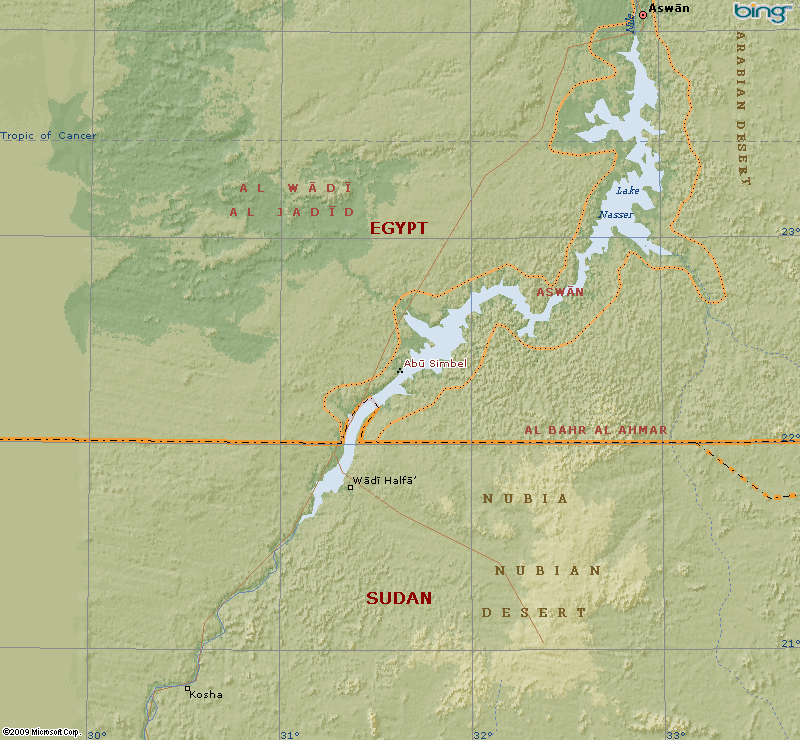
Lake Nasser, Egypt. |
Grid Reference:
24� 24' 00" N, 33� 01' 00" E |
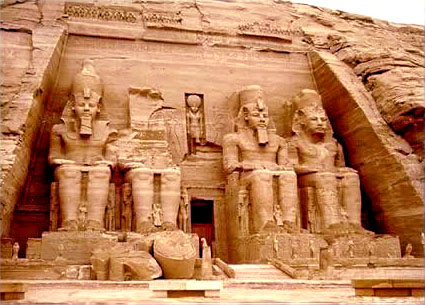
 Abu Simbel:
(Rock-cut Temples).
Abu Simbel:
(Rock-cut Temples).
Two massive rock-cut temples on the western bank of lake Nasser in
the reign of Ramasses II.
Dedicated to Rameses II and his wife Nefertari.
The whole complex was taken apart piece by piece and moved
further uphill in the 1960's, following the
development of the Aswan Dam.
(Click
here for Map of site)
|
Abu Simbel: (Temple of Ramesses) |
('Hwt
Ramesses Meryamun',
'Temple of Ramesses, beloved of Amun', 'Nubian Mountains')
The 'Great Temple' at Abu Simbel, was completed
around year 24 of the reign of Ramesses the Great (which corresponds to
1265 BCE). It was dedicated to the gods Amun, Ra-Horakhty, and Ptah, as
well as to the deified Ramesses himself (2).The temple of Hathor and
Nefertari, also known as the Small Temple, was built about one hundred
meters northeast of the temple of Ramesses II and was dedicated to the
goddess Hathor and Ramesses II's chief consort, Nefertari.
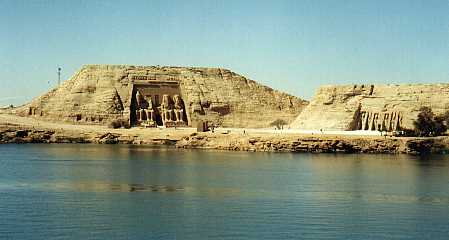
When the conservation efforts to preserve the temple from the soon-to be
built High Aswan Dam and its rising waters were begun in the 1960s,
images of the colossal statues filled newspapers and books. The temples
were dismantled and relocated in 1968 on the desert plateau, 200 feet
above and 600 feet west of their original location.
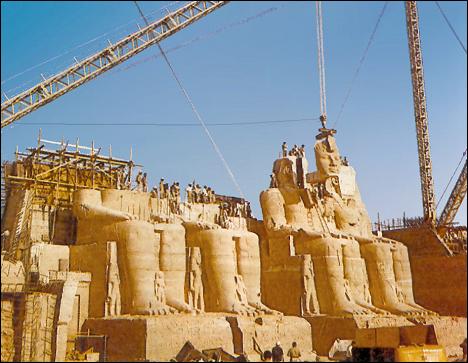
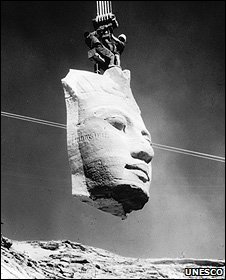
In 1959 an international donations campaign to save
the monuments of Nubia began: the southernmost relics of this ancient
human civilization were under threat from the rising waters of the Nile
that were about to result from the construction of the Aswan High Dam.
The salvage of the Abu Simbel temples
began in 1964, and cost some USD $40 million. Between 1964 and 1968, the
entire site was cut into large blocks (up to 30 tons averaging 20 tons),
dismantled and reassembled in a new location � 65 m higher and 200 m
back from the river, in what many consider one of the greatest feats of
archaeological engineering. Some structures were even saved from under
the waters of Lake Nasser. Today, thousands of tourists visit the
temples daily. Guarded convoys of buses and cars depart twice a day from
Aswan, the nearest city. Many visitors also arrive by plane, at an
airfield that was specially constructed for the temple complex.
The Orientation of the 'Great' temple:
The axis of the temple was positioned
by the ancient Egyptian architects in such a way that twice a year, on
October 20 and
February 20, the
rays of the sun would penetrate the sanctuary and illuminate the
sculpture on the back wall, except for the statue of Ptah, the god
connected with the Underworld, who always remained in the dark. (2) These
dates are allegedly the king's birthday and coronation day respectively,
but there is no evidence to support this, though it is quite logical to
assume that these dates had some relation to a great event, such as the
jubilee celebrating the thirtieth anniversary of the pharaoh's rule. In
fact, according to calculations made on the basis of the heliacal rising
of the star Sirius (Sothis) and inscriptions found by archaeologists,
this date must have been October 22. This image of the king was enhanced
and revitalized by the energy of the solar star, and the deified
Rameses Great could take his place next to Amun Ra and Ra-Horakhty.
The following extract from the Pall
Mall Gazette (20th April, 1892) offers an eye-witness testimony to
the phenomena before the temples were moved uphill to
their new resting place:
"I was fortunate in seeing
another wonderful thing during my visit to Abu Simbel... on two
days of the year the sun is said to rise at such a point that it
sends a beam of light through both halls till it falls on the
shrine itself in the very holy of holies....It was on the 26th
February. The great hall, with its eight Osiride pillars was
wrapped in semi-darkness. Still darker were the inner hall and
shrine. Behind the altar sat the four gods, Amen, Horus, Ptah
and Rameses himself, now deified. All the east was a deep rosy
flush; then that paled, and a hard white light filled the sky.
Clearer and whiter it grew, till, with a sudden joyous rush, the
sun swung up over the low ridge of hill, and in an instant, like
an arrow from the bow of Phoebus Apollo, one level shaft of
light pierced the great hall and fell in living glory straight
upon the shrine itself". (1)
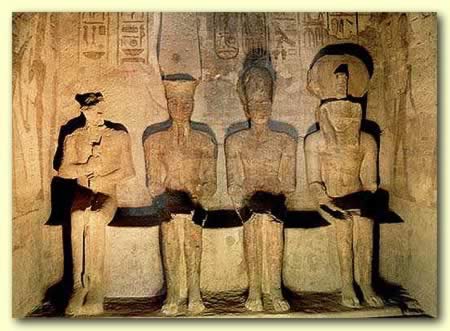
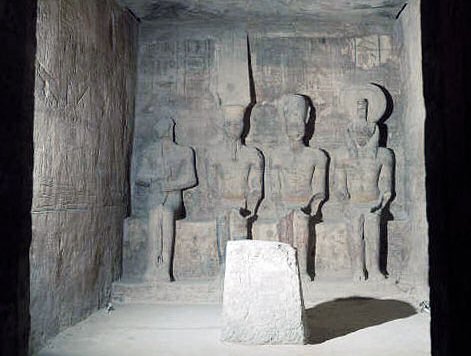
It is widely
believed that this event now occurs several days later than it did
originally due to the displacement of the Temples.
Images of the original temple, in its original setting.

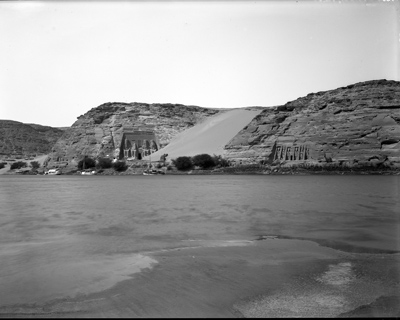
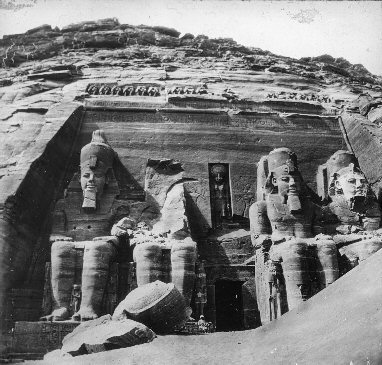
The two temples were still separated by a bank of sand
in 1906.
(Other Egyptian Sites)
|