The
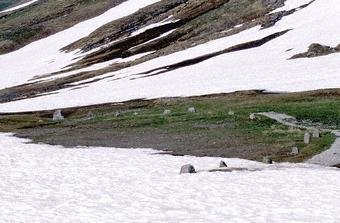
Petit Saint Bernard stone circle is believed to date back to the second
or third millennium BC. It was re-discovered last century and its large
diameter (72 m - 236ft) makes it an important European stone-circle.
Forty-six low stones remain, but originally there were probably more, as
the site is now crossed by a road which almost certainly destroyed
several others.
According to some
sources a dolmen once stood in its centre, opening to the summer
solstice.
A porphyry stone pillar, known locally as Columna
Jovis (Jupiter's Column), could also have been part of the circle. This
column now acts as the pedestal for a statue of San Bernardo, and stands
near the stone ring. Ancient books say that in Roman times there was a
big ruby called 'Jupiter's eye' or 'Escarboucle' on top of the pillar.
Petronius (the 1st century AD Roman satirist)
possibly mentions the stone circle in one of his books:
In the Alps
near the sky, where the rocks are getting lower and let you cross
them, there is a holy place where the altars of Hercules rise. Winter
covers it with a persistent snow and it raises its white head to the
stars.

 Petit St. Bernard: