|
Location:
Egypt. |
Grid Reference:
27� 10' 58" N, 31� 10' 58" E |
 Abydoss (Abjou):
(The Osireion).
Abydoss (Abjou):
(The Osireion).
Abydoss has revealed itself to be one of the most important
archaeological sites in Egypt. It is the site of the pre-dynastic
royal graveyard, which has revealed some interesting links with
Sumeria; and of the Osireion, an enigmatic underground chamber
connected to the Nile, fashioned from enormous blocks
the style of which is comparable only with
that seen at the Valley temple, Giza. The temple of the Sixth Dynasty Seti I
was later built over this site, which assuredly dates from an earlier time.
Lockyer called Abydoss
'One
of the holiest places in Egypt from the very earliest of times'
(2).
Quick Links:
|
|
The Temple of Seti I (The 'House of a Million Years') |
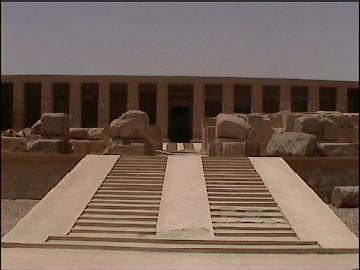 The Temple of Seti I
(1,307-1,291 BC) The Temple of Seti I
(1,307-1,291 BC)
(The house of millions of years) � Considered to have been built
towards the end of Seti�s reign.
The entrance to the Temple of
Seti I (right)
Seti I, the second king of the
19th Dynasty was the son of Ramesses I and Queen Sitre. He reconciled
with the Hittites who were becoming the most powerful state in the
region. Seti I and his heir, Ramesses II campaigned against Kadesh. In
Karnak he completed his father's plan by converting the court between
the second and third pylons into a vast hypostyle hall. He built his
vast mortuary complex at Abydos. Seti-I was enedtomb in the Valley of
the Kings where he was finally entombed was vandalized and his body was
relocated to Deir el Bahri. The mummy of Seti I was found at Dayru l-Bahri
in 1881.
The temple
of Seti I contains the famous Abydoss 'King-List'.
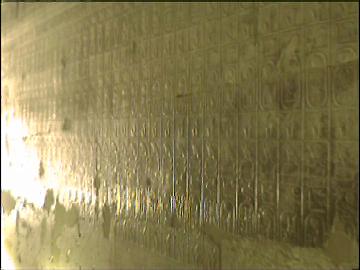
The
list of 120 Gods of Ancient Egypt and the �king list�, on the
walls
(21).
The Temple of Seti I is also gaining a reputation for these
unusual engravings found on one of the ceiling beams.
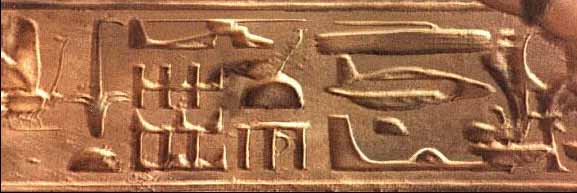
These engravings have aroused much attention in the past... Their apparent
similarity to modern vehicles is impelling, but it has been suggested
that they are the product of two sets of hieroglyphs, one over the
other... and however unusual that may be, the idea seems borne out by
looking further along the beam...
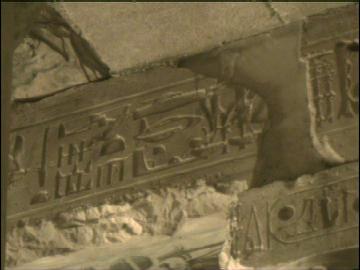
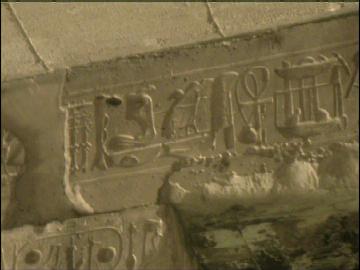
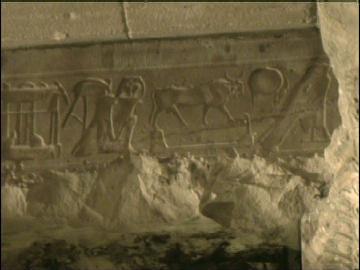
In the centre image above, an ankh can be clearly seen superimposed by
an other symbol.
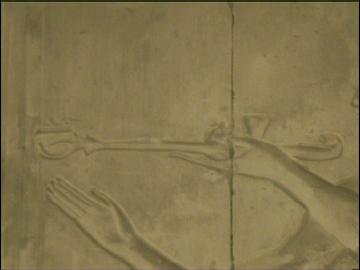
...One of the several images on the temple walls...explained as
incense or 'burnt
offerings'. This
style of pipe, with hands holding an 'incense'
bowl, are found in other sacred temples in Egypt, noticeably in South
America.
(More
on this Subject)
Alignments:
The Temple of Seti I is said to be aligned in the same way as �The way of the dead�
at
Teotihuac�n, east of due north
(21).
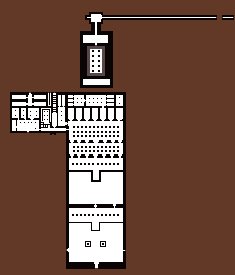
The Temple of Seti I
was built long after the Osireion (Below):
It is said that Seti I was directed
to build at this location and that he turned the temple when he found the
Osireion, but the alignment
between the two temples makes it is more likely that he was aware of the presence of the Osireion when he
began to build his temple.
|
The Osireion (Strabo's Well, The Fountain of Abydoss). |
The water in the temple is an indication of the level of the Nile
approx' 6.5 miles away. It
measures approximately 20 x 30m, is 50ft lower and is made of a clearly different construction style to that of the temple
of Seti I (Sixth Dynasty) above. The water level
insde the temple is attached to the water table.
As Seti-I began the search for a location for
his Temple, he was lead to a location north of Luxor in the bend of the
River Nile. There he began to dig the foundation for his Temple. What he
discovered was the Osireion, or the ancient temple of Osiris. Whether he
actually knew that the Osireion was there, perhaps we will never know, but
upon finding this ancient temple in the path of his new temple, he turned
his new temple to the left. It is the only temple in Egypt that makes an 'L'
turn.
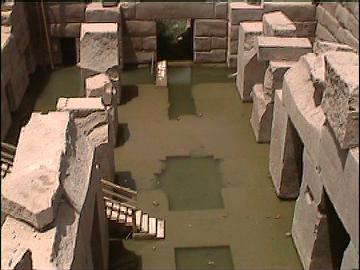
The Osireion is
aligned
with the temple of Seti I, above...
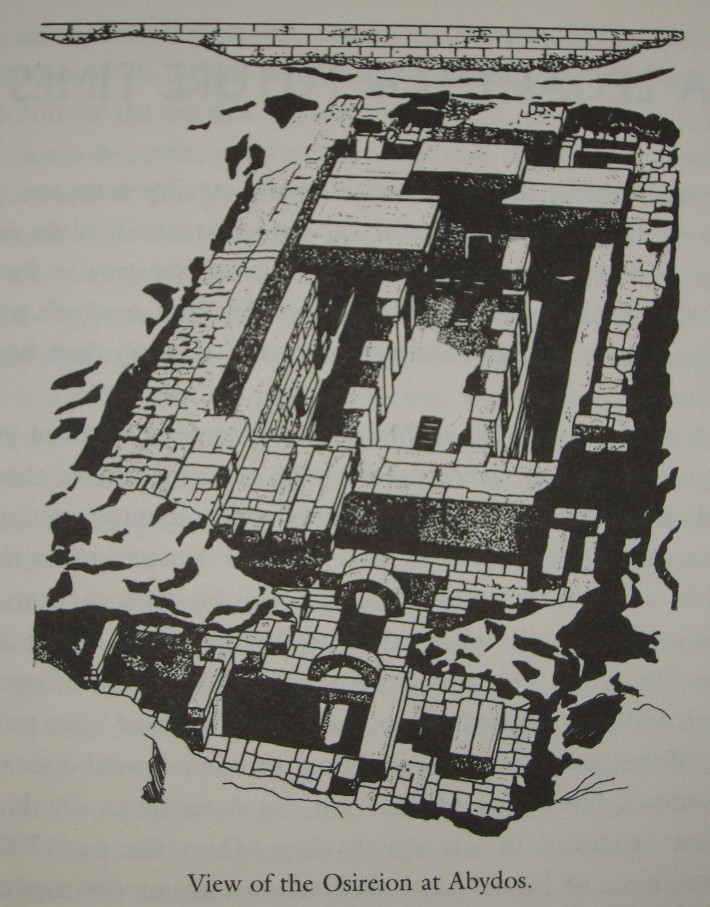
The area is constructed of blocks up to 25 ft
long. Almost flush with the water table and therefore the Nile, it is likely it was
always part filled
with water, leaving a central plinth protruding like an island in the
centre. The walls surrounding the building are 20 ft thick, red sandstone.
The chamber is surrounded by a �moat� with �cells� coming off it, six to the
east, six to the west, two to the south and three to the north. The whole
structure was enclosed within an outer wall of limestone.
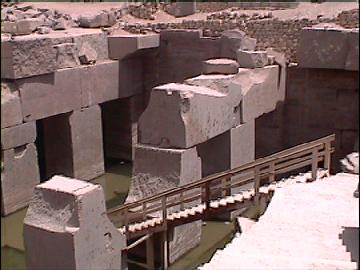
The stairs can be used as
an indication of scale.
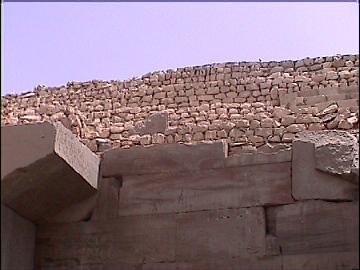
The roof has collapsed,
but compare the upper masonry with the lower.
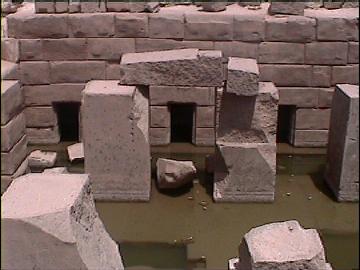
17 Cubicles surround the
central area.
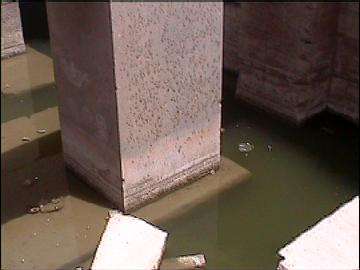
The
perfect pillar... (note the water-line)
Made of 'rose-coloured Aswan granite', the ten central
columns each measure 2.096m� (5) and 4.19�m high (5).
Note:
www.egyptsites.co.uk states that they are 2.6m�,
while
www.touregypt.net
says 2.4m� x just over 3.5m high)
The dimensions of each stone can therefore be estimated at
between (2.096 x 2.096 x 4.16 = 18.4m �), and (2.5 x 2.5 x 3.5 = 21.87m�)
Using the average density of
granite at 2.7g/cm: we arrive at an estimated weight of between 49.68
tons and 59 tons.
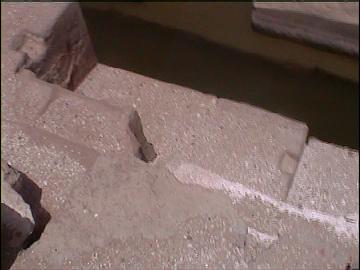
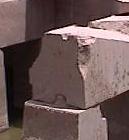
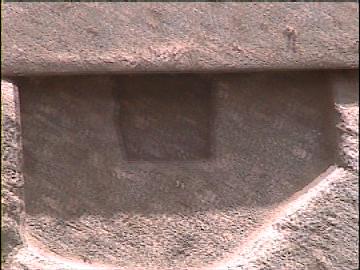
Some examples of the
Various 'Mortice and Tennon' joins used in the construction.
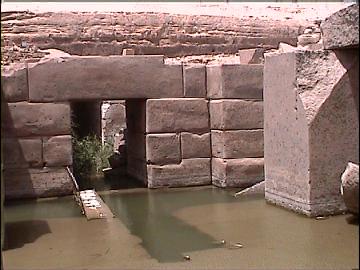
The
entrance to the rear ante-chamber with its spectacular lintel...
This structure shows significant architectural
differences to the temple above and is believed to be far older. It shows
several similarities to the �Valley Temple� at Ghiza
(21), which is also recognised as an
early-dynasty structure. In relation to this issue, it is perhaps
significant that the temple Osireion is dedicated to Osiris, while the
'Valley temple' at Giza is
associated to Isis. (More
on this below).
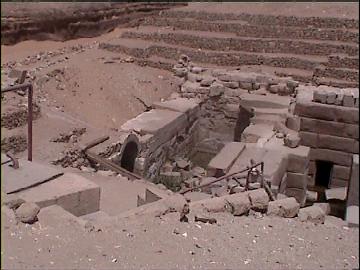
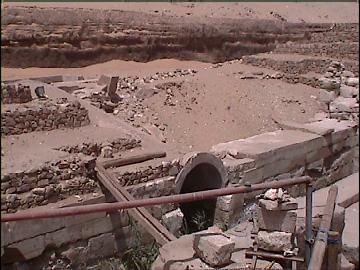
and
behind which, is an even more spectacular stone tunnel/arch...
Annual Report from the Smithsonian Institute, 1914, pp. 579-585.
Excavations at Abydoss: Naville, Edouard. (Extract)
'There is no longer any doubt, then, that we have
discovered what Strabo calls the well or the fountain of Abydos. He
spoke of it as being near the temple, at a great depth, and remarkable for
some corridors whose ceilings were formed of enormous monolithic blocks.
That is exactly what we have found.
These cells were 17 in number, 6 on each of the long
side. There was one in the middle of the wall at the back; in passing
through it one came in the rear to the large hall which was the tomb of
Osiris. A careful study of the sculptures confirmed the opinion that this
was a funeral hall where the remains of the god were expected to be found.
but this hall did not form part of the original edifice. It must have been
constructed underground when Seti I built the temple of the god. The tomb of
Osiris was very near the great reservoir. Nothing revealed its presence; the
entrance to it was exactly like that to all the other cells, the back of it
being walled up after they had dug through it...
...We have as yet no certain indications of the date of
the construction; but the style, the size of the materials, the complete
absence of all ornamentation, all indicate very great antiquity. Up to
present time what is called the temple of the Sphinx at Gizeh has always
been considered one of the most ancient edifices of Egypt. It is
contemporaneous with the pyramid of Chefren...
'The reservoir of Abydos being
of a similar composition, but of much larger materials, is of a still more
archaic character, and i would not be surprised if this were the most
ancient structure in Egypt'
Myth and Legend:
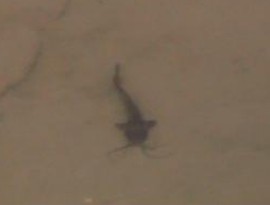
It
is said that a catfish swallowed the phallus of Osiris when he was cut into
pieces by Seth. The Osireion is traditionally known as it's final resting place. In reverence of this myth, catfish are left in the water to
this day, as the photo on the right demonstrates, taken at the Osireion in
2003.
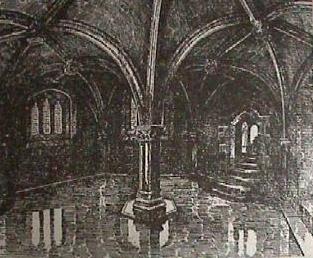
The
layer of water in the Osireion is reminiscent of the 'Holy wells' or 'Well
shrines' of pagan Britain which were noted for their healing properties,
and in many cases were popular places of pilgrimage. The picture (left), is an old
print of St. Triduana's reliquary chapel (well-shrine) in Edinburgh
(1).
Astronomy:
Sir N. Lockyer says this on the
subject: 'The orientations given by different authors are so conflicting that
no certainty can be claimed, but it is possible that at Abydoss one of the
mounds is not far from the amplitude shown in the tables for the sun in the
Nile valley at sunset at eh summer-solstice'
(2).
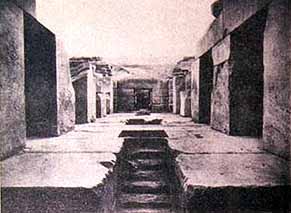
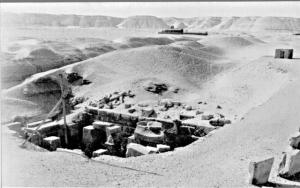
Old Images of the Osireion.
|
The Osireion and the Valley Temple: |
Are
they contemporary structures?
It has been suggested that the Osireion
and the Valley temple at Giza are contemporary structures. There are
several factors which indicate that this may be the case, which would
make the Osireion a 4th dynasty structure. We know that the temple of
Seti I was built in the 6th Dynasty
(4th Dynasty (2,613�2,498 BC), 6th
Dynasty (2345�2181 BC) (7)).
only a matter of a hundred years later, and in a completely
different style of architecture. It is worth exploring the idea that
the Osireion and the Valley temple might at least share a common
theme in construction.
- The two buildings (Osireion
and Valley Temple) are clearly similar
in design and appearance.
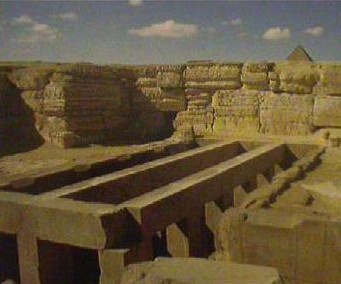
Both structures
were made from
large, unadorned and lintelled pillars. Two rows running along the
length with five pillars in
each, creating a central chamber. Both structures were covered
over, and both were associated with the Nile. The Osireion has 17 chambers running along the walls while the Valley Temple has
17 sockets
in the floor for statues. Naville, who excavated the site in
1913-14, immediately recognised the similarities between Khafre's
Valley Temple at Giza and the Osireion, and concluded that they were
of the same Old Kingdom era.
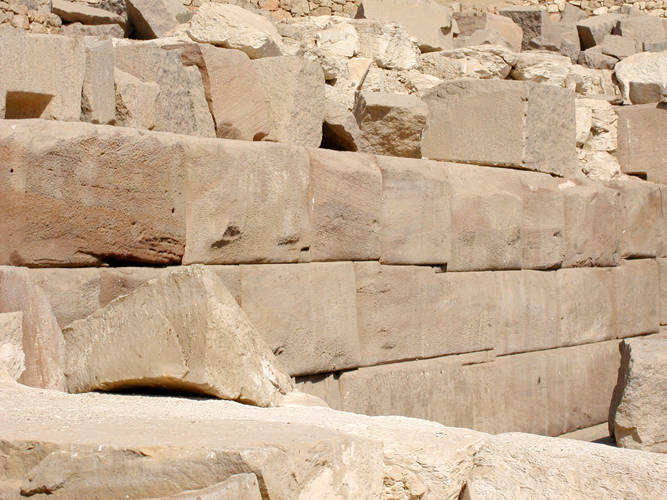
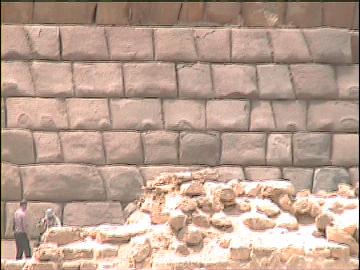
The same 'manoeuvring
protuberances' were left on the otherwise finished blocks. These
are the only two known examples of this technique in early
dynastic structures.
(Prehistoric
Construction Techniques)
-
The Osireion is
associated with Osiris, and the Valley temple to Isis, his
consort and sister, as demonstrated by the Inventory Stela,
discovered by Auguste Mariette in the 1850's. It reads as
follows:
|
Long live The King of Upper and Lower
Egypt, Khufu, given life...
He found the house of Isis, Mistress of
the Pyramid, by the side of the hollow of Hwran (The
Sphinx)
...and he built his pyramid beside the
temple of this goddess and he built a pyramid for the
King's daughter Henutsen beside this temple.
The place of Hwran Horemakhet is on the
South side of the House of Isis, Mistress of the
pyramid.
He restored the statue,
all covered in painting, of the guardian of the
atmosphere, who guides the winds with his
gaze.
He replaced the back part of the Nemes
head-dress, which was missing with gilded stone.
The figure of this god, cut in stone,
is solid and will last to eternity, keeping its face
looking always to the East '.
(10) |
The association
with Isis on this stela (whether from the 4th of 12th dynasty) is of
particular interest as it appears to confirm the early-dynastic
history of the unification of 'upper' and 'lower' Egypt and the
primal Egyptian myth of Osiris and Isis, in relation to these
temples. These temples suggest a commonality, whilst adhering to the
theme of the Isis/Osiris myths. The Osireion is associated with
Osiris, and the Valley temple to Isis, his consort, sister and
mother. The Ghiza pyramids are cardinally orientated (equinoxially),
while the great temples in the south of Egypt such as Karnack,
Denderra and The Temple of Seti (Osireion), are orientated to the
solstices. The symbolic act of unification, was not only concerned
with the physical boundaries of Egypt, but also the solar year.
Both Abydoss
(Near the Osireion) and Saqqara (Near Giza) served as Royal
Graveyards for the Early Dynastic Pharaohs.
The royal graveyard at
Abydoss contains some the earliest graves in Egyptian history and
any includes several interesting Mesopotamian discoveries which puts
the origin of the dynasties into question.
The graveyard at Abydoss contains the mastabas of the
first dynasty pharaohs.
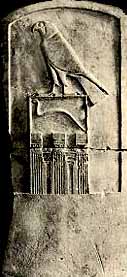
This
round-topped stellae (right), of King Djet, the 4th King of the 1st
Dynasty was probably originally erected on the east side of his royal
mastaba tomb. It was found in a royal necropolis at Abdyoss, where most
kings of the 1st Dynasty were buried. It was created of limestone, a
relatively soft stone. The
Horus falcon perches on top of the rectangular serekh, which contains
the hieroglyph of a cobra, the actual name of the king. (Uadji? Djet?)
Note the similarity to the 'buttress' walls in the
cartouche (right), and the buttress walls of the original Granite coffer
of Menkaure, from Ghiza (below).
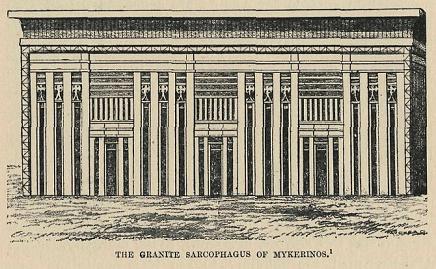
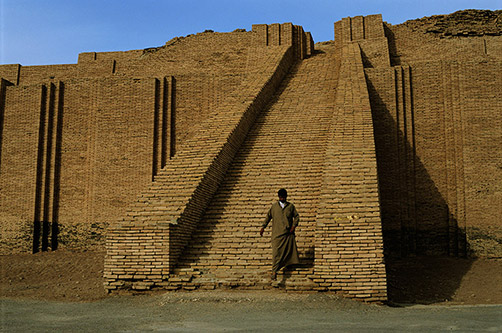
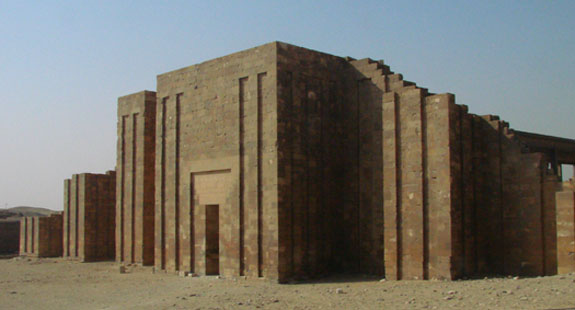
Note also the similarity with both these early Egyptian symbols and the
buttress walls of both the
Ziggurat of Ur
(below, left) and Saqqara (below, right).
Article: Hieroglyphs
Dated Back to 3,200 BC at Abydoss:
Recent discoveries
at the site of Abydoss have demonstrated that Egyptian hieroglyphs
date back at least to the 32nd century BC. Notably older than earlier
estimates, these discoveries give Egypt pride of place for the oldest
known system of writing. They have also forced a revision of some
assumptions about the development of Egyptian hieroglyphs. The
existence of ideograms alongside phonetic symbols led linguists to the
conclusion that hieroglyphs began as a rudimentary series of
ideographic characters, where one sign meant one thing, independently
of the spoken word; and that the system gradually developed a phonetic
component as greater sophistication was needed. The discoveries at
Abydoss seem to contradict this model.
At issue are small
tags, perforated with a hole in one corner, bearing one or more
primitive carvings similar to classic hieroglyphs. Some of these
carvings are more obviously similar to known hieroglyphs than others,
and the archaeologists dealing with them found that if these carvings
were read like standard Egyptian writing, they not only made sense in
a generic fashion, but they actually clarified the nature of the
discovery: they were tied to goods that were brought to the tomb then
under excavation, and identified the nature of those goods. Thus,
Egyptian writing was already phonetic at that early date.
Click here for
full article:
http://www.helium.com/items/1092970-history-of-egyptian-hieroglyphics
|
The 'Gebel
el Arak'
knife:
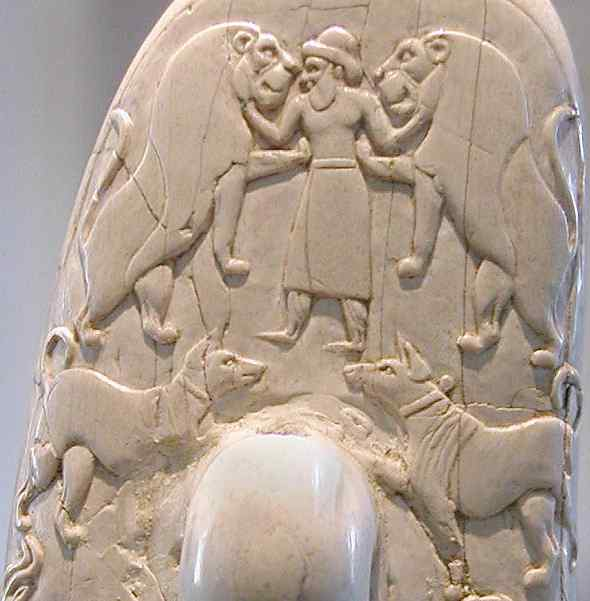
This ritual knife was discovered in the Royal
cemetery at Abydoss. The inscriptions on it are reminiscent of Sumerian and
Mesopotamian engravings. They appear to depict a battle on one side and the
'Gilgamesh' figure flanked by two lions on the other.
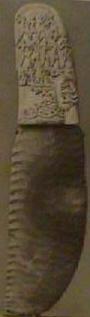
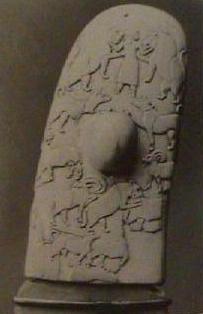 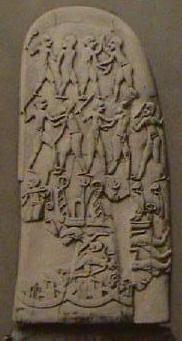
Mesopotamian motifs in Egyptian art:
The image on the ivory handle of the flint knife represents the Mesopotamian hero Gilgamesh subduing two lions, and
the same theme is repeated on a wall painting from Hierakonpolis,
belonging to one of the earliest
brick
buildings in southern Egypt
(3).
(Dry-mud brick buildings were a Mesopotamian invention).
|
The
Oldest Boats in The World:
Article:
ScienceDaily (Nov. 2, 2000)
� A fleet of the oldest built wooden boats in the
world, located in the desert sands of Abydos, Egypt-more than eight
miles from the river Nile-are painstakingly being excavated by
archeologists. The work is revealing remarkable new evidence about the
wealth, power and technological prowess of the earliest days of
Egyptian civilization. To date, 14 of the large vessels, dating from
3000 B.C. and estimated to be between 60 and 80 feet long, have been
identified.
(Link to Full Article)
(Other Underground Sites)
(Other Egyptian Sites)
|

