|
The Top-50 Megaliths:
(The largest cut-stones of all
time).
One of the most remarkable prehistoric human
achievements was our ability to work with stone on a seemingly gigantic and
effortless scale, which apart from the technical implications, reveals the
presence of sophisticated and complex people, who proved themselves to be
anything but primitive.
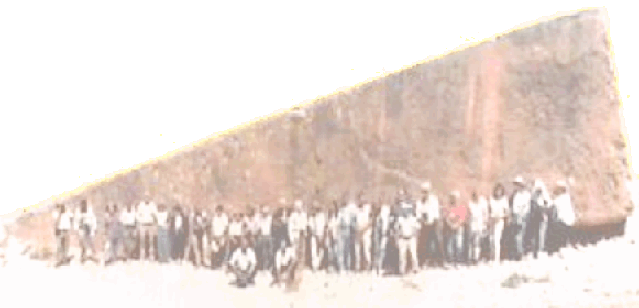
Many of the 'estimates' on this page are only estimates - and
several vary from author to author.
As such, and where estimates differ considerably,
the density of rock can be calculated using S.I. recognised estimates for the weight of
rock, but even the weight of similar rock varies from one m� to
another. As such, and without actually weighing the rocks themselves,
they will remain estimates.
Note:
(1 Metric
ton = 1,000kg), (1
US ton = 0.907 Metric tonnes), (1 Imperial ton = 1.016 Metric
tonnes)
Scroll down for the Top-50 Megaliths of all time.
|
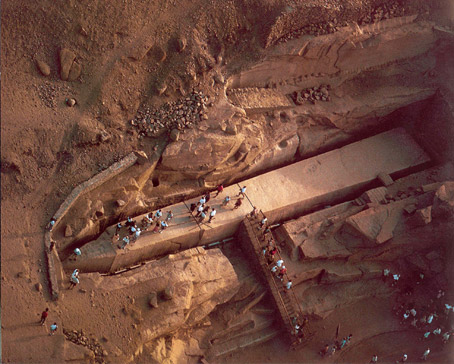 1)
The Unfinished Obelisk, Aswan, Egypt. - 1)
The Unfinished Obelisk, Aswan, Egypt. -
Measures
120-feet (42m) and would have weighed over 1,168 tons when complete.
Ref: (Sci. Amer.
Dec. 1977. No. 36). - Estimated
@ 1200 tons
This
incredible stone is more than twice the size of any known obelisk ever
raised. Quarrymen apparently abandoned the obelisk when natural fractures appeared
in its sides. However, the stone, still attached to bedrock, gives important
clues to how the ancients quarried granite. Much of the red granite used for
ancient temples and colossi came from quarries in the Aswan area (500 miles
south of Cairo). The Unfinished Obelisk still lies where a crack was
discovered as it was being hewn from the rock. Possibly intended as a
companion to the
Lateran
Obelisk
(see below),
originally at
Karnak, now in Rome.
(More about the Unfinished obelisk)
(Other Egyptian Obelisks)
|
|
 2)
Ba'albek,
Lebanon. 2)
Ba'albek,
Lebanon.
-
(The 'Stone of the
South).
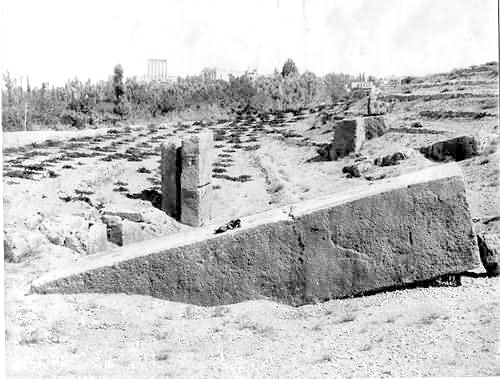
Estimates of the weight of this stone vary considerably.
Although the highest estimates of the unfinished stone's weight have reached
an incredible 2,000 tons
(7),(11),
these estimates are now considered too high.
Quarry stone: (Photo Right),
Measures
20.9m x 4.8m x 4.2m =
421.344m�.
'The average density of granite is 2.75 g/cm3'
Ref: (http://en.wikipedia.org/wiki/Granite)
Therefore the approximate weight of this stone is 1158.696 tons.
Three other smaller stones under
' The
Grand Terrace'
of the temple itself are also estimated to weigh from between 750 and 1,000
tons each
(9),
and there are several other colossal stones to be seen around the great
'Temple of the Sun' at Ba'albek.
The stones were cut
from
red granite,
with the largest 'The stone of
the south'
(as seen above), still attached to the bedrock. All the large stones used
for the temple of the sun at Ba'albek were quarried from the same
location, and taken over half a mile
uphill to
build the great temple.
(More about Ba'albek) |
|
 3)
The Ramesseum, Egypt -
The Ramesseum is the memorial temple of Pharaoh Ramesses II.
Originally called the House of millions of
years of Usermaatra-setepenra that unites with Thebes-the-city in
the domain of Amon. 3)
The Ramesseum, Egypt -
The Ramesseum is the memorial temple of Pharaoh Ramesses II.
Originally called the House of millions of
years of Usermaatra-setepenra that unites with Thebes-the-city in
the domain of Amon.
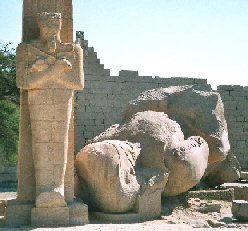
In front of the ruins is the base
of the colossus of Ramesses. On the granite colossus's shoulder is
an inscription describing Ramesses as the "sun of Princes". The
statue fell into the Second Court and the head and torso remain
there, but the other broken pieces are in museums all over the
world.
Only fragments of
the base and torso remain of the colossal statue of the enthroned
Ramasses, (19m high and weighing around 1000 tons). The stone for
the statue was transported 170 miles over land from Aswan to Thebes.
This would have once been the largest statue (except statues carved
in situ) in the world.
(23) |
|
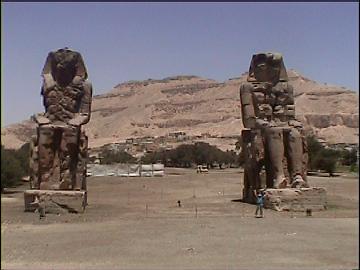 4 4 )
The Colossi of Memnon, Egypt.
-
These two giants were built from a single piece of stone each. They are
orientated towards the sunrise at winter solstice
(12)
Estimates: 2 x 1,000 tons (11), 2 x 600 tons
(2)
(Inter.
Herald Tribune (22/23 Dec 1973).) - 720 tons
(R. T. Gould; A book of Marvels; 1937, p. 133.) - 1200 tons.
The
statues are made from blocks of quartzite sandstone which was stone
quarried at el-Gabal el Ahmar (near modern-day Cairo) and transported 420
miles over land without using the Nile to Thebes. They are too heavy to
transport upstream on the Nile. The mortuary temple, built for the
eighteenth-dynasty king Amenhotep III (c. 1390-1352 BC), that once stood
behind these two figures was completely stripped for its masonry.
(Other examples of extreme
Egyptian masonry)
|
|
 5)
Solomon's Temple, Israel - 5)
Solomon's Temple, Israel -
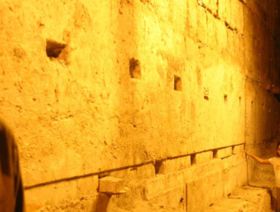
The Western-wall Stone, from the Western-wall tunnel,
The Largest stone is estimated at 11.625m long. Estimates of
weight vary from 500 to 600 tons.
'The wall had an original height of from seventy to one hundred and forty
feet. In places it is built from bottom to top of large squared stones,
bevelled at the edges and varying between 97.5cm and 1.80m in height. The
stones are laid without cement. The longest hitherto discovered measures
11.625m in length (not less than one hundred tonnes). Many of the other
blocks are from half to two thirds of this height. The massiveness of the
work is on par with the Egyptian pyramid-Kings; and the perfection of the
cutting and fitting of the stones is nearly equal.'
(1)
The stone has a length of 13.6 meters, a width estimated
between 3.5 to 4.5 meters; estimates place the weight at 570 tons. (Ref:
Wikipedia.org)
1 Kings 13-17:
13 And king Solomon
chose workmen out of all Israel, and the levy was of thirty thousand men.
14 And he
sent them to Libanus, ten thousand every month, by turns, so that two
months they were at home: and Adoniram was over this levy.
15 And Soloman had seventy
thousand to carry burdens, and eighty thousand to hew stones in the
mountain:
16 Besides the overseers who were
over every work, in number three thousand and three hundred, that ruled
over the people, and them that did the work.
17 And the king commanded that
they should bring great stones, costly stones, for the foundation of the
temple, and should square them:
18 And the masons of Solomon and
the masons of Hiram, hewed them: and the Giblians prepared timber and
stones to build the house.
(More about Jerusalem)
|
|
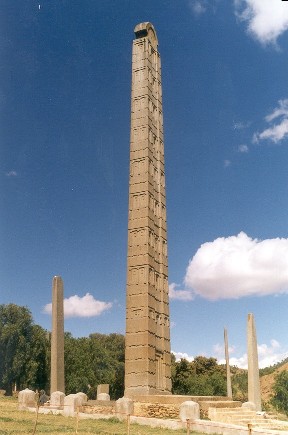 6) Ethiopia - The Stellae of Axum (Aksum). 6) Ethiopia - The Stellae of Axum (Aksum).
The area of Axum is home to what was once seven large stellae, all
decorated in the same style, with doors and windows and astral imagery
at the top. The largest
(still standing) is 21m high (70ft) but there were larger with the heaviest, now fallen and
broken estimated to have originally weighed in at around 500 tons.
(Ref: BBC. 'Around the world in eighty treasures' BBC2 - 29th
Nov 2007)
Axum was the ancient
political and religious capital of Ethiopia. Though the exact date
of its founding is not known, it is known that the Queen of Sheba,
who reigned around 1000 B.C. had Axum as her royal capital. Axum was
also rumoured to be the home of the Ark of the covenant.
(More about Axum)
|
|
7) Temple of Sais, Egypt.
Weaver
(19)
quotes Wilkinson's ''Manners and customs of Egypt', who in
turn quotes Herodotus concerning a stone edifice near the temple
(at Sais) -
"But
what in my opinion deserves the greatest admiration, is an edifice
of a single stone, brought from the city of Elephantine, a
distance of about twenty days journey. Two thousand men of the
class of boatmen were employed for the space of three years in
transporting it to Sais. Its external length is twenty-one cubits,
its breadth is fourteen, and height eight; and in the inside it
measures eighteen cubits and twenty digits in length, twelve in
breadth and five in height. It stands near the entrance of the
temple."
(Ref: Herodotus. Vol i. p. 190).
The Ancient Egyptian
unit of linear measurement, known as the Royal
Cubit, was maintained as
523.5mm in length, and was
subdivided into 7 palms of 4 digits each. (Ref: Wilkipedia). The stone in
question therefore measured as follows:
(External dimensions) - 10.99m x 7.33m x 4.19m = 337.5m �.
(1000+ tons)
(Internal
cavity) - 9.81m x 6.28m x 2.62m = 161.4m�.
(500+ tons)
Estimated weight of
remaining stone
= 500+ tons.
|
|
8)
The Ghiza Plateau,
Egypt. -
There are several extraordinary sized stones recorded at the Ghiza plateau,
with the largest regularly estimated at over 400 tons....
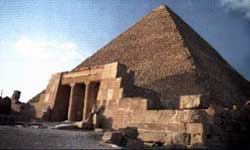
Temple East of 'Khafres' Pyramid.
'Largest stone
estimated 468 ton block' (11).
(J. Cook; The Pyramids of Giza; p. 22). - 'Khafre
foundation stones > 400 tons'.
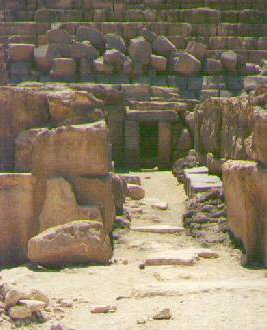
Mortuary temple
of Menkaure
(Mycerinus).
[Edwards, p. 265] - 200 tons
http://atschool.eduweb.co.uk/ - 285 tons
'Reisner
estimated that some of the blocks of local stone in the walls of the
mortuary temple weighed as much as 220 tons, while the heaviest granite
ashlars imported from Aswan weighed more than 30 tons'.
Ref:
http://en.wikipedia.org/wiki/Pyramid_of_Menkaure
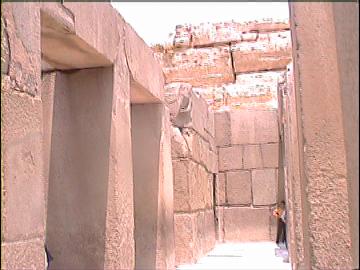
The
'Valley
Temple'
-
The Valley temple was built from huge granite blocks in the style of the Osireion at Abydoss.
They are estimated at around 50 tons + each. The whole temple in turn was encased in
even larger limestone blocks, the largest of which has been (enthusiastically) estimated at
around 200 tons.
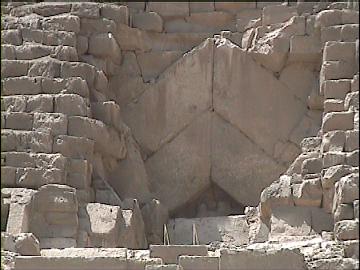
The 'Great' pyramid of Khufu - The 'Kings chamber' in the Great
pyramid is covered over with several granite stones estimated at 50-70 tons
each. The Gable stones over the entrance (left) and several of the stones covering
the descending passage are also several cubic metres in size.
Maximum weight of stone in great pyramid:
(Guinness,
p. 119). 50 tons
(R. J. Cook; The
Pyramids of Giza; p. 22). 70 tons
(More
about the Ghiza Complex)
|
It is noticeable that all the megaliths above are
from the middle-east, but it should be remembered that they were cut long
after the European ones, such as the Grand Menhir (below) which were
carved in a cruder style retaining a natural aspect to the stone, in contrast to
the squared edges produced by the Egyptian masons.
|
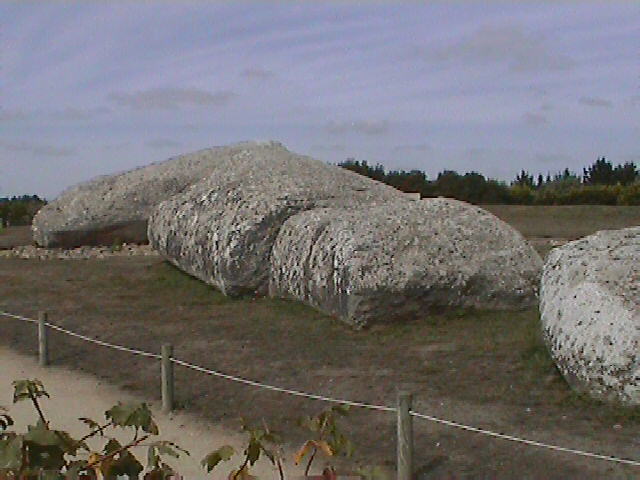 9)
Le Grand Menhir Brise, Brittany, France - 9)
Le Grand Menhir Brise, Brittany, France -
Over 20m high.
Regularly e stimated
weight @ 300-350 tons.
(Michelin Green Guide � France, p. 263). - 'Almost 350
tons'.
According to the most recent
calculations, it amounted to 347,531 kilogram's, or 342 tons
(L'Homme,
188 5, p. 1 93).
This giant now lies at the end of a Neolithic
long barrow, broken in four pieces. The stone was believed by Prof. A.
Thom. to be used to mark positions in the lunar cycle.
It is now known that this stone was once the largest of 19
menhirs, erected around 4,500 BC, which originally stood in an alignment forming a line of decreasing
height from Le Grand Menhir downwards.
(More about Le Grand Menhir Bris�)
|
Unconfirmed...
Acosta, in his "History of the Indes," lib. vi., p.459,
as quoted by Maurice "Observations connected with
astronomy and the ancient history of Babylon",
states that some of the stones in the Mexican temples to Sun and Moon
measure 38 feet by 18 feet by 6 feet. (38 x 18 x 6 = 4104 ft�) = (11.5 x
5.45 x 1.8 = 112.8 m�).
(12)
Estimated weight of stones - approx 300 -400 tons.
|
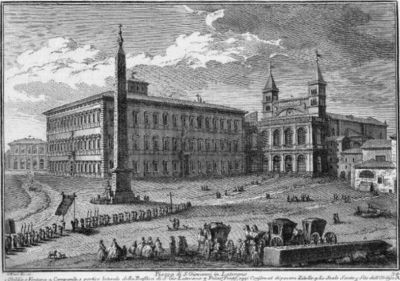 10)
The 'Lateran' Obelisk, Rome.
-
The so-called 'Lateran' obelisk is the largest
standing obelisk in the world. 10)
The 'Lateran' Obelisk, Rome.
-
The so-called 'Lateran' obelisk is the largest
standing obelisk in the world.
The obelisk is 106 ft high, weighs approximately 330 tons, and was once the
tallest obelisk
in Egypt. The Lateran obelisk had a base weighing 174 tons.
(16)
Its inscriptions state that while it was begun
during the reign of Tuthmosis III, it lay in the craftsmen's workshops for 35
years and was finally erected by his grandson Tuthmosis IV. The obelisk was
removed under the orders of the Roman emperor Constantine (A.D. 274-337), who
hoped to raise it in his new capital at Constantinople. He died before the
obelisk ever left Egypt, and his son and successor Constantius (A.D. 317-361)
had it taken to Rome, where it was re-erected in the Circus Maximus.
(R. A. Hayward; Cleopatra's Needles; pp. 15-17). -
330 tons.
(Other Egyptian Obelisks) |
|
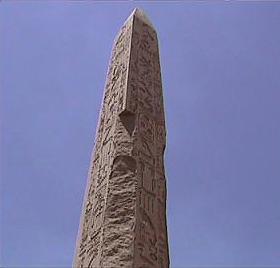 11) Karnak
(Thebes),
Egypt
- 11) Karnak
(Thebes),
Egypt
-
Karnak now only contains three obelisks, all made of pink granite from the Aswan
quarries 186 miles upriver.
Two obelisks still stand from the reigns of King Thutmose I (c. 1528-1510
BC), and Queen Hatshepsut (c. 1490-1486 BC), and are said to weigh
approximately 300 tons each (232 tons - Ref-16), with a height of 29.5
metres.
Hancock
(8), estimated the Thutmosis
I obelisk to stand at '21.3m high and weighs an estimated 143 tonnes', and
mentions an inscriptions which tells us that the obelisk was once covered
with electrum - (An alloy of gold and silver).
(8)
A third obelisk, of which only the
upper 9 metres still remain, lies nearby. Also raised in the time of Queen
Hatshepsut, this obelisk is estimated to have originally weighted 320 tons
(only 70 tons now remains). This obelisk, when thumped, is known to have
resonant qualities, that last for up to 30 seconds.
(14)
This last obelisk was also once part of a pair - the other was erected in
the place de Concorde, France in 1836
and is estimated to weigh about 300 tons.
(4)
(More about Karnak)
|
|
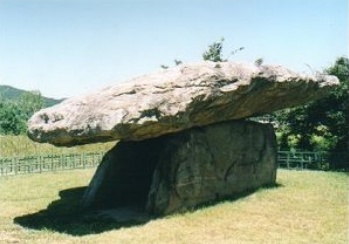 12 12 )
Korea. -
The 'Ganghwa Dolmens'
Korea has the highest concentration of
dolmens in the world, with over 30,000, possessing between 40% and 50% of
the worlds total.
The island of Ganghwa contains several
dolmens, one of which has the
biggest recorded stone in South Korea and measures at 2.6 x 7.1 x 5.5
meters. (101.53 m�)
The Ganghwa dolmen are accredited with
capstones weighing 300 tons
(28) at Gochang, but there is no support for Chatelain's
(13)
mention
of a 600 ton capstone.
( More about the
Korean Dolmens)
|
|
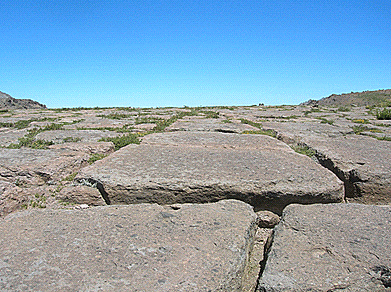 13). El Enladrillado, Chile - 13). El Enladrillado, Chile -
'The blocks are roughly rectangular, some as large as 12 to 16 ft high, 20 to
30 ft long, and weighing several hundred tons'.
'On the plateau of Enladrillado, 233 stone
blocks are placed geometrically in an amphitheatre-like arrangement.. As at
Tiahuanaco, huge chairs of stone
have been found in the ruins, each weighing approx 10 tons. Three standing
stones were placed in the very centre of the plateau, each 3 to 4 ft in
diameter. Measurements reveal that two of the stones are perfectly aligned
with magnetic north, while a line through one of these and the third stone
points to the midsummer sunrise'.
(9)
(More about El Endrillado soon)
|
|
14) Sahure's
pyramid at Saqqara, Egypt - The largest stones
over the king's chamber is estimated at around 200 tons.
(26)
Sahure was the second
Pharaoh of the 5th dynasty. He also had a pyramid complex made for him at
Abusir.
The colossal roof blocks
of Suhare's temple weighed up to about 220 tons based on estimates by J.S.
Perring. He estimated the size of the largest blocks at 35 feet by 9 feet by
12 feet. One end of these blocks was tapered so the estimated volume is 95
cubic meters by 2.4 tons. There were a total of at least 12 blocks the
smallest were less than 100 tons. All but 2 of these are now broken. The
Valley building of Sahure's Pyramid at Abu Sir included 8 monolithic granite
columns with leafs on their capitals. These were probably not more than
about 10 tons each but what makes them worth noting is that over a portion
2.6 meters long they taper from 91.2 cm to 79.8 cm with the error from the
mean diameter never more than 8 millimetres.
(26)
(More about
Saqqara)
|
Unconfirmed...
Cyprus - The Temple of Paphos
-
The largest stones measure 16ft x 8ft
(4.8m x 2.4m = 11.52m�
x ?).
' The
Temple has a double enceinte or parabolas, both of them oblong squares, the
outer one 700 ft long by 630 ft broad, the inner 224 ft by 165. The two
parabola are symmetrically placed, and were of the usual colossal masonry.
The material used was bluish granite, not to be found in the country, which
can only have been brought either from Egypt or Cilicia.'
(1)
|
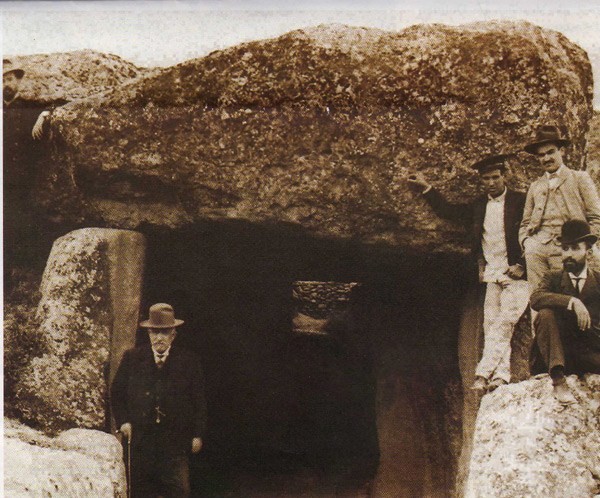 15)
Cueva de la menga, Antequera, Spain - One of three huge megalithic mounds
in the area. As well as
being composed of several gigantic stones, the entrance capstone to
the primary mound, known as Cueva de la Menga, is said to weigh
160-180 tons. 15)
Cueva de la menga, Antequera, Spain - One of three huge megalithic mounds
in the area. As well as
being composed of several gigantic stones, the entrance capstone to
the primary mound, known as Cueva de la Menga, is said to weigh
160-180 tons.
(15)
180 tons -
(George Kean; Essential Seville; AA Publishing, Basingstoke,
1992, p. 56).
The chamber is supported by three
pillars, and is said to have the largest chamber in Europe (25m x 6m
at its widest).
The mound faces the famous Pena de Los
Enamorados mountain that resembles an upturned head, and is suggested
as the reason for its orientation and/or location.
A 30m well has recently been discovered
perfectly carved into the bedrock, and still with water in it.
(More about the Cueva de Menga
complex) |
|
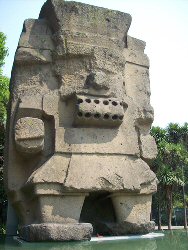 16) Tlaloc
Statue, Mexico - Found in the town of
Coatlinchan near Tlaloc Mountain in the State of Mexico and weighing
168 tons, this is the largest existing monolith in the Americas. 16) Tlaloc
Statue, Mexico - Found in the town of
Coatlinchan near Tlaloc Mountain in the State of Mexico and weighing
168 tons, this is the largest existing monolith in the Americas.
This statue was made of Basalt and
weighed an estimated 168 tons.
(24)
It was moved to the National Museum of Anthropology in Mexico City
in 1964.
Tlaloc, the
provider, had attributes of the rain. He created and brought down
the rain and the hail. He caused the trees, the grasses, the maize
to blossom, to sprout, and to grow. Also attributed to Tlaloc was
the thunderbolts and the drowning of people.
Some scholars
believe that the statue may not have been Tlaloc at all but his
sister or some other female deity.
(More about Pre-Columbian Mexico) |
 17)
Easter Island - Largest moai: 17)
Easter Island - Largest moai:
Location: Rano Raraku Quarry, named "El
Gigante". Height: 71.93 feet, (21.60 meters). Weight: approximately 145-165
tons (160-182 metric tons).
'Largest carved stone (still unfinished), approx 400 tonnes'.
(3)
Ref:
(P, Bahn & J. Flenley; Easter Island; Focus. Apr 1994. 92-97) -
275 tons.
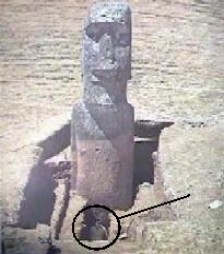
Note on Photo (Right): Zink
(5), estimates
the largest 'Moai' on the island at 90 tons ('length 90ft, still in
quarry'), so the picture provided is only
demonstrative rather than the actual stone.
(Note the person in pit for scale).
(More on Easter Island)
|
|
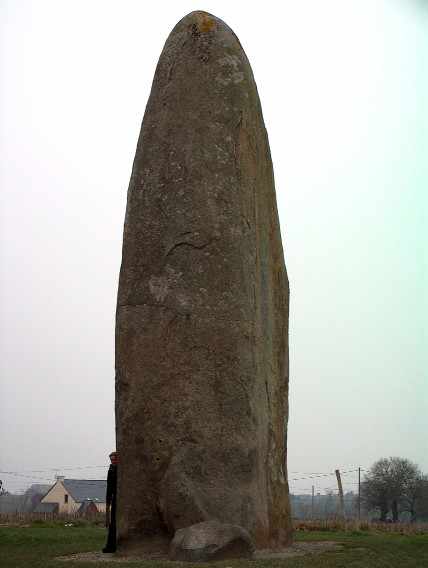 18 18 )
Dol-de Bretagne, Champ Dolent, France. - (Route
795)
Sitting
directly on the border of Brittany and Normandy, this menhir stands 9.5m high
with an estimated weight of 150 tons.
(4)
THE
LARGEST STANDING MENHIR IN FRANCE.
Nearby mount Dol is said
to have been the place where Lucifer fought St. Michael. The Stone is in
alignment with Mont Dol and Dol Cathedral. For more about this see the
Prehistoric France Homepage, or the page
on Mont St.
Michael.
(More about the Dol-de-Breton)
|
|
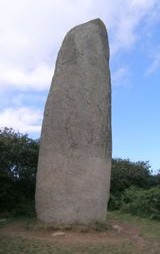 19) Kerloas Menhir. Nr Plouharnel, Brittany, France. 19) Kerloas Menhir. Nr Plouharnel, Brittany, France.
-
Highest estimated weight 150 tons. Height 9.5m.
>
100 tons. -
(P. R. Giot; Menhirs and
Dolmens; Editions Jos, 1986, p. 4).
Although Paturi
(4), claimed this to be the largest standing stone in France.
And although once correct, that claim is now technically no longer so as, following the loss of the
top 1.5m, it now stands at the same height as the Dol-de Bretagne
(above), but with a smaller girth.
(The largest Menhirs in France)
|
|
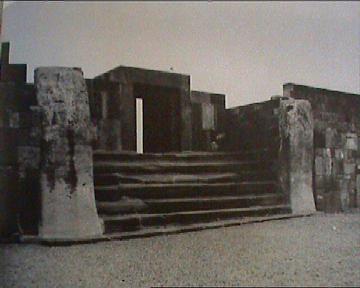 20) The
Puma Punka - 20) The
Puma Punka -
'Gate of the Puma', Tiahuanaco, Bolivia.
In a wall at Tiahuanaco (Knowledge 3. 30th Nov. 1883. No 331) - 125 tons.
The two enormous sandstone blocks in the foreground of the photo (right),
are estimated to weigh around 130 tons each.
(25) The nearest
source of sandstone is around 10km away.
Largest estimates: 200 tons -
(11),
'At least 200 tons'
(5)
One of the most mysterious and enigmatic sites in south America, due to its
height and spectacular masonry.
Certain of these
Andesite blocks resembles a machinist's work, with straight, true edges and
countersunk geometrical shapes. Some of the Sandstone and Andesite blocks
are over 27 feet long. The nearest source for this material is 20 km to the
north.
(5)
(More about Tiahuanaco)
|
|
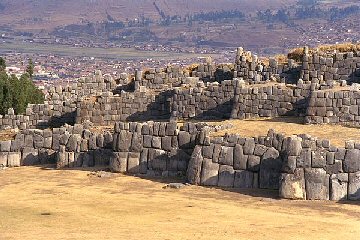 21)
Sacsayhuaman, Peru
- 21)
Sacsayhuaman, Peru
-
(The Andes. North of
Cuzco).
The
largest stones at this site are 28 ft high (8.4m) and while regularly
estimated to weigh over 120 tons
(23),
more enthusiastic estimates place the
largest stones at 300 tons
(4),
361 tons
(9), and even 440
tons (5).
Located on
the outskirts of the ancient Inca capital of Cuzco. It rests on an
artificially levelled mountaintop, and consists of three outer lines of
gargantuan walls, 1,500 ft long and 54 ft wide, surrounding a paved area
containing a circular stone structure believed to be a solar calendar. One block on the outer
walls has faces cut to fit perfectly with 12 other blocks. Other blocks were
cut with as many as 36 sides. All the blocks were fitted together so
precisely that a thickness gauge could not be inserted between them.
(More about Sacsayhuaman)
|
|
22)
Egypt, Dashur -
In the 'unfinished' brick pyramid located
at Dashur, the quartzite cask, even after being emptied, still weighs nearly
145 metric tons; as for the sealing slab, which weight 83 metric tons, it is
still in its preliminary position, raised on four temporary post, as the
cask seems never to have been used. |
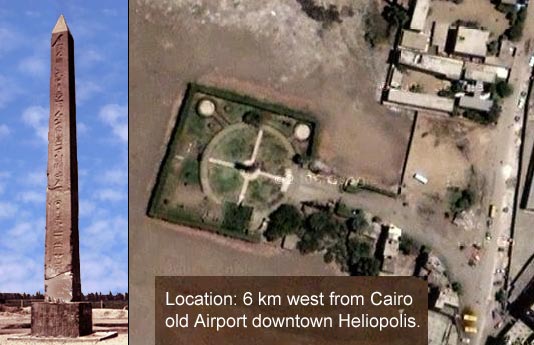 23) Heliopolis, Egypt: 23) Heliopolis, Egypt:The last standing obelisk at Heliopolis and therefore the oldest
known surviving in Egypt, this stone is twenty metres high and weighs
121 tons.
Today, all that remains of this once great city is a single (20.4m high, 121
ton), obelisk, originally one of a pair erected at the entrance of a huge temple
to mark the 12th dynasty king Senusret I's 30th anniversary at around 1940 BC.
(22)
(More about Heliopolis) |
|
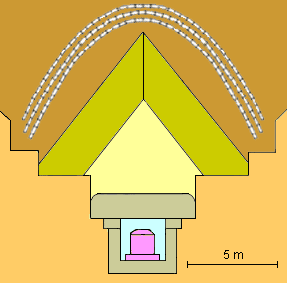 24 24 )
The Sarcophagus of Amenemhet III , Egypt.
A quartzite monolith weighing 110 metric
tons (121 Imperial
tons), was placed in a chamber with an interior length of 7 metres and walls 1
metre thick.
(16) The quartzite monolith was lowered onto the sarcophagus
by means of sand-flow, and the chamber was later covered with another two
huge 50-ton limestone vaulting stones.
Above the burial chamber were 2 relieving chambers. This
was topped with 50 ton limestone slabs forming a pointed roof. Then an
enormous arch of brick 3 feet thick was built over the pointed roof to
support the core of the pyramid.
(26)
The sarcophagus was found to be empty
when opened.
|
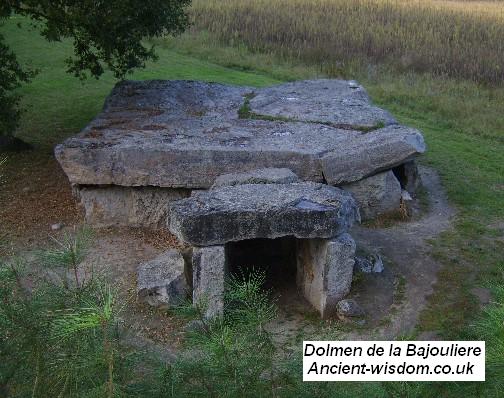 25a) Bajouliere dolmen, Near Samur, France. 25a) Bajouliere dolmen, Near Samur, France.
The beautifully carved cap-stone on this
dolmen is now broken into four pieces. It is the largest capstone
in France, and in terms of physical size, is most significantly
larger than the Brown's Hill capstone (below), although the estimate on
its weight is the same.
This dolmen is one of
the great Loire dolmens, several of which were built with stones
ranging between 50 and 100 tons each.
(More about Bajouliere and the Loire Dolmens) |
|
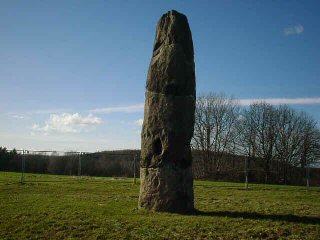 25b 25b )
The Gollenstein (Goldenstein
and G�ldenstein),
Germany.
The Gollenstein of Blieskastel has a height of 7.6m and stands as the
second-largest menhir of Central Europe. The stone originates from Neolithic
time (around 3,000 BC). During the second world war the German army broke
the good old menhir into four pieces so that the French could not use it as
a reference point. After the war, it was repaired and erected again.
(15)
It is
estimated to weigh around 100 tons.
(More about Prehistoric
Germany) |
|
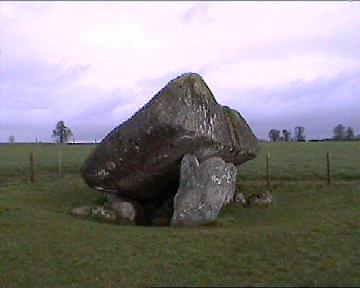 25c)
Browne's hill Dolmen, County Carlow, Ireland. 25c)
Browne's hill Dolmen, County Carlow, Ireland.
'The capstone is
estimated to weigh around 100 tons'.
(10)
(Blue Guide - Ireland, p. 148). - 100 tons.
This partially collapsed dolmen is said to have:'...the largest capstone
in Europe.' (15), but it must be noted that while the capstone on the
Bajouliere
dolmen (above) is estimated at the same weight, it is considerably larger in
size.
(More about the Browne's
Hill dolmen)
|
|
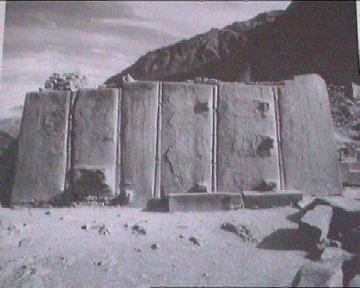 25d)
Ollantaytambo, S. America - 25d)
Ollantaytambo, S. America -
Altitude 10,000 ft. (Largest Stones estimated
at 100 tons)
6.5
x 2.7 x 2.1m = 37 m3 = 92 tons.
Ref: (J.-P. Protzen; Inca Stonemasonry; Sci. Amer. 254:2
(Feb 1986) 80 & 82).
A Pre-Inca fortress, with rock walls of
tightly fitted blocks weighing between 50 and 100 tons each. Most of the
blocks consist of a hard andesite, the quarries for which are situated on a
mountaintop seven miles distant. As well as the difficulties that must have
been experienced in dressing the stones, they had to be lowered down one
mountain, over (presumably), a river canyon with 1000 ft sheer rock walls,
then raised up the mountain the complex is situated on.
(9)
(More about Ollantaytambo)
|
|
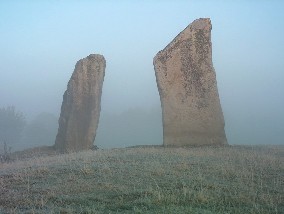 25e)
The Cove, Avebury, England. - 25e)
The Cove, Avebury, England. -
An attempt to straighten the two stones called 'The
Cove' in 2003,
revealed the fact that one of the stones, which stands 14ft (4.4m), above
the ground, also exists at least 7ft (2.2m) below the ground (reaching a
possible 10ft /3m deep).
The weight of this stone is calculated at around 100 tons.
Refs: Daily Telegraph News (8 April
2003); The Scotsman (17 April 2003), The Guardian (18 April 2003)
(More about
Avebury) |
|
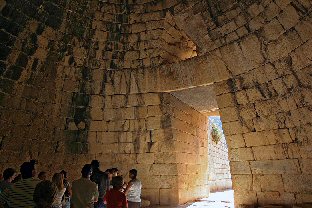 25f)
Mycenae, Greece - The Treasury of Atreus. 25f)
Mycenae, Greece - The Treasury of Atreus.
The largest stones including the lintels and gate jambs weighed well
over 20 tonnes some may have been close to 100 tonnes. (23
The famous 'Treasury of Atreus' was built on the site of an oracle
centre. It is noticeable that its shape is comparable to a 'negative omphalos' in design. �One or
the lintels over the entrance door measures 9 x 5 x 1.2m, with an
estimated weight of 120 tons.�
(More about
Mycenae)
|
|
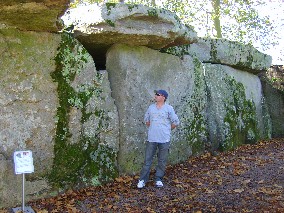 31).
The Bagneux Dolmen (Nr Saumur, France). 31).
The Bagneux Dolmen (Nr Saumur, France).
Although this is
frequently classified as a 'Dolmen', it is more of a stone chamber or
hall. Regardless of its classification, it is the largest covered
megalithic chamber in France.
This 'dolmen' has four capstones, each about 2ft thick with the largest
estimated 'very accurately by Vice-Admiral Boyle Summerville to weigh
just over 86 tons'. (10)
The same area of the Loire has
several similar 'dolmens' also made of gigantic slabs weighing between 50
and 100 tonnes apiece.
(More about Bagneux and the great
Loire dolmens)
|
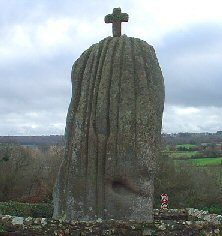 32). The
Menhir of Saint-Uzec, France: 32). The
Menhir of Saint-Uzec, France:
This heavily christianised
stone was erected around 4.000
BC. The process of re-shaping the top has resulted in the
stone losing some of its original height.
It is estimated to
weigh around 80 tons, measures 8,10 m high and 3,10 m wide. It is buried from 5 to 6 m in the ground.
The grooves on the 'rear' of the
menhir (visible in this picture) are reminiscent of the grooves
seen in the three immense 'Devils
arrow's' which stand near the
Thornborough henges in England.
(Click
here for other French Menhirs) |
|
 33). Ishibutai, Japan: 33). Ishibutai, Japan:
'A detailed study has been made of the
construction of the Japanese megalithic
tomb
of Ishibutai; which is by
no means the largest of Japanese megaliths, but is certainly one of
the largest
tombs.
Ishibutai has a rectangular chamber measuring
25ft by 11ft by 15ft high approached by a passage 38ft in length, and roofed
by two capstones each weighing between 60 and 70 tons each.
(10)
Modern estimates place the
largest stone at approximately 75 tons.
(More about Prehistoric Japan)
|
|
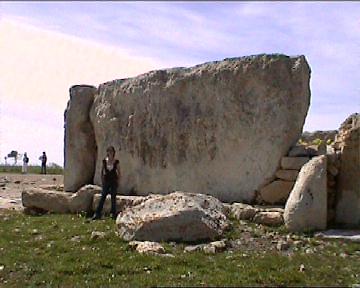 34).
Hagar-Qim (Malta).
(Jadjar-Kim) - 34).
Hagar-Qim (Malta).
(Jadjar-Kim) -
Which means cult-stones, or monument stones.
What may be the single largest stone on Malta is found in the Northern
wall of this temple; It is around 7m long, and is regularly estimated to weigh about
70 tons.
(8)
It lies at the Eastern end of Hagar Qim and measures 19 feet long by 9
feet tall by 2 feet thick. It weighs 57 tons. (Source: Insight Compact
Guide to Malta, APA Publications (HK) Ltd, 1995)
(The largest stone at Ggantija measures 5m x 8m x 0.5m = 20m�).
(More about
Hagar Qim)
|
|
35a). At Carrickglass, Sligo, Ireland: '..The chamber of the
dolmen is an accurate rectangle, and the portico is formed by adding
two side-slabs outside one of the end slabs, but still under the
cover. This last is a remarkable block of limestone weighing about
70 tons. This form of tomb is without doubt a link between the
simple dolmen and the corridor-tomb'.
(18)
35b). Howth, Dublin, Ireland: -
Partially collapsed dolmen or 'Portal-tomb'. The quartzite capstone
is estimated to weigh 70 tonnes. (ref:
www.irishmegaliths.org)
(More about
Prehistoric Ireland) |
Unconfirmed...
Mexico,
Quirigua: ��the largest Mayan stele, at Quirigua, measuring 10.7
x 1.5 x 1.27 meters, and weighing 65 tons.� �the site of Quirigua is
where the largest monolith in the Maya world stands. It is the Stella E,
weighing 65 tons and standing 35 feet high. It was quarried about three
miles away.�
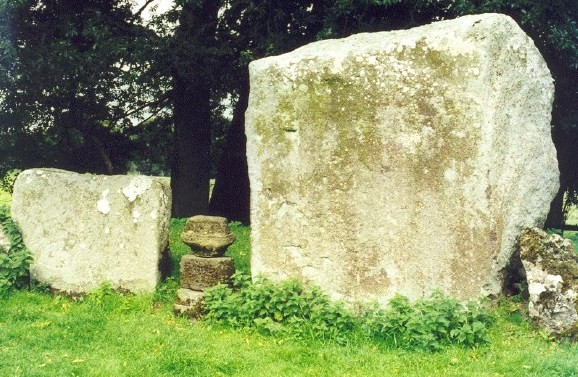 37).
Lough Gur: Lios na Grainsa, Grange, Limerick, Ireland - The largest
stone-circle in Ireland. 37).
Lough Gur: Lios na Grainsa, Grange, Limerick, Ireland - The largest
stone-circle in Ireland.
The largest stone of this late Neolithic
henge and stone circle is just N of the entrance to the henge, and is
known as Rannach Cruim Dubh (prominent black stopper or hunchback).
It weighs an
estimated 60 tons and aligns with the midsummer sunrise.
(More about 'The Lios') |
|
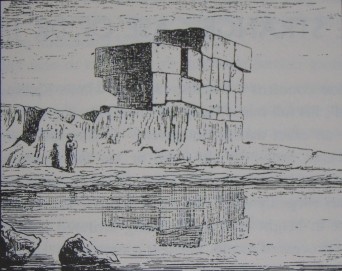 38)
The Wall of Aradus, (Now Ruad)
-
'...which formerly surrounded the whole island, and which served at once
for a defence against the enemy and against the waves It is composed of
quadrangular prisms nine feet three inches in height, and from thirteen
to sixteen feet long, sometimes without art and even with a sort of
negligence, the joints of the stones being in some cases exactly imposed
one over the other, sometimes, on the other hand, with an extreme care
and attention. The courses are at times regular, small blocks being used
to fill in the apertures, and a perfect junction of the parts being in
this way effected, but at times the arrangement of the blocks is without
any strict or rigorous order, with the exception that they are always
laid horizontally One observes no cement. The courses, which in some
places number five or six, rest upon a foundation of rock artificially
scarped...' 38)
The Wall of Aradus, (Now Ruad)
-
'...which formerly surrounded the whole island, and which served at once
for a defence against the enemy and against the waves It is composed of
quadrangular prisms nine feet three inches in height, and from thirteen
to sixteen feet long, sometimes without art and even with a sort of
negligence, the joints of the stones being in some cases exactly imposed
one over the other, sometimes, on the other hand, with an extreme care
and attention. The courses are at times regular, small blocks being used
to fill in the apertures, and a perfect junction of the parts being in
this way effected, but at times the arrangement of the blocks is without
any strict or rigorous order, with the exception that they are always
laid horizontally One observes no cement. The courses, which in some
places number five or six, rest upon a foundation of rock artificially
scarped...'
(1)
(Largest stones 13-16 ft x 9 ft 3 inches) (approx 5m x 3m = 15m�).
|
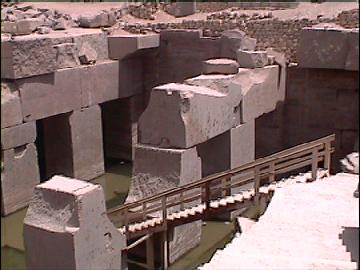 39)
The Osireion, Abydoss, Egypt. -
(Strabo's well). 39)
The Osireion, Abydoss, Egypt. -
(Strabo's well).
Each of the ten
pillars estimates at around 50 - 60 tons each.
The Royal graveyard at Abydoss is believed to date back
to pre-dynastic times, and the Osireion, over which the temple of Seti
I
was built, assuredly dates from an early time too. Lockyer calls Abydoss one
of the 'Holiest places in Egypt in the
very earliest of times' (2).
Abydoss has revealed itself to be one of the most important
archaeological sites in Egypt. It is the site of the pre-dynastic royal
graveyard, and of the Osireion, an enigmatic underground chamber
connected to the Nile and fashioned from enormous blocks. The style of
masonry has been compared to that seen at the Valley temple, Giza.
(More about the Osireion, Abydoss) |
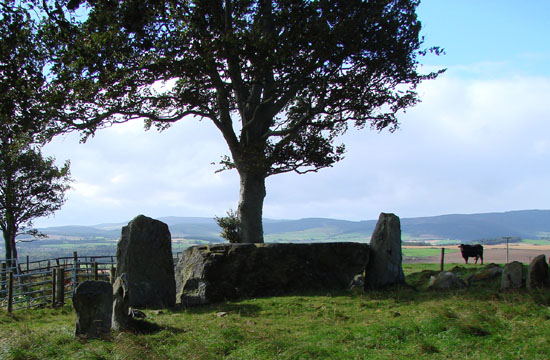 40a)
Old Keig, Scotland. (Recumbent stone circle) 40a)
Old Keig, Scotland. (Recumbent stone circle)
The recumbent stone at
Old Keig, Aberdeenshire, is the
largest in Scotland. It weighs in at approximately 53 tons (20). The
top surface of the stone is perfectly horizontal and
covers 27˚ of the horizon, enabling viewers to mark both the major
standstill of the midsummer full moon setting over the left-hand side
of the recumbent and the minor standstill of the midsummer full moon
over the right-hand side. In addition to this, the midwinter sun sets
over it as seen from the centre of the circle.
The stone was quarried from at least
ten miles away from the site.
(More about Recumbent stone circles) |
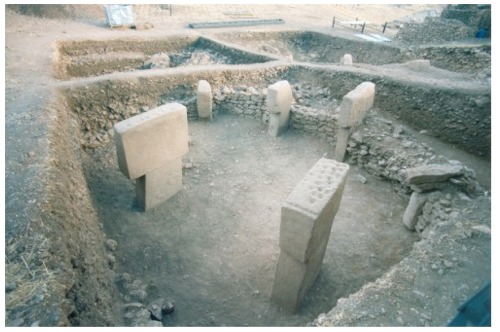 40b). Gobekli Tepe, Turkey. (Shrine/Temple) 40b). Gobekli Tepe, Turkey. (Shrine/Temple)
This site,
dated at 9,000 BC, is
currently considered to be the oldest shrine/temple/megalithic complex in
the world.
At Gobekli Tepe, 15 km northeast of the city
of Sanliurfa, stand four megalithic limestone pillars, 7m tall
and weighing around 50 tons each.
(More about Gobekli Tepi) |
|
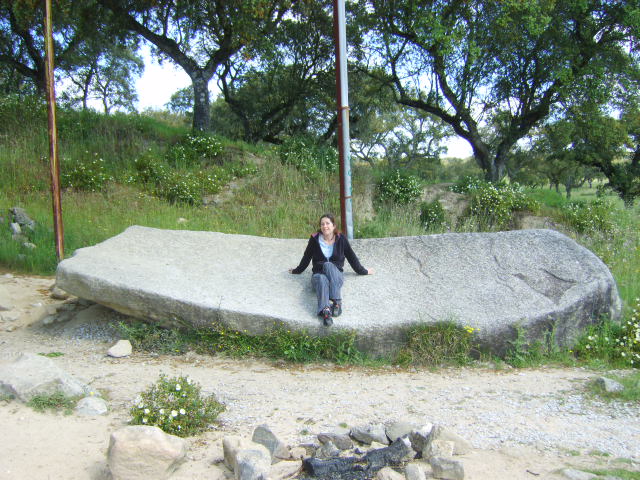 40c).
Anta Grande do Zambujeiro, Portugal. - The amazing Passage mound at
Zambujeira is composed of eight more super-sized stones, all larger than the
one in the photo (right), making the 6m high central chamber, one of the
largest in Europe. Giant stones lay around the site, which was all covered
once with a huge mound larger in size to those further north such as
Maes
Howe or Knowth. 40c).
Anta Grande do Zambujeiro, Portugal. - The amazing Passage mound at
Zambujeira is composed of eight more super-sized stones, all larger than the
one in the photo (right), making the 6m high central chamber, one of the
largest in Europe. Giant stones lay around the site, which was all covered
once with a huge mound larger in size to those further north such as
Maes
Howe or Knowth.
Measures 6m x 3.5m x 1/2m = 10.25m� = (Approx)
50 tonnes.
This site is one of the most
impressive in Portugal and is worth leaving the beaten track for a visit.
(Click here for more about Zambujeiro) |
|
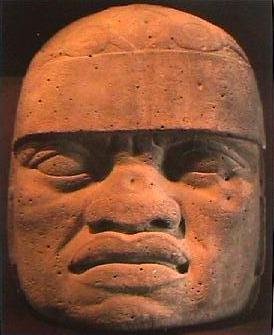 40d).
The 'African' heads: La Venta, South America. 40d).
The 'African' heads: La Venta, South America.
These colossal
heads found on the Mexican peninsula all face the Atlantic and share
the same Negroid features. They are dated between 800 BC- 680 BC
(21).
and are associated with the Olmec culture.
The largest head is
over 9ft high (3m), and was found in La Venta. It is estimated at
around 50 Tons
(23). It is described as
follows...
'...I'ts domed top
flattened so it could function as an altar. A speaking tube was
found going in at the ear and out at the mouth; it was used as an
oracle, a talking god. It was associated with the first construction
phase of the ceremonial court' in which it was found.'
(21)
(More about the
La Venta Stone Heads). |
|
40e).
Stonehenge , England. -
(Phase 3)
(From 2,100-1,700 BC).
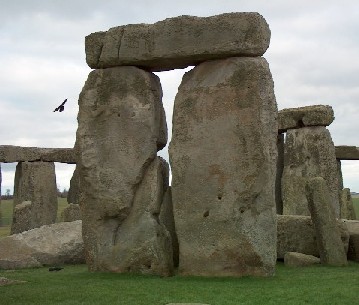 Double circle of bluestones taken down
and replaced with '81 or more' sarsen stones, weighing between 40 and 50 tons
each. Horse-shoe of five trilithon's erected in centre. These were quarried
from the Marlborough Downs about 20 miles north. (9). Double circle of bluestones taken down
and replaced with '81 or more' sarsen stones, weighing between 40 and 50 tons
each. Horse-shoe of five trilithon's erected in centre. These were quarried
from the Marlborough Downs about 20 miles north. (9).
'There is
strong evidence that they (the builders of Stonehenge III) were in
communication with the great contemporary Mediterranean civilisations of
Minoan Crete, Mycenaean Greece, Egypt, and the ancestors of the
travelling-trading Phoenicians....Atkinson inclines seriously towards this
theory, stressing the importance of the evidence of the dagger carvings and axe
carvings as well as Mediterranean artefacts found in the burials of
Stonehenge, and pointing out that Stonehenge is is unique not only in the
elegance of its construction but also the fact that it is the only stone
monument built by the Wessex people.'
(3)
(More about Stonehenge)
|
|
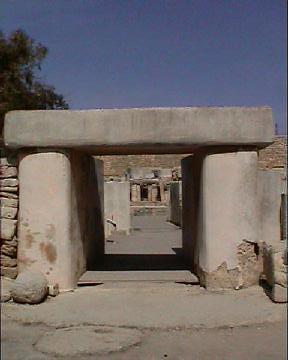 40f). Hal-Tarxien,
Malta. - 40f). Hal-Tarxien,
Malta. -
Three temples are dated to 3,000 B.C.
(12)
Location of the great 'Earth Mother' statue, which once stood at 2.4m
high. Blocks carved weighing up to 50 tons each. The temple complex at Hal-Tarxien contains examples of spirals, animal carvings, concrete, holed
stones and much more.
This temple is believed to be a 'partner
temple' to the nearby underground Hypogeum.
(More about Hal-Tarxien)
|
|
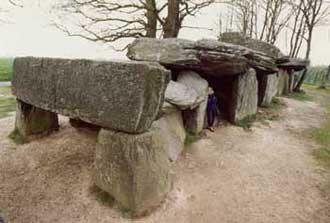 46). Roche
aux Fees. France. 46). Roche
aux Fees. France.
Originally covered by a tumulus Passage-mound), this construction
contains 42 huge stones, the heaviest
of which weighs 45 tons, which are now above ground level, giving it the
appearance of a great, multi-sectioned dolmen (Passage couvert). The
South/East facing entrance is orientated directly towards the winter
solstice sunrise.
Centuries ago, engaged couples would walk
around the stones during a new moon while counting the stones. If they
agreed upon the number of stones in the monument, their marriage would do
well, but if their numbers were more than two stones apart, the relationship
was doomed.
|
|
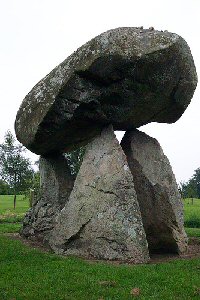 47).
Capstone of Proleek Dolmen, 'The Giant's load', near
Carlingford, Co. Louth, Ireland. 47).
Capstone of Proleek Dolmen, 'The Giant's load', near
Carlingford, Co. Louth, Ireland.
The huge capstone rests on only three
uprights. It is believed that this dolmen was aligned towards Slieve
Gullion, where on the summer solstice the sun sets behind the
mountain.
Ref: (MGG‑Ireland, p. 59). - Estimated weight 40
tons
It is
said that whoever manages to throw a stone onto the top so that it
stays there will have their wish come true.
(More about Prehistoric Ireland)
(More about Dolmen) |
|
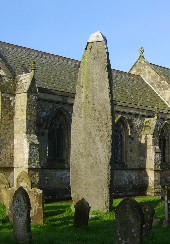 48)
Rudstone monument, England
- Estimated weight 40 tons. 48)
Rudstone monument, England
- Estimated weight 40 tons.
The tallest standing stone in
Britain, at just under 8 m in height, with a circumference of 5m.
The pointed top is protected with a metal cap. Dragged from Cayton
or Cornelian Bay 16 Km to the north, the stone weights an estimated
40 Tons. The stone was erected in approximately 1600 BC, and its
depth into the ground may be as much as its height! There is a
smaller gritstone in the nearby cemetery, along with a slab cyst
grave. An oft-quoted legend recounts how the Devil threw the stone
at the church and missed.
Plan of the surrounding area showing the site of surrounding
cursuses, shown up by air observation in 1962. Cursus A revealed
flints and pottery sherds suggesting a late Neolithic / Early Bronze
Age date, tallying with the period of greatest megalith building.
(More
about the Rudstone monument)
|
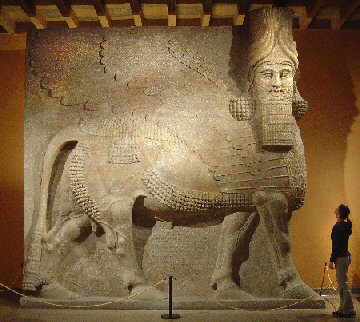 49). The Lamassu of Nimrud,
Iraq - The following is an extract from Wikipedia: 49). The Lamassu of Nimrud,
Iraq - The following is an extract from Wikipedia:
In
1847, after discovering more than half a dozen winged pair of
colossal statues of lions and bulls also known as lamassu weighing
up to 30 short tons (27 t) Henry Layard brought two of the colossi
weighing 10 short tons (9.1 t) each including one lion and one bull
to London. After 18 months and several near disasters he succeeded
in bringing them to a British museum. This involved loading them
onto a wheeled cart. They were lowered with a complex system of
pulleys and levers operated by dozens of men. The cart was towed by
300 men. He initially tried to hook the cart up to a team of buffalo
and have them haul it. However the buffalo refused to move. Then
they were loaded onto a barge which required 600 goatskins and
sheepskins to keep it afloat. After arriving in London a ramp was
built to haul them up the steps and into the museum on rollers.
Additional
30 short tons (27 t) colossi were transported to Paris from
Khorsabad by Paul Emile Botta in 1853. In 1928 Edward Chiera also
transported a 40 short tons (36 t) Colossus from
Khorsabad to Chicago.
(More about ancient Iraq)
|
|
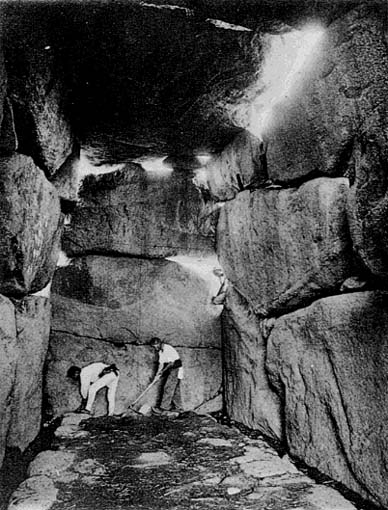
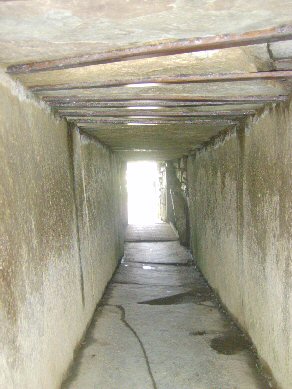 50).
Maes Howe, Orkneys, Scotland. The entrance passage to this
lovely passage mound is lined with huge slabs, the largest of which
is estimated to weigh over 30 tons. 50).
Maes Howe, Orkneys, Scotland. The entrance passage to this
lovely passage mound is lined with huge slabs, the largest of which
is estimated to weigh over 30 tons.
(29)
The
entrance to the Maes-Howe
passage-mound is orientated towards the setting winter solstice sun behind the
prominent Hills of Hoy in the distance. The chamber was placed so
that for several days before and after the winter solstice, the
sunlight flashes directly into the passage not once, but twice, with
a break of several minutes between each illumination.
The cruciform
chamber in the centre of the mound is vaulted by a corbelled roof,
and has three small sub-chambers leading from it. Each of these
chambers was sealed with a stone which only covered 2/3rds of the
opening, a feature seen at the entrance of the main passage of the
mound, where a blocking stone was fitted into a cavity in the wall,
which when closed (from inside), is small enough to allow a small
amount of sunlight to still pass over the top and into the chamber.
This particular astronomical feature is similar to 'light-boxes'
found in other passage mounds in Ireland and Wales (Newgrange,
Carrowkeel,
Bryn Celli Ddu). A similar
feature is believed to have been found on the Orkneys at the
recently destroyed/restored Crantit
Tomb.
(More
about Maes Howe) (More
about light-boxes) |
Extreme Prehistoric Masonry .
Prehistoric Construction
Techniques
Desecrated
Megaliths.
|
|

