|
Location: Aswan, Egypt. |
Grid Reference:
24�
04' 37" N. 32� 53' 43"E |
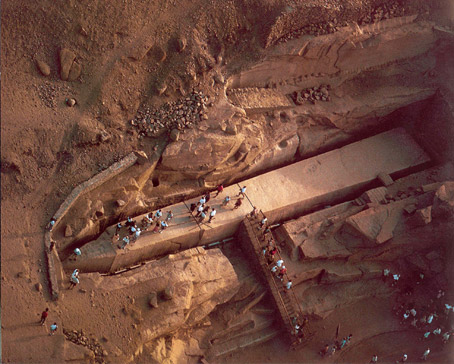
 The Unfinished Obelisk:
(Egyptian Obelisk).
The Unfinished Obelisk:
(Egyptian Obelisk).
This is disputably the largest stone ever quarried, and certainly on-par
with the unfinished stone at Ba'albek, Lebanon. This
obelisk would have been taller than
any ever raised.
Measures
120-feet (42m) and would have weighed over 1,168 tons when complete.
(Sci. Amer.
Dec. 1977. No. 36). - Estimated
@ 1200 tons
'Would have weighed nearly 1,200 tons' -
(1)
One of the most famous stones left behind is the
'Unfinished' Obelisk,
taller than any known obelisk ever raised. Quarrymen apparently
abandoned the obelisk when fractures appeared in its sides. However, the
stone, still attached to bedrock, gives important clues to how the ancients
quarried granite. Much of the red granite used for ancient temples and
colossi came from quarries in the Aswan area (500 miles south of Cairo). The
Unfinished Obelisk still lies where a crack was discovered as it was being
hewn from the rock. Possibly intended as a companion to the Lateran Obelisk,
originally at
Karnak, now in Rome, it would have measured 120-feet and
weighed over 1150 tons when complete.
The obelisk's creators
began to carve it directly out of bedrock, but cracks appeared in the
granite and the project was abandoned. Originally it was thought that
the stone had an undetected flaw but it is also possible that the
quarrying process allowed the cracking to develop by releasing the
stress. The bottom side of the obelisk is still attached to the bedrock.
The unfinished obelisk offers unusual insights into ancient Egyptian
stone-working techniques, with marks from workers' tools still clearly
visible as well as ochre-coloured lines marking where they were working.(1)
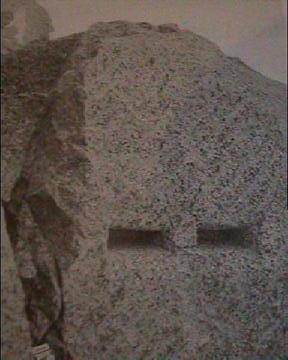
How was it done:
It is now known that the main tool employed for carving the granite were
small balls of Dolerite which is a mineral harder than granite, as seen
at the open air museum/quarry at Aswan, Egypt today. The discovery of
this obelisk and several others in their unfinished states allows us to
see how they were made. The means of separating the stone from the
bedrock was a common technique used around the ancient world, in which
small cavities were made in the stone, which were then filled with wood,
which was soaked in water causing it to expand (See photo, right. Aswan,
Egypt)
(Prehistoric
Construction Techniques)
(Other Egyptian Sites) |

