|
Location:
Beqaa Valley, Lebanon. |
Grid Reference:
34� 10' N, 36� 10' E |
 Ba'albek:
('Heliopolis', 'City of the Sun').
Ba'albek:
('Heliopolis', 'City of the Sun').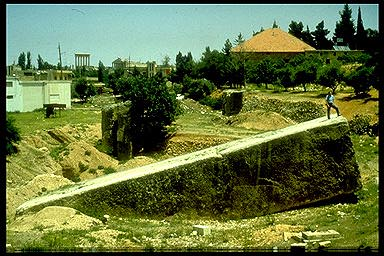
The
temple at Ba'albek is famous for its extraordinarily large foundation stones (The
largest in the world).
These stones also qualify as the largest cut-stones in the history of mankind.
There is no contemporary
testimony for the construction, which dates back at least to Phoenician times.
Quick Links:
.
Gallery of images.
The
Origin of the Name Ba'albek:
'The
first syllable 'Baal' corresponds to the Sun of the ancient Phoenicians. The Syriac
termination 'Bak' means town; the Phoenician ending 'Beka' means 'country'.
However, in a recently discovered Phoenician inscription, the word 'Beka'
has the meaning of town. In Egyptian, the word 'Bak' also means town'.
(1)
We
can conclude that the name Baalbek means
'The city/town of the Sun'.

The Beqqa valley sits at 1150m above sea
level and was recently occupied by armed forces (2004).
While Lebanon is mentioned in the bible for
its cedar-wood, it is perhaps curious that the Ba'albek temple was not also
mentioned. (except perhaps as Solomon's temple in Lebanon). The stones used for the construction of the temple platform at
Baalbek stand on record as the largest known quarried, cut-stones in prehistory
(Three of which are regularly estimated at 800 - 1,200 tons each).
The existing foundations of the temple were built over by the Greeks, who
dedicated it the temple to Jupiter.
Chronology:
The origins of the site and the first
builders are lost to us. However, it is often generally accepted that the foundations
of the temple were constructed by the Phoenicians (1),(2).
Weaver
(3), mentions the temple of Ba'albek and the Phoenicians in the same
passage:
" ... turn our thoughts to the temple of Solomon - to his own house, to
his house of the forest of Lebanon - the former of which, even the second
temple, we know from Josephus, was made of stones immensely large; and as to
the latter, the sacred historian tells us, that " the foundation was of
costly stones; even great stones; stones of ten cubits and stones of
eight cubits." And if we take into account that Huran, a Phoenician, and his
servants, who were Phoenicians, assisted in building Solomons temple..."
The
Main Temple
- (The Temple of
Jupiter)
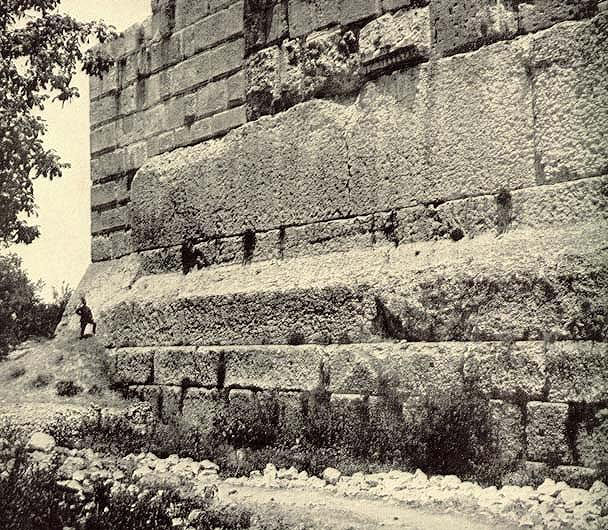
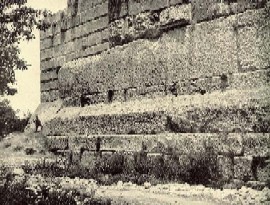
The photo (left) of the western wall of the 'Temple of
Jupiter', shows the layers of foundation stones which were brought to light when the
Arabs dug out moats around the edifice. The basement of the terrace is seen
to be supported by six immense stones measuring 33 ft long each and 14ft high (right
of the person in photo). These stones hold the weight of the three
giant stones (the so called Trilithon), which were intended to support the
last row, that should have been the higher edge of the terrace, but was never
built.
The
similarity between the 'cyclopean'
masonry in the foundations of the temple and the unfinished block (in the
quarry) suggests that the stone in the quarry (see below), was cut in the earliest stages of the temples
development.
The early date of the temple foundations
and the advanced skills of the masons reveals the presence of an unknown
page of history as the only two ancient cultures in the middle-east with
monoliths anywhere near this size were at Giza in Egypt and Jerusalem in
Israel.
We are offered a possible clue to the builders
through the following extract (from Miracle of Ages), which
adequately describes the now famous conversation between Herodotus
and Manetho:
'In the
course of his questioning he (Herodotus) encountered one
Manetho, an Egyptian High Priest, scholar and Historian, with
whom he conversed at length thru the agency of an interpreter.
Manetho informed his distinguished guest that the architect of
the huge mass of stone was one "Philition", or "Suphis", of a
people known as the "Hyksos", that is "Shepherd Kings".
According to Manetho, the Shepherd Kings were "a people of
ignoble race" who came from some unknown land in the
East; they were a nomadic band who numbered not less than
280,000 souls; they brought with them their families and all
mobile possessions, including vast flocks of sheep and herds of
cattle; and they "had the confidence to invade Egypt, and
subdued it without a battle". this same people, said Manetho,
overthrew the then-reigning Dynasty, stamped out idolatry and
endeavoured to firmly establish in the place thereof the worship
of the One true God having completed the Great pyramid, migrated
eastward into the land afterwards known as Judea and founded
there the city of Salem, which later became Jerusalem, the Holy
city.'
(6)
According to Estfan Doweihi, the Maronite
Patriarch of Lebanon: 'Tradition states that the fortress of
Baalbek... is the most ancient building in the world. Cain, the
son of Adam, built it in the year 133 of the creation, during a
fit of raving madness. He gave it the name of his son Enoch and
peopled it with giants who were punished for their iniquities by
the flood.'
(4)
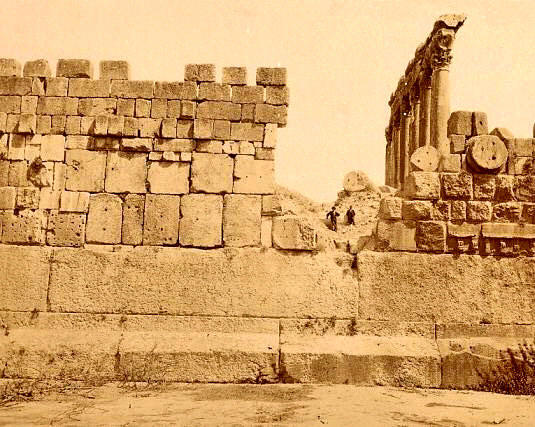
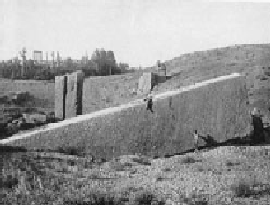
The photo above illustrates how the
three large stones (trilithon), rest upon six other smaller stones (each of
which has an estimated weight of around 400 tons).
Several other large stones are visible along the
(front-right) Northern wall...
|
Estimate for
the total weight of the nine stones in western wall.
3 x 800 tons = 2,400 tons
6 x 400 tons = 2,400 tons
Total for all 9
stones = 4,800 tons. |
Archaeoastronomy:
The temple is cardinally aligned and
opens to face the east, which Lockyer concluded to be a result of deliberate
orientation to the equinoctial sunrise
(2). This information conforms to the
fact that the temple was originally named 'The
city of the Sun' by the
Phoenicians in dedication to the sun-god Ba'al, and again later by the
Greeks, who dedicated the temple to Apollo (Their sun god), and called it
Heliopolis.
Alignments:
The proximity of the granite quarry to the
temple appears at first glance to explain the location of the temple,
however, other ancient sites such as Ghiza or
Stonehenge (etc, etc),
were located up to 500 Km distant from the nearest source of granite, and it
has been shown that the temple at Baalbek is aligned with other prominent
ancient sites, which opens the possibility that the
determination of the site may also have been realised according to geodetic principles.
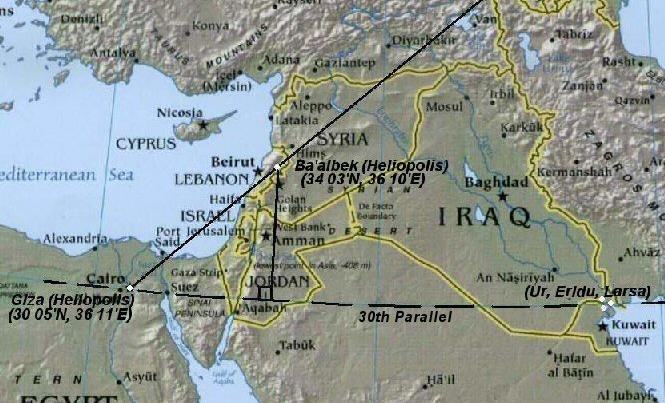
The temple was called 'Heliopolis' by the
Greeks. The Egyptian Heliopolis near Giza is located almost
exactly 5�
west and 4� south of
Ba'albek.
As well as being cardinally aligned and composed of immense blocks,
Ba'albek shares a geometric relationship with
Giza, Egypt.
As well as signifying the knowledge of a globe, (divided by 360�),
this very specific separation of both longitudes and latitudes between
the two sites has a secondary significance in that the
angle created is
(also
almost exactly)
51� 51',
which is the same angle as that of the exterior faces of the great pyramid
at Giza, a site invested with numerous geometric and astronomical
proportions.
The same 'geodetic fingerprint'
can be seen at other significant Egyptian Temple complexes like
Karnak (Thebes) and Giza, and appears to be related to the
positioning of sacred places in the middle east and Europe from a
geodetic centre-point at Giza (or perhaps at Heliopolis). Although
it is still in its infancy, the study of prehistoric geodesy is now
being recognised as a serious scientific study both then and now.
(More
about Egyptian Geodesy)
(Heliopolis, Egypt)
|
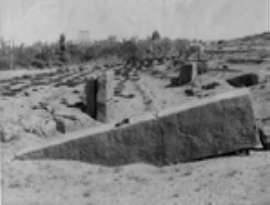
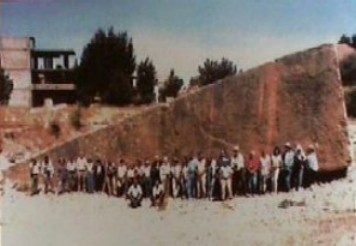
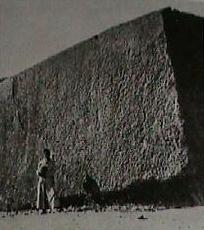
The Stone of the Pregnant Woman: |
Arguably, the largest cut-stone in the World.
(The stone of the South-Hadjar el
Gouble, The Stone of the Pregnant Woman-Hadjar el Hibla)
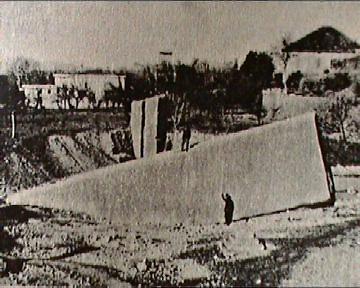 Dimensions
- There are several varying sources regarding the dimensions of this
stone. As such, they have all been compiled in the following chart. Dimensions
- There are several varying sources regarding the dimensions of this
stone. As such, they have all been compiled in the following chart.
69 ft long, 16 ft wide and
10 ft high = 11040 ft� or
20.9m x 4.8m x 3m = 300 m�.
Estimated weight - 1,500
(1) - 2,000 Tons (Fix).
The same is true of the three foundation blocks 'The trilithon', in
the nearby Baalbek temple, which have the following dimensions: The largest
is 65 feet in length, the second 64 ft 10 inches; and the third 63ft 2
inches. They are all 14 ft and 6 inches in height, and 12 feet in thickness.
Each block is therefore 350 cubic yards and they are estimated to weigh 750
- 1,000 tons each
(1).
How was the stone moved
- The ancient manipulation of such large stones
is still a largely debated phenomena. Common to other similar ancient construction feats, there are no records to testify the means
or date of this extraordinary achievement. However, the similarity to other
extremely early middle-eastern masonry achievements, such as those seen at
Ghiza or
Abydoss, in Egypt and the
foundations of the 'Temple of the mount' in
Jerusalem, have not gone un-noticed.
Likewise, there appears to be a connection in the type of stone used, which
was invariably quartzite (Red granite in the case of Baalbek).
In the past such achievements were
accredited to 'The hand of God', 'Giants' and more recently 'Alien life'.
However, we must be careful not to lose ourselves in disbelief. There is no
doubt that these stones were moved, and as with most such unexplainable
events, there is likely to be a rational answer if we look for it. For
example, the
Colossi of Memnon,
in Egypt are both estimated to weigh 1000 tons each, and their movement is
clearly depicted in hieroglyphs.
(More
about Moving Large Stones)
Why was the stone moved
- Just as important as understanding how they were moved, is the question of
why such immense stones were moved. (Any increase in advantage gained by
using large stones is balanced against the increased difficulties of moving
them). In Egypt, for example, we can see numerous 85-ton stones that were
moved over 500 km to their resting places in and around the great pyramid.
The foundation stones for the Ba'albek temple were moved
uphill to their resting place.
The proximity of the quarry to the temple
is close enough that it could be argued that the stones did not need
to be moved, at least in terms of laying a foundation, as it would have been
more effective to build the temple directly into the bedrock. This raises
the question, why bother at all?
While large stones are clearly
structurally advantageous to a temple foundation, the extra-ordinary size of
these suggest that another factor may have been involved in this choice of
design.
The idea that the temple was solar
reasonably justifies the moving of the stones uphill, as placing the temple
on top of the hill enabled it to capture the rays of the sun at the
appropriate times of the year (the equinoxes). The choice of such large
stones however, as with many ancient structures, might be better explained
through the idea of a form of worship of the stone itself.
Thanks to Mr
Daher for this photo-update (2008) and for the link to an
interesting article about the self-appointed guardian of the stone,
a certain Abul Nabi al-Afi, who has devoted himself to
the maintenance and upkeep of the site. His efforts are an
inspiration.

(Read
the Article: Ba'albek - The Daily Star. April 12, 2001)
(The Top-50 Megaliths of All Time)
|
Ba'albek: A gallery of Images. |
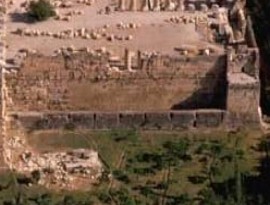
The
Ba'albek temple complex from above.
 |
 |
|
| The
western wall (left, right), the northern wall (centre) |
 |
|
 |
|
The stone of the South-Hadjar el
Gouble. Also called.... |
 |
 |
|
|
...The Stone of the Pregnant Woman-Hadjar el Hibla |
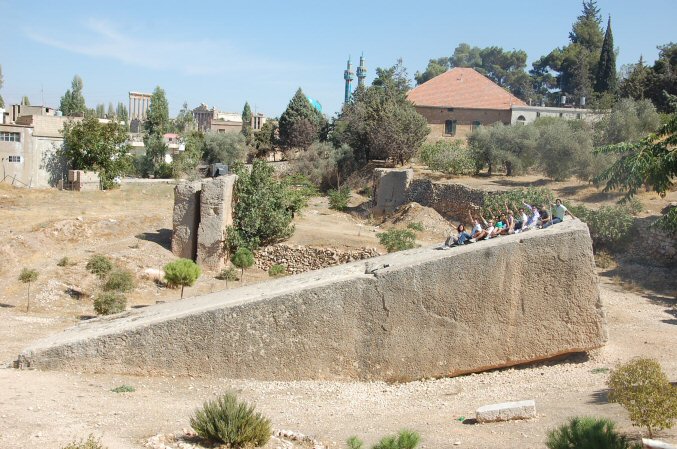
Photo Credits K. Daher 2008.
(Extreme
Masonry)
(Menhirs
and Obelisks)
(The
Top-50 Megaliths of All Time)
(Prehistoric
Construction Techniques)
(Additional
Information about Baalbek at SacredSites.com)
|

