|
 Spirals:
(Form and Function)
Spirals:
(Form and Function)
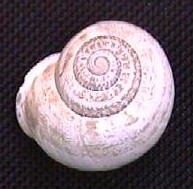
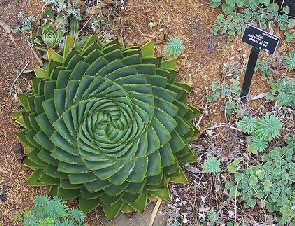
Spirals are a common natural form, appearing at all levels of nature. They
are the natural product of Phi (Ф), which is also called the 'Golden Section' or
the 'Golden Mean'.
Service and Bradbery
(2), write that the spiral refers to:
'...the belly and navel
(Neumann 1955). It is also seen as representing a
Navel of the
earth - the Omphalos...E.A.S Butterworth in
'The Tree at
the Navel of the Earth' calls it the Omphalos sign...now seen as very
ancient and very widespread (Roscher 1913), This fits well into the idea
of megalith as places of interchange between the cosmic forces of the sky
and earth'.
(2)

|
European Megalithic Spiral Art: |
Prof. Alexander Thom
suggested that some of the European megalithic spirals had been carved with mathematic precision,
using a common unit of measurement associated to
the Megalithic Yard.
Irish Spirals.
The mound at Newgrange has been dated at about 3,200 BC (Burl). The
passageway has been shown to possess both a solar orientation, and a
secondary astronomic feature in its design called a 'light-box', of which
three others have so far been identified (One at
Carrowkeel, Ireland, one
at least on the
Orkney Islands, Scotland, and another other at
Bryn Celli Ddu in Wales). All of the 'light-boxes' have one thing in
common, which is that they were orientated to solar events.
(More
about Light-Boxes)
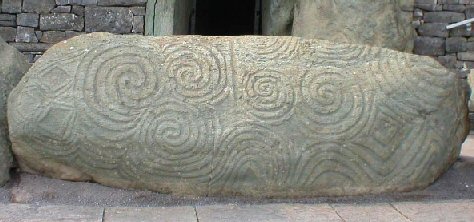
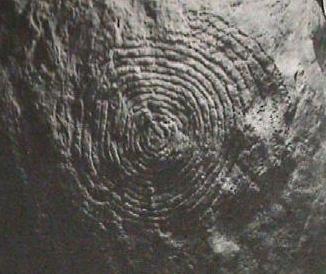
Front Kerbstone, Newgrange.
The spirals left of the central line rotate clockwise, whilst those on the right
rotate in the other direction.
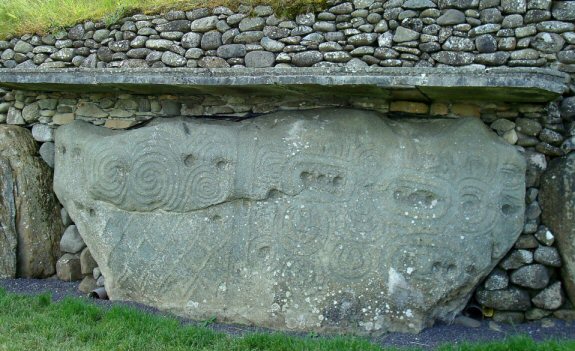
The kerb-stone at the rear of the
mound and diametrically opposite the front has a similar line
down the centre.
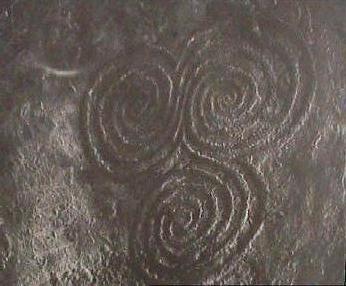
The spirals above are also from
Newgrange, in the
Boyne valley, Ireland.
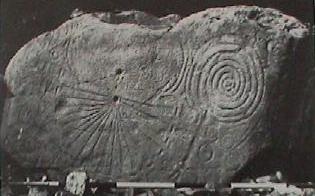
Kerb-stone from
Knowth, Ireland, also a part of the Boyne
Valley 'complex'.
Spirals are a common feature of Irish megalithic art. They
can be seen at numerous other Irish megaliths, although their exact meaning
(If there is such a thing), is far from being understood.
(More about Prehistoric Ireland)
Portuguese Spirals.
Being one of the earliest regions of megalithic
activity in Europe, it is interesting to find one of the largest spirals
in Europe here also.
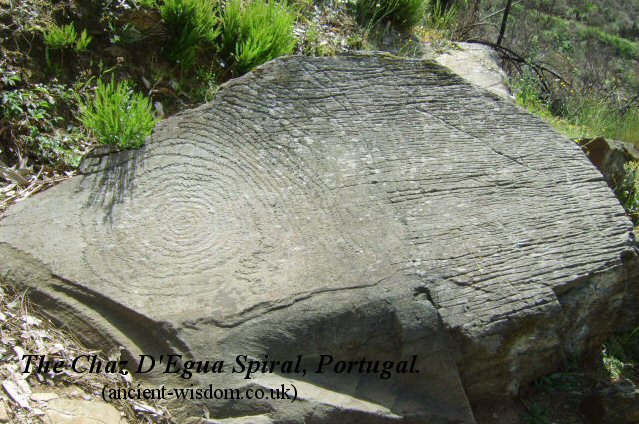
This recently discovered spiral-art (above), was found in the
region of
Piod�o
in Portugal.
The spiral is around 0.5m in diameter,
possibly making it the largest known carved spiral in Europe. Unlike
most spirals, this one sits alone on the side of a hill, with no obvious
orientation or apparent purpose. Several other spirals along with various
rock-art, stone phallus, cart-ruts and even signs of Christianisation make
it probable that this inhospitable valley system was an important
prehistoric site for a long time.
(More about Piodao
region of Portugal)
Also from Portugal, the stone circle at
Almendres
which is considered to be one of the oldest oldest stone circles in Europe
('4th to 5th
millennium B.C'
- Site plaque - 2007.), also has/had a spiral on one of it stones.
Maltese Spirals.
There are numerous
spiral motifs in Malta, but they are decorative, 'floral' spirals, unlike
the single examples found at many UK
stone
circles. Service and Bradbury (1), say that 'spiral patterns are
associated with the great goddess'. A statement that makes sense in
Malta., but nowhere else.
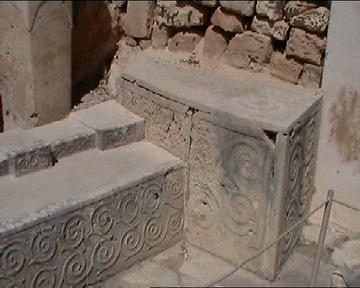
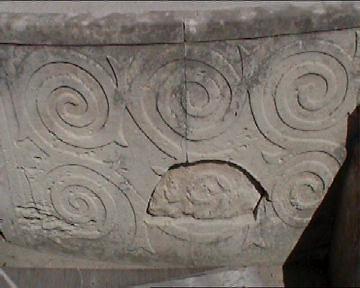
These 'floral-spirals' (above), come from the
Tarxien in Malta. They show a
strong similarity to Celtic and Norse motifs, but are dated far earlier at 3,000
-3,500 BC.
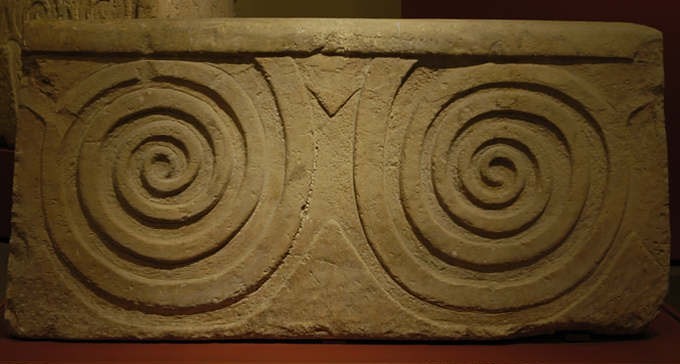
This spiral-art is from
Bugibba 'temple' on Malta is
indistinguishable
from others found in the Orkneys, Scotland as the following pictures
illustrate...
Scottish Spirals.
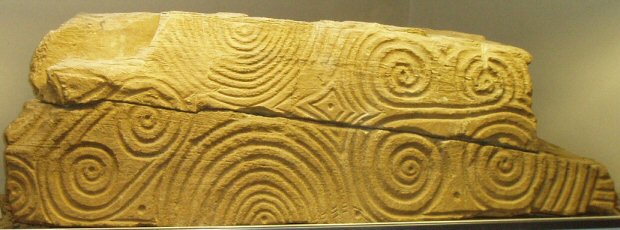
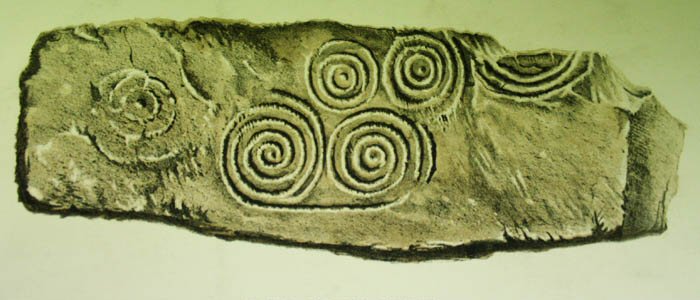
The 'Westray Stone', from Pierowall (left).
The Eday Manse stone,
Isle of Eday. (right).
(More
about the Orkneys)
Other European Spiral-art.
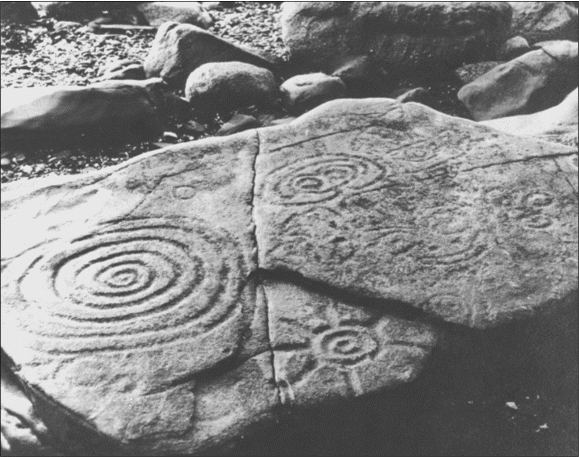
The Flat Rocks of Helluland I
(2)- with similar 'Solar-wheels' as those found in Ireland.
| The
Anasazi Spiral, New Mexico: |
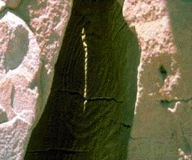 The most famous American "sun spiral" was discovered
by Anna Sofaer in 1977 near the entrance of Chaco Canyon at Fajada Butte. It
was engraved on the cliff face and then covered over with three large slabs
of stone, which were placed so that they combined to produce the now famous
'solar-dagger' of sunlight, which passes through the centre of the spiral
each summer-solstice. The most famous American "sun spiral" was discovered
by Anna Sofaer in 1977 near the entrance of Chaco Canyon at Fajada Butte. It
was engraved on the cliff face and then covered over with three large slabs
of stone, which were placed so that they combined to produce the now famous
'solar-dagger' of sunlight, which passes through the centre of the spiral
each summer-solstice.
Although commonly regarded as a 'sun'
symbol, it has also been demonstrated that the same symbol and arrangement
of stones could also be used for the lunar cycle. This offers the
tantalising suggestion that the Anasazi Indians were aware of calculate the
Metonic cycle.
Quote from J. Campbell (3):
�on the rock face behind the vertical slabs are engraved two spirals,
a larger of nine and a half turns and a smaller, to the left, of two
and a quarter. Toward noon on the day of the summer solstice, a dagger
of living light passes through the center of the larger spiral while,
in a related effect, a small spot of light, hardly noticeable, shines
for but two minutes somewhat to the left of the lesser spiral.�
�Through the following months of July, August, and September, these
two beams move steadily, day by day, to the right, until on the day of
the fall equinox, September 21, the leftward beam, now much longer
then the first, cuts through the center of the lesser spiral.
Thereafter, the rightward movement continues, and this second beam
ever lengthens. By noon on December 21, the day of the winter
solstice, the two darts, now of equal length, perfectly frame the
larger spiral, after which the movement, day by day, is from right to
left. At noon on march 21, the day of the spring equinox, the
positions of the light beams are exactly as they had been September
21, and by the summer solstice the cycle is completed.
�� the patterns formed by moonlight shining between the slabs are
as clear as hose of the day, and when the moon�s declination is
anywhere between the solar extremes of 23.5 degrees and minus 23.5
degrees, the patterns formed are the same as those of the sun.
However, in the course of a cycle of nineteen years [the Metonic
Cycle], the Moon�s declination for a part of that time, goes beyond
these solar limits. This periodic extreme was not reached again until
1987, when photographs taken on November 8th (the night the moon
attained the most northerly extreme of its nineteen-year excursion)
confirmed predictions� that the rising moon, shining on the vertical
slabs, casts a shadow which is tangent to the left edge of the spiral.
It has been noticed that the count of the lines of nine and a half
turns crossing any diameter is 9 + 10 = 19, and we know that once
every nineteen years there�s a full moon on winter solstice eve.�
(More
about the Chaco Canyon Sun-dagger)
(Archaeoastronomy)
(Sacred
Geometry)
(Labyrinths)
|

