|
 Prehistoric
Portugal:
Prehistoric
Portugal:
|
Portugal possesses some of the earliest and finest examples
of Neolithic structures in Europe.
Portugal has been continuously inhabited since at least the Mesolithic
times as demonstrated by the cave systems in Evora In addition to having the
earliest stone-circle in Europe, it is also home to
examples of 'Ogham' script, Spiral rock-art, Shell-middens and a range of megalithic
structures including
Stone circles, Dolmens, Passage mounds
and even
cart-ruts
(occasionally referred to as 'Strada's Real'). More recently, Portugal hosted the Templar's conversion
to the 'Order de Christo'.
|
|
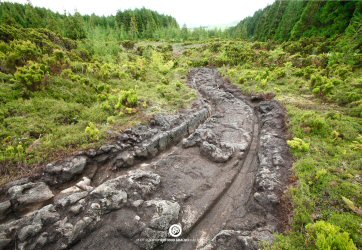 The
Azores: When were they first Populated: The
Azores: When were they first Populated:
The recent report by the President of the
APIA has opened the floodgates to the perception of prehistoric
activity on the islands. With archaeological discoveries having
been made on most of the nine islands including cart-ruts,
Hypogea and inscriptions, there is now no doubt
that they were occupied in the prehistoric past, the question
now is by whom?. Similarities to Greek and
Carthaginian remains are of particular interest as coins from
the same period had been rumoured to have been previously discovered on the island of Corvo.
(More
about the Azores) |
|
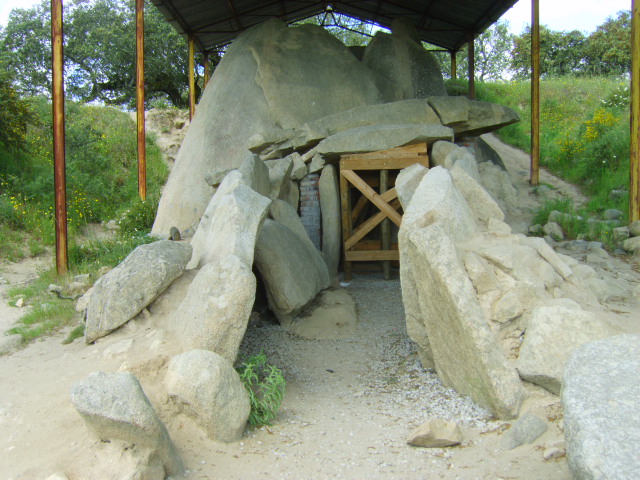 The 'Anta Grande do Zambujeiro' The 'Anta Grande do Zambujeiro'
Located near Evora in the Alentejo has the largest stones of any passage-mound in all of
Portugal, and possibly all of Europe. The stones extend over 7m above ground
and the whole construction was covered by with a mound on-par with
Maes-howe or the Irish passage-mounds at
the Boyne Valley. The style of the
structure is unique to central Portugal, although smaller versions can be found at
both
Commenda
da Igreja
and Anta do Tapadao.
Zambujeiro is one of Portugal's treasures and a must for all lovers
of megaliths.
(More about Zambujeiro)
|
|
Piodao/Chaz d'Egua.
.jpg) Spiral-rock-art
-
The photo (right), is from a rock in the region of
piod�o in the Bieras. The lines of the spiral continue
to form the shape of an animal (suggested as a horse), and then cut back and
forth across the face of the rock, ending/starting in a depression (possible
cup-mark). Spiral-rock-art
-
The photo (right), is from a rock in the region of
piod�o in the Bieras. The lines of the spiral continue
to form the shape of an animal (suggested as a horse), and then cut back and
forth across the face of the rock, ending/starting in a depression (possible
cup-mark).
(More about the Piodao
spiral)
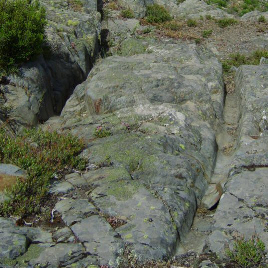
Cart-ruts - The
same region of Portugal has revealed itself to have several good examples of
cart-ruts running over the tops of the Serra d'estrella mountains. The ruts
are well-worn in places, and have several features that support an ancient
providence, although they are said to have been used up until the beginning
of the 20th
century
(More about the Portuguese
cart-ruts)
|
|
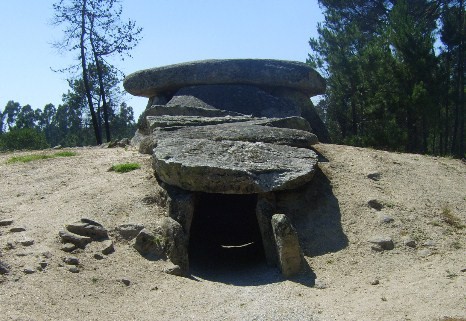 The Orca complex: The Orca complex:
The elevated granite bedrock of the Fiais region near Carregal do
Sal, offered the builders of the 'Orca' dolmens both a ready source
of building material, and a 360˚ view of the country extending
several miles in all directions, whilst remaining in close proximity
to the Mondego river. The several dolmens in this area have been
preserved and combine together to form the 'Curcuito Pre-historico
Fiais', a signposted journey through the forest tracks of Fiais.
Apart from the beautiful Orca dolmen, this circuit offers examples
of rock-art (arte-rupestre), several other smaller dolmens, and
various other traces from Neolithic life, all of which add to the
feel of the site.
(More about the 'Orca' complex) |
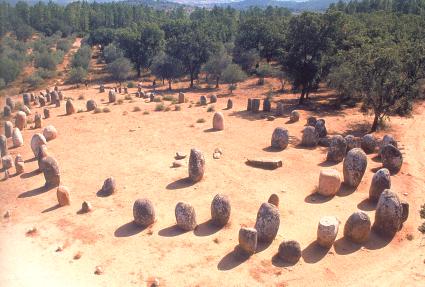 The Evora complex: (The
Mesopotamia of Iberia): The Evora complex: (The
Mesopotamia of Iberia):
The
countryside around Evora is rich with megaliths of all
kinds. This region of Portugal offers some of the biggest
and the best sites in Iberia.
There are only two latitudes
in which the Moon's maximum declination is the same as the latitude,
meaning that at its maximum elongation it goes through the zenith
(directly overhead). These two latitudes are
38 ˚
331 N (Almendres), and 51� 10' N
(Stonehenge).
Recent discoveries of
astronomical alignments between sites, support the idea that
the Evora was important in prehistory..
(More about the Evora Complex)
|
|
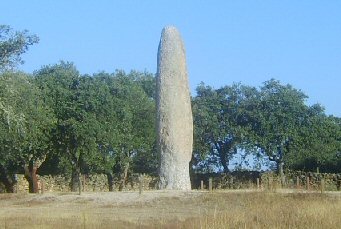 Menhir
de Meada: Menhir
de Meada:
This menhir, the largest in the Iberian Peninsula,
stands just over 7m high with a 1.25m girth and illustrates the
importance of the area in prehistoric times.
It was re-erected in 1995 by the Portuguese
heritage.
Apparently its height is due to the fact that
it belongs to a line of menhir's which were carefully arranged so that each
one was visible from the next (The Menhir of Meada stands in a lower
elevation than the others)
(2).
(More about Menhir da
Meada)
|
|
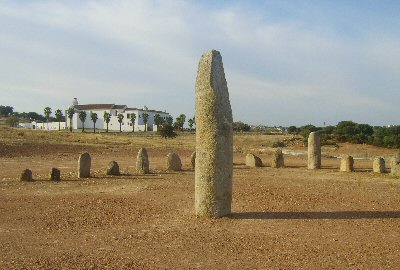 Monsaraz: Monsaraz:
The beautiful landscape surrounding
Monsaraz is home to several large Menhirs and the Xerez
stone-circle, which was moved onto higher ground following the
development of the Alqueva dam, which flooded much of the
surrounding landscape when it was constructed in 2002.
The circle was relocated around the already extant menhir
by the Convento de Orada. Although this has enabled us to enjoy the
presence of this ancient monument, it has lost its context in terms
of its relationship with the landscape into which it was originally
placed.
(More about Monsaraz) |
|
Portuguese Passage Mounds: |
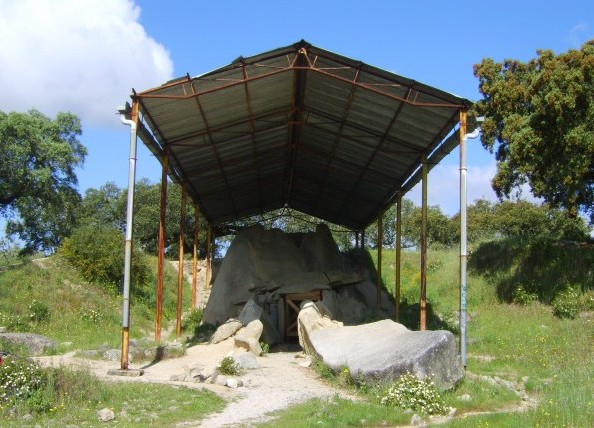
Although there are
numerous 'passage mounds' in Portugal, there is only one that
appears to have been completely covered, (Zambujeiro,
above), with most appearing to have been only 'half' covered in a
style unique to the Iberian peninsular. Apart from having one of the
largest mounds in Europe, Zambujeiro certainly has the largest
interior stones of
any passage mound in Europe.
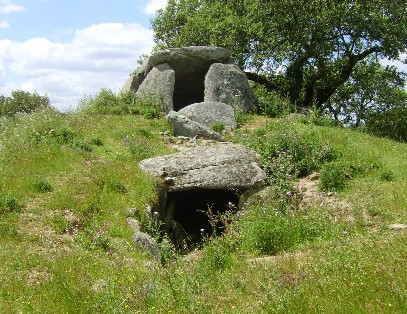
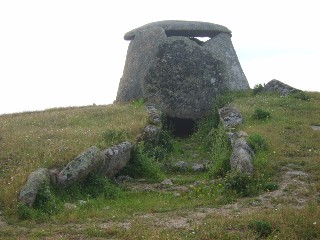
Cope
(1),
refers to these three passage mounds as 'dolmens', but
close examination proves them to be something different
altogether. While Zambureiro is clearly a passage mound, the
design at Tapadao and Igreja de Commenda (Above), appear to be a
hybrid of both Dolmen and Passage-mound, having the almost
identical internal structures, whilst apparently being built with
the top-half of the chambers exposed. This same essential design
is repeated across Portugal
In all of the
above structures (and common across Portugal), the chambers are composed of 7 large upright
stones, the one covering the front supported by the first stones
of the passage leaving it open and accessible. Also common to
many
Portuguese dolmen's or 'anta's is the destruction of the top half of one the right-hand
(eastern) upright, as seen below. This as-yet unexplained feature
was possibly the result of the 'de-paganisation' of
megaliths and can be seen at prominent sites such as
Orca,
Tapadao, Fonte Coberta,
Rio Torto, the Alle�
couverte at
Cunha Baixa and numerous others.
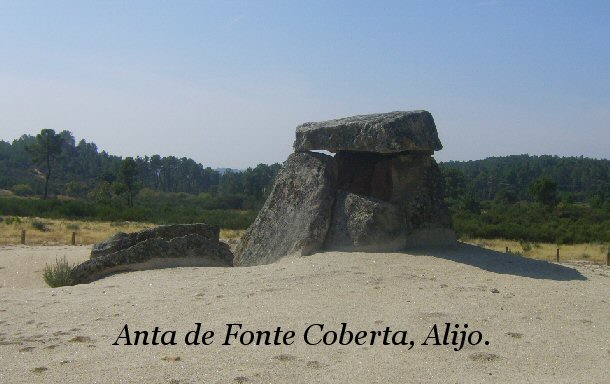
(More about passage-mounds)
|
Featured Prehistoric Portuguese Sites: |
(Full list of
Portuguese Megaliths) Northern Portugal - There are only
relatively few megalithic monuments compared with southern Portugal, but
those that remain show the same fingerprint as their southern counterparts.
There are several small-medium sized 'Anta's' with 7 uprights, covered
with a large capstones, generally flattened on the underside.
The Mondego river, Serra d'estrela -
(Northern-central).
The modern entrance to Spain from Northern-central Portugal appears to follow a
similar prehistoric route, judging from the high density of prehistoric
remains. One of several Neolithic concentrations in Portugal, sites are
dotted along the River Mondego which follows the Serra d'estrela mountain
range. Nearby this ancient and seemingly invisible route is the valley
region of Piodao, near which several important prehistoric discoveries have
been made such as the 'Orca' cluster. As well as having several impressive dolmens,
passage-mounds and cart-ruts, this area has
produced numerous prehistoric stone-carved Phallus' along riverbeds, over 50 examples of rock-art
including spirals, foot-prints, and various other symbols and motifs, is gradually
revealing itself to have been an important megalithic centre.
Castelo de Vide, Portalegre
- (Central East Portugal). This area is mountain range is surrounded by
numerous megaliths, including the Menhir de Meada, one of the largest
standing stones in all Iberia.
The Evora complex, Alentejo -
(Central). The
Alentejo region is rich with prehistoric remains. Apart from the numerous
dolmens, the area includes cave-art,
stone circles, dolmens and with over a dozen
megalithic sites, the Evora region alone is worth a visit. Sites include:
(Full list of
Portuguese Megaliths) |
|

