|
 The Evora Complex:
(The 'Iberian Mesopotamia')
The Evora Complex:
(The 'Iberian Mesopotamia')
The concentration of megaliths around Evora have given the region the
title of the 'Iberian Mesopotamia'. The area contains a diverse
selection of megaliths, and boasts cave-art (Arte Rupeste),
dating back to the Palaeolithic period in the Gruta do Escoural.
As well as having one
of the oldest and largest stone-circles in Europe (Almendres), and the passage-mound
with the largest stones in Europe (Zambujeiro),
the region around Evora includes some of the best examples of megaliths
in Portugal, if not all Iberia.
Evora has been continuously occupied for
the last
20,000 years (1),
with some of the sites showing signs of re-use (such as at Almendres). The
significance of Evora is evident through its continued use over such a
long period of time, proving it to be one of the most important
megalithic locations in Iberia.
As with many of the European
megalithic complexes, the location of Evora is astronomically
significant.
In the case of Evora, it can be seen
that it is located on one of only two latitudes in the world at which,
in some nights of the year, you get the full moon on the zenith. The
other latitude is 51� 10' N, the same as Stonehenge.
(Click
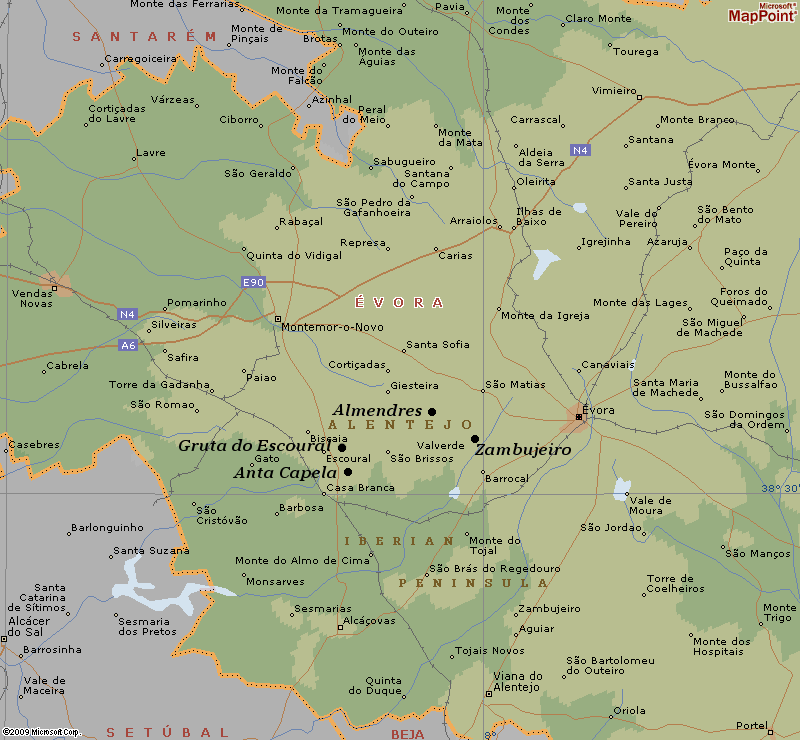
here for map of the area)
|
Featured Portuguese Locations: |
|
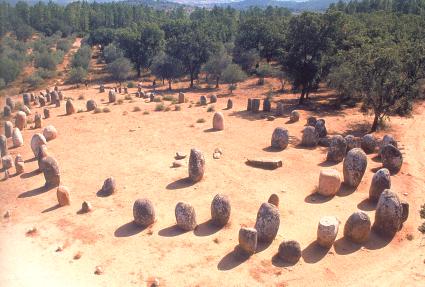 Almendres (Stone Circle
and Menhir) - The site of one of the oldest stone circles
in Europe. With 92 remaining stones and several astronomical
associations, it is also one of the most significant stone
circles in Europe and a
site of natural beauty and presence.
The Almendres stone circle
has been shown to have both Equinoctial and Solstice
orientations and alignments, involving the nearby Menhir dos
Almendres and other sites. It is dated from the 5th to the 4th
Millennium B.C. (Ref: Site Plaque), and still has
visible engravings and designs visible on some of the stones.
(More about Almendres) |
|
The
'Anta Grande do Zambujeiro':
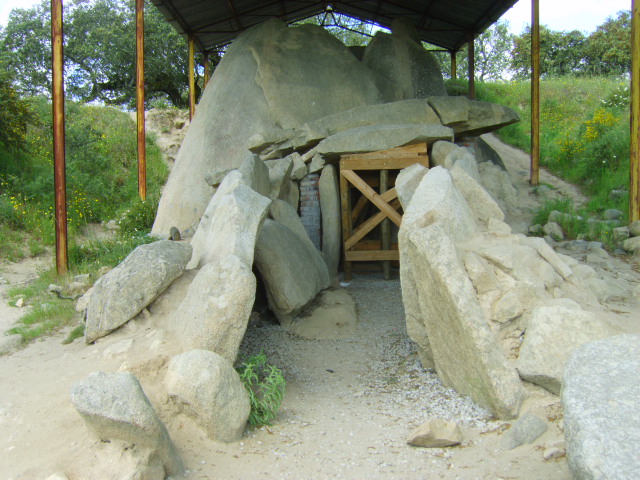 This
amazing passage mound rivals any in Europe. Although it has
been quarried heavily over the years, this has resulted in the
exposure of the inside structure, giving it the unique
appearance it has today. This
amazing passage mound rivals any in Europe. Although it has
been quarried heavily over the years, this has resulted in the
exposure of the inside structure, giving it the unique
appearance it has today.
The seven smoothed upright stones inside the Zambujeiro passage mound are the
largest in all Europe. The enormous cap-stone, now lies in pieces at the top and
has the appearance of either having been removed and broken, or having been
broken in the process of construction. Many of the artefacts discovered here are
now on view at the Museum of Evora.
The stones extend over 7m above ground
and the whole construction was covered by with a mound on-par with
Maes-howe or the Irish passage-mounds at
the Boyne Valley.
The style of the
structure is unique to Portugal, being the only true passage mound,
originally covering the whole of the internal stone structure.
Zambujeiro is one of Portugal's treasures and a must for all lovers
of megaliths.
(More about Zumbujeiro) |
|
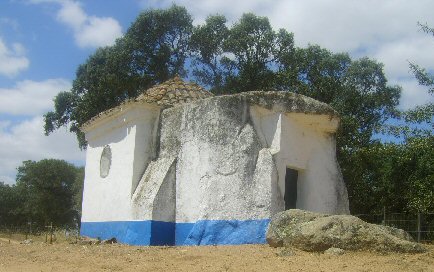 Anta Capela de Sao Brissos
- Constructed between the 3rd and 4th millenniums B.C.
This dolmen was converted in the XVII century into a chapel to
' Anta Capela de Sao Brissos
- Constructed between the 3rd and 4th millenniums B.C.
This dolmen was converted in the XVII century into a chapel to
' Nossa Senhora do Livramento' or 'Anta-Capela de
Nossa Senhora do Livramento'.
The paint job adds to the eccentricity of the
monument, and the Christianisation of this dolmen has
incidentally led to the protection of the site.
This is part of an alignment of significant sites
in the region. It was also a site of pilgrimage until recent times.
(More about the Anta
de Sao Brissos) |
|
Gruta do Escoural -
Re-discovered in 1963, the earliest date of occupation in this
natural cave system is at around 50,000 years ago in the
middle Palaeolithic. It was used repeatedly between 35,000 -
8,000 BC, and again in the Neolithic as a funerary chamber
(3).
There are
over 100 engravings and paintings in the caves from the
Palaeolithic period making it one of the most significant cave
systems in Portugal. There are two different types of images
in the caves;
some of a zoomorphic nature such as bovines and horses, and
the others abstract and geometric.
(More on the Gruta Do Escural Soon) |
The latitude is significant as it is only at this particular latitude
and one other (i.e. Stonehenge) at which the full moon can be seen on
the zenith at certain nights of the year. The specific location of two
of the largest Stone-circles in Europe at both of the latitudes where
this is possible suggests an element of deliberation on the part of
the builders.
Cromleque dos
Almendres: Apart from being orientated to mark the Equinoxes, a
line from the upper edge of the circle to the nearby Menhir dos
Almendres,
follows the same path as the winter solstice sun. It is also suggested that the number of stones in the
original circle (91) may have been used to measure the number of days
between solstices (182). (2)

Both the
Almendres
circle and the Zambujeiro passage-mound belong to an alignment of
sites which continues eastwards to the 'Cromeleque' da Xarez, around
50km away. The alignment is suggested to have a lunar significance,
corresponding to the azimuth of the spring full-moon (110�), which is
close enough to the equinox to have served as a marker (5). It is probably no
coincidence that the Anta Grande da Zambujeiro was orientated to face
the same direction.
(More about the Almendres-Xarez alignment)
| The
Evora Complex: Mound and Circle: |
One of the most basic components of many of
the European megalithic complexes is the presence of a prominent
mound, often suggested as symbolising the 'mound of creation', and
usually in the form of a passage mound, alongside a stone circle.
These two structures appear to be a basic component in several
European complexes.
While there are
regional variations on this theme, the two components can be seen to
appear together at several important sites, such as:
Avebury/Silbury, the Orkneys complex (Maes-Howe/Stennes), Gavr'inis/Er
Lannic in France and noticeably, Ggantija/Xagra, on Malta. At Evora, these requirements are met in the shape
of the Zambujeiro Passage mound and the
Almendres Stone
circle, both
the largest of their kind in Iberia.
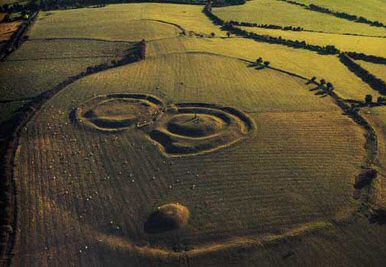
At
Tara Hill, in Ireland, the
Mound-Circle theme can be seen to share a strong similarity to the
shape of the 'cup and ring' marks found carved inside the monuments
themselves.
(European Prehistoric
Complexes) (Archaeoastronomy)
(List of Prehistoric Portuguese sites)
(Portugal Homepage)
|