|
 Prehistoric Drilling:
It was claimed by Petrie
that early dynastic Egyptians used drills for some of their
constructions. The following images suggest he was right.
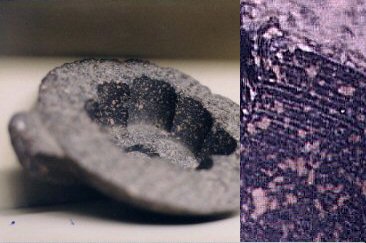
In 1996, this
tube-drilled piece of granite was on display in the Cairo Museum
without any associated identifying information. The photo clearly shows spiral grooves on the visible portions.
The grooves can be seen to be of regular depth and spacing, and
occur in all of the holes in this piece. These grooves seem to support Petrie's
conclusion of "jewelled points" set into bronze tube drills.
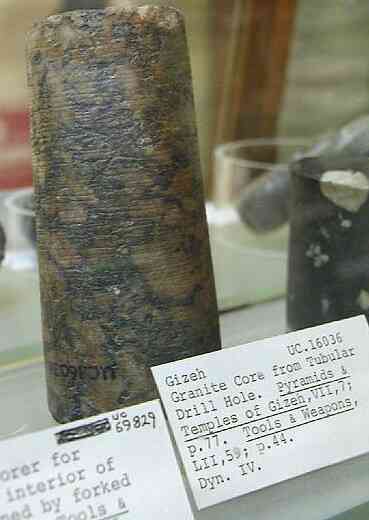
4th dynasty drill-marks (UC 16036), . Petrie
museum.
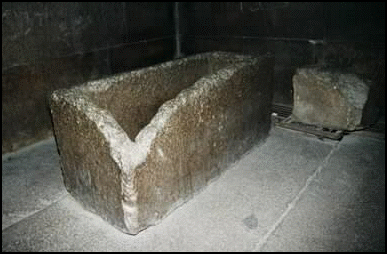
The ancient builders
used a tube drill to hollow out the sarcophagus in the King's
chamber of the Great Pyramid - they drilled off course and left a
tube drill mark on the top inside of the box on the east side.
Although the masons tried to disguise the marks, they can still be
seen today.
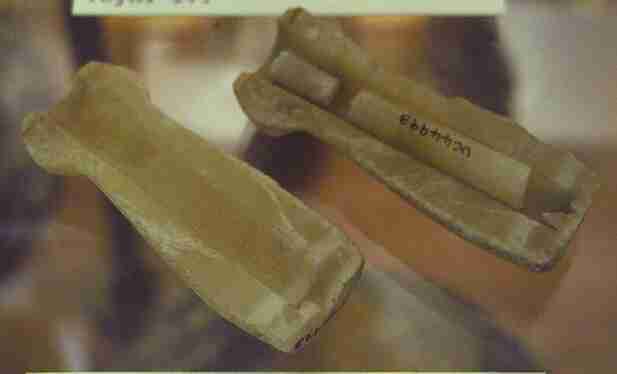
Unfinished travertine stone vessel
split longitudinally to reveal remaining drill core fragments
partially attached, possibly 4th Dynasty (height. 6.9 cm, The Petrie
Museum (UC44993), Photograph by Jon Bodsworth The Egypt Archive)
(Other Examples of Extreme Egyptian Masonry)
|
Prehistoric Surgical Drilling: |
Although not directly
connected with construction, evidence for drilling goes back
several thousand years, as testified by the numerous examples
of prehistoric dentistry and Trepanning, both involving
drilling procedures.
Article: MSNBC (2006) - Proving
prehistoric man�s ingenuity and ability to withstand and inflict
excruciating pain, researchers have found that dental drilling dates
back 9,000 years.
Primitive dentists
drilled nearly perfect holes into live but undoubtedly unhappy patients
between 5500 B.C. and 7000 B.C., an article in Thursday�s issue of the
journal Nature reports.
Researchers carbon-dated at least nine skulls with 11 drill holes found
in a Pakistan graveyard.
(Link to full article:
http://www.msnbc.msn.com/id/12168308/)
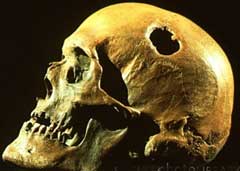 Trepanation:
Skulls with signs of trepanning were found practically in all
parts of the world where man has lived. Trepanning is probably
the oldest surgical operation known to man: evidence for it
goes back as far as in 40,000 year-old Cro-Magnon sites. The
Egyptians invented the circular trephine, made by a tube with
serrated borders, which cuts much easier by means of rotation,
and which was then extensively used in Greece and Rome, and
gave origin to the "crown" trephine, used in Europe from the
first to the 19th century. Trepanation:
Skulls with signs of trepanning were found practically in all
parts of the world where man has lived. Trepanning is probably
the oldest surgical operation known to man: evidence for it
goes back as far as in 40,000 year-old Cro-Magnon sites. The
Egyptians invented the circular trephine, made by a tube with
serrated borders, which cuts much easier by means of rotation,
and which was then extensively used in Greece and Rome, and
gave origin to the "crown" trephine, used in Europe from the
first to the 19th century.
(Link to full
article:
http://www.cerebromente.org.br/n02/historia/trepan.htm )
(More about Prehistoric Surgery)
| Other
Examples of Prehistoric Drilling: |
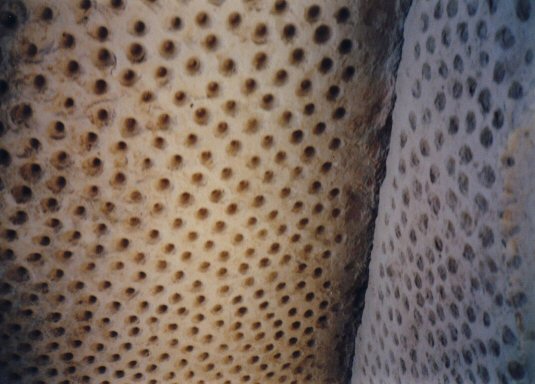
Hundreds of drilled holes on the stones at Mnajdra, Malta.
Les Pierres Plates,
Morbihan, France.
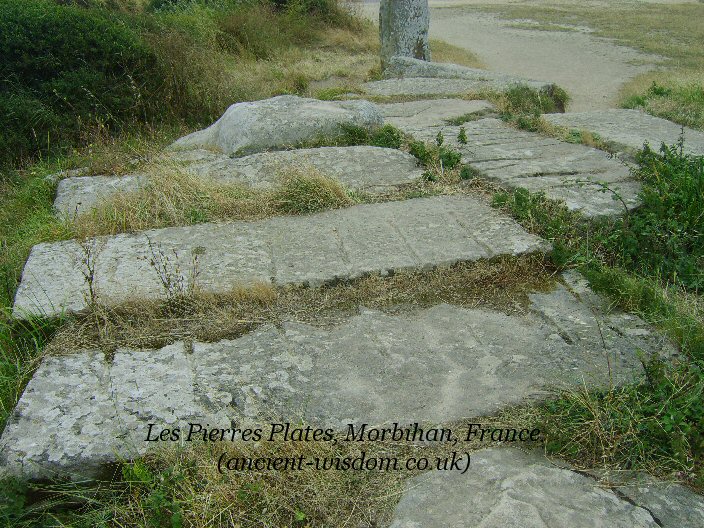
The Cap-stones of the Pierres Plates tumulus
have what appear to be drill-marks on the top-sides.
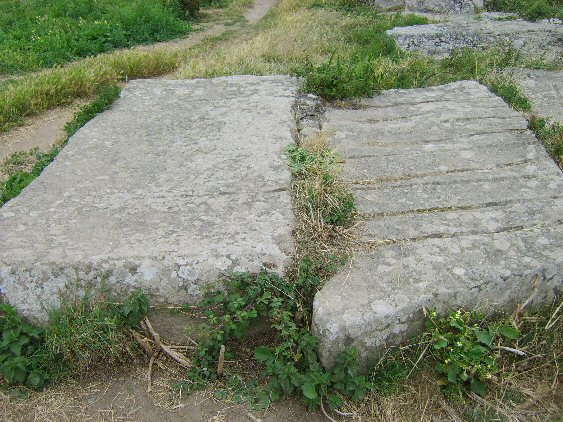
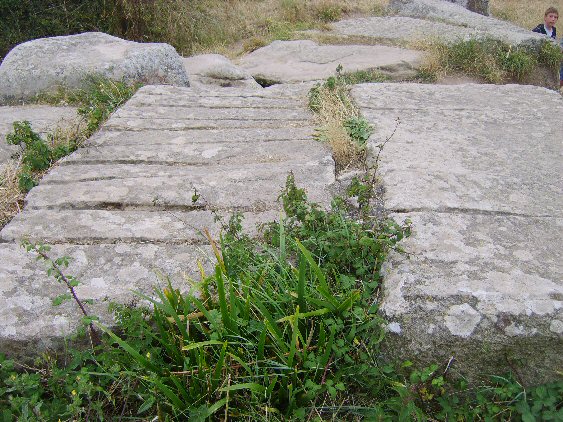
The 'Drill-marks' on some stones match those on
others, suggesting they were split in half.
(More about Pierres Plates, France)
It has been suggested that there is evidence of machining at
Puma-punka, as the following photo
demonstrates:
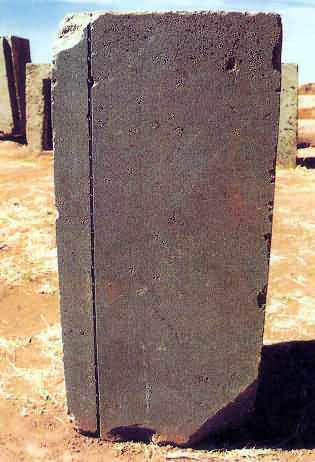
A close inspection of the stone
above reveals that there are regularly spaced drill marks along the length
of the
precision-cut 6mm groove
(Construction
Techniques) (Extreme Masonry)
|
|

