|
Location:
Marlborough,
England. |
Grid Reference:
51� 24' 30.78" N, 1� 51' 4" W.. |
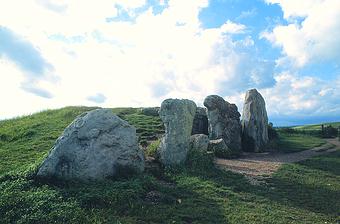
 West Kennet:
(Chambered Long Barrow).
West Kennet:
(Chambered Long Barrow).
The oldest and
longest
long-barrow in England.
The West-Kennet
long-barrow was an important part of the Avebury landscape as
determined by its location, or rather, by the location of other
nearby monuments in relation to it such as Silbury Hill which was
built so that each sat at the same heights when viewed from the
other.
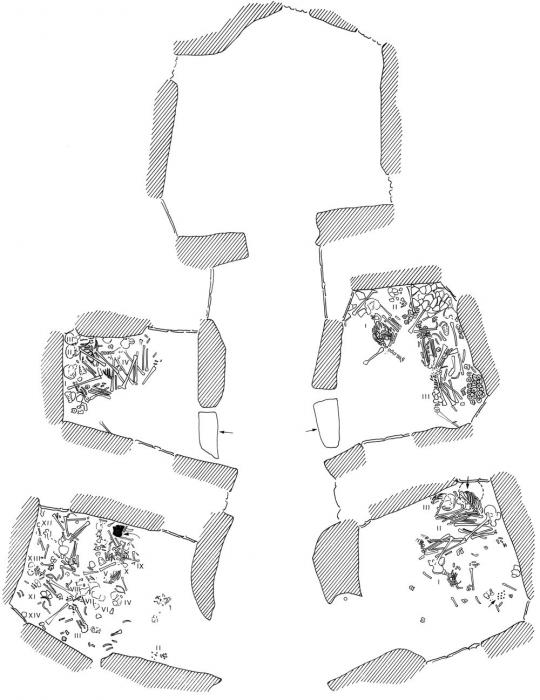
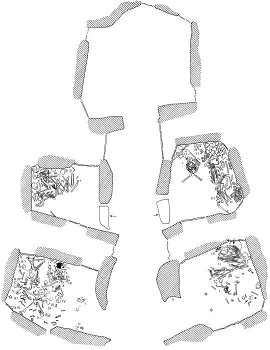
(Internal
plan of chambers and burials)
The
oldest and longest long-barrow in Britain. The mound is 350 ft long (100m) varies
in width from 75 ft at the east end and 50 ft at the west end,
where it terminates in a sepulchre approx 35 ft wide, 43 ft long
and 8 ft high. The entrance was blocked by several large sarsen
stones, one of which weighs 20 tons (9).
These stones were transported over 20 miles and were
repositioned in 1956.
This
impressive Neolithic tomb is situated on a prominent chalk ridge near
Silbury Hill and not far from
Avebury. The county of Wiltshire alone contains 148 out of
260 of Britain's long barrows, and this is one of Britains largest. In many parts of Europe this type of tomb
has been given giants' names, as a reminder of their size and presence and one of their puzzling aspects is that they are very long, for no
apparent reason.
(The chambers only occupy around 1/8th of the overall length of
the mound). Entering the tomb beyond the forecourt there are two burial
chambers either side and a larger polygonal one, 2.3m (7.5ft) high, at the
end of the passage.
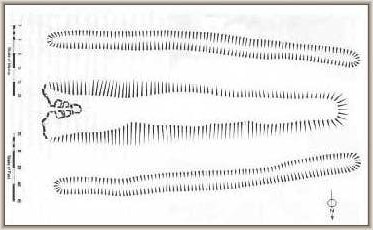
The tomb was covered over with soil taken
from either side (A similar technique was used at both
Adams-grave and Waylands Smithy)
The construction of West Kennet commenced about 3,650 BC
(1), which is some
400 years before the first stage of Stonehenge. It was used for
approximately 30 - 40 years and was then closed off,
(1)
although it was re-opened several times over the following
thousand years.
In the past the mound has
been damaged by indiscriminate digging, but scientific excavations in 1859
and 1955-56 found a total of 46 burials, ranging from babies to old
people. The latest excavations also revealed that the side chambers occur
inside an exact isosceles triangle, whose height is twice the length of
its base. It is thought that this tomb was in use for as long as 1,000
years and at the end of this period the passage and chamber were filled to
the roof by the Beaker people with earth and stones, among which were
found pieces of pottery, bone tools, and beads.
Archaeologists found traces of fires,
animal bones, pottery and beads just outside the entrance to the tomb.
(1)
The barrow has been dug into at
various times over the centuries notably by a Dr. Toope who,
during the late 17th Century, who used any bones he found as an
ingredient in potions and medicines. Because of these earlier
intrusions no acceptably accurate record of its original
contents can now be made.
Internal
Engravings and Markings:
There are several reported stones with faces on them (nine in one
report). In the south-west chamber is a megalith with three
cup-depressions near the top. It was in this chamber in 1955-56 that
Stuart Piggott found that three skulls had been arranged against the
south wall in a row: the skulls of a child, a young woman, and an
elderly woman, perhaps alluding to the three ages of woman.
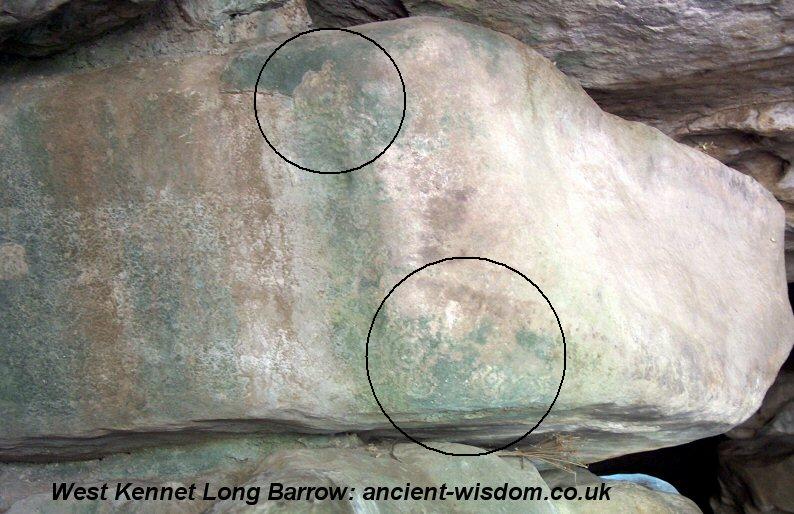
Concentric Circles on one of the
internal stones of the West Kennet Long-Barrow.
Alignments:
The length of the passage is reminiscent of other astronomically
orientated passages and it is
reasonable to speculate that the passage may have been originally designed
so as to receive sunlight on a particular day of the year.
The passage is aligned to true east. A local
legend tells how this tomb is visited on Midsummer Day by a ghostly
priest and a large white hound. Because the passage was blocked by large
sarsen stones, it is not possible to determine exactly how the light
would have entered the tomb.
The internal
arrangements of the tomb are reminiscent of the earth-mother
design of other Neolithic passage mounds and temples such as
those found on Malta and the
Orkneys.
(More
about the Earth-Mother)
West Kennet: Gallery of Images.
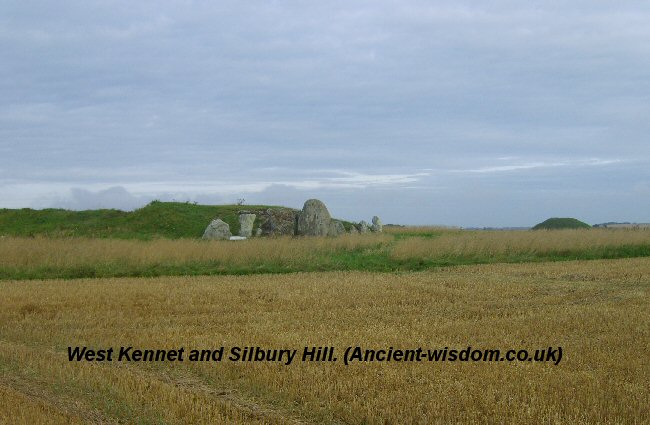
Silbury Hill was
built such that the top is at the same altitude as West-kennet.
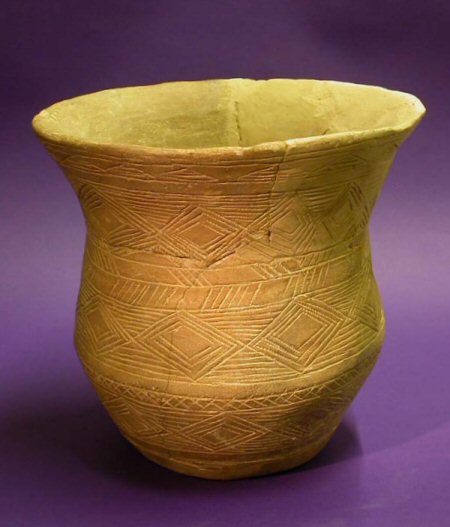
Complete Beaker
found in West Kennet.
(Avebury)
(Silbury
Hill)
(Other
Prehistoric English Sites)
|