|
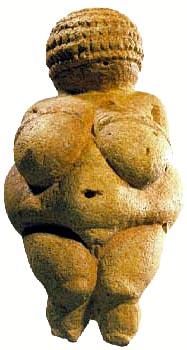
 Earth-Mother-Earth:
Archaeological
evidence from
around the prehistoric world suggests that the Earth may have once
been viewed/worshipped as a living, female being. Ancient texts and mythologies support the idea that the
primary goddess was intimately associated to the earth, fertility and
agriculture, as epitomised by Cybele, the Phrygian Earth mother,
who represented the fertile earth and was the Goddess of caverns, mountains
and all nature. The Greek Cybil's later became the female
oracles inspired to divination by the Gods.
The
worship of the Earth-mother was a common belief before the more
recent development of
the patriarchal society (c. 3,000 BC), coinciding with a shift in focus
from Lunar to Solar worship across Neolithic Europe. Traces of a
matriarchal society can be seen reaching back into the
Palaeolithic period through the numerous Venus
figures discovered in Europe.
The early mother-earth belief system
also had close connections to the beliefs in the afterlife, as seen in
the use of red-ochre in funerary rights.
Featured Articles:
|
Mythology of the Earth Mother: |
Many ancient cultures
worshipped female deities who match the modern conception of a
"mother goddess". The word 'Gaia' originates from ancient Greece,
in which it was considered the primary Greek Goddess personifying
the Earth. Gaia is a primordial and Chthonic deity in the Ancient Greek
pantheon and considered a mother Goddess or Great Goddess.
In Greek mythology, the myth of
Demeter and Persephone tells the story of a mother who discovers
that her daughter has been abducted by Hades, who drags Persephone
into the underworld with him. Demeter, goddess of the harvest,
whose name originally meant 'earth mother', wreaked revenge upon
the earth by refusing to provide any crops.
The Sumerians wrote many erotic poems about their mother goddess
Ninhursag:
(Sex, Love & Eroticism in Mesopotamian Literature,
G, Leick, Routledge, 2003).
In the Hindu
context, the worship of the Mother entity can be traced back to
early Vedic culture, and perhaps, even before that time. The
Rigveda calls the divine female power, Maimata (R.V. 1.164.33),
a term which literally means Mother Earth.
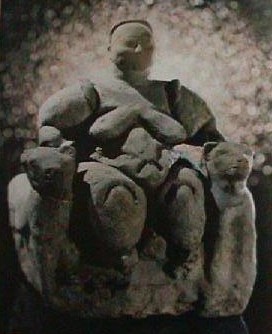
In
Anatolia, the Neolithic settlement from 7,500 BC,
Çatal-höyük,
has yielded many examples of worship of a mother goddess. Examples
found show that images of the goddess greatly exceeded the small
number of a male deity found in early associations and that the
male images eventually ceased to appear at all after a certain
time, as evidenced in the temporal stratification of the
excavations of the site.
(3)
To date eighteen levels have been
identified. These careful figurines were found primarily in areas Mellaart believed to be shrines. One, however – a stately goddess
seated on a throne flanked by two lionesses – was found in a grain
bin, which Mellaart suggests might have been a means of ensuring
the harvest or protecting the food supply. The image on the left
was found in excavations there and depicts a Mother Goddess seated
on a throne that is flanked by two lionesses. It is dated at c.
6000-5500 BC and resides in the Museum of Anatolian Civilizations
in Ankara.
(More about Chatal Huyuk)
Mother goddesses
are present in the earliest images discovered among the
archaeological finds in Ancient Egypt. Primarily the Supreme Egyptian
Goddess, Hathor, who is portrayed as a cow, a woman, and the
holder of the sky. It is interesting in relation to the finds at Chatal Huyuk that one figure of a deity, depicted standing between
two lionesses, exists among those on one of the earliest paintings
found among the Naqada Culture.
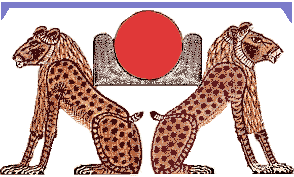
In Egyptian
mythology Aker was the double lion god, the guardian of the
sunrise and the sunset. Between the lions is the Akhet symbol
which represents the horizon on which the sun rises or sets. This
symbol is made up of a solar disk cradled between the two peaks of
the mountains Djew. The western peak was called Manu, while the
eastern peak was called Bakhu.
Following this line of
thought, the Female goddess above can be seen to represent the
earth itself.
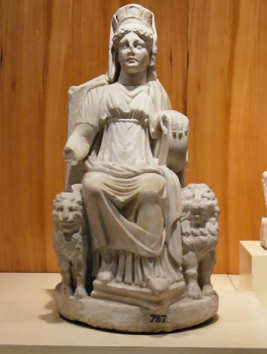
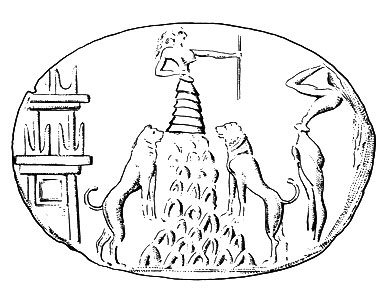
The European Prehistoric Earth Goddess 'Cybele' (left), (later Britannia), is also often depicted enthroned with lion/s
as is the Minoan mountain goddess (right).
(Note the similarity to Sumerian
Gilgamesh figure)
The Modern Gaia theory,
which was
revived by James Lovelock, approaches the
Earth as a super-organism with self-regulatory functions.
Malta -
'Home of the
Mother-Goddess'.
The large
number of female figurines discovered in
the prehistoric Maltese temples has led to suggestions that it
was once home to a 'matriarchal oracle-culture'.
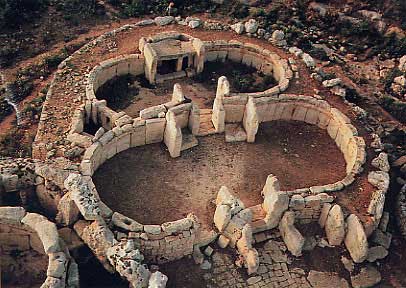
It has been suggested that the temples themselves may have been built in the shape of the mother-earth.
(More about Malta)
The same design
feature
has also been noted at Skara-Brae, on the
Orkneys where the interior outline
of one of the buildings bears a stark similarity to the human form
(5).
A similar but more primitive version on the same theme is said to be
seen at the Neolithic house at Gruting School, also on the Shetlands,
a pit-dwelling at New Barn Down, Sussex, and in the outline of the
moat surrounding Silbury-hill (as the
pregnant earth-mother) (5)
Marcel Gruale
recorded the following account in 1947, from a member of the Dogon
tribe from west Africa:
'The big central
room is the domain and the symbol of the woman; the storerooms each
side are her arms, and the communicating door her sexual parts. The
central room and the storerooms together represent the woman lying on
her back, with outstretched arms, the door open, and the woman ready
for intercourse. The room at the back which contains the hearth shows
the breathing of the woman' ... ' The Village should extend from north
to south like the body of a man lying on his back'
(5).
|
The Palaeolithic Venus
Figurines.
The worship of the female figure can be traced back to the Palaeolithic
period through the numerous Venus figurines which have been discovered
across Europe and Asia. Although there is no direct association, the
figurines display the same featureless face, exaggerated hips, breasts and
belly as seen in later images of the mother earth.
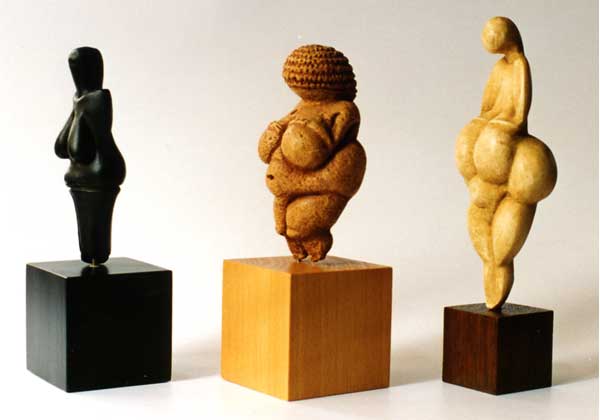
The fact that so many examples of this type of
female figure have been found over a broad geographical area
ranging from France to Siberia, suggests that some system of
shared understanding and perception of a particular type of woman
existed during the Palaeolithic.
It has been noticed that
while these figurines exhibit amplified sexual/reproductive
organs, they tend to lack limbs such as hands, feet or
faces. This has been suggested as being due to the figurines
representing the 'fertility' of women rather than a goddess.
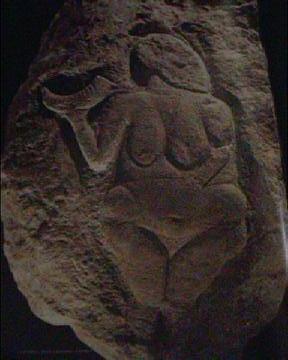
The 'Venus of Laussel' (left), is
suggested to include a lunar-count on the conch. It is also
suggested that because she has her hand on her belly, that the
lunar count is represented here in relation to the female cycle.
Images of women, mostly figurines of the same
type as the "Venus" of Willendorf (see top of page), all dating to the Palaeolithic
period, far out-number images of men. This has lead to speculation
about the place of women in Stone Age society.
Some have argued that these female figures
denote the existence during this period of a prominent female
deity identified usually as the Earth Mother or the Mother
Goddess. On the basis of this assumption, it has been suggested
that, unlike today, women played a considerably more important, if
not dominant role in Palaeolithic society.
(More about Venus
Figurines) |
Problems with the Earth-mother-goddess Theory.
Recent research has made it clear that our
belief in a primitive female Mother-earth-goddess cult is based more on
current perceptions than on actual facts. Apart from the fact that these
discoveries come from a time period stretching from the Upper Palaeolithic
c. 40,000 to Neolithic c. 5,000 years ago, the context of discovery is often
ignored, something which has supported the modern-myth of a prehistoric
Goddess figure. In addition:
The
discovery of a naked female figurine is not in itself proof of earth-mother
worship.
Spatial
and Temporal considerations: Most of the discoveries of female statuettes
can be broadly seperated into one of two categories: Discoveries from Eastern
European Upper Palaeolithic, and discoveries from the Western Mediterranean
Neolithic era. Apart from the huge diversity in style, form and composition, it
is no longer tenable to consolidate all prehistory into a single homogenous
image. The broad range of discovery across such vast distances in both time and
space make it probable that each discovery served its own unique purpose to its
individual maker.
Many of the prehistoric figurines are of
males, while others are sexless or have dual sexuality: Quantitative
analysis of Upper Palaeolithic imagery has shown that no single source can
affirm more than 50 percent of the imagery as being recognisably female.
(6)
Context of Discovery: Was the figure
found in a well, a rubbish dump, a building or a grave? Many of the Upper
Palaeolithic discoveries have been found without supporting contextual
information, such as associated stone tools, climatic information, associated
fauna or knowledge of the habits of the people it belonged to. Many statuettes
were discovered before such disciplines were considered important, and such
contextual information is lost to us.
The "lady of
Villers-Carbonnel"
Article: (Dec 10, 2011) The Independent:
Rare Earth Mother Figurine found on the Banks of The River Somme
.
Omphalus: (Navel stones).
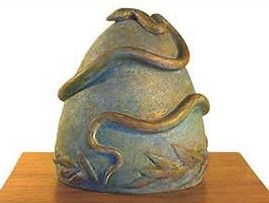
Omphalus stones
have been found at several sacred sites. (i.e. Delphi, Dodona and Thebes
(Egypt). Within these stones lies a symbolism which is almost lost to us
now.
Although not at
first apparent, the Omphalus stones from Thebes and
Delphi have several
features in common through which it is possible to see the fusion of
Egyptian and Greek iconography and mythology, and through them both, the thread of an older
set of ideas.
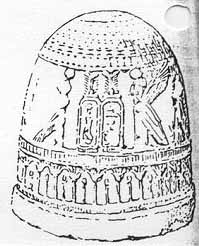 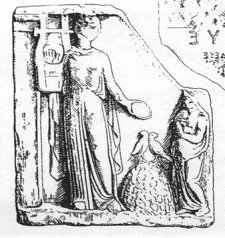
Thebes, Egypt
(left), Greek engraving of Delphi (Note: Apollo’s harp, Doves), (right).
Santillana
(4), offers several examples to support the association between
navel-stones and ‘the great flood’ by referring to their function as
‘plugs’; an idea typified by the following phrase “The opening of the
navel brings the deluge”. If one considers the myth of the 'Ark',
and the symbolic reference to doves notifying the end of the flood, then
one can see the Ark itself as a symbolic navel or 'plug', the Doves on both the omphalos above reflect
this suggestion
Service and
Bradbury
(2), state that 'Within concept of the Omphalus, there is also
implied an umbilical cord, an invisible link reaching from the depths of the
earth through the navel right up into the heavens' (Roscher 1913)
(2).
Earth-Navels.
Several Earth-navels are considered to have been
significantly situated.
Cuzco - Literally translated means 'Navel'. The capital of the Inca
empire was situated at Cuzco, high in the Andes. Tradition states that the
city was founded according to 'geomantic' principles.
Easter Island -
Was also called 'Te-Pito-O-Te Henua' Which translated means, 'The
Navel of the Earth'. Hancock suggested that its geographical location may
have determined the original settlement.
(1)
Jerusalem - As
the capital of the 'Holy land' Jerusalem is called an Earth Navel.
Delphi -
Contained an 'Omphalus', which
was believed to mark the centre of the world. It was supposed to have fallen
from heaven. The story is that Cronus, the god of time, was driven to the
depths of the universe by Zeus, who forced him to vomit the stone, which
landed in the centre of the Earth. The current Omphalos is a replica of the
original, made in the Hellenistic period.
(1)
Eridu
- Iraq. The
original Sumerian 'Mound of Creation'.
Angkor Wat - The 'Bayon'
in the network of temples at Angkor was described by B. Groslier as 'the
Omphalos in Angkor's stone cosmos'.
(1)
Karnak, Egypt - An
Omphalos was excavated in the sanctuary of the Great Temple of Amon at
Karnak, by G. A. Reisner. It supports the Greek traditions of doves flying
between Delphi and Karnak. (1)
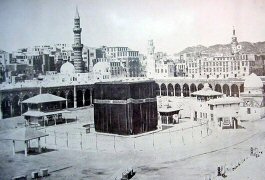
Mecca - The centre of Islam. The
location of the
Kabba,
and the 'black stone' which, according to Islamic tradition, fell
from heaven during the time of Adam and Eve. It is said that Abraham found
the black rock and when he rebuilt the Kaaba, Archangel Gabriel brought the
Stone out of hiding and gave it to him.
Allahabad, India - Formerly called Prayag, and
listed in the Mahabharata as the last and most important of 270
ancient holy places. Prayag was considered the mythical creation point of
the universe. The chief cult shrines at Prayag stood on an island with a
shrine to the primordial serpent who protected the eternal tree (seen by
Hsuan Tsang in 644). A goddess-shrine was recently found south of
Allahabad that dates to 11,000 BC, along with Mesolithic cave paintings of a
dancing shaman with horned head-dress, bangles and a trident, closely
resembling Shiva.
(3)
Allahabad is still the site of
the largest gathering of humanity on earth.
(More about Prehistoric India)
|
(The
Oracles)
(Divination)
(Gaia:
The Living Earth)
(More
about Earth Navels)
(More
about the Venus Figurines)
|
|

