|
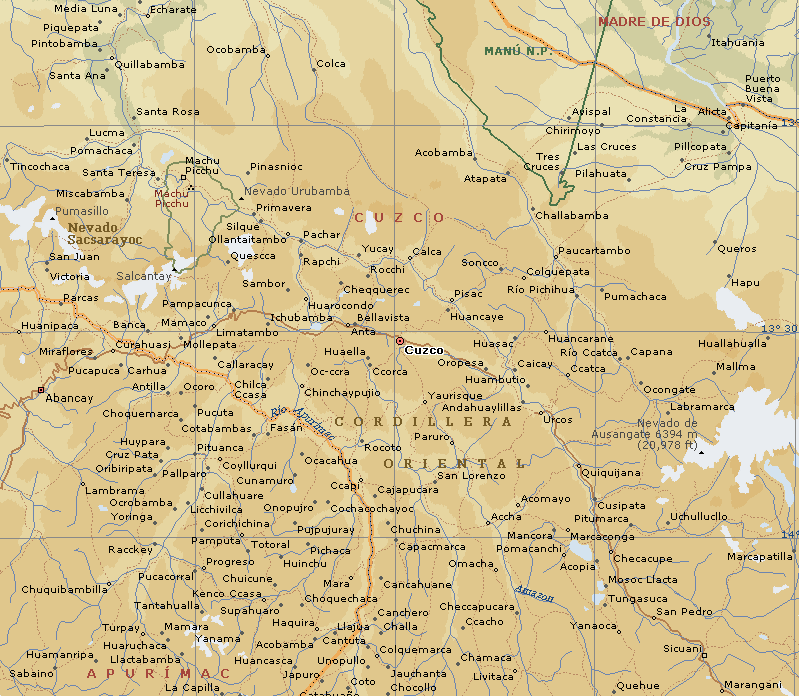
Location:
Urabamba Basin, Andes, Peru. |
Grid Reference:
13�
31' 30" S, 71� 58' 20" W. |
 Cuzco:
(Navel of the Earth, Inca Capital).
Cuzco:
(Navel of the Earth, Inca Capital).
Capital of the Inca civilisation.
Cuzco is the centre of a network of
spirit-paths (cerques), that radiate across the landscape. The son of the
ninth king, Inca Pachacuti (1438-1471 AD), initiated a road construction
program that ultimately developed over 6,000 miles of road, including one
road 3,000 miles long from Quito in Ecuador to Talca in Chile.
(2).
The oldest continuously inhabited city in south America.
(Click
here for location of Cuzco)
(Click
here for map of city)
Description - Cuzco means 'Navel' in Quechua, and was the 'earth
navel' of the Incas nations. Cuzco was occupied by the Inca from around
1,200-1,500 AD, although it was occupied before this time by the
Killke
culture from 900 - 1,200 AD. The city is overlooked from the north by the famous walled
fortress Sacsayhuaman.
The Cuzco Jaguar:
Cuzco is said to have been originally designed in the shape of a jaguar
(puma)
with the main plaza being the belly, the river Tullumayo forming its
spine,
the 'Sundial' as the Eye and Sacsayhuaman itselfas the head. This would make the Coricancha the genitalia.
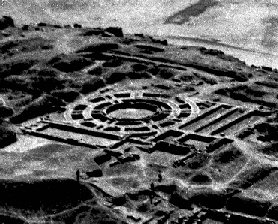
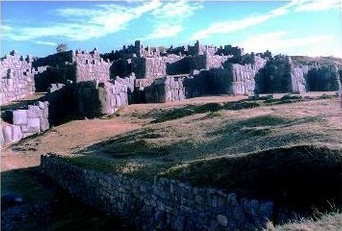
Left: The Cuzco 'sundial' (The Eye of
the Jaguar), Right: Sacsayuaman (The 'Head of the Jaguar').
(Click
here for map of Cuzco overlaid with Jaguar)
Although there are still
some remains and foundations of Inca buildings, most were lost following the
sacking by Pizarro in 1535. today there are only a few structures left to
see such as the palace of the Incas, the Temple of the Sun (Coricancha)
and the Temple of the Virgins of the Sun.
The excellent stonework, of perfectly carved Andesite blocks, along with other
construction features,
is noticeably reminiscent of Egyptian architecture. The granite Inca
walls have survived several earthquakes while other newer structures have
fallen, notably the Dominican Priory and Church of Santo Domingo, which were
built on top of the Temple of the Sun which ere badly damaged following an
earthquake in in 1950.
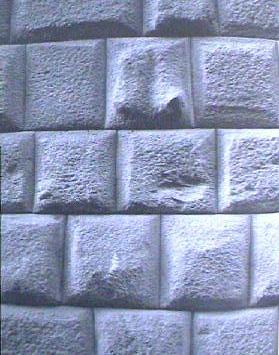
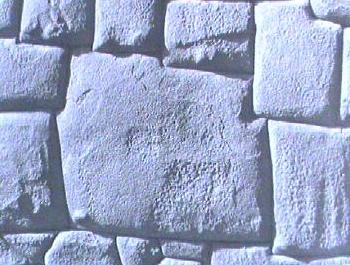
Examples of the
excellent masonry at Cuzco - (Right - The 'Stone of the 12 Angels')
(Prehistoric
Construction Techniques)
The Coricancha
(Qorikancha)
The Coricancha was
originally covered with plates of
gold, and its interior contained a series of temples dedicated to the sun,
moon, rainbow, stars, and thunder and lightning. Golden, bejewelled
objects were found throughout, and the Temple of the Moon was covered in
sheets of silver. The courtyard, or "golden garden" contained life-size
gold replicas of the animals and plants of the kingdom.
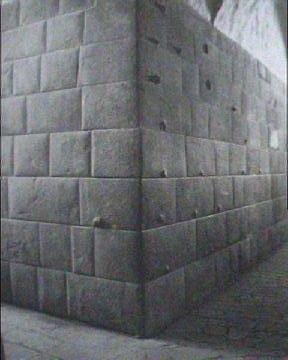
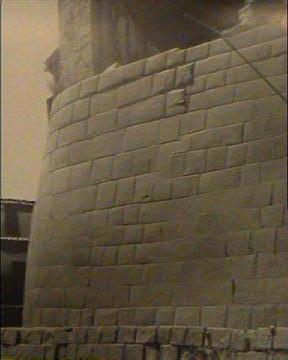
The superb Inca masonry of the Coricancha.
The Coricancha as 'Earth-Navel'
'The Coricancha was the
sighting centre for a remarkable system of radial organisation. Radiating
out from the Coricancha, 41 sight lines stretched to the horizon and
beyond. Along these lines or adjacent to them were built 328 'huacas'
or survey points, suggested by some as representing the number of
days in 12 sidereal lunar months. One third of these ceque points
comprised the major springs and water sources of the region'.
(4)
(More about
'Earth Navels')
Mythology of Cuzco:
The principle myth describes the founders of Cuzco as two 'children of the
Sun'. Manco Capac and
Mama Occlo Huaco, who were both brother and sister and husband and wife.
Sent by the Sun, the couple advanced from lake Titicaca with a golden
wedge, which was destined to sink into the earth without any effort at
their final place of residence, which was Cuzco.
(2). Prescott spoke
of the 'white' and 'bearded' men who came from lake Titicaca, and established
ascendancy over the local natives. Prescott made reference to the story of
Quetzalcoatl's appearance
in Mexico, who appears similar and had the same 'mission'.
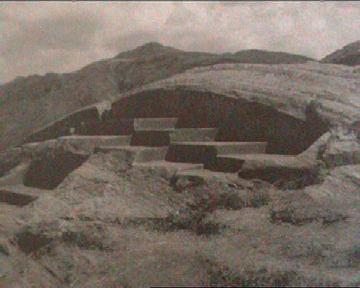
This structure, located
near Cuzco is called the 'Throne of the Inca'
|