|
 Archaeoastronomy: (Prehistoric
Astronomers)
Archaeoastronomy: (Prehistoric
Astronomers)
For a long time now
the scientific establishment has shown a resistance and even disregard to the idea of
astronomy having been practiced in prehistory. Thankfully, the question of
whether astronomy was practiced is now beyond debate, and the doors are open for us to discover the extent of this important
development in human awareness.
The earliest suggestion of an
astronomical record comes in the form of notched bones, a
finding which A. Marshak and others have interpreted as Palaeolithic lunar counts.
While this theory is by no means substantiated, there are several
ancient structures which have a clear astronomical nature in their
design and the high frequency of association between megaliths and
astronomy suggests an mutual relationship.
A Chronology of Ancient Astronomers:
The first suggestions of human
astronomical observations come from the Palaeolithic period.
Carved-engraved bone plates were the earliest objects which
attracted the attention of researchers. Alexander Marshack
(1972) interpreted several of the various Palaeolithic and Mesolithic,
mostly portable objects with engraved or painted series of
dots or lines as accurate lunar observations. His arguments were
based not only on counting the signs but on what he called
"microscopic analysis". The interpretation of the markings on
various artefacts as notational systems rests on the hypothesis
of a slow accumulation of these marks which correlate with lunar
or solar motion. Thus he concluded that these artefacts reflect
non-arithmetic observational astronomical skills and lore.
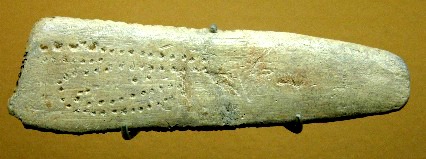
The most
well-known depiction interpreted by him is found on the bone
plate about 30,000 years old, from Abri Blanchard (Dordogne,
France) which is said to represent the waxing and waning moon
positions in serpentine form.
35,000 - 33,000 BC
- Decorated baboon fibula with 29 parallel incised notches from Kwazulu
border cave, Africa. (4)
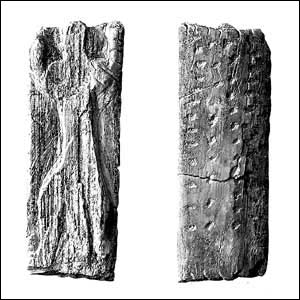 'The oldest image of
a star pattern, that of the famous constellation of Orion, has
been recognised on an ivory tablet some 32,500 years old'. 'The oldest image of
a star pattern, that of the famous constellation of Orion, has
been recognised on an ivory tablet some 32,500 years old'.
(BBC - Science/nature)
There are 86 notches on the tablet, a
number that has two special meanings.
First, it is the number of days that
must be subtracted from a year to equal
the average number of days of a human
gestation. This is no coincidence, says
Dr Rappenglueck. It is also the number
of days that one of Orion�s two
prominent stars, Betelguese, is visible.
To ancient man, this might have linked
human fertility with the gods in the
sky.
(More
about Orion Worship in Prehistory)
32,000
BC - Lunar notations
found on remains in W. Siberia. (Ref: Science CXLVI, Nov 6, 1964).
22,000 BC
- Artefacts to record the solar year and phases of the moon from Ma'alta,
Siberia. (4)
|
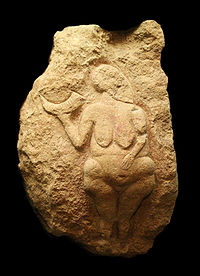 The
'Venus de Laussel', France. The
'Venus de Laussel', France.
The 25,000 year old 'fertility goddess /
mother-earth' figure from Laussel, near Eyzles in France, was
painted in red ochre and holds a crescent-conch shape with 13-lines on it.
It has
been suggested that the 13 lines on the conch refer to the 13 lunar/menstrual cycles each
solar year. The object is currently on display at the Bordeaux
Museum.
(More
about Venus Figurines)
|
The Lascaux Caves,
France;
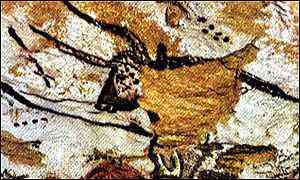 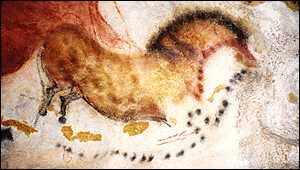
These two images from
Lascaux, France are suggested as
showing Pleiades (left), and a lunar count (right).
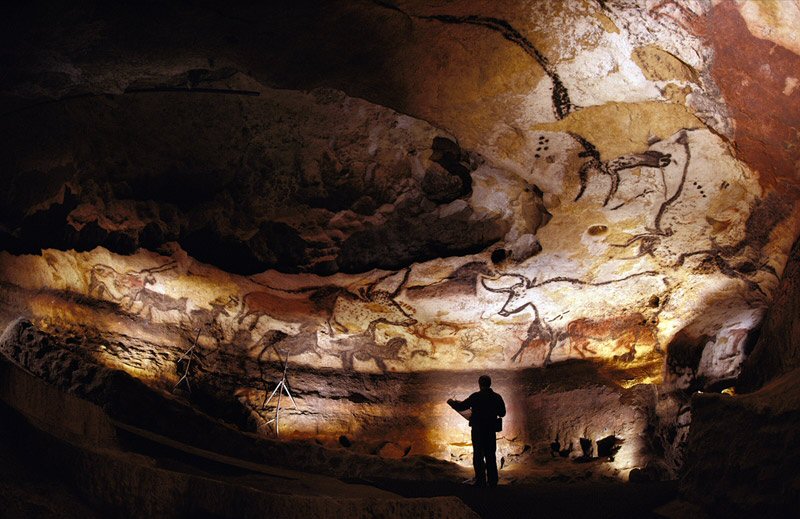
The 17,000 year old Lascaux Caves are now
realised to have had their original opening facing the setting summer solstice. The
sun has been observed to enter the chambers for one hour on this date.
A survey of several Palaeolithic caves nearby has demonstrated a
correlation between cave-art and caves with openings facing important
parts of the solar cycle.
(Bibliography
of Research Literature on Palaeolithic Notation)
(More
about Lascaux)
(Palaeolithic
Homepage)
9,000 -
8,000 BC - Bone plaque with lunar notations from Grotte Dutai,
W. France. (4)
8,000 BC - Earliest Lunar Calendar, Scotland.
'Excavations of a field at Crathes Castle
found a series of 12 pits which appear to mimic the
phases of the moon and track lunar months. The pit
alignment aligns on the Midwinter sunrise'.
(Link
to Full article)
|
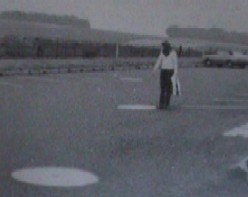 7,180 -
6,140 BC: Stonehenge, England. - C-14 dates for the 'car park' post holes 250m NW of
Stonehenge.
Each once contained a Pine trunk (1.5-2m Diameter),
which align to the positions of the sun and moon with 'extreme
accuracy'.
(5) The
existence of
these 'totem' trunks several thousand years before the stone circle suggests
a significance even at this early time and certainly raises
questions about whether the significance of this latitude was recognised. 7,180 -
6,140 BC: Stonehenge, England. - C-14 dates for the 'car park' post holes 250m NW of
Stonehenge.
Each once contained a Pine trunk (1.5-2m Diameter),
which align to the positions of the sun and moon with 'extreme
accuracy'.
(5) The
existence of
these 'totem' trunks several thousand years before the stone circle suggests
a significance even at this early time and certainly raises
questions about whether the significance of this latitude was recognised.
(At the latitude of
Stonehenge, the sun and moon have their maximum declinations at
right angles to each other).
(More about
the Astronomy of Stonehenge)
|
6,850 BC - Tumulus of St. Michael, Carnac - Orientated
east-west. One of seven large tumulus on the Carnac
landscape. The tumulus at Carnac contain burial deposits in sealed
cysts including several large hordes of finely polished axe-heads,
some of extraordinary size, (presumably ceremonial rather than
functional).
The Tumulus was
positioned so that small islands to the east and west could be
used as cardinal marker-points.
(More
about the 7-Tumuli at Carnac)
6,500 BC - Engraved bone with lunar notations from
Ishango, Congo. (4)
|
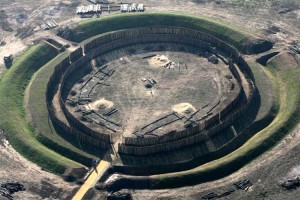 5,000
BC - Goseck, Germany - Currently the
oldest known solar observatory in the world. Located
on the same Latitude as Stonehenge and 12 5,000
BC - Goseck, Germany - Currently the
oldest known solar observatory in the world. Located
on the same Latitude as Stonehenge and 12 �
to the east. This recently restored Henge monument
demonstrates an awareness of the solar cycle, and
the simple step required to mark the day end/start
point of each cycle. The two southern entrances
would have illuminated the centre at both the rising
and setting sun each winter solstice (the wooden
posts reduce the beam of light to a narrow shaft).
The northern entrance was the main entrance to the
site (The bottom entrance on the photo left).
(More
about Goseck, Germany)
|
4,700 BC -
Carnac, France:
The
Kerkado passage mound was built aligned to midwinter sunrise.
First Lunar observations at
the original Morbihan,
monument as determined by Prof.
A. Thom.
|
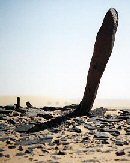 Nabta
Playa, Egypt:
c, 4,500
- 4,000 BC. Nabta
Playa, Egypt:
c, 4,500
- 4,000 BC.
The 12-foot-in-diameter stone circle
contains four sets of upright slabs. Two sets were aligned in a
north-south direction while the second pair of slabs provides a line of
sight toward the summer solstice horizon.
Because of Nabta's
proximity to the Tropic of Cancer, the noon sun is at its zenith about
three weeks before and three weeks after the summer solstice, preventing
upright objects from casting shadows. The vertical sighting stones
correspond to the zenith sun during the summer solstice.
(More about Nabta Playa) |
|
The Sumerians:
c. 4,000 BC.
(Shumer- 'Shem' - 'points to sky',
'pointed stone marker'),
The Sumerians were one of the first civilisations
to record their observations, and their fascination resulted in
the basis for much of modern astronomy today.
They recorded the sun at the centre of a system surrounded by
several planets. They
considered the New-year to begin at the exact moment when the Sun
crossed the spring equinox.
The 25,000 texts devoted to Astronomy and Astrology found in the
ruins if the Nineveh library of
Ashurbanipal
bear
witness to the Sumerian fascination with the motions of the
celestial sphere.
|
Sumerian |
Translation |
Modern Name |
|
GU.AN.NA
MASH.TAB.BA
DUB
UR.GULA
AB.SIN
ZI.BA.AN.NA
GIR.TAB
PA.BIL (Archer)
SUHUR.MASH
GU
SIM.MAH
KU.MAL
|
Heavenly Bull
Twins
Pincers, Tongs
Lion
Her father was Sin
Heavenly Fate
Which claws and cuts
Defender
Goat-Fish
Lord of the waters
Fishes
Field dweller
|
Taurus
Gemini
Cancer
Leo
Virgo
Libra
Scorpio
Sagittarius
Capricorn
Aquarius
Pisces
Aries
|
The Sumerians called the twelve
major zodiacal constellations the 'Shiny herd'.
The Sumerians were the first to divide both space and time by
units of six. The modern division of the year into 12 months, the
24 hours of each day, the division of hours into 60 minutes and 60
seconds, and the divisions of the circle/sphere by 360 degrees,
each composed of 60 minutes and 60 seconds of an arc, are all
Sumerian developments. This same division by units of six has been
observed at several of prominent British megaliths.
Aubrey Burl said of it:
'From
Brodgar, where there was
once 60 stones, to the Stripple stones with a probable thirty, the
builders may have counted in multiples of six. Stennes had twelve. The
inner and outer rings at Balfarg have been computed at twenty-four and
twelve respectively. Twenty-four has been suggested for Cairnpappel,
thirty-six for
Arbor Low, and the same number for the devils quoits'.
(3)
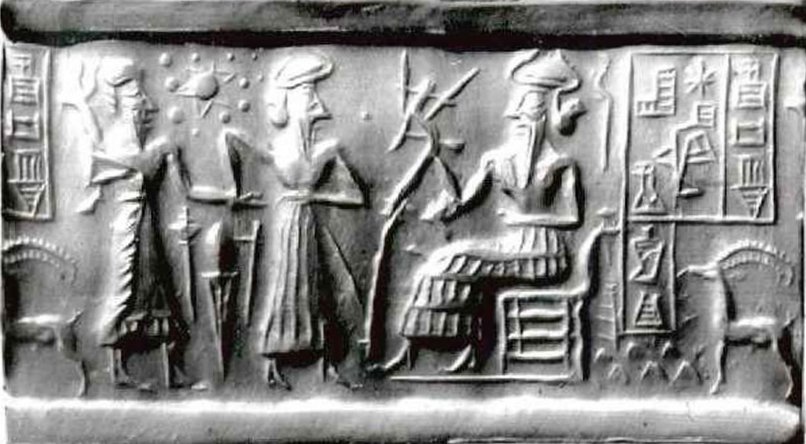
Sumerian seal (VA/243).
State museum, East Berlin.
(23).
Whichever planets this
image was
intended
to represent, the smaller 'planets' certainly appear to be
surrounding the larger, sun-like object in the centre.
The Planisphere: British Museum (K8538)
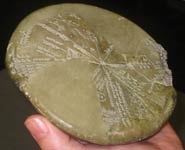 Article:
(2008) Bristol University. Article:
(2008) Bristol University.
(Quick-link)
'Cuneiform Clay Tablet Translated for the First
Time'.
An clay
tablet has been translated which records an asteroid approach on
collision course
29th June 3,123 BC - as documented by a Sumerian astronomer.
(11)
It was found by Henry Layard in the remains of the library in
the Royal Place at Nineveh, and was made by an Assyrian scribe
around 700 BC. It is an astronomical work with drawings of
constellations on it and the text has known constellation names.
The tablet has recently been claimed to describe a
collision occurred near modern
K�fel, Austria causing the
K�fel
Landslide, although the date of the K�fel event is placed at 9,800
BC.
(12) Regardless of the
location of the event, the date itself stands out as one of
great change in the prehistoric world.
( More
about Sumeria)
|
3,500 - 3,000 BC - Malta.
Several temples orientated to astronomically
significant moments of the solar and lunar cycle. Discovery of pottery
with astronomical marking on.
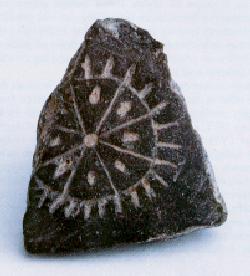
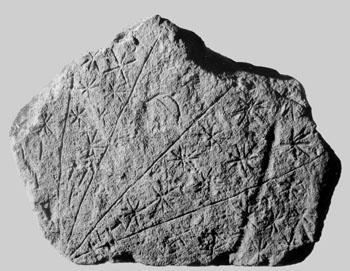
Stones From Hagar-Qim
(left), and Tal Qadi (right). Both astronomical in
nature.
(More
about Prehistoric Malta)
|
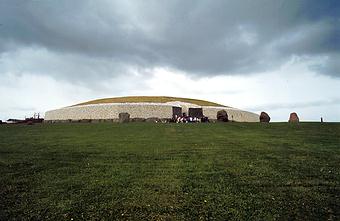
The Boyne Valley Complex, Ireland:
c. 3,300 BC.
The Boyne Valley complex consists of the three
huge passage mounds;
Newgrange,
Knowth and
Dowth all of
which were built in the curve of the river Boyne. The combined orientations
of the passages creates an observatory capable of calculating
both the lunar and solar cycles accurately.
(More
about the Boyne Valley Complex)
|
3,300 BC -
Lochmariaquer, France - Several
monuments in the Carnac area
(dating from 4,700 - 4,500 BC) dismantled and re-used for new
constructions.
It is suspected that at this time, the new monuments were designed
with a solar emphasis, in contrast to the earlier, predominntly lunar monuments
at Lochmariaquer.
(More about Lochmariaquer)
|
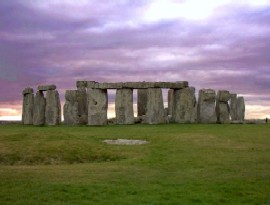 Stonehenge,
England: c. 3,200 BC: Stonehenge,
England: c. 3,200 BC:
The Henge and 56
'Aubrey holes' were placed. (Lunar alignment only).
It is suggested that these 56 holes were later used
to calculate the Metonic
cycle of 18.6 years (3 x 18.6 = 55.8). The same system can be used
to calculate tidal motions (based on lunar activity), eclipses,
and ultimately to synchronise the movements of the sun and moon.
(More about
Stonehenge)
|
Article: BBC News: Nov 2011.
Two previously
undiscovered pits
have been found in
the Stonehenge
Cursus which point to it
once being used as a place
of sun worship long before the
stones were erected. The
pits are positioned in such
a way that when
viewed from the
'Heel-Stone' at
Stonehenge, they
would have marked
the rising and
setting positions of
the sun on the
summers solstice.
(20)
(Link
to Full Article)
(More
about Cursus)
3,114 BC
(Aug 13) - The Mayan 'long count' begins.
The great cycle was believed to last for 13 baktuns - 1,872,000
days. The present cycle comes to an end on 21st December 2012 AD.
The
Mayans used two calendars with each day having two names, the
first a repeating cycle of 260 days, called a ' tzolkin', and the
second a 'vague' year of 365 days called a 'haab'. The year was
composed of 360 days divided into 18 months of 20 days each plus a
short month of 5 extra days and the intercalary days. Using the
dual calendar system, any specific combination of day names did
not occur for a period of 52 'vague' years (52 x 365 = 18,980 = 73
x 260). The 5+ intercalcular days were considered unlucky. The
'Dresden codex' contains tables for the prediction of eclipses.
(Pre-Columbian
Americas)
|
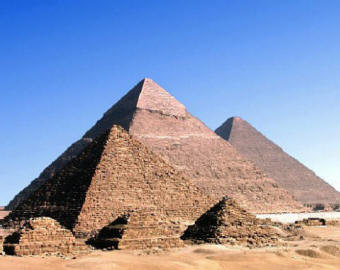 The Giza Complex:
c. 3,000 BC.
The Giza Complex:
c. 3,000 BC.
The vast unprecedented constructions
at Giza were built with several fundamental astronomical
features incorporated into them as the early dynastic Egyptians
adopted the cosmos into their concept of the afterlife. As well
as incorporating astronomical data into the Giza pyramids
themselves, they were built on the 30th parallel, a latitude
sacred to several ancient cultures.
(Radio-carbon
dating at Giza)
|
2,800 - 2,500 BC
- Metsamor, in
Armenia shows evidence of astronomy and the first known zodiacal division of
the heavens into 12 equal parts.
|
Chinese Astronomy:
2,400 BC - The canons of the Chinese emperor
say, 'In the lifetime of Yao,
the sun did not set for ten full days
and
the entire land was flooded (by an immense wave), that reached the
sky'.
2,137 BC - (April 26) - Two official astrologers of Emperor
Chung Kang, who were paid mainly to predict eclipses so that the
population could be told in advance not to panic, got stone
drunk on rice wine on this day and forgot to give the warning.
Neither could they, as custom required, stand up and shoot
arrows at the monster devouring the sun. So the culprits were
decapitated on the spot, and since then Chinese astrologers
drink nothing but water when eclipses are expected.
(13)
(More about Prehistoric China)
|
2,000 BC -
Callanish,
(In the Outer Hebrides on the Isle of Lewis, Scotland): An avenue of stones
points to Mount Clisham, where the midsummer moon-set occurs from
Callanish. Because the complex lies only 1.3 degrees south of the
Arctic latitude for the moon, so that ancient observers would have been
able to see the moon appearing to 'roll along' at about one degree
above the horizon. This 18.6 year cycle is the same as that
recorded at Stonehenge. Both avenues of stones allowed ancient
astronomers to observe what is called the 'moon's wobble', a small
amplitude ripple of the moons declination at extreme positions. It
is possibly significant that with both sites having key
observation stones with similar geometry, and with Callanish
situated at a latitude where the moon appears to skim the
horizon, while at Stonehenge, the extreme positions of the moon
appear at right angles to the Sun; it makes Earth's curvature
obvious and from that the calculations necessary to determine
its size. (9).
|
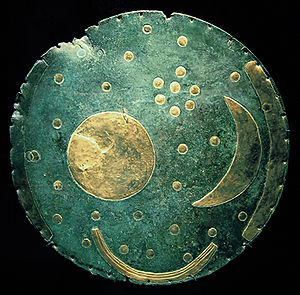
The Nebra Sky Disc,
Germany (c. 1,600 BC):
Found at the top of a mountain in Germany and
long believed a fake, this remarkable object is now accepted as a genuine artefact. It is the
only piece of its kind in central Europe and includes astronomical
information relevant to its location.
(More about the Nebra Sky Disc)
|
|
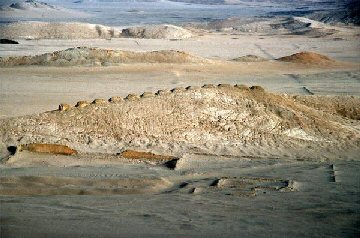 Chankillo, Peru
(c. 300 BC):
The Thirteen Towers of Chankillo run
north to south along a low ridge within a
fourth-century B.C. ceremonial complex in
north coastal Peru. They formed an artificial toothed
horizon that spanned the path of the annual rising and
setting arcs of the Sun.
At present, the
culture that made them has not been named.
(More about the Chankillo Observatory) |
4th Cent BC - A belief existed at the
time of Aristotle that a comet had once joined the solar
system as a planet. This theory was later expanded by Velikovsky,
who believed the story to be a reference to the appearance of
Venus.
3rd Cent BC - Aristarchus
of Samos suggests that the motions of the heavenly bodies could
better be explained if the Sun - and not the Earth - was in the
centre.
2nd
Cent BC - Hipparchus,
who lived in Asia Minor, discussed 'the displacement of the
solstice and equinoctial signs'.
(23) A clear reference to the
phenomena called the
precession of the equinoxes, which some people suggest was
understood a long time before this.
1st
Cent BC -
Diodorus
Siculus, the
Greek historian, states that...'the Chaldeans named the
planets�in the centre of their system was the Sun, the greatest
light, of which the planets were offspring'.
(23).
|
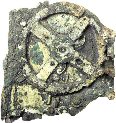
The Antikythera Mechanism.
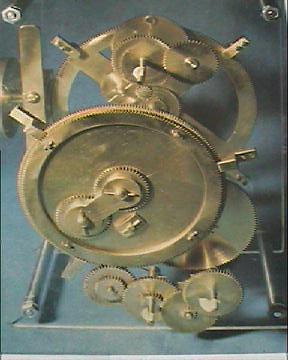 83 BC -
A Mechanical device for working out the
motions of the sun, moon and planets
(based on number and relationship of over 30 gears).
Found underwater off Antikythera Island, Greece, 1901 (Current
Location:
National museum, Athens). Examined by Derek De Solla Price with
x-ray. It is made of different metal alloys with 1/10 mm precision
teeth.
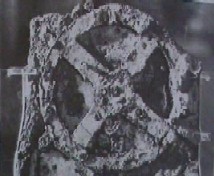
Ref: (Readers digest into the unknown, 1981. ISBN 0-89577-098-9
(+13)
(More about
the Antikythera Mechanism) |
2nd
Cent AD - Ptolemy
in Alexandria states categorically that the Sun, Moon and five
planets rotated around the Earth. A belief that lingers for over
1000 years.
|
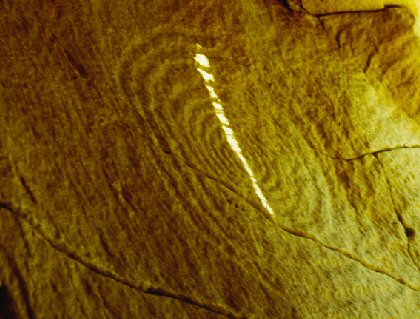 Chaco
canyon Chaco
canyon :
c. 900
AD
- (The 'Sun
dagger')
Chaco Canyon was the home of the Anasazi people who lived in the region from about 500 to 1300 AD. Some 120
meters above the canyon floor near the top of an outcropping
known as Fajada Butte, three slabs of sandstone are leaning against a rock
wall creating a shaded space. Carved into this shaded wall are two spiral
petroglyphs, one large and one small. Sunlight passes over them at various
times throughout the year as it streams through chinks between the
sandstone.
(More about the
Chaco-canyon sun-dagger)
|
1543 AD -
Nicolaus Copernicus suggests / re-discovers that
the we are part of a Heliocentric system.
(23).
|
|
|
Archaeoastronomy: Other
Featured Articles.
|
Astronomy and the European Megaliths: |
For
a long time, megaliths were considered to have had primarily
funerary purposes, which is reflected in the names given them
such as 'Chamber tombs', 'Burial-mounds', 'Passage graves',
'Gallery graves' etc. This assumption is now in
question...
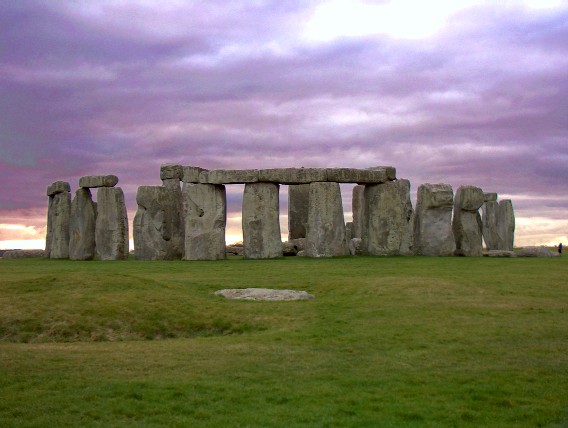 The idea that
prehistoric people might have been knowledgeable in the field
of astronomy is even today received with the greatest of caution.
However, the accurate astronomical orientation of so many
ancient megaliths leaves no doubt as to the importance of
astronomy to the builders.
Sir N. Lockyer pioneered many fields of research, one of which
was the study of astronomically aligned ancient megaliths and
temples. His realisation that many temples Both in Prehistoric
Egypt (and Britain) showed several
different adjustments to their alignments, with records to date
the changes, ultimately led to the creation of the field of
science which we now know as archaeoastronomy.
In Neolithic Europe, there is evidence of at least two marked phases of
cultural development involving the development (and/or redevelopment) of
large, civil-scale constructions involving primary astronomical orientations
and alignments at several 'megalithic complexes' along the Mediterranean and
Atlantic coastline of Europe, many of which were positioned at
astronomically significant latitudes (such as Stonehenge, Orkneys, Carnac,
Evora). The following examples are some of the most important European
'megalithic complexes', for which astronomy can be seen to go a long way in
explaining their specific placement, often in relation to each other.
The Astronomy of the Stonehenge/Avebury
Complex.
One of the
strongest pieces of evidence in favour of Stonehenge serving an
astronomic purpose is the location of the site itself, as it is
along this latitude at which the sun and the moon have their
maximum declinations at right angles to each other ,
in addition to which
the latitude of Stonehenge (51�
10' N), is one of only two latitudes in the world at which the full moon
passes directly overhead on the maximum zenith. The
other (38�
33′ N),
is perhaps coincidentally on the
same as the latitude of the oldest stone-circle in Europe, at
Almendres in Portugal.
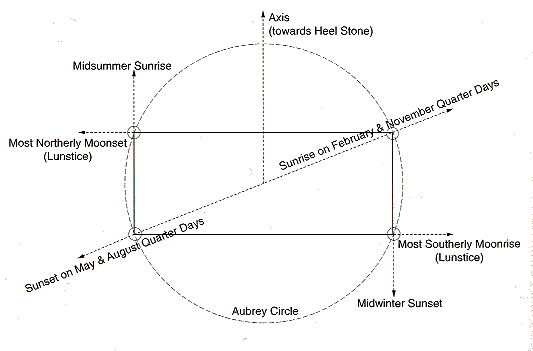
The 56
Aubrey holes were suggested by Prof. G. Hawkins, to have been
used for calculating the phases of the moon and also for
predicting the month of the year in which eclipses would take
place. The same design can also be used to predict the tides and
is one of the many facts which combine to suggest that
Stonehenge was an 'instrument' designed to calculate
astronomical cycles. (3)
Although
the orientation of the 'Avenue' is commonly believed to be in line
with the summer solstice, there are indications that the
orientation was originally lunar...
Extract from Burl
- 'The heel-stone is popularly thought to stand in line with the
midsummer sunrise but it does not and never did...astronomical analysis
has shown instead that the stone is in-line with rising of the moon
halfway between its northern minor and major positions'.
The angle of orientation of both the 'Avenue' and the geometry of the
'Station-stones', mirror the sites latitude of
51� 10' N.
(More about Stonehenge)
|
Megalithic
Quadrangles:
The mathematical peculiarity of the Stonehenge
'Station-stones' having proportions that mirrors the latitude of the site, is only surpassed by the
fact that both the Sun and the Moon (at their respective maximum
settings) rise at
approximately
the same point on the horizon from
the site, which is also mirrored in the latitude of 51 �
51'.
This remarkable astronomical fact, and the quadrangle design
occurs at two (Possibly three) other known European locations, each
of which demonstrates a relationship between their latitude, their
internal geometry, and an astronomical relevance in their placement.
One of the other interesting astronomical facts concerning
Stonehenge is that it lies under one of
two latitudes in the world at which the full moon passes directly
overhead on its maximum Zeniths, these are at Stonehenge and
Almendres in Portugal.
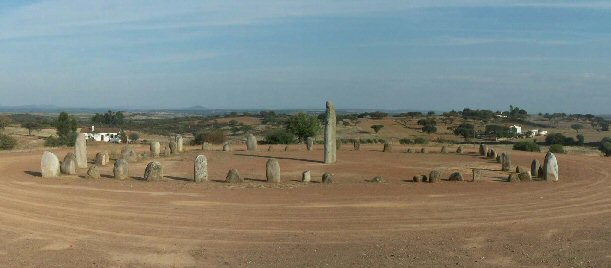
The Almendres Stone Circle at the Evora complex in Portugal is
one of the oldest circle in
Western-Europe. It simultaneously calculates the solstices and the
equinoxes, being composed of two circles superimposed over each
other. There exists an alignment running for over 50km approximately
east from Almendres circle, following the path of the spring
full-moon. The alignment passes over the largest passage mound in
all Iberia (Zambujeiro), and ends
at the Xarez Quadrangle (above) at Monsaraz.
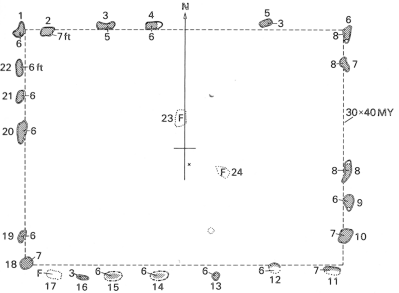
Another alignment to
the midsummer sunrise exists through
the rectangular 'Crucuno'
enclosure at Carnac which encompasses a 3:4:5 triangle, with the east - west sides aligned to the
equinox sunrise and sunset, and perhaps more importantly, the
diagonals being aligned to both the solstice sunrise and sunset positions,
a feature similar to the four 'station-stones' at
Stonehenge. These particular examples of megalithic quadrangles
betrays the simultaneous application of the knowledge of geometry,
astronomy and latitude, demonstrating the existence of a
sophisticated set of ideas as suggested by Prof Alexander Thom in
the 1960's.
(More
about Megalithic Quadrangles)
|
The Boyne Valley Complex.
3 ,300 BC -
Boyne Valley, County Meath, Ireland - The Boyne Valley
Passage-mounds are an elegantly simple
'observatory mechanism' employed for accurately measuring all of
the important extremes of the Solar and Lunar cycles. The
simplest of calculations would have yielded the 'Metonic cycle'
to the 'priests/astronomers' who resided over events
at the mounds. These constructions are large enough to be termed
'civil-structures', revealing specialisations in skills,
co-operation of a large communal workforce, and the ability to calculate and
complete the complex over several sustained generations.
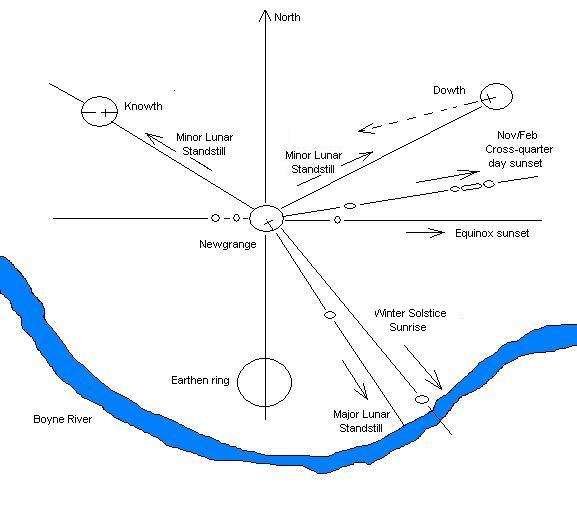
The
Boyne-Valley Complex incorporates several important lunar and
solar orientations.
BBC News Article:
Thursday, 22 April, 1999
A map of the Moon 10-times older than anything
known before has been claimed to be found carved into stone at one of Ireland's
most ancient and mysterious Neolithic sites.
It has been identified by Dr Philip Stooke, of
the University of Western Ontario, Canada. He spends most of his
time preparing maps of asteroids based on spacecraft observations,
but he has also prepared detailed maps of the Moon.
What puzzled him greatly was that there was no
recorded map of the Moon older than about 500 years. "I simply
could not believe this," he told BBC News Online. "I felt there
just had to be an older map somewhere."
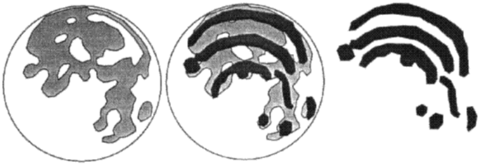
So he began looking in old manuscripts and
history books as well as in the records of excavations of the
Neolithic sites on the British Isles.
Then he found one. It took the eye of an expert
to see it for what it was. It was carved into a rock in one of
Ireland's most remarkable prehistoric tombs at Knowth, County
Meath.
"I was amazed when I saw it. Place the markings
over a picture of the full Moon and you will see that they line
up. It is without doubt a map of the Moon, the most ancient one
ever found," said Dr Stooke.
"It's all there in the carving. You can see the
overall pattern of the lunar features, from features such as Mare
Humorun through to Mare Crisium."
Before this discovery, the oldest known map of
the Moon was by Leonardo da Vinci, drawn about 1505. The Knowth
map is 10-times older. Knowth is already a major focus of research
into understanding prehistoric man. Now, it will become one of the
most important scientific sites in the world.
"The people who carved this Moon map were the
first scientists," said Dr Stooke. "They knew a great deal about
the motion of the Moon. They were not primitive at all."
The passage tomb at Knowth is estimated to be
about 5,000 years old. It was obviously built by men who had a
sophisticated understanding of the motions of the Sun, Moon and
stars.
It is known that many stone circles and ancient
tombs are aligned with the Sun but less attention has been paid to
possible lunar alignments. This is despite the fact that at
certain times the Moon can rise or set at any location on the
horizon that the Sun can.
Investigations at Knowth almost 20 years ago
showed that at certain times moonlight could shine down the
eastern passage of the tomb. Remarkably, the moonlight would also fall on
the Neolithic lunar map.
During excavations, the stone in question was
named Orthostat 47. Its right-hand section contains a series of
arcs.
The circular limb of the moon is not included
in the carving. Dr Stooke believes that it may have been drawn on
the rock with chalk or with coloured paint.
(Ref:
http://news.bbc.co.uk/2/hi/science/nature/325290.stm)
(More about the Boyne Valley
complex,
Ireland)
|
Scottish Recumbent
Stone Circles:
Scotland is home to hundreds of 'Recumbent' stone circles.
These circles are usually fairly small, the largest being (Innesmill
(B5/1 at 110 ft diameter). Recumbent circles in the Grampians of Scotland have been shown to have a primary
association with the observation of the extreme setting points on the lunar
cycle. They are defined by a prominent 'recumbent' stone, positioned
horizontally, so that the moon sets behind it at both extremes of its cycle,
and upon which stones cup-marks are often found.
In Aberdeenshire, with a mean
latitude of 57� 30's, the moon at its maximum, will rise at 155�
SSE, and set at 205� SSW. Of the 48
recumbents where it is possible to plot their
axis, 45 have recumbent between these limits. The remaining were placed at 230�,
231� and 232�, the min moon setting.
(Ref: Burl. Stone circles).
It is interesting to note that the only
recumbent circles found outside of Scotland, are in the Ross-Carbery area of
Ireland (SW), which places them too far south to make them any use as lunar
observatories, and have in fact been shown to be solar in their
orientation. Cope (4), makes note of the
Drombeg RSC, where the sun has been observed setting at midwinter
(solstice), directly into a notch in the landscape behind the recumbent
stone.
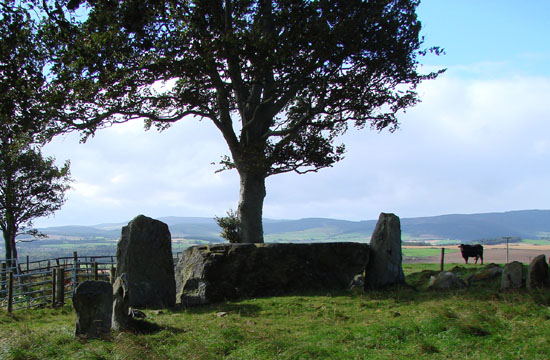
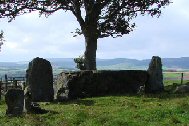
The largest recumbent stone in Scotland is at
Old Keig (above), in Aberdeenshire, which at an
estimated 53 tons, and still sitting perfectly horizontally, is a testimony
to the engineering skills of the builders. The Old Keig recumbent was
positioned so that its length (5m), was such that the moon rose at its
minimum and maximum settings (over the 18.6 yr cycle) from behind the left
and right 'flankers', gliding along the surface of the recumbent (due to its
specific latitude).
(Recumbent Stone Circles)
|
The Megalithic yard:
Prof Alexander Thom determined the presence of both
geometry and astronomy at hundreds of prehistoric sites across Europe. His
findings confirmed the accuracy of numerous astronomically
orientated megalithic sites, and also revealed the use of geometry in the
design of megalithic circles, including the use of 3:4:5 triangles and the 'megalithic yard', a
common unit of measurement, which he suggested was used throughout
prehistoric Europe.
It is suggested that the Megalithic yard is a natural product of
astronomical observation.
(More about Alexander Thom and the Megalithic
Yard)
The Metonic cycle is attributed to the Greek
mathematician/astronomer
Meton
(4th cent. BC). Who identified the synchronous cycles of the Sun
and Moon over a period of 18.6 Solar years, during which the Moon has
235 Lunations, with an error of only two hours.
(Exactly corrected for over a period of 1116 solar years or 14,100 lunations)
It is noted that at
Stonehenge, in England, there are
56 Aubrey holes (3 x 18.6 = 55.8). The
largest menhir in France (now fallen),
Le Grande Menhir Brise, was once a
part of a huge construction consisting of 19 menhirs of decreasing size, and
the large stone in the back of the adjacent
La Table des Marchands has 19
crescent shapes scored on either side of it. All suggestive of an early
awareness of the Metonic
cycle.
How far back the Metonic cycle was recognised is
still a matter of debate, but there is no doubt that the European megalithic
builders were measuring both lunar and solar cycles at the same time, as
testified by Stonehenge and the great Boyne Valley
complex, where all the minor and major setting points of both cycles
were determined through orientations and alignments of the three great
passage mounds Newgrange,
Knowth and Dowth.
Robin Heath
(3), suggested that the Megalithic
yard was linked to the Metonic cycle, (in which the earth orbits the sun 19
times and the moon has 235 lunation's). He Proposed that if the measurement
of time is transferred to the measurement of space (i.e. each day = one
Megalithic Inch 'MI'), then the difference between the solar and lunar
cycles over a three year solar period amount to a deficit of 1.104812
lunation's, which amounts to 32.625 days: which if transferred into
Megalithic Inches 'MI' (one MI = one solar day), equals 2.7188 ft. A figure
extremely close to Thom's estimate of 2.72 ft.
|
|
Prehistoric
Egyptian Astronomers: |
At approximately the
same time as Europe was undergoing the conversion from
Mesolithic to Neolithic, Egypt was undergoing dramatic changes of its own.
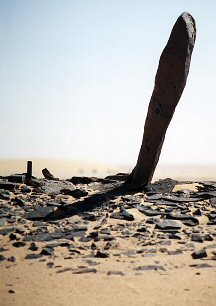 The
earliest evidence of astronomy in Egypt is the Nabta Playa Stone
circle and associated megalithic remains, which were built on the
Tropic of Cancer, the very latitude at which the sun casts no shadow
at midday on summers solstice. The remains have been dated at c.
4,500 - 4,000 BC and they attest to a recognition of the annual
cycle of the sun. The
earliest evidence of astronomy in Egypt is the Nabta Playa Stone
circle and associated megalithic remains, which were built on the
Tropic of Cancer, the very latitude at which the sun casts no shadow
at midday on summers solstice. The remains have been dated at c.
4,500 - 4,000 BC and they attest to a recognition of the annual
cycle of the sun.
(More about
the Nabta Playa stone circle)
In ancient Egypt, religion and astronomy were irrevocably entwined,
resulting in the complex mythological tapestry as seen in the 'Book of the
dead' and the so called 'pyramid texts', which simultaneously describe both
the journey of the sun on its daily cycle and of the soul passing into the
underworld. These texts are found first in fifth dynasty pyramids before
which time, pyramids
appear to have been unadorned.
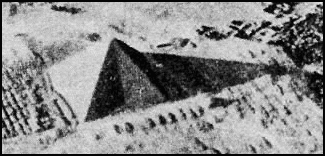 The Giza complex
in Egypt
shows numerous geometric and astronomical references in its design. Pi (л) in
the exterior dimensions of the Great pyramid, the 3:4:5 triangle in the
dimensions of the 'Kings chamber' of the 'Great pyramid', and the sacred
mean (0.618) in the overall layout of the site. In addition, the structures at Giza have several
astronomical features built into them. In particular, the almost exact
cardinal orientation of the pyramids, the polar-shafts in each pyramid, cut
to face the pole-star at the time of construction. The 'Star-shafts' in Khufu's pyramid, said to align to both Orion
and Sirius, and not forgetting of course the majestic sphinx, which
sits facing the rising sun on the equinoxes. The Giza complex
in Egypt
shows numerous geometric and astronomical references in its design. Pi (л) in
the exterior dimensions of the Great pyramid, the 3:4:5 triangle in the
dimensions of the 'Kings chamber' of the 'Great pyramid', and the sacred
mean (0.618) in the overall layout of the site. In addition, the structures at Giza have several
astronomical features built into them. In particular, the almost exact
cardinal orientation of the pyramids, the polar-shafts in each pyramid, cut
to face the pole-star at the time of construction. The 'Star-shafts' in Khufu's pyramid, said to align to both Orion
and Sirius, and not forgetting of course the majestic sphinx, which
sits facing the rising sun on the equinoxes.
Davidson
(7),
showed how the shadow cast by the Great pyramid could have been used to
measure the solstice, equinoxes and quarter periods of the year.
(More about The
Giza complex)
(More about
Egyptian Astronomy)
|
The Precession of the Equinoxes: |
The precession
of the equinoxes refers to the celestial phenomena that appears in the
skies over a period spanning 25,920 years, during which time the constellations
appear to rotate around the heavens, taking turns at rising on the horizon before
the rising sun on the vernal equinox.
|
The Precession of the equinoxes = 25,920 yrs = (360�)
The sky is divided into 12
constellations:
(25,920 / 12 = 2,160)
A New sign appears on the horizon each
2,160 yrs (30�)
Note: (2 x 2,160 or 12 x 360 =
4,320 yrs)
Therefore
to
move 1�
on the horizon = 72 yrs.
|
This remarkable cycle is due to a synchronicity between the speed of the
earth's rotation around the sun, and the rotational speed of the galaxy.
It has been observed that certain myths, sacred
texts and ancient buildings have these figures �stored� within them, as numerical units which are
common throughout the ancient world.
(More about Precession)
|
|
Light-boxes: Form and Function: |
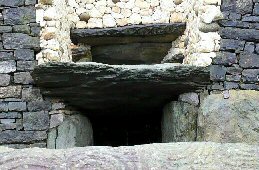
Light-boxes
are a megalithic design feature employed so as to restrict
the entrance of light into a chamber or passage. They are a Neolithic construction feature that
have so far only been recorded at four (possibly five) sites
in the UK, with the two in Ireland (Newgrange
and
Carrowkeel)
both having the same design, two on the
Orkneys (Maes
Howe and
Crantit) in Scotland and one in
Wales (Brynn-Celli-Ddu).
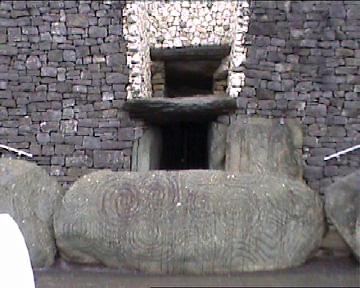
Newgrange at the Boyne Valley, possesses one of the finest known examples of
'Light-boxes'.
The incorporation of light boxes into megaliths is one of the
few direct proofs of the link between megaliths and astronomy, as
their purpose was the manipulation of light into the passage mounds at
certain times of the year only. In Egypt, the earliest pyramids all contain
'polar-shafts', on Malta, the 'Temples' orientated towards the solstices and
equinoxes and in Britain, all the known passage-mounds containing
light-boxes were also aligned with solar events, (i.e. the equinoxes
or solstice)
-
Newgrange - Ireland, (Winter Solstice, Lunar Standstill)
-
Crantit
Tomb Orkneys - (start and end of winter..?)
Carrowkeel
- Ireland, (Summer and winter solstice, Lunar standstill)
Maes Howe - Orkneys, (Winter
solstice).
Bryn Celli Ddu - Anglesey, (Summer
solstice, Lunar standstill)
(More about Lightboxes)
|
We can see how astronomical information is
still recorded into everyday terminology such as the names of the days
of the week.
|
Latin |
French
|
English
(Norse/Germanic) |
|
Lunae (Moon) |
Lundi - (Lunar-day) |
Monday - (Moons day) |
|
Martis (Mars) |
Mardi - (Mars-day) |
Tuesday - (Tīw's
day) |
|
Mercurii (Mercury) |
Mercredi - (Mercury-day) |
Wednesday - (Wodin's-day) |
|
Jovis (Jupiter) |
Jeudi - (Jupiter-day) |
Thursday - (Thor's -day) |
|
Veneris (Venus) |
Vendredi - (Venus-day) |
Friday - (Freya's-day) |
|
Saturni (Saturn) |
Samedi - (Sabado/Sabbath) |
Saturday - (Saturn-day) |
|
Solis/Dominicus (Sun) |
Dimanche - (Domingo) |
Sunday - (Sun-day) |
Why the particular order of the
days of the week ?
If you order the "planets" according to
either their average distance from Earth (assuming
the Earth to be the centre of the universe) or their
period of revolution around the Earth, you arrive at
this order:
Moon, Mercury, Venus, Sun, Mars, Jupiter, Saturn
Now, assign (in reverse order) these planets to the
(24) hours of the day:
1=Saturn, 2=Jupiter, 3=Mars, 4=Sun, 5=Venus,
6=Mercury, 7=Moon,
8=Saturn, 9=Jupiter, etc. etc etc, until 24=Mars
The next day will then continue where the old day left
off:
1=Sun, 2=Venus, etc., until 24=Mercury
And the next day will go...
1=Moon, 2=Saturn, etc.
If you look at the planet assigned to the first hour
of each day, you
will note that the planets come in this order:
Saturn, Sun, Moon, Mars, Mercury, Jupiter, Venus.
Which gives the order of the associated
week days...
(Who
works these things out anyway...?)
|
According to Dr Richard L. Thompson (Mysteries of the sacred
universe), The Bhagvata Purana, contains a body
of astronomical knowledge. He looks at the Blue Mandala,
which consists of circles and intersecting spheres of precise,
very large, dimensions. He argues that the Blue Mandala is an
accurate map of the solar system and as a planar projection map of
the earth. He points out correlations with dimensions given in the
texts and those of the planetary orbits within the solar system.
(Ref: Hancock, Underwater kingdoms)
We have mentioned the astronomical phenomenon called the ' Precession
of the equinoxes'
above, and it appears likely that there was a working
understanding of this great cycle in prehistoric times. Before the
written word, information and knowledge would have been
transferred verbally, and there are several myths which are
suspected of incorporating observations of astronomical events.
Apart from the numerous references to
fiery dragons
and a war between
the gods in heaven,
there are also more specific myths that come from unrelated
sources which appear to share similar descriptions of an event. It
is in these myths that we can begin to view mythology as an
historical narrative rather than a purely imaginative one. But
what should we make then, of the 'The
day the sun stood still',
a myth found independently around the ancient world...
(More about Mythology)
|
(Ancient
Sciences Homepage)
(Index of
Ancient Sites)
(A-Z Site Index)
References:
1) G. Santillana and H. Von Dechend.
Hamlets mill. 1983. D. R. G. Press.
2). A. Service & J. Bradbery.
Megaliths and their Mysteries. 1979. Macmillan.
3). Aubrey Burl.
Stone Circles of the British Isles.
1976. Yale University Press.
4).
Richard Rudgley. The Lost Civilisation of the
Stone Age.
1999. Arrow. Press
5). Sir
B. Cunliffe. Facing the Ocean: The Atlantic and Its Peoples,
2001, Oxford University Press
6).
http://www.physorg.com/news126183668.html
7). D. Davidson & H. Aldersmith.
Great Pyramid, Its Divine
Message. 1924. Williams and Norgate.
8). Dr. Hans J. Zillmer.
Darwin's Mistake, 1998.
Adventures Unlimited press.
9). Rene Noorbergen.
Secrets of the Lost Races. 1977. New English Library.
10).
http://www.astrocal.co.uk/lunarstandstills.html
11).
http://www.bris.ac.uk/news/2008/212017945233.html
12).
http://en.wikipedia.org/wiki/Umhausen
13). Maurice Chatelain.
Our Cosmic Ancestors. 1987. Temple Golden Publ.
14).
http://en.wikipedia.org/wiki/Alan_Bond_(rocket_developer)
20).
http://www.birmingham.ac.uk/news/latest/2011/11/25Nov-Discoveries-provide-evidence-of-a-celestial-procession-at-Stonehenge.aspx
21). G. Hancock. Fingerprints of the gods. 1996. Mandarin.
23). Z. Sitchin.
The 12th Planet. 1976. Avon books.
Further Research:
1).
The Planetary_Culture_of_13_Moons_Part_I_-_Ancient_Artifacts
2).
The
Planetary_Culture_of_13_Moons_Part_II_-_Superstition_Speculation_and_Revolution
|