|
 Oracles:
(Oracle centres, Sybils)
Oracles:
(Oracle centres, Sybils)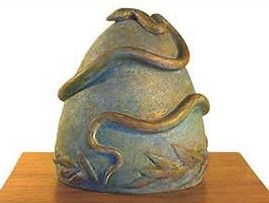
The earliest known oracle was in the
renowned temple of Per-Wadjet. This was an important site in the Predynastic
era of Ancient Egypt, which includes the cultural developments of ten
thousand years from the Paleolithic to 3.100 BC The temple was dedicated to
the worship of Wadjet and may have been the source for the oracular
tradition that spread to Ancient Greece from Egypt. The Per-Wadjet tradition
continued through the entire history of the Ancient Egyptian culture. The
later Greeks called both the goddess and the city Buto.
(6)
Livvio
Stecchini suggested that the ancient oracle centres
were placed according to geodetic principles at which 'Omphalus' or 'Navel
stones' were placed.
Featured Articles.
|
The Ancient Oracle Centres: |
Essentially, an oracle was a means of making a personal
request to a deity to answer a question. Evidence for the use and
belief in oracles comes from the many oracular decrees engraved on
temple walls or delivered on papyrus to private persons who then
wore the oracle as an amulet; references made in administrative or
private records; original petitions on papyrus or ostraca and laid
before the god; and statues and reliefs associated with oracles.
The Following
Oracles are amongst the Best Known :
Karnak
(Thebes), Egypt -
Karnak is the mother oracle to all other oracle centres. The name translates as 'The
most perfect of places'. It is the
site from which all other oracles are said to originate. It is suggested
that they were able to communicate with each other by the use of 'homing'
doves, enabling them to 'see into
the future'..
Nestled between the ancient cities of Luxor and Thebes, lie the remains of
Karnak, one of the most magnificent temple complexes ever constructed.
It became a religious center during the period known as the New Kingdom
(founded c. 1550 B.C ). Dedicated to the sun deity Amon-Ra (also Amun-Re)
and built around 1500 B.C. Karnak consists of massive pillars, towering
columns, avenues of sphinxes, and a remarkable obelisk that stands 97 feet
tall and weighs 323 tons.
 Two
relevant texts can be seen at Karnak, they read as follows: Two
relevant texts can be seen at Karnak, they read as follows:
�Ye people from south and
north, all ye eyes that see the sun, all ye who come from south
and north to Thebes to entreat the lord of gods, come to me! What
ye say I shall pass to Amun at Karnak. Say the "offering spell" to
me and give me water from that which ye possess. For I am the
messenger whom the king has appointed to hear your words of
petition and to send up to him the affairs of the Two Lands.�
and:
�Ye people of
Karnak, ye who
wish to see
Amun,
come to me! I shall report your petitions. For I am indeed the
messenger of this god. The king has appointed me to report the
words of the Two Lands. Speak to me the "offering spell" and
invoke my name daily, as is done to one who has taken a vow.�
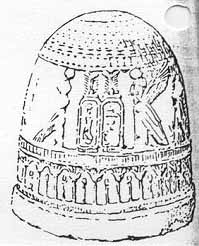
An Omphalus was excavated in the sanctuary of the Great Temple of Amon at
Karnak, by G. A. Reisner. It supports the Greek traditions of doves flying
between Delphi and Karnak.
(1)
(More about Karnak-Thebes, Egypt)
 Delphi
(Greece) - Delphi
(Greece) -
Delphi, which
had the most famous oracle of ancient Greece. Delphi was regarded as the
centre of the world. According to mythology, it is here that the two
eagles sent out by Zeus from the ends of the universe to find the navel of
the world met. The sanctuary of Delphi, set within a most spectacular
landscape, was for many centuries the cultural and religious centre and
symbol of unity for the Hellenic world. The history of Delphi begins in
prehistory and in the myths of the ancient Greeks. In the beginning the
site was sacred to Mother Earth and was guarded by the terrible serpent
Python, who was later killed by Apollo. Apollo's sanctuary was built here
by Cretans who arrived at Kirrha, the port of Delphi, accompanied by the
god in the form of a dolphin. This myth survived in plays presented during
the various Delphic festivals, such as the Septerion, the Delphinia, the
Thargelia, the Theophania and, of course. the famous Pythia, which
celebrated the death of Python and comprised musical and athletic
competitions.
The earliest finds in the area of
Delphi, which date to the Neolithic period (4,000 BC), come from the
Korykeion Andron, a cave on Parnassos, where the first rituals took place.
(7)
(More
about Delphi, Greece)
Siwa Oasis. Libya: The
Siwa oasis must not be forgotten as it is was specifically
mentioned in relation to Karnak and
Dodona by Herodotus. Its rich history includes a visit from
Alexander the Great to consult the Oracle of Amun in 331 BC, and
another by the King of Persia who led an army of 50,000 to destroy
the oracle, with the entire army lost to the desert.
Dodona (Greece) -
Was a prehistoric
oracle devoted to the Earth-Mother Goddess identified at other
sites with Rhea or Gaia. The shrine of Dodona was the oldest
Hellenic oracle according to the fifth-century historian Herodotus
and in fact dates to pre-Hellenic times, perhaps as early as the
2nd Millennium BC. Aristotle considered the region to have been
the most ancient part of Greece and where the Hellenes originated.
Priestesses and priests in the sacred grove interpreted the
rustling of the oak (or beech) leaves to determine the correct
actions to be taken.
Herodotus (Histories
2:54-57) was told by priests at Egyptian Thebes in the 5th cent.
B.C. that: 'two priestesses had been carried away from Thebes
by Phoenicians; one, they said they had heard was taken away and
sold in Libya, the other in Hellas; these women, they said, were
the first founders of places of divination in the aforesaid
countries'.
(More about
Dodona)
Delos
(Greece) - According to
Greek mythology, Delos was the
birthplace of Artemis and Apollo, but it had a position
as a holy sanctuary for a millennium before Olympian Greek
mythology made it the birthplace of Apollo and Atremis.
The omphalos at Delos (left), contains the symbol of the Pythona
coiled around the navel-stone.
(More
about Delos)
It has long been argued that there
exists a geometric connection between such sites, with a clear
geodetic connection between Delphi, Dodona and Karnak (Egypt), as
established by Livvio Stecchini. (See below)
(Other Earth
Navel's)
The Geodetic
placement of Oracle centres.
Livvio
Stecchini suggested that certain ancient oracle centres
were placed according to geodetic principles at which 'Omphalus' or 'Navel
stones' were placed.
This idea is supported by the historical narratives of
Herodotus, who wrote that the oracle centre of Amon in Libya was founded by
flying doves from Thebes, which was long considered the geodetic centre of
ancient Egypt, and is located 2/7ths of the distance from the equator to the
North pole (and at which an Omphalus was later discovered). Herodotus also
wrote that the oracle centre at
Dodona was
said to have been founded by Egyptian priestesses from
Thebes and that doves
flew between the two sites.
A
milestone of literature on the subject of the geodetic placement
of oracle centres already exists, written by Livio Stecchini
(22),
who concluded that several ancient oracle centres in the
Mediterranean and Middle-east, were deliberately placed along
specific latitudes and separated by units of 1�, which he
suggested composed an 'oracle octave', along which the
seven major centres were placed, each devoted to one of the
seven known planets and symbolised by different sacred trees
(for more on this subject refer to the 'Tree alphabet' in
R. Grave's book, 'The White Goddess'). Underlying this
geodetic placement, he believed was a set of knowledge that that
formed the basis of the 'Eleusian
mysteries'. Much of the following work should be credited to
Stecchini.
Stecchini said this
about the subject:-
�The Temple of Ammon at Thebes at latitude 25� 43� N was considered, and
is, located at 2/7 of the distance between the Equator and the pole.
Ancient geographers divided the space between the Equator and the Pole
into 7 zones. Egyptologists have vainly tried to explain why the Greeks
gave the name of Thebai to the city called Wast by the Egyptians; the
explanation is provided by the Hebrew word thibbun meaning �navel�. From
the Bible (Jud. 9:37) we learn that �a navel of the earth� was located at
Mt. Gerizim where there was originally the sacred center of the Hebrews
before it was moved to Jerusalem; the Samaritans never accepted such a
shift, and geographically they were right, since the claim of Jerusalem to
be the navel of the earth was not correct. The eastern gate of the
Second
Temple, where the standards of length were located,
was called Gate of
Susa, but
Susa was located at the latitude of
Mt.
Gerizim which is 32� 11� N. The sanctuary of
Mt.
Gerizim was located at a latitude that is 2� sevenths
from the Equator. Egyptian benchmarks had the shape of the �navel� found
at the
Temple of
Delphoi in
Greece. These �navels� had the shape of a hemisphere
with the meridians and parallels marked upon them; at times they are half
a sphere and at times they are elongated at the Pole. The sanctuary of
Delphoi was considered a �navel of the earth,� as being located at 3/7 of
the distance from the Equator to the Pole. This would correspond to a
latitude 38� 34� N; the Temple of Delphoi is actually located at a
latitude 38� 29� N, � which makes it 6� to the North of one of two
Egyptian anchor points, the original apex of the Nile Delta at latitude
30� 05� N on the axis of Egypt which is 31� 13� E. Susa was computed as
being 17� to the East of this point; it is at latitude 48� 15� E. When the
Assyrians established their religious capital at
Nimrud in 875 B.C. they chose a point that was 6� to
the North and 12� to the East of this Egyptian anchor point.
(22).
Stecchini's theory
was later included as a part of R. Temples book 'The Sirius mystery',
(22)
in which he suggested that the distribution of oracle centres embodied an
ancient knowledge which had been stored in myth and tradition.
Significantly, he states that the pre-dynastic capital of Egypt, Behdet 'existed
before 3,200 BC', and was replaced by the city Canopus, (The same
name as the star that represents the 'rudder' of the constellation Argo).
He suggested that this was the key to the connection between the two
mythological narratives of the �Ark� of the Hebrews and the �Argo�
of the Argonauts, which he believed, revealed evidence of a prehistoric
system which included an understanding of astronomy mathematics and
geo-metry (as in the sense of measuring the earth).
We shall not focus
on his work overly as it has already been done, but rather, by taking his
lead, have a closer look at the two most famous Greek oracle centres,
namely the first ever oracle at Dodona, and
the most famous one at Delphi to see if
they might have been situated specifically, and according to geodetic
principles:
The importance of
the oracles to the ancient Greeks is apparent from their prominence in
mythological and historical texts; however, they were never exclusive to
Greece, nor did they originate there, having been clearly recorded as an
Egyptian introduction. Herodotus repeated what he was told by the
priestesses of Dodona, the first Greek oracle, concerning its
introduction:
�Two black doves
flew away from Egyptian Thebes, and while one directed its flight to
Libya, the other came to them. She alighted on an oak, and sitting there
began to speak with a human voice, and told them that on that spot where
she was, there should thenceforth be an oracle of Jove (Zeus). They
understood the announcement to be from Heaven, so they set to work at once
and erected a shrine. The dove that flew to Libya bade the Libyans to
establish there the oracle of Ammon (Amon).�
(Herodotus II, 53-5).
In Egypt however,
Herodotus was given a different version of the legend. The priests of
Jupiter (Amon) at Thebes said:
�Two of the sacred
women were once carried off from Thebes by the Phoenicians. The story went
that one of them was sold into Libya, and the other into Greece, and these
women were the first founders of the oracles of the two countries�
Regardless in the
differences between versions, the concept of the oracle (otherwise named �sacred
women�, Sybil�s or Pythona�s); perhaps found easy favour
in Greece through their close affinity to the already extant and universal
mother-earth-goddess cults in the Mediterranean and beyond. So strong are
the similarities between the two, that an earlier connection between
cultures can be easily inferred. The pictures below illustrates how the
peculiar mixture of symbolism was already present in Greece long before
the arrival of the Egyptian oracles.
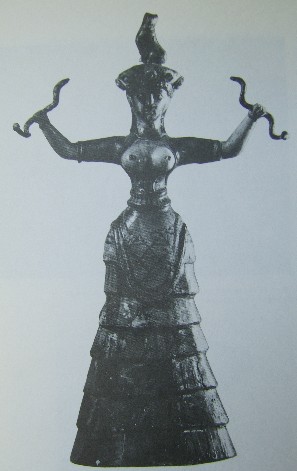
(Cretan goddess with
snakes in hand and dove on head)�
Mackenzie
(24)
had the following to say concerning the subject of the Minoan
mother-goddess worship before the advent of the Egyptian pantheon:
In Crete there were
three outstanding forms of the mother-goddess � the snake-goddess,
the dove-goddess, and the �lady of the wild creatures� � As in
Egypt, and Babylonia, it is found that one goddess tends to absorb the
attributes of the other�
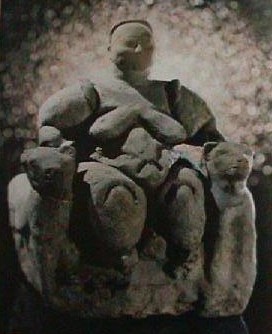
The similarities
between the Cretan, Egyptian, Babylonian mother-goddess find parallels in
several other primitive cultures from the same time. It is interesting to
note that on pre-Hellenic Crete, she was depicted in a strikingly similar
way to the Babylonian Ishtar, and is flanked by felines (as seen at
Malta and Metsamor:
Right). Mackenzie goes on to say:
�The great goddess
was depicted wearing a flounced gown suspended from her slim waist, round
which a girdle is clasped. The upper part of the body is bare, and she has
enormous breasts. Sometimes she stands on a mountain top, guarded by
two lions�. (24)
(More about
the Earth-mother goddess)
We are
told by Larousse that: �Cretan iconography is associated with the
survival of the Neolithic mother goddess, symbol of fertility with her
bare breasts, the serpent, the bull�s horns, which recur in the
architecture, and the bird, which precedes the dove of Aphrodite�. We
can see that all of these icons are repeated in the set of myths
surrounding the oracle centres, which are later imported from Egypt, and
which relate to a deeper set of myths with only a trace of memory in
them.
Herodotus noted the religious transference from the earlier
earth-mother-goddess to a pantheon of gods between Greece and Egypt, at
the same time confirming the status of Dodona as the first Greek oracle
site, and places the existence of oracles before the gods. He said:
�After a long lapse of time the names of the gods came to Greece from
Egypt� not long after the arrival of the names, they sent to consult the
oracle at Dodona about them. This is the most ancient oracle in Greece,
and at that time there was no other.�
(24)
In addition to
having been recorded as the first Greek oracle centre, Dodona has a still
greater, and older claim to fame being located at the foot of Mount
Tomaros, which is named in Greek myth as the refuge for Deucalion and his
wife, the sole survivors of the great �flood of Deucalion�. It is
within this myth that an older, perhaps hidden significance (and
connection), can be found in the location of Dodona, for while Mt. Tomaros
is the reputed resting place of the Greek ark, the Hebrews record the
final resting place of their ark as being on
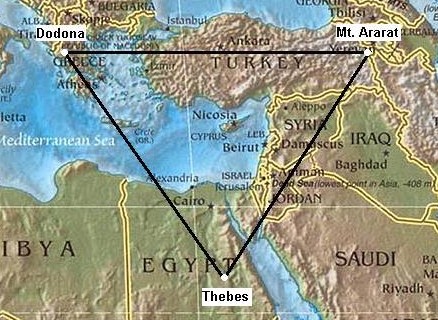 Mount
Ararat in Turkey (near Metsamor), both of which sit on the same latitude as
Dodona and happen to be equidistant from Thebes, so that the three
locations form an almost perfect equilateral triangle. It is also
interesting to note the location of the 30th parallel in
connection to this triangle, as it runs across it a third of the way its
height. Mount
Ararat in Turkey (near Metsamor), both of which sit on the same latitude as
Dodona and happen to be equidistant from Thebes, so that the three
locations form an almost perfect equilateral triangle. It is also
interesting to note the location of the 30th parallel in
connection to this triangle, as it runs across it a third of the way its
height.
Having already seen
that certain prominent sacred sites from Northern (Lower) Egypt share a
geometric and geodetic connection with the region of Mount Ararat, we can
see now that Thebes, the geodetic centre of Southern (Upper) Egypt, also
shares a similar relationship. The accuracy between the locations of these
three important sites lends favour to Stecchini�s suggestion of a
deliberate placement of ancient oracle centres. It is also apparent that
as well as having a geometric relationship, a geodetic one can be seen at
both Egyptian sites (namely, Heliopolis being on the 30th
parallel in the North, and Thebes being located exactly 2/7th�s
of the distance from the Equator to the North pole).
While it is possible
that such a geometric connection between sites may be a coincidence, the
earlier mythological connections (of earth-mother and ark) are harder to
explain. It is not possible to know if the significance of the site was
already known to the Egyptian priests at Thebes (or Phoenicians) when the
oracle at Dodona was established, but there is little doubt that the
location had a special significance from before the arrival of the
Egyptian oracles.
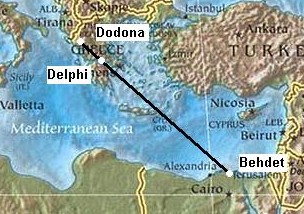 As
if to confirm that the placement of sacred sites was ordained through
geodetic principles, a look at the most famous of all Greek oracle centres
brings us to Delphi which contains a tradition of geodesy in
its origin myth, which says that it was located by Zeus who released two
birds from the eastern and western ends of the earth, with the point where
they flew past each other being considered the centre of the world and
therefore marked with an omphalus stone. As well as being located almost
exactly one degree south of Dodona, it also happens to be placed 3/7th�s
of the distance from the equator to the North Pole. Delphi also lies along
the same alignment formed by connecting Dodona to Behdet in Egypt (which
was the geodetic capital of Northern Egypt before 3,000 BC according to
Stecchini), and which sits at the same Latitude as Alexandria. It is
noticeable that as well as forming an alignment, these three oracle sites
are separated by almost exact degrees of latitude (based on a division of
360). As
if to confirm that the placement of sacred sites was ordained through
geodetic principles, a look at the most famous of all Greek oracle centres
brings us to Delphi which contains a tradition of geodesy in
its origin myth, which says that it was located by Zeus who released two
birds from the eastern and western ends of the earth, with the point where
they flew past each other being considered the centre of the world and
therefore marked with an omphalus stone. As well as being located almost
exactly one degree south of Dodona, it also happens to be placed 3/7th�s
of the distance from the equator to the North Pole. Delphi also lies along
the same alignment formed by connecting Dodona to Behdet in Egypt (which
was the geodetic capital of Northern Egypt before 3,000 BC according to
Stecchini), and which sits at the same Latitude as Alexandria. It is
noticeable that as well as forming an alignment, these three oracle sites
are separated by almost exact degrees of latitude (based on a division of
360).
Dodona (39� 30'
N. 20� 51' E)
Delphi (38� 29'
N, 22� 26' E)
Behdet (31� 30'
N, 31� 14' E)
The oracle centre at
Delos also had an omphalus (with a serpent wrapped round it), and we can
see that it too was located almost exactly one degree south of Delphi.
Delos � (37�
26� N,
25� 17� E)
It is sufficient for present to demonstrate the strength of
the connection between the regions of Mt. Ararat and that of Dodona, both
sharing the same mythological �fingerprint�, both on the same latitude,
and both equally distanced from Thebes, the ancient navel of Egypt.
However, it is clear from Santillana�s work that there is evidence of a
complex set of traditions involving the following themes: navel-stones,
Geometry and Astronomy in some way related to a flood event.
We have also seen
that the two sites for the landing of the ark are geometrically connected;
this reference to the ark leads us neatly to the aspect of
Navel-stones,
which were famously found at both Thebes in Egypt and at Delphi. In order
to understand the significance of the oracle centres it has been necessary
to look at the myths that surround them, this proves to be the case with
the Omphalii too.
|
Omphalos: (Navel stones).
Omphalus stones
have been found at several important oracle centres. (i.e. Delphi, Dodona and Thebes
(Egypt). Within these stones lies a symbolism which is almost lost to us
now.
Although not at
first apparent, the Omphalus stones from Thebes and Delphi have several
features in common through which it is possible to see the fusion of
Egyptian and Greek iconography and mythology, and the thread of an older
set of ideas.
Thebes, Egypt
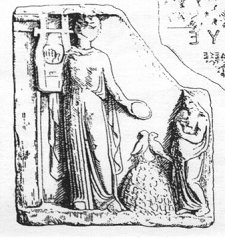
(left), Greek engraving of Delphi (Note: Apollo�s harp, Doves), (right).
Santillana
(4), offers several examples to support the association between
navel-stones and �the great flood� by referring to their function as
�plugs�; an idea typified by the following phrase �The opening of the
navel brings the deluge�. The Doves on both the omphalus above reflect
this suggestion
Service and
Bradbury
(2), state that 'Within concept of the Omphalus, there is also
implied an umbilical cord, an invisible link reaching from the depths of the
earth through the navel right up into the heavens' (Roscher 1913).
(More about
'Earth-Navel's)
|
We can
identify several features common to both the primitive
earth-goddess and the Sibyl's of ancient Greece; They were
invariably associated with the feminine, they were connected to
both serpents and doves (birds), and shared a similar set of
traditions with roots leading back to the primitive worship of an
�earth-mother� or �mother-earth�, in relation to agriculture and
harvest.
The Delphic Sibyl was a legendary
prophetic figure who was said to have given prophecies at Delphi
shortly after the Trojan War. The prophecies attributed to her
circulated in written collections of prophetic sayings, along
with the oracles of figures such as Bakis. The Sibyl had no
connection to the oracle of Apollo, and should not be confused
with the Pythia.
Like Heraclitus, Plato speaks of only one
Sibyl, but in course of time the number increased to nine, with
a tenth, the Tiburtine Sibyl, probably Etruscan in origin, added
by the Romans. (8)
|
The Maltese 'Oracle' centres.
Several of the prehistoric temples on Malta have 'oracle
holes' in them. The underground Hypogeum contains the so-called 'speaking
chamber', a depression in the wall which produces an echo which reverberates at
the same speed as the beating heart.
(More about the
Hypogeum)
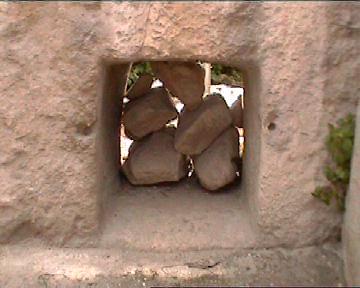
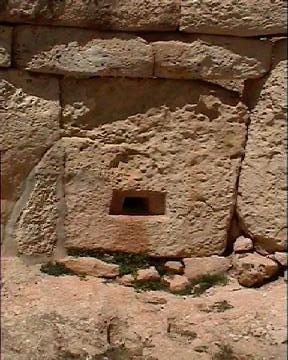
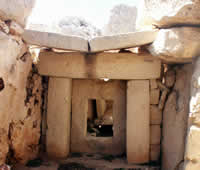
Several other temples have small holes cut neatly into the
large dividing slabs that compose the temple walls. |
|
The 'African' Heads: La
Venta.
Van Sertima suggested that one of the gigantic Olmec
stone-heads found on the Mexican peninsula may have served as a 'Talking
god'.
Extract from Van Sertima
(5):
'Four Negroid heads in all
were excavated at La Venta. The largest of the four - nine feet high -
had its domed top flattened so that it could function as an altar. A
speaking tube was found going in at the ear and out at the mouth; it
was used as an oracle, a talking god. It was also, according to
Stirling, associated with the first construction phase of the
ceremonial court.'
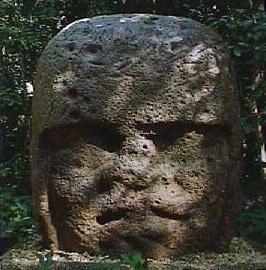
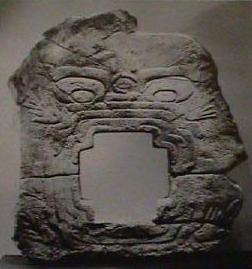
Olmec head, La Venta (Left), 'Jaguar Stone',
Mexico (Right)
The
'Jaguar Stone'
(Chalcatzingo, Morelos,
Mexico), is
another possible oracular relic.
It was found at the entrance to a natural cave and is dated from 800
to 100 BC '
(More about the
'African' heads) (Other examples
of 'Holed-Stones')
|
(Divination)
(Shamanism)
(Earth
Navels)
(Earth-Mother-Earth)
|

