|
 Pyramids:
(Form and Function)
Pyramids:
(Form and Function)
|
The Origin of the Egyptian Pyramid: |
The Egyptians were the first people we know of who built
pyramids. The standard theory for the evolution of the Egyptian pyramid
is that the shape and design developed from the mud-brick
Mastaba's of the first dynasty
(below, left), into the larger stepped pyramid, then finally the
traditional, flat-sided, stone pyramids (All in a period of around 100
years).
This
theory also lays the groundwork for the claims that pyramids were built to
house the bodies of dead pharaohs.
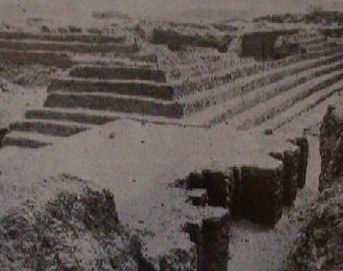
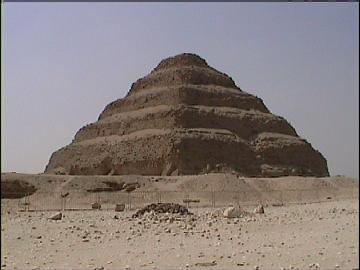
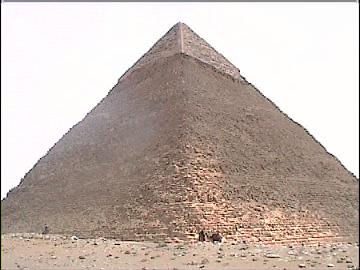
(Left to right - Saqqara-1st dynasty Mastaba
3504,
Saqqara-Djoser, Giza-Khafre)
This theory is undoubtedly on firm ground, but it is also true that
over their hundred years of development, the funerary aspects of the structures diminish at the same time at the
astronomic and geometric influences increase. For example, in the 0 - 2nd
dynasty royal cemetery at Abydoss, mounds, boat-pits and the proto-false
door can all be seen, but there is no evidence of the pyramid shape,
cardinal orientation, or polar shafts, suggesting the introduction of an
unknown influence at some time around the third dynasty.
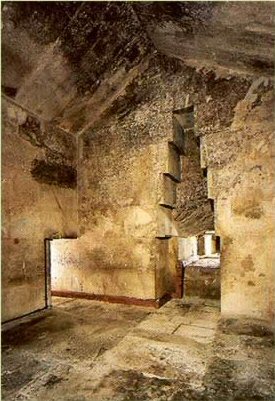
The same 'mastaba' design can also be seen in an 'inverted' form inside the pyramids.
Red pyramid, corbelled roof (left) and 'queen's'
chamber of Great pyramid (right)
What's the point - There is much talk of the 'Primeval mound' in Egyptian
text and there have been several suggestions that the Giza plateau may be a
representation of this idea. However, the primeval mound can also be said to
be represented in form by the 'ben-ben', then the
obelisk, and apart from the irritating fact that the
ben-ben
for the Great pyramid has never been discovered or recorded, it is now a
recognised fact that all the
large 3rd-5th dynasty Memphite pyramids were aligned towards Heliopolis,
or 'On'
as it is called in the Bible (More
on this subject), casting a long
shadow of doubt on the Giza/Primeval mound theory.
The Function of a Pyramid:
Although it has long been argued that the original purpose of pyramids was
exclusively
funerary. There are several facts which suggest that this theory is
not an absolute, and it is reasonably
argued that they (the Egyptian pyramids), were more complex in nature and
may never have intended for such purposes.
There have been
no original human internments
discovered from any Pyramid in Egypt. Athough this fact is countered
by the argument that the Early dynastic
pyramids were pillaged following the religious upheavals of the 5th
dynasty, this theory does not explain the lack of funerary
remains in latter pyramids or many of the design features of the
3rd-5th dynasty pyramids.
Egyptian tombs always
contained figures of
Neteru, offerings or inscriptions, which are all
noticeably absent from the earliest and largest pyramids at Giza, Dashur and Meidum pyramids. The pyramids of Giza,
Dashur and Meidum also have extremely small passages, which is contrary to
other Egyptian tombs, where ample room is provided in the passages or
shafts for manoeuvring the sarcophagi.
As well as the traditional funerary association, the Egyptian pyramids
are also credited with geometric and astronomical functions.
There is little doubt today that geometry was involved in the
design of the Giza pyramids (amongst others). The inclusion of mathematical
constants in the dimensions suggest an advanced knowledge of mathematics,
such as:
- The figure Pi ∏ (3.14), in the overall dimensions
of the 'Great' pyramid.
- 3:4:5 triangle in the dimensions of the 'Kings chamber'
and Khafre's pyramid.
- Sacred mean (1.618), in the ground-plan of the Ghiza
pyramids.
(More about the Geometry of Ghiza)
There are also several clear evidences that the pyramids of
the fourth and fifth dynasties (at least), were built to incorporate
astronomical observations, such as:
- They were all
cardinally aligned.
- They all contained 'Polar'
passages.
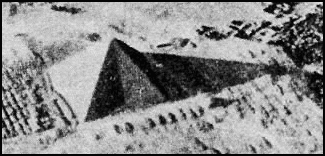
-
The design feature visible in this
overhead photo of the 'Great' pyramid at Giza, is only seen in one other
pyramid, that of Menkaure, also at Ghiza. Strangely, it was
not
used on Khafre's pyramid, which sits at the centre of the complex, and
attaches to the
Sphinx and
Valley temple via a
causeway.
(More about the Astronomy of Giza)
|
The Giza Complex.
The Giza complex has long been recognised as one of the
most spectacular achievements from ancient times. The origin and purpose
of the site has been the subject of debate for thousands of years.
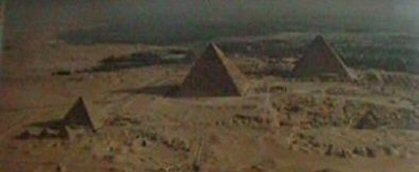
(The Giza complex)
|
|
The Dashur (Snoferu) Dilemma: |
Egyptologists believe that Snoferu, the father of Cheops, had the
following
three pyramids built for him.
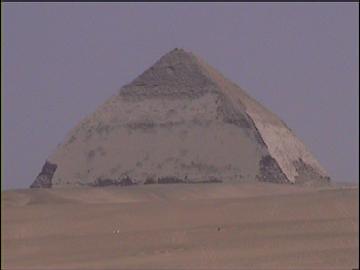 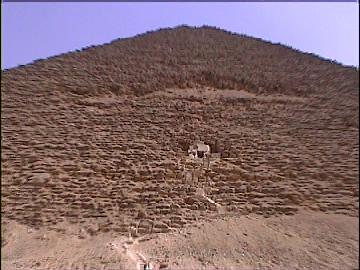

Left
to right - Dashur (Bent), Dashur (Red), Meidum.
The Dashur pyramids remained a site of worship for well over 1,000 years and Snoferu's cult was still alive in the new kingdom. The traditional names of
the pyramids are:
The Red pyramid - 'Snoferu's northern pyramid'
The 'Bent' pyramid - 'Snoferu's southern pyramid
Meidum - 'Djed Snoferu' Snoferu endures''
A decree from the time of Pepi I (6th Dynasty), which exempts the priests of
'the
two
pyramids of Snoferu' from certain taxes, was written in relation to the 'Red'
and 'Bent' pyramids at Dashur. Cartouches of Snoferu have also been found on both
pyramids (On the corner-stones and upper chambers of the 'Bent' pyramid),
but none yet on the Meidum pyramid.
Although the Meidum pyramid is associated to Snoferu by name,
archaeologists have yet to confirm the patron of this particular pyramid through
inscription. Regardless of this, we are still left with two pyramids attributable clearly attributed to Snoferu.
Why would the father of the 4th dynasty pharaohs want or need
more than one pyramid.
Snoferu is only credited with a reign of just 23 years (2,575
- 2,551 BC)
(2), suggesting that he managed to move two/three times the
amount of stone as his son, Cheops (Khufu), but in only half the time.
Each of the Dashur pyramids was built in a
completely different architectural style, with the bent pyramid showing two
separate styles alone (The bottom courses of masonry curve upwards at the
corners, while the top half are built horizontally as at Giza).
It is noticeable that the two Dashur pyramids (which
are
attributable to Snoferu) align to Heliopolis, as
do several other pyramids built in the 4th-5th Dynasties (see below).
These facts cast a long shadow on the definitive
'Pyramids as Tombs' Theory.
|
Pyramids: Cross-cultural Similarities: |
The fact that pyramid's are
found around the ancient world has led many people to suggest that they are
evidence of cross-cultural contact between peoples around the
world. The addition of associated solar worship at many 'old' and 'new'
world pyramid complexes certainly reinforces such an idea.
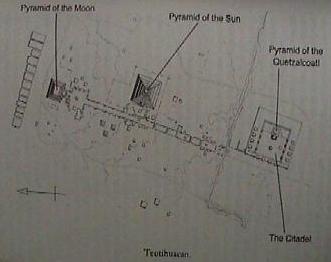
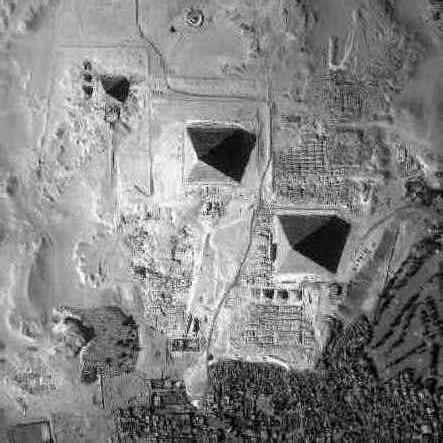
The arrangement of the pyramids at
Teotihuacan (Left),
have been compared with those at Ghiza (Right).
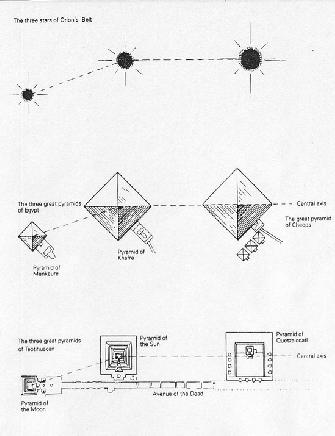
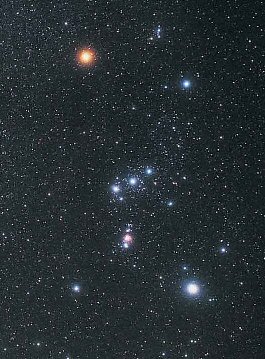
The layout of the pyramids at both complexes has been
compared with Orion's belt (Above), as have the several examples of Triple Stone-circles and
Henges in Britain such as
Thornborough and the
Hurler's. The same layout has also been
claimed at the newly
suggested pyramids in
Montevecchia,
Italy (see below)
(More about Triple Stone-circles)
(Orion Worship in Prehistory)
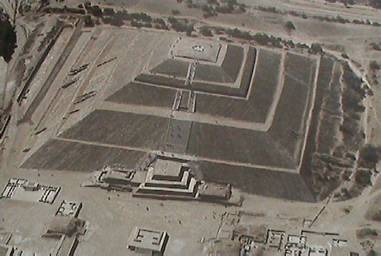

The Pyramid of the Sun at
Teotihuac�n has the same base dimensions and is half the height of the
'Great' pyramid at Ghiza. This means that the Pyramid of
the Sun incorporates 'Pi' in the following way:
(4 x
Π) x h = Perimeter / Circumference of base.
In both 'Old' and 'New' world cultures, pyramid worship
was closely associated with solar worship.
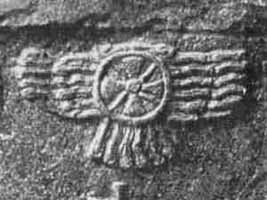
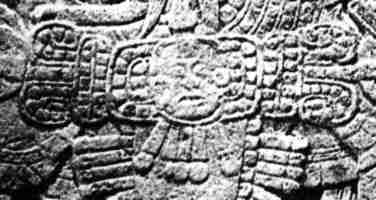
Left: Zoarastan Sun-god. Right:
Mexican Sun-god.
(Contact
between the 'Old' and 'New' world cultures)
|
The Alignment of Pyramid Corners: |
It is now realised that
the corners of many of the large Egyptian pyramids from the third to fifth dynasties
align towards Heliopolis.
 Pyramid sight lines at Abusir,
Saqqara and
Giza
Pyramid sight lines at Abusir,
Saqqara and
Giza
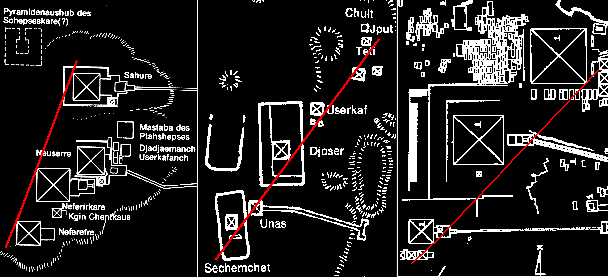
It was Hans Goedicke who made the earliest
suggestions. They were not published first in a scientific journal, but
in a newspaper in 1983. And what does the theory say? Goedicke noticed
that there seemed to be a common constructional element at several
necropolises: one corner of each structure is often on a straight line with
the same corner of other structures in the necropolis. These alignments are
found at Giza (south-east corners of Khufu, Kaphre and Menkaure), Abusir
(north-west-corner of the pyramids of Sahure, Neferirkare and Neferefre),
Saqquara (south-east-corners of Sekhemkhet, Djoser, Userkaf und Teti) - and
even between necropolises as Goedicke suggested that the east face of Userkaf's
Pyramid is aligned with the same face of Khufu's Pyramid several kilometres
to the north.
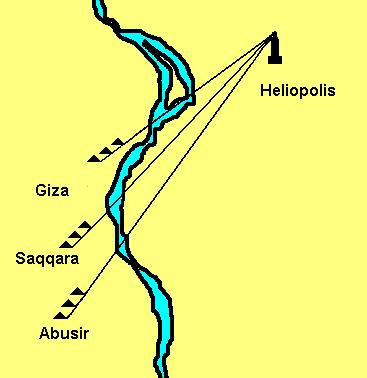
Goedicke later concluded that these sight lines were aimed at the
solar temple at Iunu (Heliopolis).
Miroslav Verner later confirmed that the south east corners
of the three Giza pyramids and the north west corners of Sahure,
Neferirkare, and the unfinished pyramid at Abusir are aligned with
Heliopolis. He suggests that these alignments intersected at the
temple of the sun god Re, at the tip of the obelisk, which may have
represented a fixed point in the world of the ancient Egyptians in
that period. (Verner, The Pyramids, 2001, p.302)
The plateau at Abu Rawash, where
Djedefre built his pyramid, is the northernmost of all the Egyptian
pyramids and was named: 'Djedfre's Starry Sky' (Verner) [2]. It is
approximately eight kilometres from and 80 meters higher than the Giza
plateau. It would have been an ideal location for viewing the sky.
An observer standing at Djedefre's pyramid looking 52.2 degrees south
of east over the Giza group would have seen Orion's belt in the sky
- 37 degrees above the Giza Plateau. At this point, the angle of the
'belt' matched the layout of the three Giza Pyramids as they would
appear to an observer viewing Giza from a position to the north.
Alnitak is below and to the left of Mintaka corresponding to G1
northeast of G3.
Continuing on the same
sight line from Abu Rawash to Giza, 52.2� degs south of east, is a 4th
dynasty pyramid named 'Neferka-is-a-Star', and a third dynasty pyramid, both
located at Zawyet el-Aryan
[3]. The line continues to
the pyramid group at Abusir and finally reaches the vast necropolis at
Saqqara.
[2] Abu Rawash is about 8
km north of Giza; Djedefre's pyramid was built between the reigns of
Khufu and Khafre.
[3] One is a 3rd Dynasty 'Layer Pyramid' attributed to
Kha'ba. The other is the 'Unfinished Pyramid'.
There is general agreement amongst Egyptologists that this pyramid was
built during the 4th Dynasty, but it is uncertain if it was built
between the reigns of Khufu and Khafre, or between Khafre and Menkaure.
(More
about Heliopolis)
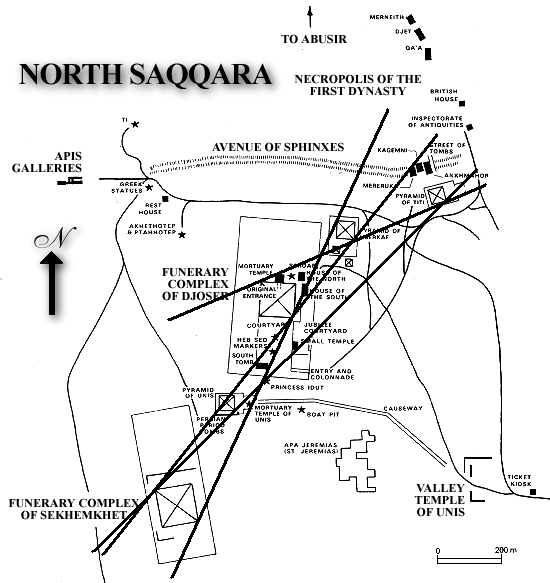
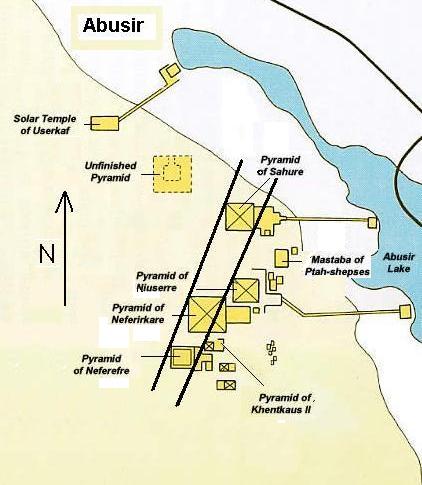 It appears that there are more alignments
to be found at each site ...
It appears that there are more alignments
to be found at each site ...
Verner notes also that at
Abusir, the 'Unfinished pyramid' was finally determined to have belonged
to Neferefre, a suggestion which finds support in its placement at the
southwest of the Abusir complex, suggesting a chronological placement. He
says:
'As a precise geodetic measurement has confirmed, its
northwest corner is on a line that already connected Sahure's and
Neferirkare's pyramids and represented the basic axis of the pyramid
necropolis at Abusir'
(3).
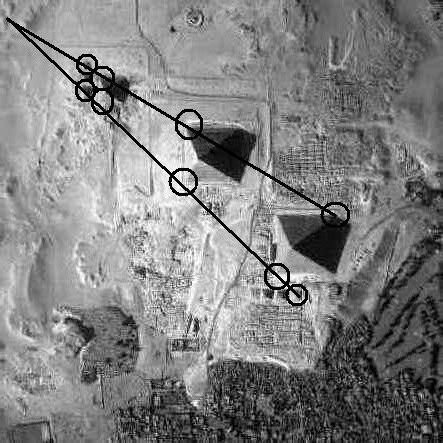
As we can see,
Giza has two sets of corner-alignments, not one.
Should we arrive at the
conclusion that there was an overall design for the Giza complex, and a
specific one too, then we are able to open our eyes to a new set of
possibilities. It is also important to determine whether the great
pyramid itself (and all of its chambers), was built from an original
design. There are various definitive studies that show exactly that.
The Great Pyramid is credited to Khufu. Following Khufu, the
chronological list of rulers who built pyramids through the end of the
25th century B.C., with the estimated dates of their reigns and the
locations of their pyramids are as follows:
| |
Khufu |
2,551 - 2,528 |
Giza |
| |
Djedefre |
2,528 - 2,520 |
Abu Roash |
| |
Khafre |
2,520 - 2,494 |
Giza |
| |
Nebka |
2,494 - 2,490 |
Z. El-Aryan |
| |
Menkaure |
2,490 - 2,472 |
Giza |
| |
Userkaf |
2,465 - 2,458 |
Saqqara |
| |
Sahure |
2,458 - 2,446 |
Abusir |
| |
Neferirkare |
2,446 - 2,426 |
Abusir |
| |
Shepsekare |
2,426 - 2,419 |
Abusir |
| |
Raneferef |
2,419 - 2,416 |
Abusir |
| |
Niuserre |
2,416 - 2,388 |
Abusir |
Userkaf and Niuserre also built large sun
temples at Abu Ghurab. Egyptologist Miroslav Verner has noted that the
diagonal line formed by the southeast corners of the three main pyramids at
Giza points towards ancient Heliopolis and that the diagonal line formed by
the northwest corners of Sahure, Neferikare and Raneferef's pyramids at Abusir
also points towards Heliopolis. As the course of the Nile moved eastward
during the dynastic period of ancient Egypt, the capital city of Memphis
also moved eastward.
A diagonal line from
the pyramid at Abu Roash to archaic Memphis has an azimuth of 51.85 south
of due east. This is the same angle as the slope of the faces of the Great
Pyramid. In between Abu Roash and Memphis, this line crosses over Giza,
Nebka's pyramid at Zawyet El Aryan, the sun temples of Userkaf and Niuserre
at Abu Ghurab, Suhare's pyramid at Abu Sir, and Userkaf's pyramid at
Saqqara.
(More about the
Geodetic Placement of
Egyptian Sites)
(The
Alignment of Prehistoric Sites)
|
Middle Eastern Pyramids (Ziggurats): |
The tradition of building in elevated stages
was common in the Middle-east, where ziggurat's were once found in most
important Mesopotamian cities. The word 'Ziggurat' is an anglicized form of
the Akkadian word Ziqqurratum, the name given to the stepped towers of mud
brick. It derives from the verb zaqaru, �to be high'.
There are 32 known ziggurats near Mesopotamia. Four of them
are in Iran, and the rest are mostly in Iraq. The most recent to be
discovered was Sialk, in central Iran. It is the oldest known middle-eastern ziggurat, dating to the early 3rd
millennium BCE.
One of the best preserved ziggurats is Choqa Zanbil in
western Iran, which has survived despite the devastating eight year
Iran-Iraq war of the 1980's in which many archaeological sites were
destroyed.
The Ziggurat of Ur, in modern day Iraq
(below) was a 'Step-pyramid', which is officially classified as a
'Solar
Temple'. The similarity in style
between Djoser's step pyramid at Saqqara
is too strong to ignore as
both structures were built with mud bricks, built in steps, and both are
surrounded by the same relief pattern on the walls (although at Saqqara this
pattern is transposed onto the compound wall rather than on the pyramid
itself as at Ur).
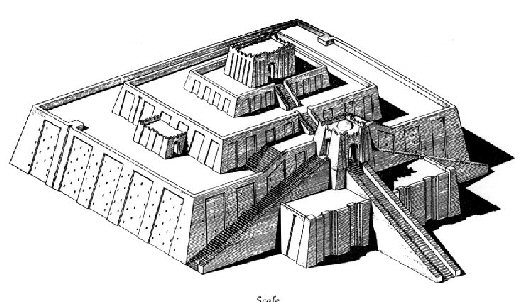
The
Ziggurat of Ur, Sumeria.
(More about the Ziggurat of Ur)
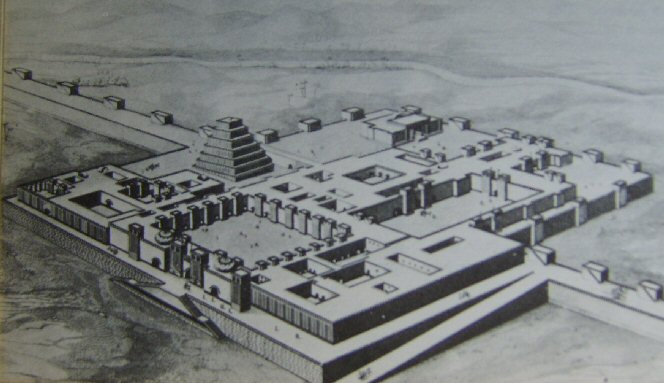
The Khorsabad ziggurat was built in seven levels, each 18 feet high, and
each was painted a different color.
The ziggurat was part of the
religious architecture found at the centre of Mesopotamian settlements
and was probably a feature of most cities after c.2000 B.C. Millions
of sun-dried mud bricks were used in their construction. Layers of
bricks were often separated by layers of reeds, perhaps helping to
spread the load or allow drainage. Baked bricks and bitumen were used
to protect the exterior from rain and wind. In Babylonia ziggurats had
a shrine on the top-most stage but it has been suggested that in
Assyria there were no buildings on the summit.
Cuneiform texts from 2100 B.C.
onwards refer to temples with seven storeys, and are described as
being like mountains linking earth and heaven. However, depictions on
cylinder seals, boundary stones, stone reliefs and clay tablets show
buildings with either four or five storeys. Some of the seals date to
the mid-third millennium B.C. which shows that the idea of a ziggurat
predates the best known and best preserved example at Ur (c.2100
B.C.).
'The Ziggurat of Nabu at Borsippa (Basipki)
was known as 'The
House of the Seven Bonds of Heaven and Earth'
and represented the cosmic link between the earthly and heavenly
planes. James Fergusson, in a History of Architecture in all Countries
(1893) wrote:
This temple, as we know from the decipherment of the
cylinders which were found on its angles, was dedicated to the seven
planets or heavenly spheres, and we find it consequently adorned with
the colours of each. The lower, which was also greatly panelled, was
black, the colour of Saturn; the next, orange, the colour of Jupiter;
the third red, emblematic of Mars; the fourth yellow, belonging to the
Sun; the fifth and sixth green and blue respectively, as dedicated to
Venus and Mercury; and the upper probably white, that being the colour
belonging to the moon, whose place in the Chaldean system would be
uppermost'
The Saqqara Complex.
Saqqara was the northern Royal
funerary complex in pre-early dynastic Egypt. 'Djoser's'
step-pyramid is considered by Egyptologist's to be the oldest pyramid
in the world. It is in-fact a 7-stepped ziggurat.
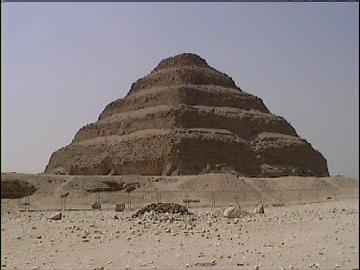
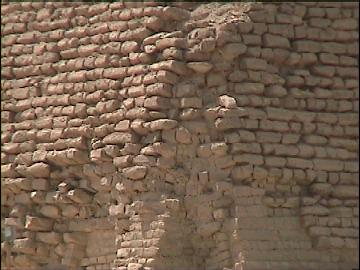
The Saqqara step-pyramid was built with
mud-fired bricks,
identically fashioned (With mud and straw packed in wooden frames), to bricks
made in Mesopotamia long before the time of Djoser.
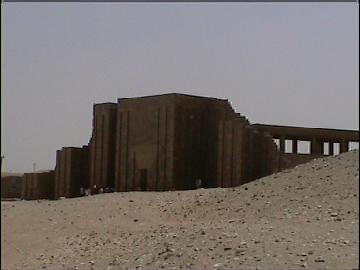
The
Photo (right) shows a part of the original enclosure walls.
(note the similarity in style to the buttress walls on the Ziggurat of Ur).
(More about
Saqqara)
Hattusa, Turkey: Capital city of the Hittite and
Hatti empires.
Yerkapi: 'The
Gate of the Earth'.
One of the most
remarkable monuments of the �Upper city� at Hattusa, is a
large oblong pyramid some 250 by 70 meters wide and 30 meters high
at the southern end of the citadel.
A kind of rampart was built on top of this platform, consisting of a
single line of walls with several towers and two gateways decorated
by sphinxes.
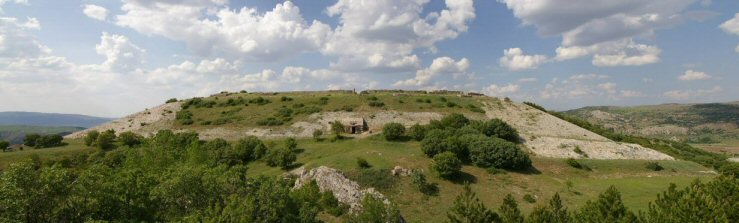
(Photo Credits: A. D. Riddle).
(More
about Hattusa)
Article:
Live
Science.com. (Feb, 2012)
'35 Pyramids Discovered In Sudan Necropolis'.
'At least 35 small
pyramids, along with graves, have been discovered clustered
closely together at a site called Sedeinga in Sudan'. They
date back around 2,000 years to a time when a kingdom named
Kush flourished in Sudan. Kush shared a border with Egypt'.
(Link
to Full Article)
In 1964, aerial photography identified nearly 1,000
pyramid sites in
Peru (1)
The oldest
'Proto-Pyramid' complex in the America's is at
Caral, in Peru.
La Venta, Mexico:
(Olmec city).
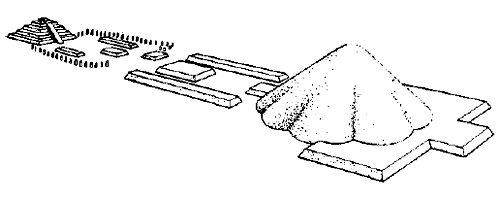
La Venta has one of the earliest pyramids known in Mesoamerica, the Great
Pyramid is 110 ft (33 m) high and contains an estimated 100,000 cubic
meters of earth fill. The current conical shape of the pyramid was
once thought to represent nearby volcanoes or mountains, but recent
work by Rebecca Gonzalez-Lauck has shown that the pyramid was
originally a rectangular pyramid with stepped sides and inset corners,
and the current shape is most likely due to 2500 years of erosion. The
pyramid itself has never been excavated, but a magnetometer survey in
1967 found an anomaly high on the south side of the pyramid.
Speculation ranges from a section of burned clay to a cache of buried
offerings to a tomb.
(More
about La Venta)
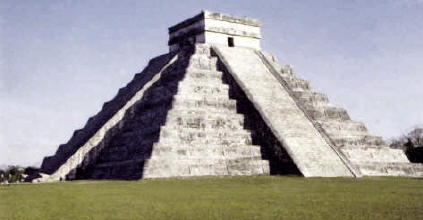 Chichen
Itza - (Abandoned Mayan city). Chichen
Itza - (Abandoned Mayan city).
The stepped pyramid-temple (Left), records
the equinoxes in a unique way. The sun creates a shadow of a huge 'snake' which
ascends the steps in spring, and descends again in autumn. Whether or not this
was a deliberate design feature is speculative, but other astronomical features
at the site certainly lend weight to the idea that it was intentional.
Each step corresponds to a day, each platform
to a Mayan month. The temple is erected above the 365 steps.
(More about
Chichen Itza)
Teotihuacan:
(The City of the Gods)
It was
suggested by Stansbury Hagar that the city had been built as a 'map of
heaven'. During the 1960's and 1970's a comprehensive mathematical survey
was carried out by Hugh Harleston Jr. He found that the principle structures
line up along the street of the dead (and beyond), and suggested that the
city was a precise scale model of the solar system, including Uranus,
Neptune and Pluto (not rediscovered until 1787, 1846 and 1930 respectively.
(21).
Both
the arrangement and the dimensions of the pyramids at
Teotihuacan (above),
have been compared with those at Ghiza
While it is true that no original
pyramid internments have been discovered in Egypt,
several have been found in Mesoamerican
pyramids. The recent discovery of funerary remains in the
'Pyramid of the Moon' is in keeping with discoveries at Mayan centres
of Palenque and Copan.
(Other
Pre-Columbian Complexes)
Cuicuilco Pyramid: Mexico.
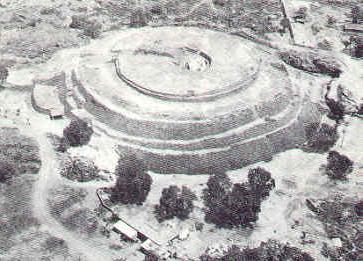 Cuicuilco
is one of the most important early Mesoamerican
sites, said to have developed in Central Mexico
during the formative period, between 700 B.C. and
A.D. 400, following which it was totally destroyed
by a volcanic eruption. Cuicuilco
is one of the most important early Mesoamerican
sites, said to have developed in Central Mexico
during the formative period, between 700 B.C. and
A.D. 400, following which it was totally destroyed
by a volcanic eruption.
According to
translations of ancient Nahuatl, Cuicuilco is
variously interpreted as the 'Place of Power' or the
'Place of the Rainbow' and the 'place where they
make songs and dances'.
Cuicuilco is the only conical or
circular pyramid in Mesoamerica, and the earliest. The population of
Cuicuilco are now believed to have migrated north to Teotihuacan.
(More
about Cuicuilco)
 The
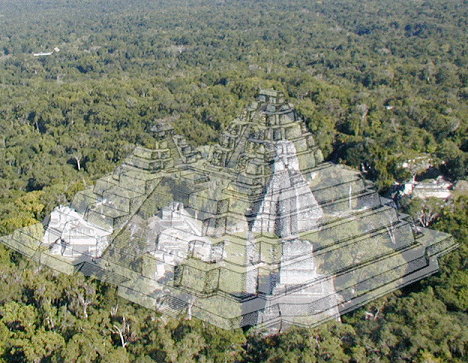
Largest Pyramid in the World: La Danta. The
Largest Pyramid in the World: La Danta.
Archaeologists are in the process of
uncovering one of the oldest and largest pyramid complexes in
Mesoamerica. The site in Guatemala is located in the Mirador Basin,
within which over 30 pyramid complexes/cities have now been
determined.
The La Danta pyramid
(left) rises approximately 70 metres (230 ft) tall from the forest
floor, and considering its total volume (2,800,000 cubic meters) is
now considered to be the largest pyramid in the world.
(More
about Mirador and La Danta)
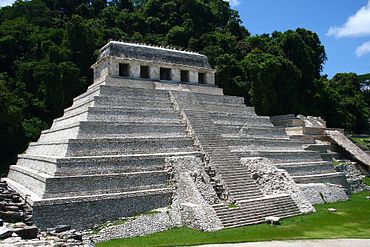 Palenque:
(Mayan Pyramid Complex) Palenque:
(Mayan Pyramid Complex)
'The
entire city of Palenque was solely a priestly centre, a place of pilgrimage'.(8) The city is laid out
in the shape of an amphitheatre, with a central pyramid. The city was
deserted in the 8th century AD, along with several other Mayan centres. Archaeologist's estimate that only 5% of the total city has been uncovered.
The Temple of Inscriptions (right)
is the largest pyramid of the complex. It was the
resting place of Lord Pakal, and offers one of the
best surviving examples of Mayan texts.
(More about Palenque)
Construction Similarities between Old-World
America and South East East Asia/ Polynesian Islands.
It has been observed that there are several
similarities between the prominent temple structures of the Old
World Americas, and those of the Asian/Pacific Islanders, as the
following images demonstrate:
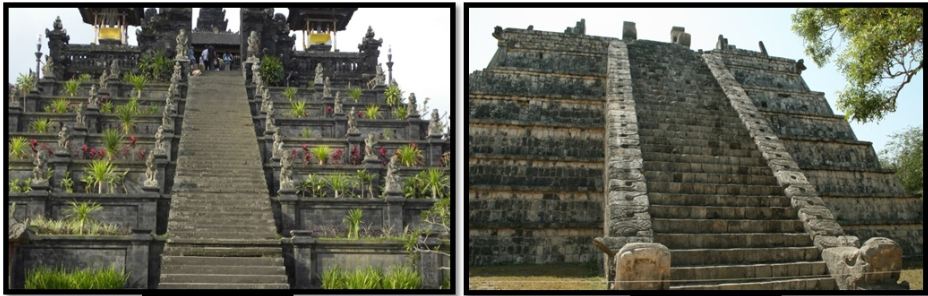
(Left) The
Mother Temple of Besakih, or Pura Besakih, in Bali, Indonesia.
(Right) The Mayan 'Ossuary' at Chichen Itza, Mexico.
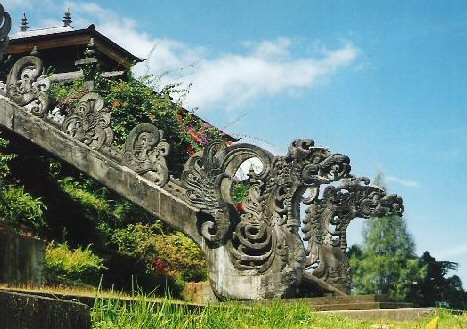
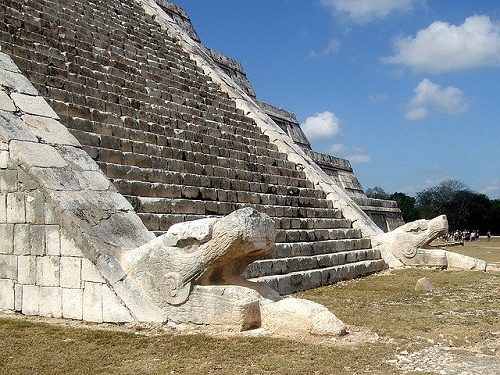
(Left) The
top of the Besakih temple, (Right) The Serpent Stairwell,
Chichen, Mexico (shadow-play transforms them into two undulating
serpents each 21st June)
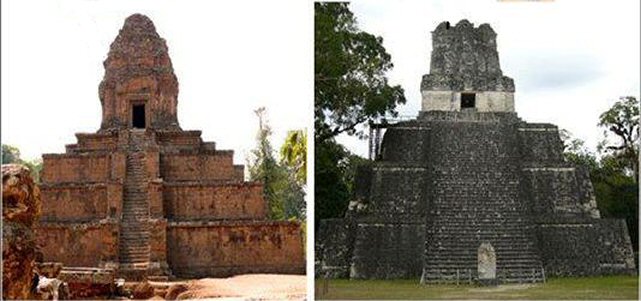
(Left) Cambodia,
(Right), Guatemala.
Deep within China near the ancient capital
city of Xi'an lies a series of pyramid-mounds virtually unknown outside the country
until last century. The Chinese pyramid fields are
now
recognised as one of the greatest pyramid concentrations in the world.
They have flattened tops, and are therefore more similar in shape to the South
American pyramids than
the pyramids of Egypt.
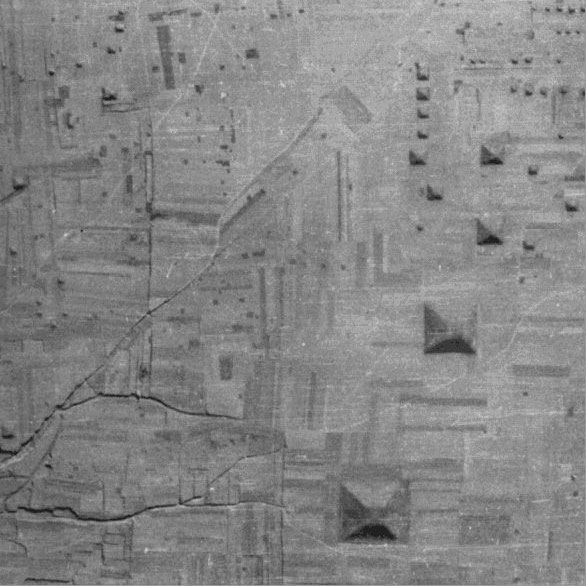
The
image above is of the Ya-sen valley, Xi'an, in which the pyramids were all
orientated cardinally.
Most of the pyramids range
from 20 to 200 ft in height and 50 to 600 feet in width. They are mostly
found in an area of concentration NE of Xi'an and they all
face exactly north, south, east and west. The oldest of these pyramids is
believed to be the tomb of
Qin shi Huangdi, first emperor of the Qin dynasty who
unified China which makes them no older than 2,500 years old.
Qin Shi Huang's
tomb
With 1,960,000 cubic metres, it is fourth largest pyramid in the
world. The pyramid at Cholula, Mexico, and the two largest pyramids at the
Gizeh plateau precede it.
Apparently, one of the first projects the young king accomplished while
he was alive was the construction of his own tomb. In 215 BCE Qin Shi Huang
ordered at least 300,000 men (The Chinese historian
Sima Qian, writing a century after the First emperor's death, wrote
that it took 700,000 men), to construct his tomb to specification.
The
�Segalen mission�, a tour of China that Segalen made in 1913, measured the
pyramid�s height at 48 metres, encompassing five terraces. One side measured
350 metres, 120 metres longer than the side of Great Pyramid at Giza,
Egypt.
The main tomb containing the
emperor has yet to be opened and there is evidence suggesting that it
remains relatively intact.
Sima Qian's
description of the tomb includes replicas of palaces and scenic towers, 'rare
utensils and wonderful objects',
100 rivers made with mercury, representations of 'the heavenly bodies', and
crossbows rigged to shoot anyone who tried to break in.
(54).
The tomb was built on Li Mountain which is only 30 kms away from Xi'an.
Modern archaeologists have located the tomb, and have inserted probes
deep into it. curiously, the probes revealed abnormally high quantities
of mercury, some 100 times the naturally occurring rate, suggesting at
least part of the legend can be trusted. Secrets were maintained, as
most of the workmen who built the tomb were killed.
(47)
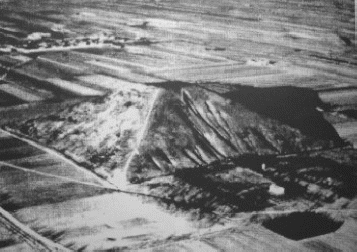
The first photos of Chinese pyramids were taken in 1945 at the end
of World War II.
Xian: Places of Historical Interest (2002),
under the section describing Maoling Mausoleum: "An
American pilot, taking photos in the air, took Maoling Mausoleum for his
discovery of a 'pyramid' in China."
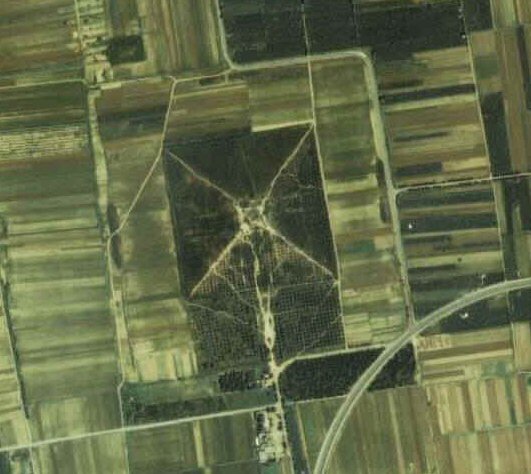
Satellite photo of the Maoling Pyramid
today.
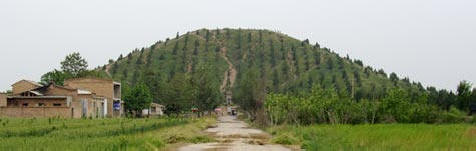
The Maoling Pyramid.
(More
about Prehistoric China)
Europe is the home to several pyramids,
with more being re-discovered each year. The following examples illustrate
that the tradition of pyramid building was far from restricted to Egypt.
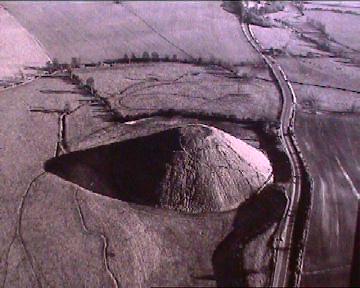 Silbury
Hill -
Officially, the Silbury Hill monument
in England is not classified as a proper pyramid. However, its smooth exterior hides the
several man-made steps which constitute the main bulk of the structure.
There is no evidence of any original internment. Silbury
Hill -
Officially, the Silbury Hill monument
in England is not classified as a proper pyramid. However, its smooth exterior hides the
several man-made steps which constitute the main bulk of the structure.
There is no evidence of any original internment.
The exterior angle of Silbury of Silbury Hill (30�), is the same as the
latitude of the Great pyramid, whose exterior angle (51� 51'), is the same
as the latitude of Silbury Hill. The flattened top has the same diameter as
the Stonehenge sarsens.
(More
about Silbury Hill)
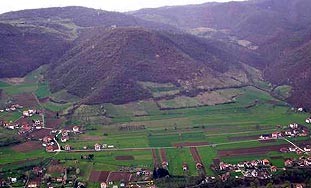
These (still unconfirmed) pyramids
have been discovered in Bosnia -
Near the city of Visoko, 30km north of Sarajevo, there are
five
stone pyramids of monumental size, claims the Bosnian archeologist Semir
Osmanagi�, who lives and works in the USA.
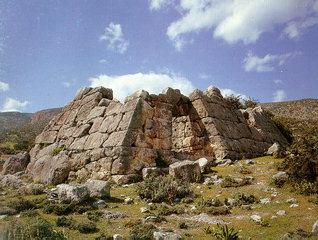
Greece - At least
16 ancient pyramids are known across Greece. Examination by 'Optical
Thermo-luminescence' has determined that the oldest one dates to a
staggering 2,720 BC.
http://www.ancientgr.com/Unknown_Hellenic_History/
The results were published in 1995
by the Academy of Athens following dating measurements performed by
the Laboratory of Archaeometry at Dimokritos Research Institute in
Athens and by the Nuclear Dating Laboratory of the department of
Physics at the University of Edinburgh in Scotland.
Pausinius from the 2nd Century AD
wrote of them: "
...walking on the road away from from Argos towards Epidaurus there
is a pyramid structure on our right, it is adorned with shields in
the Argolic style..."
he continues to say that the pyramid was erected after the
fratricidal battle between the twin brothers, Proetus and Akrisius,
during a war of succession following the death of their father, king
Avas of Argos. The battle ended in a deadlock and the pyramid was
erected as a burial monument in honour of the fallen in this battle.
(More
about Prehistoric Greece)
Lastly -
News of
another European discovery was recently proposed: Three 'pyramids'
were discovered thanks to satellite and aerial imagery in northern Italy,
in the town of Montevecchia - 40 km from Milan.
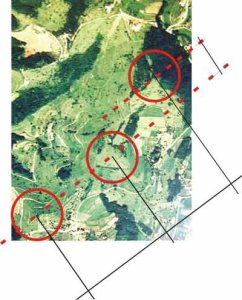 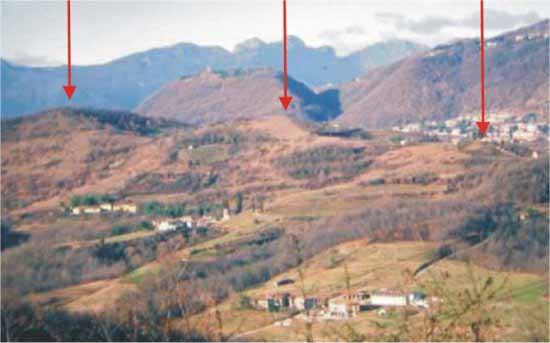 They
are the first pyramids ever discovered in Italy and the dimensions are
quite impressive; the highest pyramid is 150 meters tall. They are stone
buildings, as recent excavations have proved. However, they are now
completely covered by ground and vegetation, so that they now look like
hills. They
are the first pyramids ever discovered in Italy and the dimensions are
quite impressive; the highest pyramid is 150 meters tall. They are stone
buildings, as recent excavations have proved. However, they are now
completely covered by ground and vegetation, so that they now look like
hills.
The inclination degree of all the three pyramids is
apparently 42�
43' (As seen on the 'Bent' and 'Red' pyramids at
Dashur) and it has been
suggested that there is a perfect alignment with the Orion constellation (a
suggestion which appears valid, if the photo - right is correct).
There appear to be similarities with the Egyptian pyramids. At the moment,
little is known about their origin or age.
(More
about Orion Worship in Prehistory)
|

