|
Anomalous Artefacts:
The archaeological
revolution of the last two hundred years has unearthed some amazing discoveries
from
the world over. When on occasion, artefacts are found which have no
historical context, their presence is often assumed as either completely false or
mistaken.
These objects belong to an ambiguous category labelled 'Anomalous
artefacts'.
Anomalous artefacts can be
divided into three categories:
Evidence of Pre-historic Science and Technology
- Artefacts from this
category exhibit evidence of the application of apparently lost sciences and technologies from
before their 'official' discovery.
Evidence of Cross-culturality
- Artefacts from this category are objects found in the wrong places. They provide
evidence that suggest a level of cross-cultural association occurred
between ancient prehistoric cultures.
OOPArts
- The last category are
anthropomorphic discoveries found within strata
dated from before humans are believed to have existed. They are classified as 'Out
of Place Artefacts', or 'O.O.P.Art's'.
|
The unknown nature of the artefacts that compose this
particular field of research makes it imperative to keep both an objective
and open mind when looking at them. In recent times, several artefacts have,
in fact, proven themselves to be forgeries, a fact which cannot be ignored.
It is worth looking at some examples of these now:
Coso artefact - The Fossilised spark-plug -
The similarity between this artefact and a 1920's Champion spark plug
demonstrates how easy it is to be misled and the importance of rigorous
research... ( More about the Coso artefact)
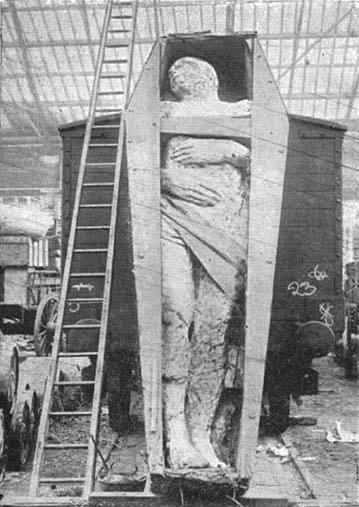
Giants - There are references to giants in some of
the worlds oldest texts and several discoveries appear to confirm their
existence, but there are also some giant fakers out there...( More
about giants)
(More on the subject of fake artefacts soon...)
The debate over
the origin and extent of astronomical knowledge still rages.
While many historians still believe that megalithic structures
were built primarily for funerary purposes, there is now enough
evidence to show that our prehistoric ancestors were extremely
well acquainted with the heavens.
|

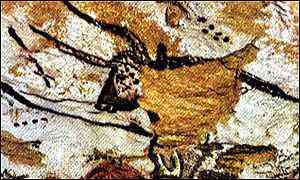
At 16,500 years old, the
Palaeolithic maps of the
night sky, discovered on the walls of the famous painted caves at Lascaux in
central France, include
representations of Pleiades, Orion and a possible lunar count. (1) It is
just one of a growing number of Palaeolithic evidences of astronomical
observation.

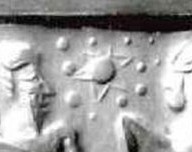
The thousands of astronomical texts unearthed at the
great library of Nineveh testify to the importance of astronomy to the
Sumerians. Does this Sumerian seal (VA/243), represent a knowledge of the
planets in a heliocentric solar system. There are many that argue it can
show nothing but...

The great megaliths themselves are prehistoric artefacts, which have now
been shown to have served as astronomical tools.
Stonehenge was
constructed on the exact latitude so that the lunar and solar cycles had
their extreme settings at 90 °
to each other, it also had the potential to predict eclipses. (Hawkins)

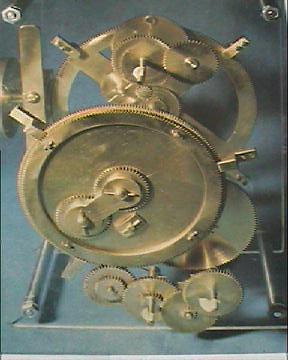
The Antykithera astrolabe (right) was found fossilised, in a
shipwreck dated to 85 - 50BC.
The gear wheels
of this mechanism were proportioned to show the movements of the
sun, moon and planets. The gears could be moved backwards and
forwards, making the device able to calculate the
positions of planets in the sky at any required date.
(More Archaeo-astronomy) |

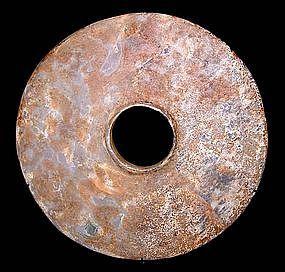
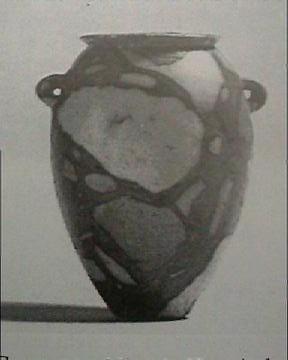
The
Egyptian dynasties produced several enigmatic artefacts which continue
to defy a satisfactory explanation. The schist disc on the right can
be seen at the Cairo museum in Egypt, where it is officially classified as
an 'incense burner' although there are no other similar artefacts to
support this supposition. The Egyptian skill with stone produced some
incredible results...
(Other examples of extreme Egyptian
masonry)

Chemical analysis of Egyptian
mummies has determined that they contain large amounts of plant material,
including tobacco and cocaine, apparently unknown in Egypt at the time. In fact,
the only source has always been across the Atlantic from North and South America.
(Old
world - New World Contact)
(Prehistoric Drug-Use)
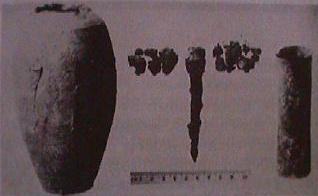
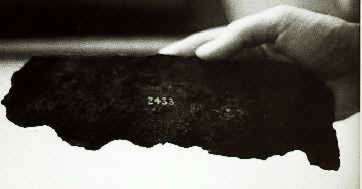
The Iron-plate -
According to the textbooks, it was only around 1,200 BC that it became
possible to make a furnace hot enough to smelt iron. Yet in 1838, the
English explorer Col Richard Howard Vyse discovered an iron plate
embedded in the structure of the
Great Pyramid
in Egypt, an edifice traditionally dated to about 2,600 BC. Subsequent
tests showed the plate to have very low carbon content, proving it
could not have come from a meteorite (the only known source of iron in
ancient Egypt) but must have been smelted.
(More about the Iron Plate)
Prehistoric S ciences:
|
Crystals
The human fascination with crystals
extends back to antiquity, as evidenced by the discoveries of crystals
placed with burials all around the ancient world. Were the builders of the
megaliths aware of the electrical properties of crystals when they dragged
their huge granite stones to locations sometimes hundreds of miles away, as
in the case of
Stonehenge. Why were
mica sheets sandwiched between two courses of masonry in
Teotihuacán
pyramids and what about those crystal skulls.
(More
about Crystals)
|
|
Electricity

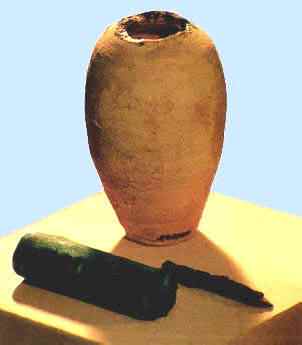
Batteries - While there is no suggestion that
electricity was ever used in the capacity it is today, the Iraqi batteries
(right), date from 500 BC, and were clearly
constructed for a purpose...
More bizarre still is the discovery electroplated
copper vases from Sumerian sites in Northern Iraq, dating around 2,000 BC
(2).
(Ancient Electricians) |
|
Cartography
Global Mapping Projects -
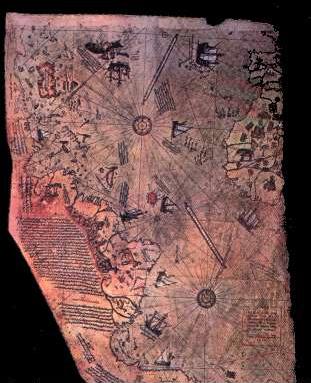
Possibly one of the most
significant finds in modern time. The
Piri-reis map
(right) shows the coastlines of
both the American and Antarctic continents.
The map indicates an
inherent knowledge of the World as a sphere and the application of 'higher
maths' to convert observed longitudinal and latitudinal points onto a
two-dimensional format.
As the Antarctic
continent has been concealed by ice since approximately 6,500 B.P, this map
alters all previous conceptions of the abilities of our pre-historic
ancestors.
(Prehistoric
Navigation)
(Prehistoric Navigation)
|
|
Astronomy
Fossilised
Computational Device (Astrolabe) - The object on the
left,
has been reconstructed from its original encrusted form. It was originally
capable of calculating the positions of the planets in relation to the
sun.
Find out more about this machine, its
place in history, astronomy and the megaliths, and a look at the path of human
astronomical achievements.
(Ancient
Astronomers)
|
|
Magnetism
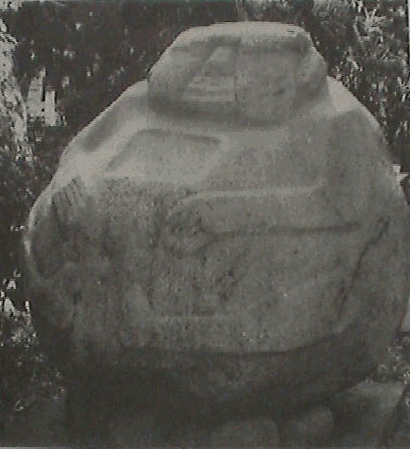
The 'Fat-boy'
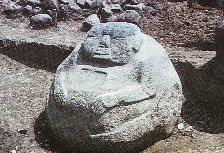
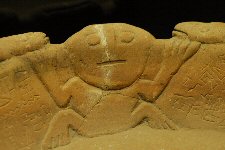
- The carved stone in the
photo (right) is called the 'Fat-boy', and is from La-Venta
in Mexico. The figure has been determined to be naturally magnetised in
the temple and navel areas. One of many surprises from this
mysterious ancient Olmec site.
Examine samples of magnetic
archaeological discoveries, and look at the use of magnetism in the
orientation of ancient sites.
(More about Magnetism
)
|
|
Surgery
Examples of prehistoric human surgery are
found all around the ancient world. Sophisticated surgical procedures
have been carried out, it seems, for the last 20,000 years. Open-heart
surgery, dentistry and the common procedure of 'trepanning', amongst
others, reveal an intellectual and objective approach to illness, with
similar procedures appearing around the globe.
(Prehistoric Surgeons)
|
Metallurgy
Metsamor - Forget all
the pre-conceived ideas of 'Copper age' and 'Iron age' people. Evidence
from
Metsamor in Turkey has shown that
metal processing was occurring as early as 5,000 BC, while several
hammered copper items have been found at nearby
Çayönü,
dated at 7,200 BC.
The casting in the photo on the right is from the
Harappan culture in Pakistan, dated 2,500 - 2,000 BC.
(Ancient
Metullurgists)
|
|
Acoustic
Phenomena
The suggestion that sonic
vibrations may have been understood and 'used' in the ancient past is taken
more seriously in light of modern technology, which has now also
managed to achieve the impossible. The idea that the testimony of Tibetan
monks, the collapse of the walls of Jericho, and other stories from history
might have some substance to them, has led us to create a page dedicated
to this subject.
(More about acoustic
phenomena)
|
|
|
Featured Items.
Phaistos Disc.
Electricity.
Giants.
OOPArts.
Acoustic Phenomena.
Magnetism.
Crystal
Skulls.
Piri Reis
Map.
Flight.
Antikythera Object.
Holed-Stones.
Stone
Heads.
Stegosaurus.
Indian Maize.
Fuene Magna.
Carved
Stone Balls
Top-50 Stones.
|
|
O.O.P.Art's
Out of Place Artefacts
-
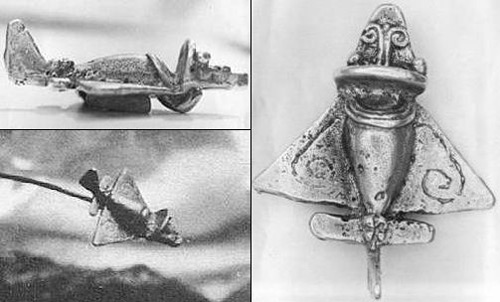
As well as the numerous prehistoric artefacts listed in the pages above,
there exists a second category of discoveries, which are considered so 'Out
Of Place' that they challenge the ideas of human
development in that they are generally found in strata belonging to a time
before
humans are believed to have existed. This whole idea has upset both
geologists and historians who are still scratching their heads over
discoveries such as the fossilised artefact in the photo (left), which
certainly appears
to be a hammer.
(O.O.P.Art's Gallery page)
|
|