|
 Magnetism:
(The ancient use of)
Magnetism:
(The ancient use of)
|
Although
there are only a few artefacts to prove the case, the
following few examples suggest that the properties of
magnetism were
understood by our ancestors.
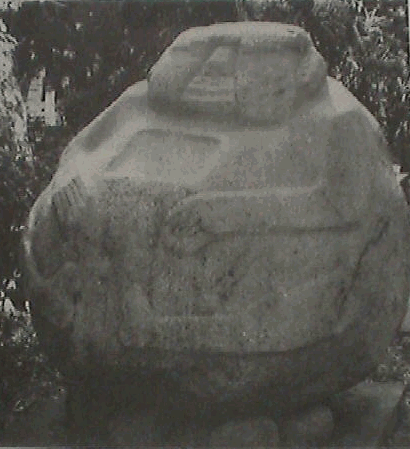
The rock on the right
is one of several which are now realised to have been carved around
naturally magnetic stone in both the navels and temples of stone carved figures
of people and animals.
It is completely
unknown how such properties were recognised at such an early time in
Meso-American Guatemala but there is no doubt that that they were,
making these magnetised statues one of the first conclusive evidences of
an understanding of the properties of magnetism by prehistoric people.
|
 |
| Chronology of Magnetism
in History: |
The Chinese Application of Magnetism:
2,637 BC - "This date has been conclusively
shown to be the earliest one at which history notes anything resembling
the application of the magnetic influence. It is related that, during
this sixty-first year of the reign of Hoang-ti (Yeou-hioung-che, also
named Koung-fen and Hiuen-yuen), the emperors troops, who were pursuing
the rebelious prince Tcheyeou (Tchi-yeou), lost their way, as well as
the course of the wind, and likewise the sight of their enemy, during
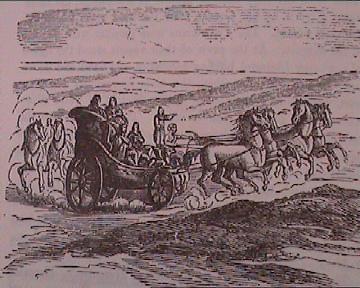
the heavy fogs prevailing in the plains of Tchou-lou. Seeing which,
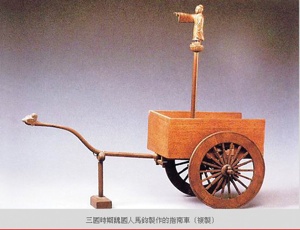
Hoang-ti constructed a chariot upon which stood erect a prominent female
figure which indicated the four cardinal points, and which always turned
to the south whatever might be the direction of the chariot. Thus he
succeeded in capturing the rebellious prince, who was put to death.
Some say that upon this chariot stood a needle, to
denote the four parts of the world. That, states the French author
writing in 1736, would "indicate the use of a compass, or something very
similar to it ... and it is unfortunate that the device has not been
explained more fully." (3)
1,110 BC - Tcheou Koung is said to have at this
date taught the use of the needle and compass to the envoys from
Youa-tchang. "As the ambassadors sent from Cochin China and Tonquin" (Humbolt,
"Cosmos," Vol. V. p. 51) "were about to take their departure2 (which was
in the twenty-second cycle, more than 1040 years BC), "Tcheou-Koung gave
them an instrument which upon one side always turned towards the north
and on the opposite side to the south, the better to direct them upon
their homeward voyage. This instrument was called tchi-nan
(chariot of the south), and it is still the name given to the compass,
which leads to the belief that Tcheou-Koung invented the latter." In his
chapter on "the magnetic needle," Humboldt says the apparatus was called
fse-nan (indicator of the south). (3)
(More about
Ancient China)
|
The Olmec Application of Magnetism:
|
2,000 B.C.
- One of the several so called 'Fat-Boy's'
from Guatemala. This one (below) is 6ft high and was found to have magnetised stone at
both the temple and navel.
The 'Monte Alto' culture in Guatemala are often termed as 'Pre-Olmec', and
there are suggestions that the culture may have its roots in the 'Monte
Alto' region.
Many of
the Monte Alto sculptures are magnetic as well. In as much as certain
distinctive patterns of magnetism recur with some frequency, it would appear
that the sculptures were executed by artisans who were aware of these
properties. If this is true, the Monte Alto sculptures no doubt deserve
recognition as the oldest known magnetic artefacts in the world.
Of the
collection of "fat boy" sculptures from Monte Alto on display in the town
park of La Democracia, Guatemala and in front of its local museum, four of
the heads and three of the bodies were found to have magnetic properties.
All four of the heads have a north magnetic pole located in their right
temples, while three of them have south magnetic poles below the right ear
and the fourth (that in front of the museum) has a south magnetic pole in
its left temple, Such a pattern of occurrence is unlikely to be a matter of
chance, even in a sample size as small as four.
(The La Venta Stone Heads)
The "Fat Boys" assembled in La Democracia
and the turtle-head found at Izapa do not exhaust the examples of magnetic
sculptures found in Soconusco, however. Among the assortment of stone
carvings brought together in the open-air "museum" at the El Ba�l sugar
plantation in Guatemala are not only the third-oldest known Long Count
inscription but also at least two statues possessing magnetic properties.
One of these (discovered in 1979) depicts two men sitting cross-legged on a
bench with their arms crossed on their chests. Both men have north magnetic
poles where their arms cross, while under the bench upon which they sit are
two south magnetic poles - the pole below the man on the left, as one faces
them, being more pronounced than that beneath the man on the right. Nearby,
a well-fashioned likeness of a rampant jaguar was found to have north
magnetic poles in both of its paws, but no discernible south poles. Finally,
a small humanoid sculpture situated in the plaza of the village of TuxtIa
Chica near Izapa was found in 1983 to be magnetic in the right side of its
head. (6)
(More
about Pre-Columbian Guatemala)
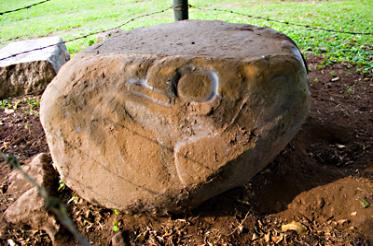
Izapa ruins, Chiapas
State, Mexico (Mayan Sculpture)
The stone (left) is
magnetically polarised with the exact centre of the nose attracting a
compass needle, the mid section repelling the needle and the end section
away from the nose, attracting the south end of a compass needle.
Although we have no idea
how such properties were recognised in the first place, there is little
doubt that they were. It has been loosely suggested that this figure might
have some association with the homing instincts of turtles.
(6)
Malmstrom
speculates the magnetism may have been the magical power by which
sea turtles found their way across great expanses of ocean. (He also
suggests that the magnetic turtle may hint at Olmec contacts with
the Chinese, since they also made their early compasses in the shape
of turtles.)
(More
about Ancient China)
1 ,000 B.C.
-
It has been established that
this fragment (34 x 9 x 4mm), was part of a larger bar. It has been polished
on each face, and has a groove running 'approximately and possibly
intentionally parallel to the edges' along one of the flattened-faces.
If its function was to serve as a directional finder (as is commonly
supposed), the longer its original length, the more accurate the reading
would have been. Under experiment, it repeatedly provided a consistent
bearing (to within 1/2�), using a 'stadia-rod' at 30m.
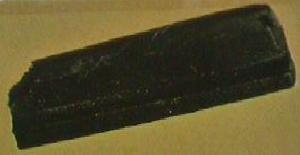
This naturally magnetic square metal fragment (M-160)
points 35.5� West of magnetic
North (when made to float). It was found in an Olmec mound in Vera Cruz,
Mexico.
All of the roughly dozen
magnetic sculptures which are known from Mesoamerica. are found within the
volcanic bedrock zone of piedmont Soconusco. Several other areas of volcanic
bedrock exist in Mesoamerica, such as in the Tuxtla Mountains and along the
Transverse Volcanic Axis which runs across the center of Mexico from
Citlalt�petl (Orizaba) in the east to Volc�n Colima in the west; however, in
none of them did the local inhabitants recognize the presence of magnetic
iron ore as they apparently did in Soconusco. Because magnetism appears
always to have been associated with relatively massive stone carvings which
could not be easily moved, the knowledge of this force seems never to have
diffused beyond the region. (6)
In 1983, a small
humanoid sculpture in the plaza of Tuxla Chica, Mexico was found to be
magnetic in the right side of its head.
(7)
(More
about Ancient Mexico)
Greek Application of Magnetism:
Pliny relates that the Egyptians were aware of magnetism.
He wrote that:
'..the temple of Arsinoe was to
have been vaulted with magnetic stone, in order to receive a hovering statue
of Arsinoe made of iron, according to the arrangement of Ptolemaus
Philadelphus, but who, as well as the architect, died before the completion
of the temple..' (3)
Cedrenus says that an ancient image in the
Serapium at Alexandria was 'suspended by magnetic
force'. (3)
Cassiodorus stated that 'in the temple of
Diana hung an iron Cupid without being held by any band'.
(3)
Socrates said of it in Plato's "Ion" c.
380 BC.
Speaking well about Homer is not a thing you
have mastered, it's a divine power that moves you, as a "Magnetic"
stone moves iron rings. (That's what Euripides called it; most
people call it "Heraclian".) This stone not only pulls those rings,
if they are iron, it also puts power in the rings, so they in turn
can do just what the stone does
- pull other rings
- so that there is sometimes a very
long chain of iron pieces, hanging from one another. And the power
in all of them depends on this stone.
And Manetho wrote the following profound statement in
relation to magnetism..
'for like as iron drawn by a stone
often follows it, but often also is turned and driven away in the opposite
direction, so also is the wholesome, good and regular motion of the world.'
(3)
(More
about Ancient Greece)
At around c. 500 BC in ancient India, the
Indian surgeon, Sushruta, was the first to make use of the magnet for
surgical purposes. (5)
(More about
Ancient India)
|

