The use of electricity before the 20th century has been proven beyond
refute by the numerous examples of 'batteries' found in the middle-east,
dating from approx 250 BC. These are the earliest absolute proofs of the
use of electricity, although they represent the result of objective
experimentation at a time when there seems little or no purpose for it.
At present, there seems to be only one candidate for such
a science, which is the electroplating of objects with fine layers
of gold or silver. The earliest potential example of this art is from
Sumeria, at about 2,000 BC, over a thousand years earlier than the
discoveries of any batteries, offering more questions than answers over
the presence of these electroplated objects.
2,500 -
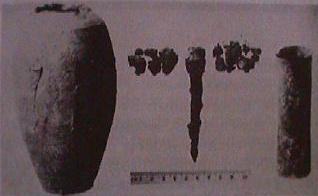
2,000 BC - The oldest example of the use of electricity is the Copper
Vases, electroplated with silver were once to be found in the Baghdad
museum. They had been excavated from Sumerian sites in southern Iraq.
(9)
Ancient Egypt -
Unconfirmed electroplated objects
were reportedly found in Egypt by the 19th Century French Archaeologist August Mariette. Excavating in the area of the
sphinx at Ghiza. Mariette came upon
a number of artefacts at a depth of 60ft. In the 'Grand Dictionaire
Universal du 19th Siecle', he describes the artefacts as "pieces of gold jewellery
whose thinness, and lightness make one believe they had been produced by electroplating"
(2)
The
renowned astronomer Sir J. Norman Lockyer, who studied ancient Egyptian
temples and tombs in depth, In his Dawn of Astronomy, in 1894,
pointed out an enigma of the time�when he wrote:
"In all freshly-opened
tombs there are no traces whatever of any kind of combustion having taken
place, even in the inner-most recesses. So strikingly evident is this that
my friend M. Bouriant, while we were discussing this matter at Thebes,
laughingly suggested the possibility that the electric light was known to
the ancient Egyptians."
Ancient India - In the Prince's Library of
Ujjain in India, there is a well preserved document called the 'Agastya
Samshita', which dates back to the first millennium BC. It contains a
detailed description not only of how to construct an electric battery/cell,
but also, how to utilize the battery to 'split'
water into its
constituent gasses.
(2)
The text runs as follows:
�Place a well-cleaned copper plate in an
earthenware vessel. Cover it first by copper sulfate and then moist
sawdust. After that put a mercury-amalgamated-zinc sheet on top of an
energy known by the twin name of Mitra-Varuna. Water will be split by
this current into Pranavayu and Udanavayu. A chain of one hundred jars
is said to give a very active and effective force.�
South America - Two 90ft Sq.
Sheets of 'Mica' were found sandwiched between horizontal courses of a
pyramid in Bolivia at
Tiahuanaco
early in the 20th century. One was broken up and sold to the electrics
industry, the other remains in situ. (Mica is an insulator and was
commonly used as a dielectric in capacitors up to recent times).
The nearest source of Mica is hundreds of miles away in the Amazon basin.
600 - 580 BC - Thales of Miletus, Ionia, one of the
"seven wise men of Greece" (the others being Solon, Chilo, Piccatus, Bias,
Cleobolus and Periander), founder of the Ionic Philosophy, and from whose
school came Socrates, is said to have been the first to observe the
electricity developed by friction in amber.
(3)
320 BC - A Ptolemaic
inscription describes how wooden flagstaff's, 30m tall, were placed in front
of temples and capped with a sheath of copper, and used to 'Cut the
lightning from the sky'.
(2)
China - 265-31 BC - An
Aluminium 'Girdle' was recovered from the tomb of the Chinese general 'Chu',
which is made from an alloy of 85% Aluminium, 10% Copper and 5% Manganese.
The only known viable method of producing aluminium from Bauxite is in an electrolytic process, after Alumina (The Aluminium Chloride component of the
ore) is dissolved in molten 'Cryolite', patented in the last century. (Note
- The Baghdad batteries (above), are not sufficient for this process, as
a substantial dynamo-generated current is required).
2nd Century AD
- Pausanius wrote that the 'Temple of Minerva had a light that could
burn for over a year'.
(2)
Electric Cells
(The 'Baghdad batteries')
-
(AD 225-640)
One of several substantiated
archaeological discoveries which suggest an
understanding of the properties of electricity over 2000
years ago. The discovery of contemporary electroplated
jewellery in the same region lends to the theory that
Sadly these relics were lost to the world during the looting of the Baghdad
Museum in 2003, during the invasion of Baghdad.
354-430 AD
- St. Augustine claimed that in an Egyptian temple dedicated to Isis (Venus), a lamp burned
which neither wind nor water could extinguish.
He said of it:
That in Egypt...�There was, and still is, a temple of
Venus, in which a lamp burns so strongly in the open air that no storm or
rain extinguishes it.� He blamed the cause of this marvellous lamp,
which was likely an arc light, on the miracles of the �black arts� performed
by demons and men.
(2)
13th Century AD -
When the Sepulcher of Paris was opened near Rome in the early 1400's, it was
found to be still lighted by a lantern, which had presumably been alight for
over 2,000 yrs.
(2)
13th Century AD - Eliphas
Levi, in his 'Histoire de la Magie', records the story of a
mysterious French Rabi named Jechiele, who was an advisor to Louis IX.
Jechiele's contemporary's reported that he often astounded the King with his
"Dazzling lamp that lighted itself".
The lamp possessed no oil or
wick, and Jechiele placed it in front of his house for all to see.
Interestingly, another device he was reputed to have had was a door knocker
that was ale to produce an electric shock.
(2)
Electricity in Ancient Greece:
The first written
record concerning electricity, which is still extant today, is that of
Theophrastus who was writing around 300 BC. Not only amber but also
lyncurium had the power, when rubbed, of attracting straw, small
pieces of stick, or even small bits of copper and iron. The lyncurium
of Theophrastus is the tourmalin of today. Pliny in his writings
mentions several times the attractiveness which amber possessed.
(3)
Electric fish were used for medicinal purposes in Greek and Roman
times for relieving headache and gout. Scribonius Largus wrote long
ago, �For any sort of foot gout, when the pain comes on it is good to
put a living black torpedo fish under his feet while standing on the
beach, not dry but one on which the sea washes, until he feels that
his whole foot and ankle are numb up to the knees.�
(1)
In ancient Greece,
Egypt, and Rome, electric eels were used to treat arthralgias,
migraines, melancholy, and epilepsy. In 50 AD, Scribonius Largus
reported treating headaches and gout with electric torpedo fish.
And Finally:
Christmas tree lights
powered by an electric eel. (Refer to image at top of page..?)
1)
http://www.answersingenesis.org/creation/v16/i2/battery.asp
2).
Rene Noorbergen.
Secrets of the Lost Races.
1977.
New English Library.
3).
Paul. F. Mottelay. Bibliographical History of Electricity and
Magnetism. 1922. Charles Griffin and
Co.

 Electricity: