|
 Crystals:
(The Prehistoric Use of)...
Crystals:
(The Prehistoric Use of)...
The fascination and reverence
for crystals is not a recent phenomena...
|
Crystals
are associated with human funerary rituals dating back from at least the
Lower Palaeolithic era.
|
|
Chronology of Crystal Use: |
Homo Erectus
Pekinensis: (c. 500,000 B.C) Quartz tools and numerous pieces of quartz crystal found with remains
of 'Peking Man' in Zhoukoudian, Beijing.
(7)
According to the original excavation
report, more than 10,000 stone tools have been recovered since
the site was first excavated in 1921. Forty-four different raw
materials were used by the ancient inhabitants of the cave, and
89 per cent of this raw material is quartz. The remainder of the
raw materials used includes 5 per cent rock crystal.
(8)
Article:
Crystal
Artefacts
Unearthed
In a Palaeolithic Cave
in China:
'It was
announced in a press conference held on 8 August 2009 by a
Chinese provincial cultural relic authority, that a cave
containing rich artefacts including crystals dating back to
so-called "Palaeolithic Age" 30,000 years ago has been
discovered'.
(Link
to Article)
Rock-Crystal tools,
Magdalenian, Austria - (17,000 - 9,000
BC)
Rock crystal is normally a
poor choice for a knapping stone, as its crystalline structure
is relatively course. Only large, pure crystals of rock crystal,
can be used to produce longer blades, which are not present at
the site. Why this material is preferred at Gudenus cave and
several other sites remains an unresolved question.
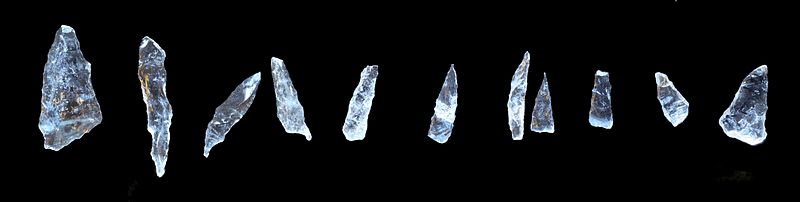
'In Europe Rock crystal was
occasionally used during the Mousterian in S/W-France (Les
Merveilles and Laussel in the Dordogne, La Chapelle-aux-Saints
and Chez-Poure in the Corr�ze). Rock crystal Solutrean leaf
points are known from Le Placard (Charente), and from the rock
shelter of Badegoule (Dordogne). Rock crystal was also used
during the Hungarian Epigravettian and during the Magdalenian at
Zitny Cave in Moravia'.
(Link to
Full Article)
8,000 to
7,000 BC - Crystal Spear-tips, France - On display in the
Sion History Museum, France
(6).
 6,000 BC - Quartz
crystals used in ritual burials, California.
(2) 6,000 BC - Quartz
crystals used in ritual burials, California.
(2) Burials from the US 'Early horizon' have revealed a large number
of quartz artefacts. Almost one-quarter of the burials have whole or
fragmentary quartz crystals, sometimes in large numbers.
3 ,500 BC - First
Man-made glass from Egypt .
3,300 BC - Quartz
Crystal Mined in Egypt.
2,000 BC - Kept in the
form of lenses by the people of Nineveh and Crete.
(More about
the Crystal Lens)
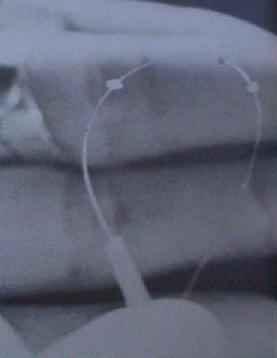
The Quartz beads in the
picture (left) were discovered on a Peruvian mummy. The beads are so small
that it is that it is unknown by what method they could have been fashioned.
A remarkable achievement.
(Prehistoric
Peru)
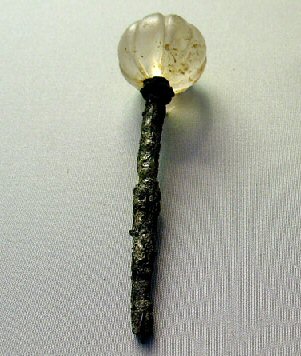
17th- 16th Cent BC -
Grave Circle B 'The
Grave of the Crystals' (part of the prehistoric cemetery at Mycenae)
- Grave 'Omicron' belonged to a woman whose many grave gifts included
gold jewellery, diadems with repousse decoration and necklaces. This
grave is conventionally named 'the Grave of the crystals', owing to its
exquisite duck-shaped rock-crystal kymbe and bronze pins with ornate
rock-crystal heads. Of particular interest are the semi-precious stone
necklaces, as well as one made of amber, precious material imported from
north-western Europe. (4)
(More
about Mycenaean Greece)
Article:
(Nov, 2011). Vikings Used Crystals to Navigate at Sea: (Quick-Link)
|
Crystals and the Megaliths: |
It seems that quartzite stone
was the preference of the megalithic builders. The extra effort involved in
transporting particular stone from further distances, in preference to using
more abundant and locally available stone, suggests that stones were
selected for specific properties. The consistent use of crystalline stone,
which is far more challenging to work with, in ancient constructions such
as at Stonehenge and the Granite-lined chambers and passages of pyramids,
tombs and temples around the world support this idea.
The Specific Selection of
Stone types.
While it is apparent
that the megalithic builders showed a preference for certain stone
types, the reason for this has yet to be explained satisfactorily.
The extra distance and effort required to employ specific stones in
ancient structures offers us with a clue as to the possible
aspirations of the builders. As noted above, the pyramid builders at Giza went
to great lengths to include granite in their sacred buildings,
transporting it hundreds of miles in preference to the more readily
available limestone. At Giza, we can see that granite was used for
the lower levels of casing blocks on both Menkaure and Khafre's
pyramids, whilst in the Great pyramid of Khufu, it is found only on
internal features (plugs, girdle stones, antechamber portal stones,
kings chamber). The selection of features for which granite was
chosen reveals something interesting: namely, that it was not just
used structurally. So, at the same time as recognising that granite
is a stronger stone, there are other reasons why granite was
selected for use in sacred structures. This supposition is supported
by evidence from other megalithic structures, for example:
Although the area surrounding
Stonehenge is littered with
perfectly suitable sarsen stones, the builders chose to use over 80
Bluestones instead, requiring them to transport them over 200
miles from the Prescilly mountains in Wales. It is perhaps relevant
then that a piece of bluestone was found in almost every one of the
59 Y and Z holes. At Stonehenge, the specific selection of
stones was continued to the slaughter stone which, while all the
other stones were either sarsen or bluestone, it alone is made of a
sandstone laden with Mica.
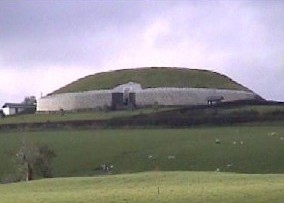
At
Newgrange in Ireland,
we are told that while the mound was built from 280,000 tons of
river-rolled stones, but that the builders also chose to travel 50 miles to the coast to
collect the white granite stones that are were used to make up the
face of the mound. (Site guide) The idea that quartz
had a significance beyond its strength alone is reinforced by the
several findings of crystals in funerary remains and it is also common to find 'significant' stones
at the European megaliths either made entirely of granite or having
quartz seams in them, for example:
Boscawen-Un, in
England is a granite circle of 19 stones, and was suggested by W. Stuckley as having been one of the first circles in UK. (The 19
stones being suggestive of the 18.6yr lunar cycle). Although the
whole circle is composed of granite stones, there is a single white
quartz stone at the S/SW of side the circle (aligning the centre
with the May-day sunrise).
Two huge 15-ton portal-stones at
Castelruddery, also in
Ireland.
At Balquhain stone
circle (and Bannau Sir Gaer), in Scotland the builders chose white
granite for the outlying stones.
At Glenquickan, also
in Scotland, a white granite obelisk was placed in the centre of the
circle.
And at the
Hurlers
triple circle, the centre of the circle was coated with a bed of
quartz crystals.
The Excavation of the Aztec 'Templo
Mayor' site in Mexico, produced a funerary casket, from the inner-most
layers of the pyramid, beneath a Chac-mool statue, 'thought to represent
the god Quetzalcoatl'. Within the casket were found several crystal
artefacts which included; Several crystal cylinders, thought to represent
the 'feathered tail of Quetzalcoatl'. Crystal Lip-plugs, crystal
ear-spools and a row of thirteen crystal beads 'thought to have been part
of a necklace'. (1).
All of the above
examples highlight the fact that granite (or perhaps crystal), was
considered to have special qualities other than just strength.
Records show several examples of crystals and quartz being placed
alongside funerary remains (a feature that can be traced back to
Palaeolithic times), and a fact that raises the question of whether or not
the megalithic builders were aware of the other physical
properties of crystal.
(More
about Specific Stone Selection)
(Article -
The Language of Stone - Stone Worship in
Prehistory)
|
Crystalmancy : Magic and Healing: |
Research Scientist, Marcel Vogel states that a crystal is
able to transmit energy in a form that has discreet biological
effects. This is most like a resonance effect.
(9)
The Pineal Gland: The
Earth is a huge magnetic sphere. The E/M field of the Earth
varies in strength and consistency through the ages. Our bodies
own magnetic frequencies and our bio-field patterns react to
this variance of the Earth�s field. The pineal gland is the
principal structure in the brain that is directly sensitive to
the Earth�s magnetic field. The Pineal Gland Senses the
Field. To sense the Field the Pineal Gland contains small
calcite crystals. (Ref: Wikipedia).
Article: ' Caves
and Crystalmancy: Evidence for the use of Crystals in Ancient Mayan
Religion'.
'Modified and unmodified
fragments of rock crystal have been recovered from a number of caves
in the southern Maya Lowlands, suggesting that theses tones were
used in ancient ritual' ... 'Ethnographic literature reports the
utilisation of crystals to be restricted to ritual specialists for
use in caring and divining' ... 'The power of crystals was
apparently believed to be derived from the power of the earth so
that crystals found in caves, which are also connected to the earth,
might be considered especially powerful ... Evidence suggests that
caves may have been an important source of these "power" objects'.
(3)
There are a number of well known crystal skulls which have been carved from solid
rock-crystal. Their origin has always a matter of contention.
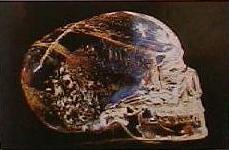 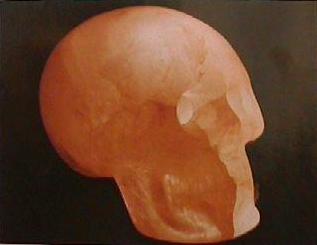
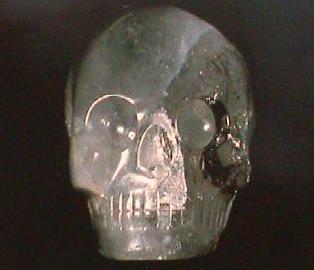 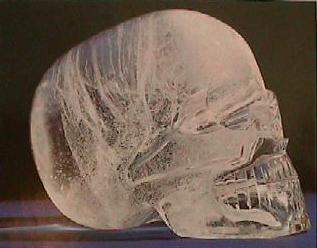
From
left to right :
Mitchell-Hedges, 'Cursed' Smithsonian, Max, and the British Museum skull.
Note - The Mitchell-Hedges
skull, has a unique separate jaw-bone made from the same lump of crystal.
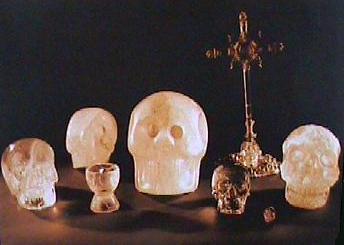
From left to right:
British Museum, Max, Monte-Alban Goblet, Smithsonian, Modern German,
British museum 'tiny', 'Sha Na Ra'.
Article: Science Daily. (2008):
Origin of two crystal skulls determined.
New research suggests that two well-known crystal
skulls, in the British Museum and the Smithsonian Institution,
Washington DC, did not, after all, come from ancient Mexico. Academics
now believe the British skull was made in 19th century Europe and the
American one even more recently.
The British Museum bought its skull, a life-size
carving from a single block of rock crystal from Tiffany and Company,
New York in 1897
However, there have been doubts about the
authenticity of the skull since the 1930s. Now an international team
has used the latest scientific techniques to examine the British
Museum skull and a larger white quartz skull donated to the
Smithsonian Institution in 1992. Electron microscope analysis for tool
marks found both skulls were carved with rotary disc-shaped tool -- a
technology which the Ancient Mexicans did not have. Analysis of the
quartz in the British Museum skull suggests it was quarried from
Brazil or Madagascar -- far outside the Ancient Mexicans' trading
links.
The team, made up of experts from Cardiff
University, the British Museum, the Smithsonian and Kingston
University, concluded that neither skull could have been made in
Mexico before the time of Columbus. They believe the British skull was
created in Europe in the 19th century, and the Smithsonian's shortly
before it was bought in Mexico City in 1960.
|
The Physical Properties of Crystal: |
Electrical properties
- Crystals act as transducers, transforming and transmuting energy from one
form to another. Quartz crystals in particular behave as capacitors, storing
energy in a form which can later be discharged. Some also function as
multi-wave oscillators, capable of dealing with a wide range of frequencies.
Article: iTechPost - (Nov, 2013) -
Light Improves Electrical Conductivity in Crystals by 400%
The 'Hope Diamond' (Diamond
of Disaster) - Currently owned by the Smithsonian Institute,
Washington. A catalogue of disasters befell the owners of this notorious
diamond. It was eventually lent to the De Beers research laboratory in
Johannesburg in 1965, where scientists discovered that the diamond's rare
deep-blue colour was caused by the replacement of a few of the carbon atoms
at crucial points in the crystal lattice by atoms of Boron. The result of
this unusual occlusion is that the diamond was acting as a powerful Semi-Conductor of electricity (only conducting under certain
conditions by stimuli involving heat, light, pressure, or other
electromagnetic energies).
(Ref: The Secret life of
Inanimate Objects).
When pressure is applied
to a crystal it produces electricity. Many modern lighters use this property
in their 'sparkers'.
Quartz in Radios:
When a crystal is made to vibrate at its natural frequency by the
application of a voltage, the system is said to be in resonance. A crystal
in resonance will maintain a constant, unfaltering frequency. When coupled
with vacuum tubes or transistors, this constant frequency can be changed
into a radio signal. Such was the design of the quartz radio, used primarily
during World War II. (5)
Quartz in Clocks:
All clocks rely upon some form of oscillator
to keep regular time; for example, mechanical clocks sometimes use a
pendulum to regulate the motion of their hands. In a quartz timepiece, a
small ring-shaped piece of crystal is made to vibrate at its natural
frequency. Because the crystal's vibration is unfaltering, quartz clocks are
among the most precise timekeeping devices, losing less than one hundred
thousandth of a second each day. Quartz crystals can be used to regulate
both digital and analogue clocks and watches.
(5)
There is a clear and
definite association between megaliths (which show a preference for quartz
granite), and underground water-sources.
Crystals and Water
-It is a curious fact that when a
crystal is placed under pressure it produces electricity.
Experiments by Marcel Vogel, a research chemist for IBM over 27
years, suggest that water (as long as it's not too pure) can act as an electrolyte and pick up
charge from a crystal with which it comes into contact. Measurements
by spectrophotometer, an instrument for comparing light radiation,
show changes in the 'atomic footprint' of water before and after
exposure in this way. Paul Devereaux began the 'Dragon project' in
order to research this particular aspect of the megaliths.
'The first experiments on
manufacturing or growing synthetic quartz began in 1851, but it was not
until the latter part of the 20th century that the process was sufficiently
perfected for the manufactured quartz to be of practicable use to the
electronics industry' (1)
(Natural
Earth Energies)
|
The Crystal Lens, Nineveh: |
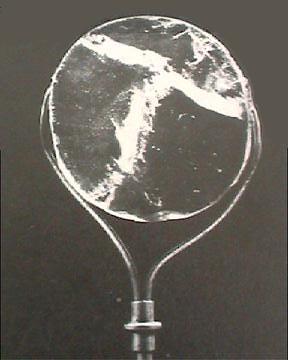
The Crystal �lens� from
Nineveh (Kuyunjik, Iraq)
In 1853, Sir David Brewster
(1781-1868) presented a lens to the British Association for the
Advancement of Science that had been found in excavations by Austen
Henry Layard (1817-1894) at Nineveh (Kuyunjik, Iraq). It had been
found in deposits dated around 600 BC and although its provenance
was not in question, doubts were raised about its function. Whilst
it clearly works as a lens, it was thought to have been used as a
decoration in a piece of jewellery.
With this object, we can see how
contemporary perceptions of form and function may not always be
correct. The �obvious� interpretation of a ground oval crystal with
a biconvex cross-section as an optical lens is not a guide to its
original function. What would be the context for such a piece in the
ancient Near East? Had it been part of a piece of optical equipment,
there ought to be other evidence for such equipment. If, say, it
were part of an astronomical telescope, then elements of the
telescopes and their mountings ought to be found. If part of a pair
of spectacles, then some sort of frame should be found from time to
time.
In relation to the idea that the lens may have originally been
part of a telescope, it is interesting to note that there is
evidence from the Middle-east that supports the idea of telescopes
being used in antiquity. Most revealing of all are the thousands
of clay tablets recovered from Nineveh, which record the
observations of objects only visible with the use of optical
assistance. The following text adequately describes this fact:
The ancients apparently used
the telescope long before Pythagoras�s time. Babylonian
astronomers, like the one illustrated on the ancient seal
above, catalogued the non-planetary fixed stars, observed and
recorded their observations on occultation's of the planets by
the sun and moon, and determined correctly within a small
fraction the length of the synodic revolution of the moon. They
also knew the true length of the solar year was 365 days and a
quarter. In fact, the exact length of the ancient Babylonian
year has been determined to have been 365 days, 6 hours, and 11
minutes, which varies less than two minutes from the sidereal
year. They also ascribed eclipses of the sun to the
interposition of the moon between the sun and the earth, and
they apparently knew the arrangement of at least seven planets
and spotted some of their moons�which certainly requires the
use of a telescope.
Their long line of
astronomical records on clay tablets stored in the British
Museum, dating back to 747 B.C., indicate they observed some of
the moons of Jupiter and Saturn. �There is said to be distinct
evidence that they observed the four satellites of Jupiter, and
strong reason to believe that they were acquainted likewise with
the seven satellites of Saturn,� wrote the English Orientalist
George Rawlinson, in the 1860�s. �It has generally been assumed
that they were wholly ignorant of the telescope,� added this
Camden professor of ancient history. �But if the satellites of
Saturn are really mentioned, as it is thought that they are,
upon some of the tablets, it will follow�strange as it may seem
to us�that the Babylonians probably possessed optical
instruments of the nature of telescopes, since it is
impossible, even in the clear vapourless sky of Chaldea [ancient
Babylonia], to discern the faint moons of that distant planet
without lenses.�
Ref:
http://ancientskyscraper.com/224801.html
|


